
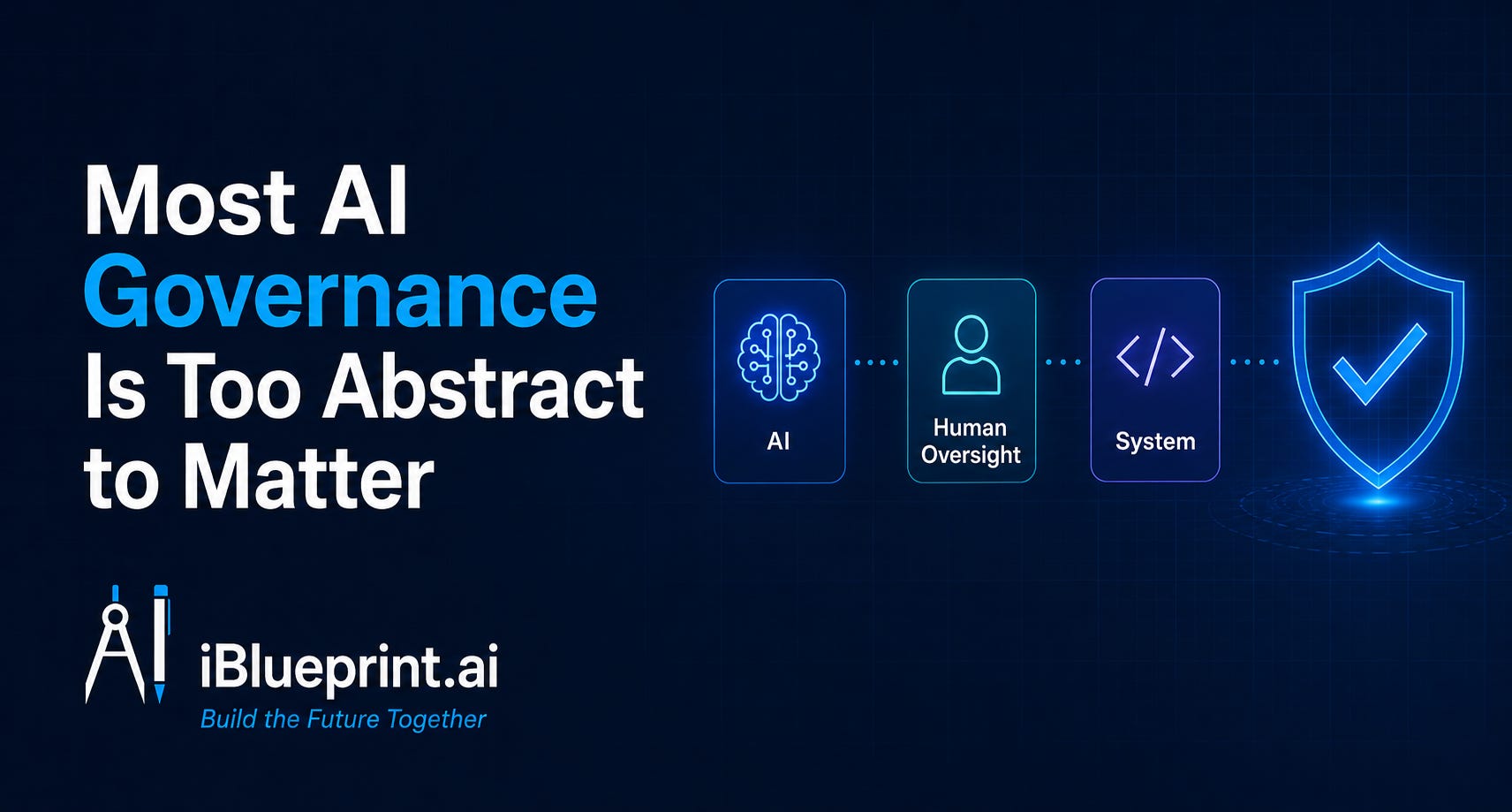
There is a lot of noise around AI governance. Principles. Frameworks. Committees. Risk matrices. Policy decks. But none of that matters if governance is not built into the actual work your organization is doing.
You do not govern AI in the abstract. You govern how AI is used to review a contract, process an application, draft a recommendation, analyze a document, communicate with a customer, or trigger an action in another system.
That is where most governance efforts fall apart. Organizations create broad rules for “responsible AI,” then leave employees to use general-purpose models with little structure, limited oversight, and no consistent way to test, monitor, or audit what happens. That is not governance. That is governance theater.
The wrong question is: How do we govern this model?
The better question is: What role should AI play in our work and specific workflows?
An AI agentic work process may include:
A model extracting information from a document
Code validating required fields
A business rule calculating an amount
Another model drafting an explanation
A human approving the final decision
A system recording the action
Not every step should be handled by AI. AI should handle the scopes it performs well. Code should handle repeatable logic and calculations. Humans should remain responsible for judgment, discretion, accountability, and care. Governance is the intentional design of those boundaries.
Organizations often focus too heavily on which model they are using. The model matters, but the harness around the model matters more. The harness determines:
What the model is allowed to do
What information it can access
Which tools it can use
What output it must produce
What checks must occur
When a human must intervene
What gets logged
What happens when something fails
Without a harness, an AI agent is simply a model with permission. With a harness, it becomes part of a controlled and auditable workflow.
MIT Sloan’s Center for Information Systems Research argues for “minimum viable governance”: enough structure to manage real risk without suffocating innovation. (https://mitsloan.mit.edu/ideas-made-to-matter/balance-ai-innovation-and-risk-minimum-viable-governance?utm_campaign=MVG&utm_medium=social&utm_source=mitsloanlinkedin) That is the right direction. Governance should not force a low-risk brainstorming tool through the same process as an AI workflow affecting benefits, hiring, health care, or financial decisions.
But “minimum viable” does not mean weak. It means practical, proportional, and embedded directly into the work. The goal is not to slow teams down with more paperwork. The goal is to give them approved ways to build, test, and use AI responsibly.
At iBlueprint.ai, we are turning governance into product capabilities. Our Blueprints allow organizations to break complex work into smaller, governed steps. Each step can be assigned to the right resource:
An AI model
A human reviewer
Conventional code
A knowledge source
A business application
A specialized tool
Teams can test workflows across models, establish approval points, control access, maintain versions, evaluate performance, and preserve an auditable record of how the workflow operated. That is more useful than another responsible AI policy sitting in a shared drive.
iBlueprint.ai is designed to help organizations build AI systems that are:
Controlled
Testable
Visible
Auditable
Model-independent
Governed by design
The platform’s collaboration, workflow-building, evaluation, and organizational library capabilities are intended to help companies govern the AI-enabled knowledge and processes they are actually creating.
The real risk is not that organizations have no AI principles. The real risk is that those principles never reach the actual AI-powered work and workflows. AI governance becomes meaningful only when an organization can answer:
What did the AI do?
What information did it use?
What tools did it access?
What rules constrained it?
Where was human approval required?
What happened when it failed?
Can we audit the result?
Can we improve it?
That is the difference between talking about responsible AI and actually operating it. Governance should not be a wall around innovation. It should be the harness that makes trustworthy innovation with AI possible.
No posts
Comments
Nothing yet. Say the first thing.
Sign in to join the conversation.