
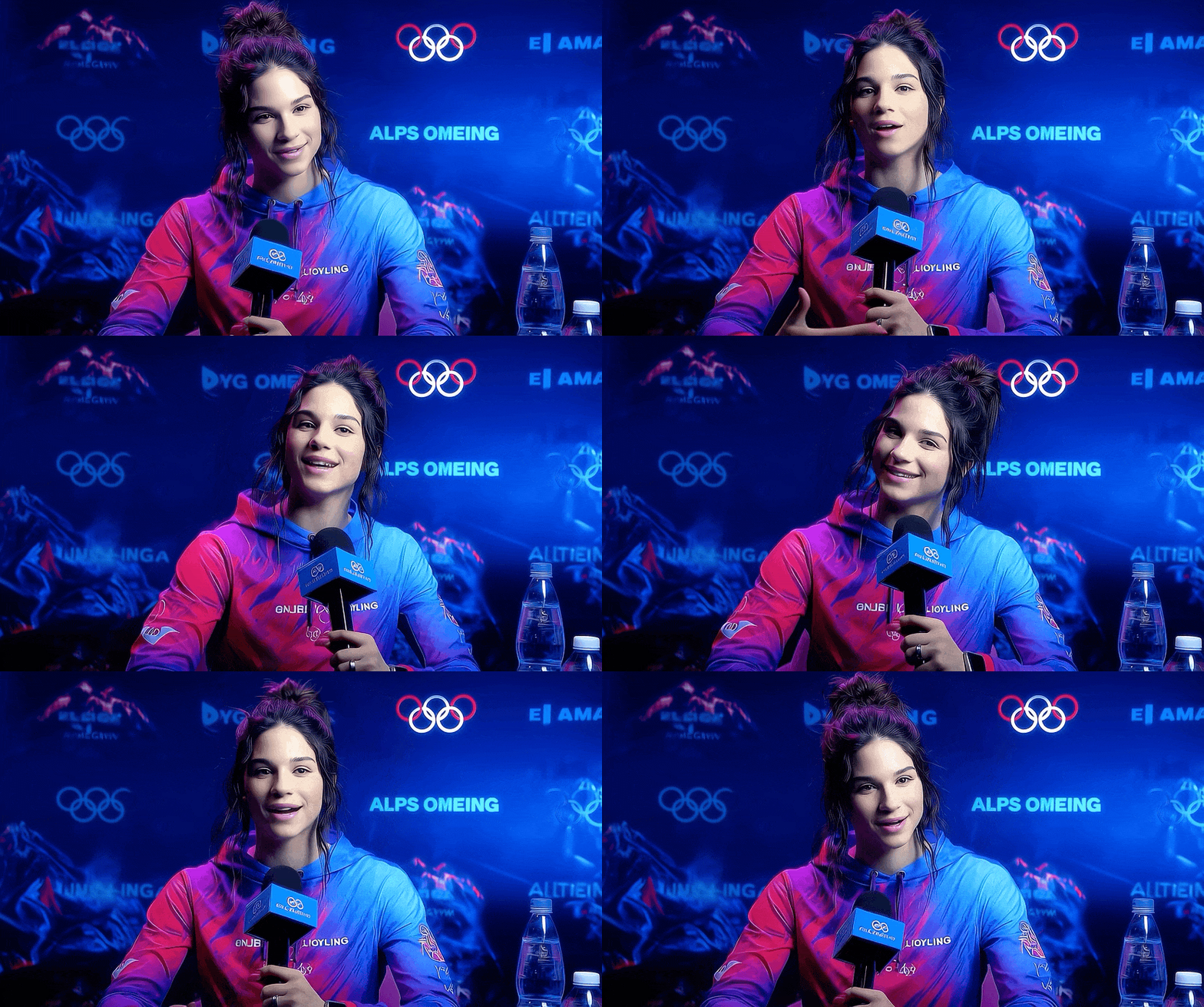
You may have seen that clip that went viral after the Olympics: a reporter asked Eileen Gu, the most decorated female free skier in history, whether she saw her two silver medals as “two silvers gained or two golds lost.” She laughed a little, took a breath, and then gave an answer that sparked a debate across social media.
Some people said she was arrogant. Some said she was right. Some said both.
I won’t get in that debate, but from a public speaking standpoint, I recognize a few “mishaps” that might have triggered these reactions in the audience.
Today I want to share them with you and offer my secret for avoiding them.
So again, I am not talking about whether she was right or wrong in what she said. And certainly not about whether top athletes should also be top communicators. That is a whole other conversation for another day.
What I want to talk about is what happened structurally in her answer, because I see the exact same thing happen to professionals every single week, after pitches, client or board meetings, or during Q&A at conferences.
You give a great presentation, and then an audience member asks a question that feels more like an attack than a genuine inquiry. And in that moment, if you do not have a clear process to follow, your emotions take the wheel, deiscussion start becomes tense, and the convincing discourse you had just delivered so carefully is questioned.
So what happened in Eileen’s case?
First, she started answering while emotionally reacting. When someone asks you a question that feels triggering, something very human happens in your brain. The amygdala, our old emotional alarm system, fires up. It floods your body with a bit of adrenaline. Your thinking slows, while your emotional response speeds up. You do not decide to become defensive. But you appear so.
This is what I believe happened to Eileen. The question was framed in a way that felt almost designed to make her admit some kind of failure. “Two golds lost.” Her immediate reaction was passionate and a little sharp, and completely human.
But “completely human” and “completely effective” are not always the same thing.
Unfortunately, because she was still emotionally triggered, her first sentences came across as defensive, arrogant, and antagonistic.
The best reflex is to try to gain time to lower our emotional response.
In her case, that small laugh at the beginning was gold she did not use. That moment could have given her the one or two seconds needed to choose her direction consciously, before speaking.
The second common “issue” in her response is that, when she started answering, you could feel she was holding two tracks in her mind, and did not really made up her mind yet.
She developed a first point that seemed to be “Every competition is equally difficult, no matter how many wins you have accumulated before, so we should not measure my performance against growing public expectations.” Inviting the listener to see high-level competition in a different light.
Then, near the end, she pivoted to a second point, closer to “My self-worth is not attached to any single result. I look at my whole career, and therefore I feel good about where I am.” It is also a valid point, promoting a growth mindset and not being too attached to individual results.
What made the whole answer problematic was that she switched to the second message without building a bridge to the first.
The listener, who has been following the first thread, suddenly finds themselves on a different terrain with no announcement of the change. And that is when the conversation starts to feel slightly off, even if you cannot quite say why.
I see this happening constantly in business. We start answering a question about budget overrun and end up making a point about company culture. We begin by discussing a project delay and finish by defending the whole team’s competence. The intention is good, but the execution leaves the audience a little confused, and confusion can easily be misread as being overly evasive or defensive.
Here is the thing about most questions: they almost always have a surface layer and a deeper layer. The surface question is what was literally said. The deeper question is what the person actually wants to ask about.
In this case, the journalist asked: “Two silvers gained or two golds lost?” but there are many ways to actually understand that:
“Is second place a failure or an honor?”
“Are you disappointed given the expectations?”
“Does your self-worth depend on this result?”
And each deserves a different structure.
If you answer the surface question literally, you might miss the emotional heart of the question.
If you answer the deeper question instead, you touch something real, and the audience feels it.
The most powerful communicators, whether they are politicians, CEOs, or seasoned conference speakers, excel at not “just” answering. They identify the real question, then consciously choose which angle of that question they want to address. Then they build a clear, intentional bridge from the words that were said to the point they want to make.
It is a bit like being a GPS. The question sets a destination, but you choose the route to answer it (your message). And if you decide to switch routes during navigation, announce it clearly. If you realize there is a deeper point to make, that is fine, just signal it.
For instance, simply saying “but there is a deeper side of your question” makes the pivot feel natural.
Here is what I recommend and use for Q&A sessions.
Even if it is just two seconds. Breathe, take a sip of water, repeat the question… Let your rational brain catch up with your emotional one. This is not a sign of weakness. It is a sign of mastery.
Ask yourself, “what is this person actually asking or challenging?” Not the words, but the concern behind the words.
What is the one thing you want this person to walk away understanding? This is your north star for the entire answer. Commit to it before you open your mouth.
This is the move politicians know well, and it is perfectly legitimate when used honestly. You say something like, “I think the deeper question here is...” or “If we look at this from a broader perspective...” or “What I think is really worth considering is...” You are not dodging the question. You are elevating it to the level where you want to answer.
Every sentence should be pulling in the same direction. If you want to add a second point, even on the fly, hold it until you finish the first one, then announce the transition. “And there is another dimension to this that I think is important...” Now your listener is ready for the second track and will not feel confused or jarred by the shift.
Imagine if Eileen had said something like: “You know, I think the real question is whether my performance should be judged against other people’s expectations rather than against my own standards. And the honest answer is no. Every competition is as hard as the last one, no matter how many medals you have. So I compete to be the best version of myself on that specific day. That is the only metric I care about.”
And if she realized midway she wanted to change her response, she could have said: “I do not judge wins based on expectations, but beyond that, I do not link my self-worth to a single event. I look at my career as a whole, and I have done things no female freeskier has ever done. So when you frame it as two gold lost, with respect, that framing does not match the way I understand success at all.”
Two frames, clearly separated, both addressed, and suddenly the answer becomes even stronger.
So every time you step into a Q&A after a pitch, after a conference talk, after presenting your quarterly results, you are stepping into this exact kind of situation.
Someone will ask you a question that is really about something else. Someone will challenge your framing, your numbers, your decisions. And in that moment, the quality of your answer will either reinforce the trust you built during your presentation or quietly erode it.
The good news is this: with a little bit of preparation and a clear process, you can train yourself to pause, find the real question, choose your message, and build a bridge from the question to your answer. It takes practice, but it is absolutely learnable.
And if Eileen happens to read this someday: she is an extraordinary athlete and a fascinating communicator. This is not about being perfect. It is about having the tools to match your message to your ability. She just deserves a structure as strong as her skiing.
I created a custom GPT to provide responses and guidance with my knowledge and style. Today it is available publicly to anyone with a chatGPT 4 account and totallize already 1000+ users, ranking number 1 in public speaking GPTs on the GPT store!
Give it a try:
https://chat.openai.com/g/g-Bevc5jv8V-public-speaking-master-impactful-speaking
Are you looking for a personal coaching for your next big speech? Do you want to equip your team with the skill of speaking with impact?
I offer group training and individual coaching. Read all about it and get in touch:
https://www.impactfulspeaking.com

No posts
Comments
Nothing yet. Say the first thing.
Sign in to join the conversation.