
Last week, four things happened in legal AI and AI infrastructure that, taken together, marked the end of one era and the beginning of a more uncertain one.
Legora announced a $50M extension to its Series D, bringing the round to $600M and valuing the company at $5.6B post-money, with Atlassian and NVentures, NVIDIA’s venture capital arm, joining what TechCrunch reported was NVentures’ first legal AI investment. Harvey, valued at $11B after a $200M raise co-led by GIC and Sequoia, had recently signed a brand partnership with Gabriel Macht, the actor who played Harvey Specter in Suits. Will Chen, a former Latham & Watkins lawyer, launched Mike Oss — an AGPL-licensed, open-source legal AI platform that he says he built in two weeks with Claude. And Y Combinator published its Summer 2026 Request for Startups, which opens with the line “AI has stopped being a feature and started being the foundation,” and names Software for Agents, Dynamic Software Interfaces, and AI Operating System for Companies among the categories where the next generation of foundational companies will be built.
Taken together, these moments point to a harder question for legal AI: if the visible surface area of a multi-billion-dollar product can be recreated this quickly, where does durable value actually live?
I am going to argue something less satisfying than the cleanly opposing thesis you might be expecting. I am not going to tell you that JustiGuide has built the four moats that make us defensible against this collapse. I do not believe anyone in this category has built defensible moats yet, and I am suspicious of any founder who claims otherwise. The wrapper era is ending. But the next era has not been named, and the honest way to survive a category this young is not to publish a thesis. It is to build the layer underneath the thesis — the regulated infrastructure that any future application layer in this category will eventually have to run on — and to keep building it through every wrong turn the category takes between now and the moment we collectively figure out what legal AI actually becomes.
Before the critique, the credit. Mike Oss quickly became the kind of project Hacker News was built to debate — a beautiful landing page, a name that legal Twitter decoded in about four seconds (the “OSS” doing double duty as both the license and a wink the audience could not miss), and a thesis that should make every legal AI investor uncomfortable.
Will Chen’s read of the legal AI market is sharper than most VCs’. He correctly identified that parts of the legal AI market are still priced like deep infrastructure while much of the visible product surface remains closer to workflow and model orchestration. He correctly identified that BYOK reframes the entire pricing conversation. He correctly chose AGPL-3.0 over MIT to prevent cloud providers from rewrapping his work. He correctly named the project so that the technical layer (open-source software) and the cultural layer (an unspoken reference his audience would never miss) did the marketing work that closed-source incumbents have to spend tens of millions on. And he correctly bet that the United States v. Heppner ruling — an early federal decision holding that a defendant’s self-directed Claude exchanges were not protected by attorney-client privilege or work product doctrine — would create a flight to self-hosted infrastructure that the closed incumbents cannot serve.
These are not small wins. They are the marks of a builder who understood the moment.
But the moment is not the market. And one of the most-upvoted comments on Mike Oss’s Hacker News thread told a truth that cuts in every direction in this category — including ours:
“What legal professionals actually pay for, and that is virtually impossible to replicate, is to give the AI access to a legal database of case law. Without case law, you can’t do accurate legal research, and you are inviting disaster.”
The commenter was talking about Westlaw and Lexis. But the deeper point is that nobody — not Mike Oss, not Harvey, not Legora, not us — has solved the foundational data and trust problems this category will eventually require an answer to. The honest position is that we are all running experiments while the rules of the category are being written in real time, often by forces outside our control: a court ruling here, an Anthropic plug-in there, an administration change every four years, a sovereign government rewriting the rules of immigration overnight.
The companies that will define the next decade of legal AI are not the ones with the cleanest current thesis. They are the ones built to survive being wrong about that thesis, more than once, and to learn faster than anyone else what the next thesis should be.
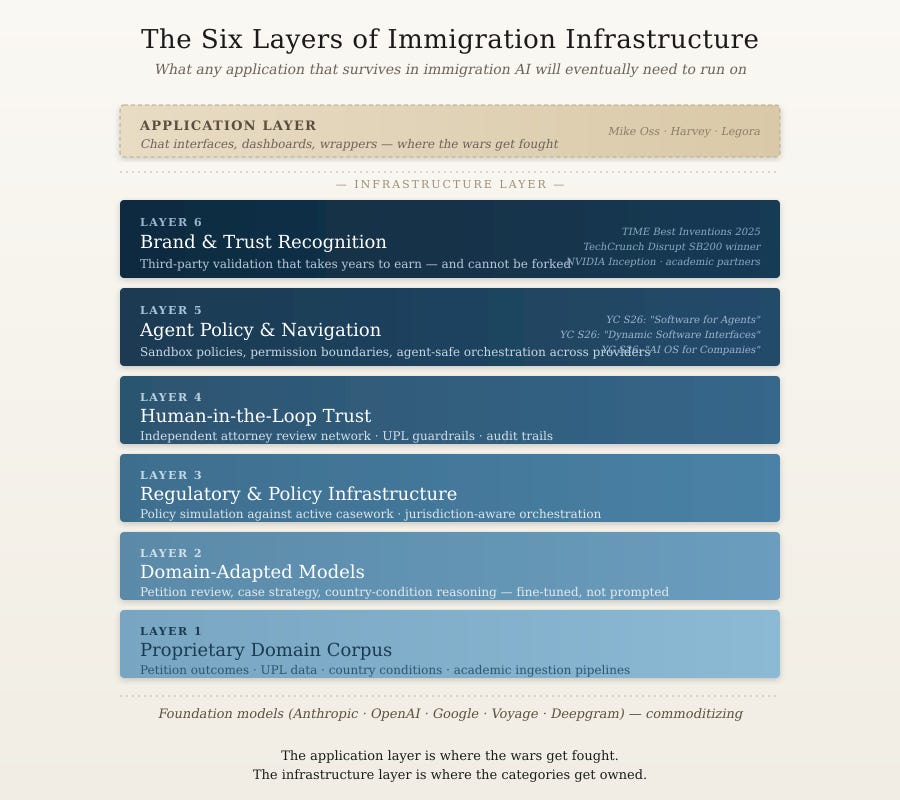
I do not know what the durable application-layer winners in legal AI will turn out to be. Neither does anyone else. What I can tell you is that any application that survives in immigration AI will eventually need six layers of infrastructure underneath it, and these are the six layers we are building.
A proprietary domain corpus. Not “we trained on the internet.” A specific corpus that captures the failure modes, edge cases, and tacit knowledge of a regulated practice area. For us, that means immigration: years of redacted petition outcomes, the unauthorized-practice-of-law guardrail data we have been quietly assembling, the country-condition material that no general-purpose model has seen, and the ingestion pipelines from our work with academic researchers studying immigration policy. Every wrapper that ships in this category will eventually need a corpus like this. Most will never build one. The few that try will discover it takes years.
A domain-adapted model layer. Mike Oss explicitly does not fine-tune. Harvey and Legora are still primarily generalist substrates with prompt scaffolding. Our position is that immigration is narrow enough and high-stakes enough that a domain-adapted model will outperform a generalist model on the cases that actually decide outcomes. We are running that work now. If we are right, the application layer above us — whether it is our own products, a partner’s, or an enterprise customer’s — gets to build on a substrate that no foundation model and no wrapper can match.
A regulatory and policy infrastructure layer. Harvey integrates with iManage. That is document management integration. It is not regulatory integration. We are building the layer underneath the chat interface — a system that models policy changes against active casework before those changes take effect, and an orchestration framework that lets agentic workflows execute petition logic with auditable, jurisdiction-specific guardrails.
The reason we have submitted a proposal to the Spanish government on the architecture this would require for their 500,000-person regularization program is not that the contract itself would be transformative for our business, though it would be. It is that sovereign-scale regularization events are exactly the forcing function that builds infrastructure no competitor can replicate retroactively. Every time a government has to process hundreds of thousands of cases on a compressed timeline, the organization that handles it builds workflow patterns, edge-case data, multilingual operational muscle, and government-grade audit trails that compound into capability long after the program ends. This is how durable infrastructure has historically been built in adjacent categories: serve the hardest, most logistically chaotic customer first, and the systems you build to serve them become the substrate for everything that comes after.
We do not have the Spain contract. We have a thesis that climate migration, regional regularization programs, and refugee-scale processing events are not edge cases this category will eventually have to address — they are the dominant case for global immigration over the next two decades. The companies that build infrastructure to serve sovereign-scale events early will own the substrate for a market that does not fully exist yet but is unmistakably arriving. Spain is one bet on that thesis. There will be others.
A human-in-the-loop trust layer. Mike Oss’s privilege thesis — that self-hosting with your own enterprise API keys may help preserve attorney-client privilege in light of Heppner — is plausible and unproven. Our approach is different and operative now: every petition we help file through the platform is reviewed by an independent licensed attorney under a structured engagement, with the AI doing the drafting and a human doing the certification. The trust layer is not a feature you can ship in two weeks. It is a network you have to build, audit, and maintain — and it is the layer that turns AI output into something a government, a court, and a family can actually rely on.
An agent policy and navigation layer. This is the layer that almost no one in legal AI is taking seriously yet, and it is the layer that will determine which platforms remain safe to operate in two years. Y Combinator’s Summer 2026 Request for Startups, published last week, names this category three different ways: Software for Agents (”the next trillion users on the internet won’t be people. They’ll be AI agents”), Dynamic Software Interfaces, and AI Operating System for Companies. The opening line of the RFS itself states the underlying shift directly: “AI has stopped being a feature and started being the foundation.” The most influential accelerator in the world is telling founders that the application layer needs to be rebuilt for agents as first-class citizens, and a parallel research and standards conversation is underway across the broader industry on agent permissions, agent authentication, and machine-readable interaction policies.
We have been building toward this from first principles, but in the context of the highest-stakes regulated consumer workflow we know of: a deportable user, a multilingual interface, a regulator watching, and an attorney whose license is on the line. Every dashboard we have shipped was designed from the outset around the question how does an agent navigate this safely? — which means privacy and protection are structural rather than retrofitted. The sandbox policies that govern our agent registry, the auditable permission boundaries between user-facing and attorney-facing agents, the orchestration layer that lets a workflow span multiple model providers without leaking context across them — none of this is exotic in a year or two. It will be table stakes. Today, almost no one in immigration AI has it. We have spent the time to build it because the alternative — agents acting without policy in a category where mistakes cost lives — is not an alternative we are willing to ship.
A brand and trust recognition layer. This is the layer the technically-minded essays about legal AI almost always omit, and it is the layer that actually decides which company a frightened person calls at midnight. In commodity SaaS, brand decays quickly because switching costs are low and the next vendor is identical. In immigration, brand and trust are the purchase decision. A person navigating a deportation risk does not comparison-shop. They go to whoever their cousin trusted, whoever their consulate recommended, whoever they saw covered by a magazine they recognize, whoever speaks their language in the way their family speaks it. The notario industry has thrived for decades on nothing but trust, most of it betrayed. The legitimate alternative has to win on trust first and technology second — because the customer cannot evaluate the technology and would not trust their own evaluation if they could.
Trust at this scale is built slowly and cannot be bought. TIME’s Best Inventions 2025 selection is not a trophy on a shelf; it is a permanent third-party validation that any future competitor must either match or work around — which is difficult, because trust signals accumulate historically. A competitor can win its own validation. It cannot retroactively inherit ours. TechCrunch Disrupt Startup Battlefield 200 — where we won best pitch in the Policy + Protection category — is the same kind of asset. NVIDIA Inception. Our academic partnership work around immigration policy. The 47,000-person immigration pipeline we acquired through VisaNow. Together, these are trust assets accumulated over years of work: credentialed third-party validation, academic relationships, ecosystem recognition, and an inherited pipeline of people who came to us because they were already looking for the legitimate alternative. A wrapper can fork our code tomorrow. A wrapper cannot fork our TIME citation, our TechCrunch placement, our academic relationships, or the trust we have accumulated across the people we have actually served. That is the asymmetry no amount of cloned surface area can close.
There is a reason Harvey, Legora, and now Mike Oss are all aimed at the same use cases: contract review, due diligence, and document analysis for BigLaw. Those workflows are high-value, well-defined, and — critically — they tolerate failure. If a contract review AI misses a clause, a partner catches it on the second pass. The cost of a mistake is a redline.
Immigration does not work this way. The cost of a mistake in a petition is a deportation, a family separation, a visa denial that bars re-entry for ten years. The cost is not a redline. It is a life.
This asymmetry is why immigration AI cannot be built as a wrapper. The unauthorized-practice-of-law exposure is higher. The regulatory surface is broader and changes faster — every administration, every consulate, every country condition update shifts the ground under the model. The user is not a sophisticated counterparty negotiating a deal; the user is often a frightened person whose English is their second or third language, whose previous experience with “legal help” was a notario who took $3,000 and disappeared.
You cannot serve this user with a chat interface and a Claude API key. You serve this user by building the regulated infrastructure underneath the chat interface — the corpus, the adapted models, the policy engine, the attorney network, the agent navigation substrate, and the brand and trust accumulated over years of being recognized as the legitimate alternative — and then operating it with the discipline to keep iterating through model changes, ruling changes, administration changes, and the inevitable wrong turns along the way. Application-layer wrappers will come and go in this category. The infrastructure layer is what compounds.
I think Will Chen is going to be fine. Mike Oss is a smart project, and the AGPL play gives him a real path to a hosted commercial product that captures most of the value while letting law firms own their infrastructure. I’d invest in him on the strength of the launch alone.
I think Harvey and Legora are going to be fine, too — at least the next two years. Their enterprise contracts are sticky, their brand spend is working, and BigLaw moves slowly enough that even an inferior product can entrench before the market notices.
But the next decade of legal AI will not be defined by which application company had the cleanest thesis in 2026. It will be defined by who built the regulated infrastructure underneath the application layer — the corpora, the adapted models, the policy engines, the trust networks, the agent navigation substrates, and the brand and recognition that takes years of credentialed third-party validation to accumulate — and operated that infrastructure with the discipline to keep it running through every wrong turn the category takes between here and maturity. The application layer is where the wars get fought. The infrastructure layer is where the categories get owned.
We are an infrastructure company. We are building the layer underneath immigration AI that any future application — ours, a partner’s, an enterprise’s, a sovereign government’s, an autonomous agent acting on a user’s behalf — will eventually need to run on. We have a team that has shipped through three model generations and acquired complementary infrastructure along the way. We have TIME, TechCrunch, NVIDIA Inception, and our academic partners as validation points for the work we are building. We have the operational discipline to kill the experiments that do not work and the conviction to keep funding the ones that do, even when the market has not yet validated them.
We did the unglamorous work because the people we serve cannot afford for us to have done anything less. And we are going to keep doing it — through whatever the next era of this category turns out to be — because somebody has to build the layer underneath, and the wrappers are not going to do it.
The wrapper era is ending. The infrastructure era is what comes next. We are building it — and the trust we have earned along the way is part of the infrastructure itself.
Bisi Obateru is Founder & CEO of JustiGuide, an AI-powered immigration legal infrastructure platform based in San Francisco. JustiGuide was named to TIME’s Best Inventions 2025 and won best pitch in the Policy + Protection category at TechCrunch Disrupt Startup Battlefield 200. Reach him at bisi@justiguide.com.
No posts
Comments
Nothing yet. Say the first thing.
Sign in to join the conversation.