
Part 1
This series is a response to the following post by the Centre for Studies in Hindu Conservatism (CSHC). I highly recommend reading it to get tapped into what the Indian leftist intelligentsia has been doing.
“Cretins always lie. For the cretins even built a tomb,
Lord, for you. But you did not die, for you are eternal.”
— Adapted from Callimachus’ “Hymn to Zeus”
An arrow can never hit what it should if the hunter is mistaken about the beast he seeks to shoot with his shafts. This is all the more true when trying to put one’s bolts through a boar while paying no heed to the larger swine that should be slaughtered.
Please excuse the pedantry, but what I speak of here is not individual men or women, but systems of thought. Ideologies. “Left-liberal” (or in its oft-shortened online form, LeLi) in Indian English parlance, and more specifically, among segments of the Indian Right, covers a field of meanings, stretching between what in America one might call “Cultural Marxists” and “Wokes”.
What is wrong with this? While it may correctly acknowledge communists, feminists, and progressives as foes, it nevertheless allows liberals to get a pass so long as they are of the ‘Right’ kind.
Being overly fixated on leftist academics who spew intentionally inflammatory imprecations against all that is True and Holy while not even sparing a word in criticism of the much more mainstream, world-spanning, liberal physicalism is like trying to shoot a mangy dog growling at you from the street outside your house while the well-fattened pig you brought into your home for no reason but your kindness gulps down everything you own while your back is turned.
We can see this error when the writers of the CSHC work rightly call out the books written to serve as vehicles of leftist ideologies as “ideological replacements” for the Śāstras and Itihāsas at the same time that they call Tripathi’s writings as “imaginative fiction that does not claim to correct theology”, ignoring the fact that his strongly euhemerist narratives do precisely that. They are right when they say that the leftist (or “Left-liberal” in their words) worldview “views religion as something evil” and critiques it accordingly (yet always somehow from a hypercathedralist position for some reason…). And yet, they pay no mind to the fact that, at their core, works like Tripathi’s ‘Shiva Trilogy’ implicitly view the narratives of religious orthodoxy as fantastical and capable of being ‘rationally’ reinterpreted in a humanistic manner, with a thin coating of feel-good, cosmic mysticism to make the medicine go down easier for the New Indian, without ever declaring their conceit.
Oh wait.
That’s not right.
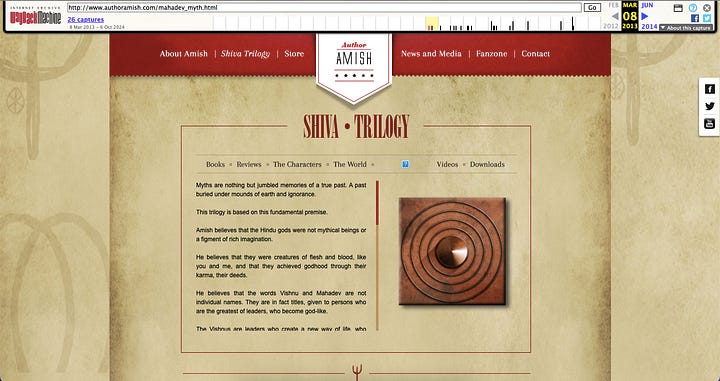
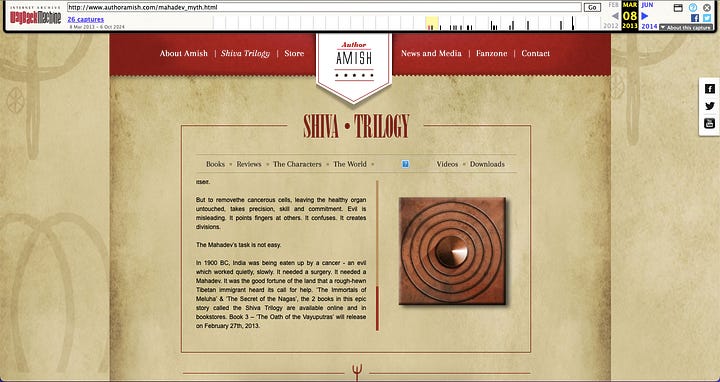
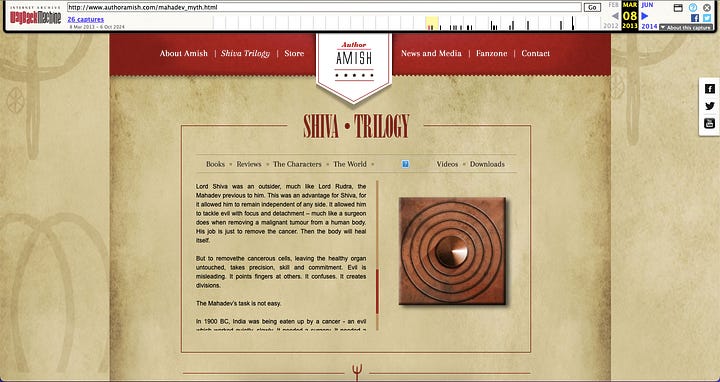
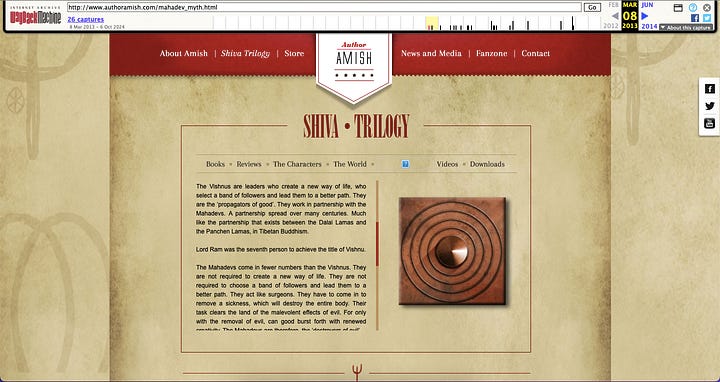
Tripathi actually laid out his views on his website back in 2011, some time after his second novel was published. The page on the ‘Shiva Trilogy’ presents his thesis quite clearly:
“Myths are nothing but jumbled memories of a true past. A past buried under mounds of earth and ignorance.”
This is just first sentence in his description of the series. It only gets worse from here. After this insult to our teachers, our Forefathers, and the great Seers of our traditions, he goes on engage in an utter denial of divinity:
“Amish believes that the Hindu gods were not mythical beings or a figment of rich imagination.”
Worse still, he says they are just “creatures of flesh and blood”, like us, and that names like “Vishnu and Mahadev are not individual names,” but “titles, given to persons who are the greatest of leaders, who become god-like”. The “Vishnus” are nothing more than demogogues, in Tripathi’s vision — leaders of social movements inevitably destined to failure and requiring rescue by the “Mahadevs”, outsiders who come in to purge and destroy “evil”. That he frames this dynamic as one of “propagators of good” and “surgeons” who excise “evil” is just window-dressing for an utterly debased humanism.
As an aside, I find it rather interesting that Tripathi had wanted to write a work on the philosophy of evil, only to be convinced to make something more mainstream on the advice of his kinsmen. Considering what he created and the response it had, I can only think that this lends credence to Bataille’s belief that the “essence of literature” is “an acute form of Evil” (pg. ix).
If a critique of mythological fiction doesn’t take into account gross euhemerism the kind that Tripathi propagates then it must be considered incomplete. Now, one might ask what exactly is wrong with euhemerism. After all, it’s not like euhemerists are making fun of or dialectically recasting Gods and Heroes as villains to be deconstructed and revolted against. And yet, it is precisely that which makes it so pernicious. Those who openly seek to make the Gods their foes are seen oft enough these days, but folks who use slight of hand to replace the core of our culture with a hollowed-out puppet doppelgänger are like the Fae beings of European legend, stealing children in the night only to swap them out with a changeling — at times thought of by some as a fairy child, but by others as a dead log, spelled to look human. Once swapped, the changeling would either seem not to respond to the world or even seem to quickly die.
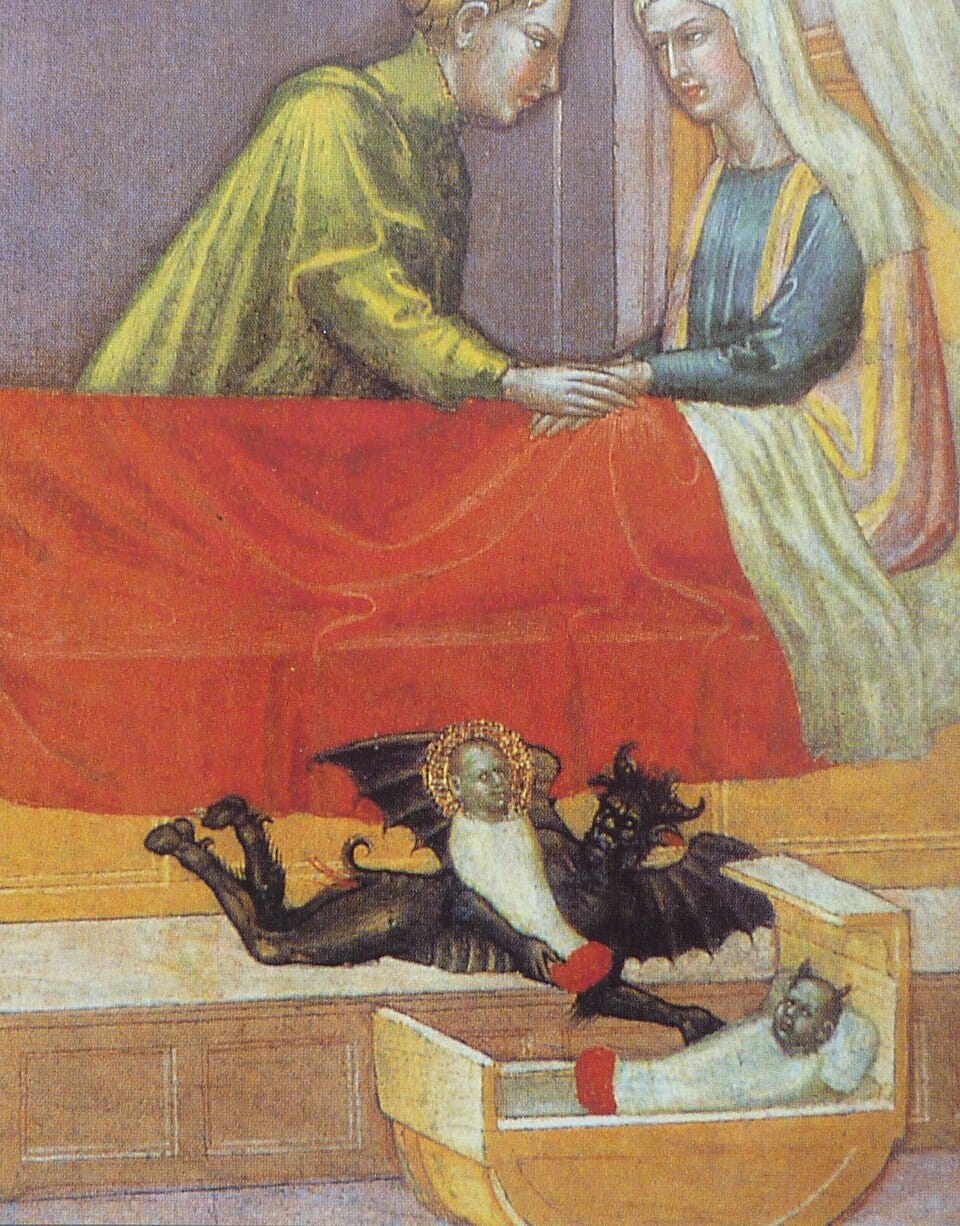
The trick writers like Tripathi play on us is a civilization-wide act of slight-of-hand, stealing away the immortal vitality of real Dharma and Śāstra and giving us cheap wood-pulp in return, which in the heat and humidity of India, at least, will soon rot and die after having left generations of Hindu minds a scorched wasteland of rationalism, where Śrī Gaṇeśa and Mā Kālī are nothing but monstrous mutants with bodily deformities. “Creatures of flesh and blood” indeed.
Furthermore, euhemerism is the soft hand of the Butshikans, which is employed to poison peoples’ minds when tearing temples down is not currently prudent. In the waning days of Rome, throughout Greece, Anatolia, and the rest of the imperial domains, murders of wandering black crows flew about shattering shuttered shrines and defacing deities’ demesnes. But in the barbarian North, the scavengers had to play pretend to fit in among strangers. Part of this process was the euhemerization of the Gods of those folks as mere men (see Snorri Sturluson and Saxo Grammaticus), which may have been the only way to preserve their stories in a form amenable to the authorities of the day after the conversion of the lands-folks. Strange then that some of the most popular books in modern India should be ones which thus presuppose the non-divinity of the Gods and seek to entice Hindus into this compact with lies.
In the past, euhemerism was a sign of a massive cultural change, albeit one that preceded at a slow enough pace that there was not a huge rupture between the ancestral past. Unfortunately for the converts, once one has opened up Euhemerus’s box there is no putting the skepticism back inside forever — just Euhemerus’ ideas were used by the crows to mock the Gods of the Greeks, so too is the spirit of that skepticism, taken to the extreme, used to mock the king of the crows themselves these days. What Nietzsche spoke about the ‘death of God’ was already millennia late the moment he uttered it. The dignity of the Divine had already been denigrated a score of centuries past, long before the ways of the Greeks — and the Romans, Nords, Celts, and Persians — had fallen into destruction and those of the Hindus into disrepair.
What writers like Tripathi do is nothing less than set us on the same path as our distant cousins. The nāstika-mārgas were like a plague sent by the Gods to teach us not to languor in indolence, luxury, and self-indulgence — lessons it seems we’ve forgotten again, and for which I have no reason to expect that the resulting punishment won’t be even worse.
One might ask why this age of decadence is worse than the preceding one which birthed the strange cults of the past — cults which succeeded in subverting the pieties of many of our forebears and their kin. Indeed, I think there are many parallels to be drawn between that age and this, from the openly impious cynicism of the hedonists to the cruel mockery of zealous converts to new ways, ‘Indic’ or otherwise, many of which sought to create totalizing societies that would reshape the world with both sword and scripture — the imperial body of the despot described by Deleuze & Guattari in Anti-Oedipus (1972).
What makes our era worse, however, is that the heterodox thinkers of today find their refuge in a totalizing ideology par excellence — one even further distanced from the ‘primitive’ body of the earth (AO) — liberalism. For our purposes let us operationalize a broad definition of liberalism synthesized from multiple sources containing the following core tenets:
Anthropocentrism: the human subject as the center of the social order
Individualism: the individual person as the fundamental unit of society
Equality: especially before the law; one state, one populace, one law
The first demands a ‘liberation’ of Men from the cosmic order, thus turning them into nothing but mere humans. The second demands a ‘liberation’ of humans from their identifications with ‘territorialized’ and ‘segmented’ systems of kinship and alliances (AO), thus turning them into plastic, re-organizable clay to be moulded as needed by the state. The third demands a ‘liberation’ of humans from considerations of individual or collective excellence, thus turning them all as worthless as the mud under their feet.
Nowhere in this scheme is there a place for even the deity of the peoples that developed this system of sociopolitical organization — with key theorists like John Locke arguing for a completely nihilistic skepticism towards the role of religion in a liberal society — what to speak of the Gods of our Seers and Fathers, The Gods. When a liberal cannot even bear talk of an aristocracy of the blood, how can he tolerate the concept of an aristocracy of being itself, where we owe our fealty and worship to beings beyond and above us — the Seers, the Fathers, and the Gods? As such, the liberal, while he might take an ambivalent position towards (certain forms or aspects of) religion for reasons of personal attachments, familial ties, a feeling of lack in secular society, or even strongly-held individual belief, if he were asked for even mild concessions, such as the reconstruction of destroyed sites of worship — much less the complete restructuring of society along religious lines — his reaction would be one of recoiling in horror.
Now, to his credit, Tripathi, has not, to my knowledge, ever gainsaid the building of the recent Ram Mandir. Seen from another perspective, however, he has done something arguably worse. In the first novel of the ‘Shiva Trilogy’, The Immortals of Meluha (2010) he ascribes to ‘Lord Ram’ the creation of system of social engineering so vast and monstrously un-Manlike that it could only have been born from the mind of a modern bureaucrat. The Tibetan immigrant ‘Shiva’ speaks with King Daksha and General Parvateshwar of the McLuhan Empire, which was founded by an ancient figure named ‘Lord Ram’ who fought against — get this — fathers teaching their sons their skills (p. 62).
Yes, you read that right. Tripathi’s ‘Lord Ram’ — named after a God who is frequently referred to by patronymics and other epithets derived from His earthly clan’s name as well as those of His earthly parents — in the novel’s world decided instead to create a country-spanning system of social organization that involved (p. 63-64):
The suborning of parents’ claim to their children by the Empire;
The construction of a city-sized hospital all pregnant women are required to travel to to give birth;
A ban on the presence of any family members during a woman’s delivery;
The forced separation of a new mother from her child after birth and her forced return home, and;
The enrollment of all children into a massive indoctrination system from birth, ludicrously referred to as a ‘gurukul’.
There’s nothing quite as horrifying as reading this for oneself, and so that you don’t think I’m exaggerating, dear reader, you may do just that:
‘Yes Shiva,’ said Parvateshwar, speaking for the first time to Shiva. He noticed that
Parvateshwar did not fawn over him and call him Lord. ‘In Lord Ram’s view, any society that conducted its transactions based on anything besides merit could not be stable. His view was that a person’s caste should be decided only on that person’s karma. Not his birth. Not his sex. No other reason should interfere.’
‘That is nice in theory, Parvateshwar,’ argued Shiva. ‘But how do you ensure it in practice. If a child is born in a Brahmin family, he would get the upbringing and resources which would be different from that of a child born in a Shudra family. So this child would grow up to be a Brahmin even if he was less talented than the Shudra boy. Isn’t this unfair to the child born in the Shudra family? Where is the “merit” in this system?’
‘That was the genius of Lord Ram, Shiva,’ smiled Parvateshwar. ‘He was of course a brave general, a brilliant administrator and a fair judge. But his greatest legacy is the system he created to ensure that a person’s karma is determined only by his abilities, nothing else. That system is what has made Meluha what it is — the greatest nation in history’
‘You can’t underestimate the role that Somras has played, Parvateshwar,’ said Daksha. ‘Lord Ram’s greatest act was to provide the Somras to everyone. The elixir is what makes Meluhans the smartest people in the universe! The Somras is what has given us the ability to create this remarkable and near perfect society.’
‘Begging your pardon, your Highness,’ said Shiva before turning back to Parvateshwar. ‘But what was the system that Lord Ram set up?’
‘The system is simple,’ said Parvateshwar. ‘As we agreed, the best society is when a person’s caste is decided only by his abilities and karma. Not by any other factor. Lord Ram created a practical system that ensured this. All children that are born in Meluha are compulsorily adopted by the empire. To ensure that this is done methodically, a great hospital city called Maika was built deep in the south, just north of the Narmada river. All pregnant women have to travel there for their delivery. Only pregnant women are allowed into the city. Nobody else.’
‘Nobody else? What about her husband, her parents?’ asked Shiva.
‘No, there are no exceptions to this rule except for one. This exception was voted in around three hundred years ago. Husbands and parents of women of noble families were allowed to enter,’ answered Parvateshwar, his expression clearly showing that he violendy disagreed with this corruption of Lord Ram’s system.
‘Then who takes care of the pregnant woman in Maika?’
‘The hospital staff. They are well trained in this,’ continued Parvateshwar. ‘Once the child is born, he or she is kept in Maika for a few weeks for health reasons while the mother travels back to her own city’
‘Without her child?’ asked a clearly surprised Shiva.
‘Yes,’ replied Parvateshwar, with a slight frown as if this was the most obvious fact in the world. ‘The child is then put into the Meluha Gurukul, a massive school created by the empire close to Maika. Every single child receives the benefit of exacdy the same education system. They grow up with all the resources of the empire available to them.’
‘Do they maintain records of the parents and their children?’
‘Of course they do. But the records are kept in utmost secrecy and only with the record- keeper of Maika.’
‘That would mean that in the Gurukul or in the rest of the empire, nobody would know who the child’s birth parents are,’ reasoned Shiva, as he worked out the implications of what he was hearing. ‘So every child, whether born to a Brahmin or a Shudra, would get exacdy the same treatment at the Gurukul?’
‘Yes,’ smiled Parvateshwar. He was clearly proud of the system. ‘As the children enter the age of adolescence, they are all given the Somras. Thus every child has exactly the same opportunity to succeed. At the age of fifteen, when they have reached adulthood, all the children are given a comprehensive examination. The results of this examination decide which varna or caste the child will be allocated to — Brahmin, Kshatriya, Vaishya or Shudra.’
Now, to be fair to Tripathi, this may well just be a biased view, provided by an ideologically-motivated character (Parvateshwar). The ‘Chandravanshis’ (the enemy of the Meluhan ‘Suryavanshi’ dynasty) are said to be the descendants of the survivors of ‘Lord Ram’s’ purge of his Empire (which can, quite frankly, be read very easily as the absolutism of an enlightened despot taking all the state’s power into his hand to eliminate rival claimants to sole sovereignty — priests and aristocrats — to pave the way to true democracy later on). Later on in the novel, ‘Shiva’ comes to abandon any partiality for one dynasty or the other, when he comes to see the negatives of both civilizations. What I find strange regarding his observations of the society of the sensuous, pleasure-seeking, consumeristic, exhibitionistic and voyeuristic Chandravanshis (who, in the novel, rule the ‘Ramjanmabhoomi, Ayodhya) is that they seem to parallel quite strongly the communist-feminist critiques of Rāmarājya presented by Ranganayakamma in her Ramayana, the Poisonous Tree, right down to the existence of a poor beggar as evidence that the society is irrevocably flawed (p. 210), even if Tripathi does the liberal thing by subverting that critique by turning the old man into his symbol of “Freedom for the wretched to also have dignity” (p. 210).
It only gets worse from here, however. In the next chapter, the priest at the ‘Ramjanmabhoomi temple’, who actually turns out to be a ‘Vasudev’ (a tribe from which the next ‘Vishnu’ could come), tells ‘Shiva’ that the ‘Devas’ and ‘Asuras’ are just like the human dynasties that the latter has been dealing with thus far — neither of them are good or evil, just necessary dualities. It’s one thing for a real God to offer a teaching on non-duality on the spiritual plane. It’s quite another thing for a novelist to put his own words in the mouths of “creatures of flesh and blood” who he claims we turned into Gods and then use our reverence for the real Deity as cover for his trick to create ‘equality’ on the level of ontology between the Gods and their adversaries.
Pro-tip: people who try to ameliorate the reputations of the Asuras (and not in the Vedic sense) are not people who have your best interests at heart — at best, they are just deluded and confused; at worst, they want to drag you into ignorance with them.
It is easy to despise those who defame what you love. But, to find that those you admire have corrupted very foundations of everything you and everyone you loved have stood on and for right from under your feet is nigh intolerable. The mainstream success of writers like Amish Tripathi is, frankly speaking, an omen of abominations to come. We should have taken it as a sign that we were, as a people, traversing the wrong road entirely, instead of lifting up the signpost and raising it above our heads as though it were something to be celebrated.
Truly, Bataille said it best:
“Literature is not innocent. It is guilty and should admit itself so.” (pg. x)
No posts
Comments
Nothing yet. Say the first thing.
Sign in to join the conversation.