
This live blog is being updated from August 7 to August 16.
Thank you for reading our updates and highlights. Our International and Monetary Economics Network has been developing in an impressive way, and we would like to express our sincere thanks to our members as well as to all individuals and organizations who have supported us with donations. You can become a member using this form or by joining us on Substack as a paid subscriber. We are open to collaborations, and we support our network members in realizing high-quality projects. Through our channels, we now reach more than 70,000 subscribers and followers.
Highly relevant! " "This Bulletin assesses how the AI boom is shaping near-term macroeconomic dynamics and the attendant implications for monetary policy and financial stability. It documents four sets of findings. First, AI is driving a large investment and financing impulse: spending on data centres, semiconductors and related infrastructure has reached around 1% of GDP in the most exposed economies, and the associated capital expenditures increasingly rely on public debt markets as well as private credit. Second, these forces are reshaping trade and equity markets, generating sizeable terms-of-trade and wealth effects that differ markedly across countries. Third, the productivity payoff, though potentially large, remains uncertain and uneven and is accompanied by some early signs of labour market softening in the economies most exposed to AI. Finally, by moving demand and supply at the same time, AI blurs the cyclical signals on which central banks rely, thereby complicating monetary policy calibration."
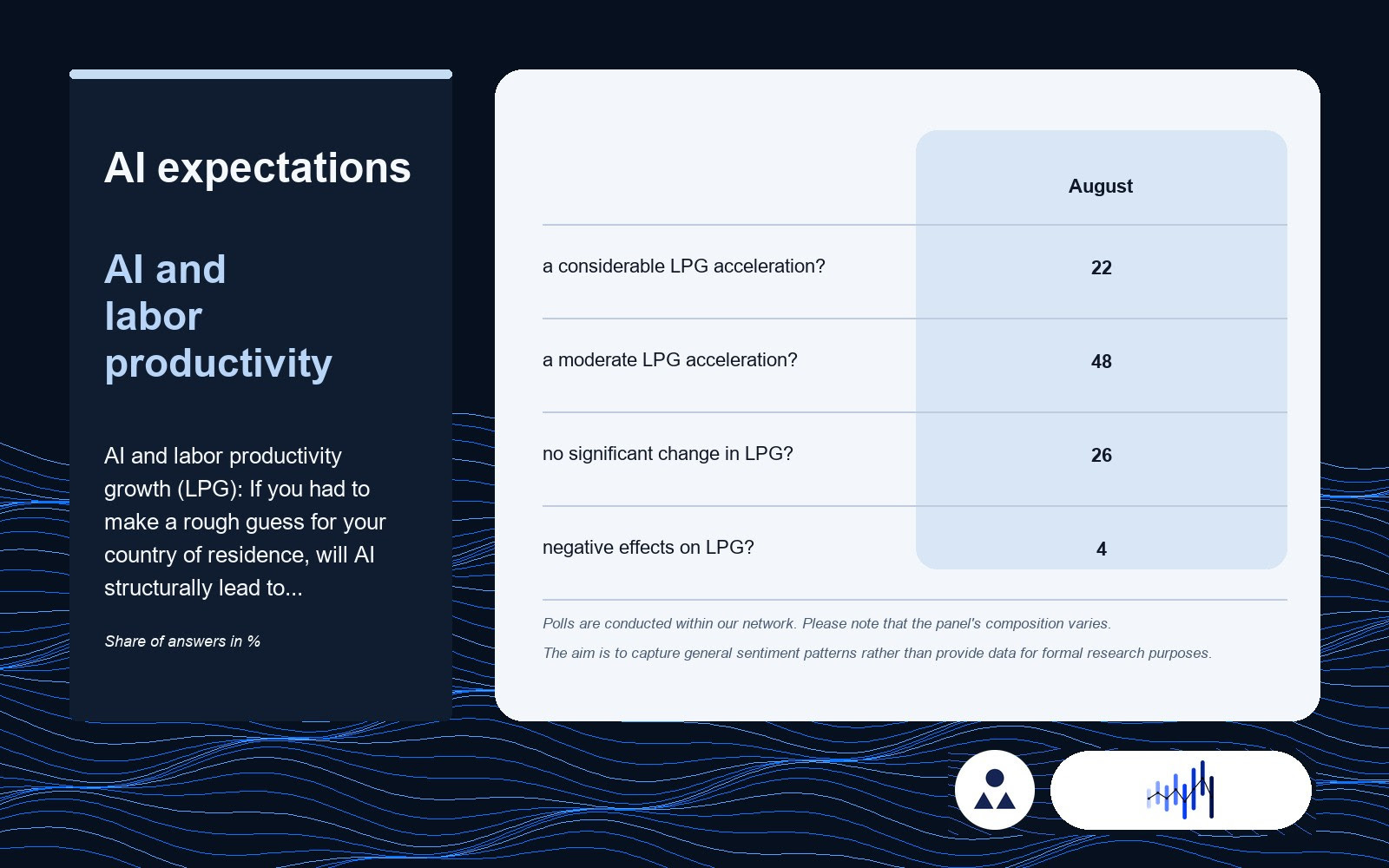
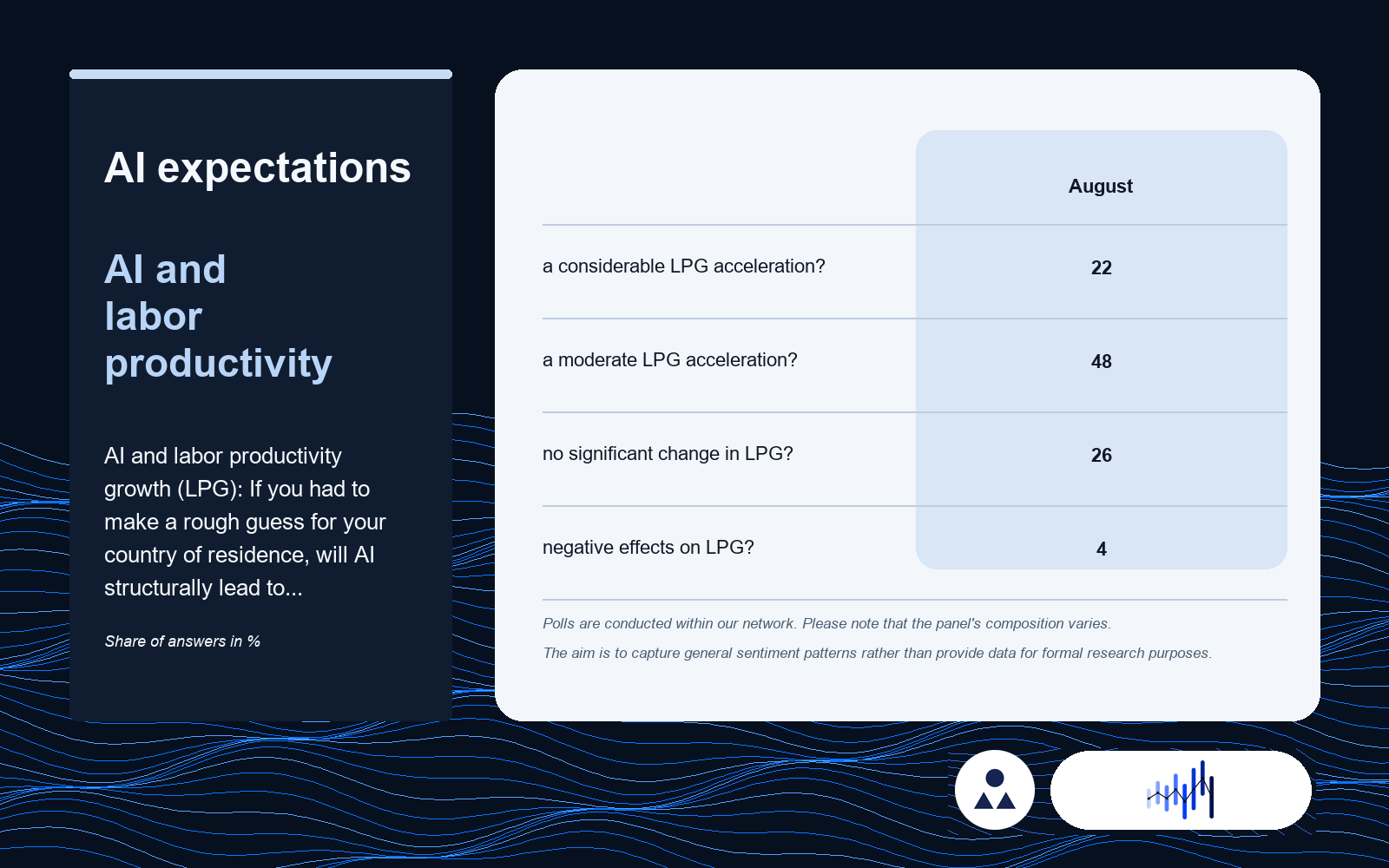
Interesting results emerged in our poll on the labor productivity effects of AI. There is no consensus among our respondents. 48 percent expect a moderate acceleration in labor productivity growth, while significant shares anticipate either a boom or no meaningful change.
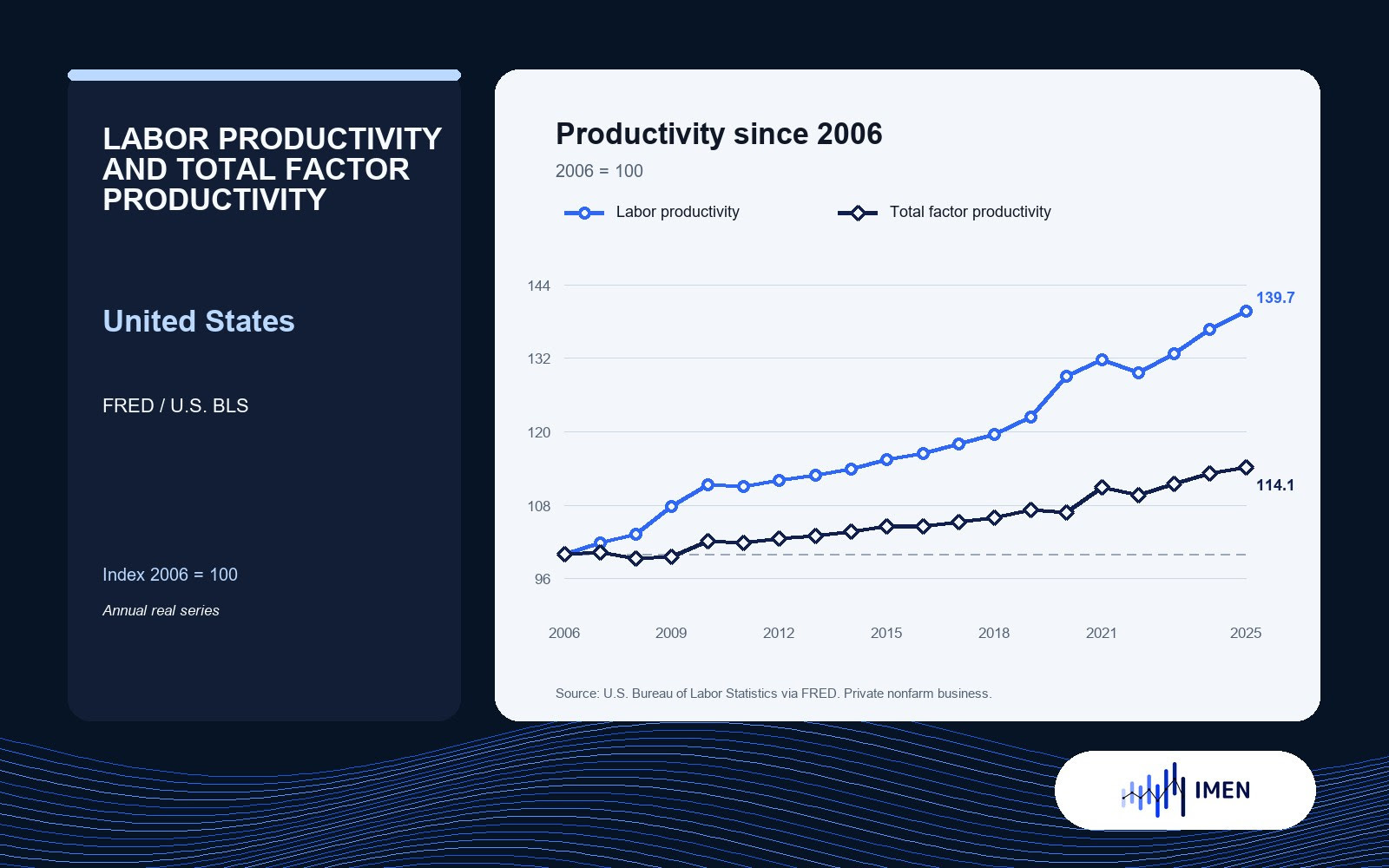
In the United States, where AI creation and adoption tend to be faster than in other economies, we have indeed seen a moderate acceleration in labor productivity growth in recent years. The same pattern can be observed for total factor productivity growth. While labor productivity growth is also affected by the investment boom since the pandemic, total factor productivity growth captures productivity gains unrelated to factor accumulation. Future analyses might be better able to disentangle the productivity‑enhancing effects of AI from other potential determinants such as remote work or demographic factors.
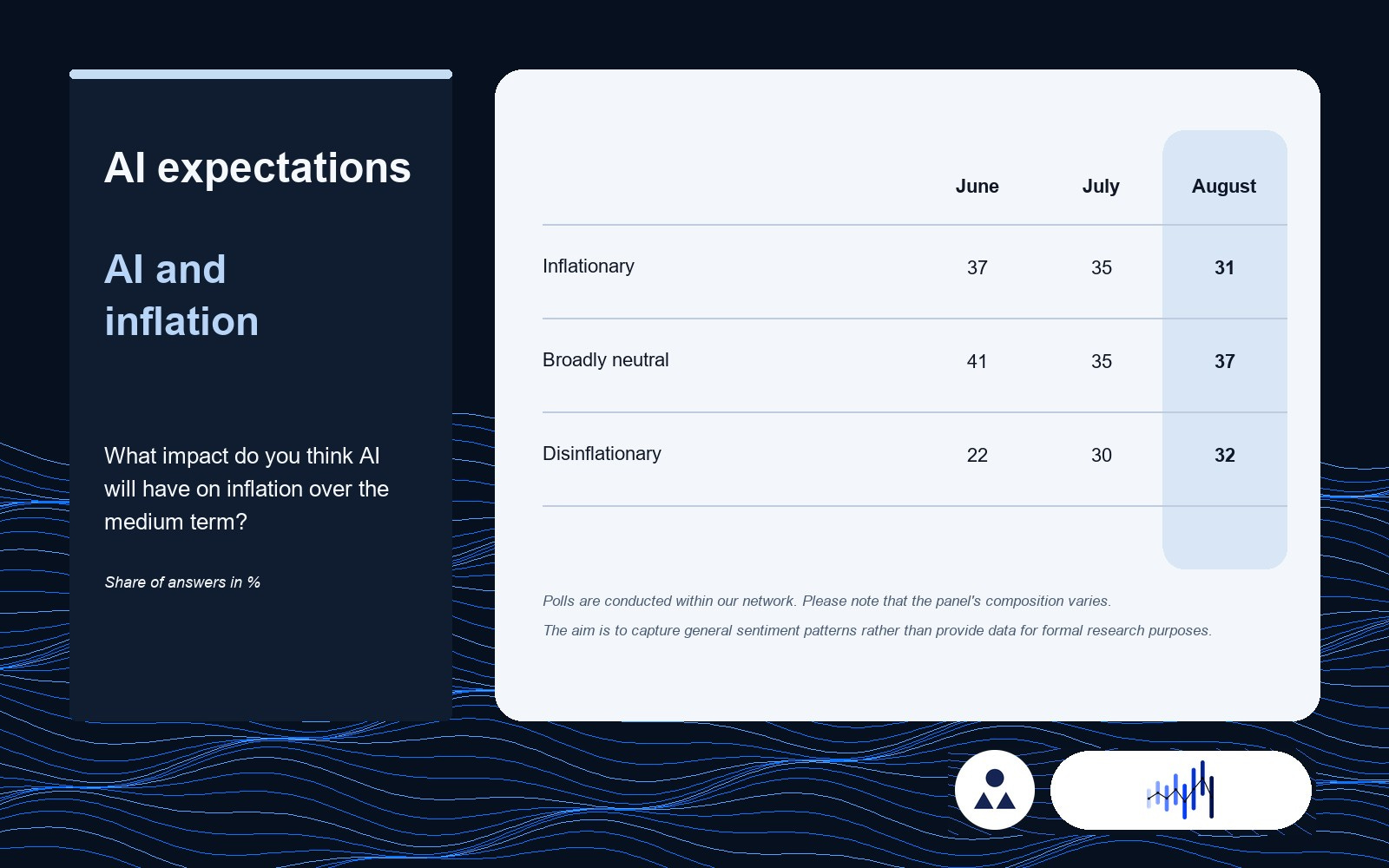
AI and inflation: Will AI be inflationary, neutral, or deflationary? In our monthly polls, no consensus emerges.
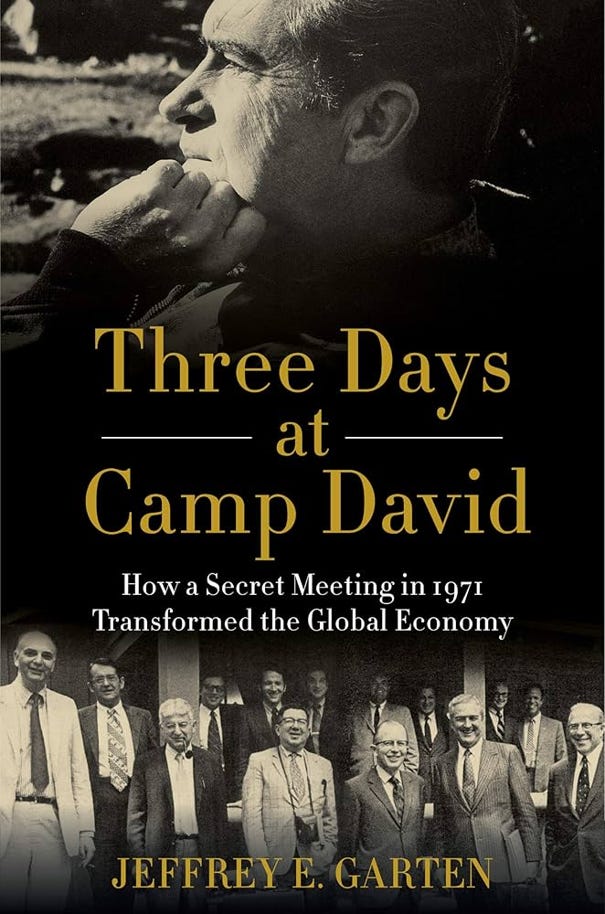
Great Books for Summer or Winter Reading: Thought-provoking, perhaps controversial, and definitely worth reading! " "Over the course of three days—from August 13 to 15, 1971—at a secret meeting at Camp David, President Richard Nixon and his brain trust changed the course of history. Before that weekend, all national currencies were valued to the U.S. dollar, which was convertible to gold at a fixed rate. That system, established by the Bretton Woods Agreement at the end of World War II, was the foundation of the international monetary system that helped fuel the greatest expansion of middle-class prosperity the world has ever seen...In making his decision, Nixon shocked world leaders, bankers, investors, traders and everyone involved in global finance. Jeffrey E. Garten argues that many of the roots of America’s dramatic retrenchment in world affairs began with that momentous event that was an admission that America could no longer afford to uphold the global monetary system."
At IMEN, we independently select the events featured on our social media channels. However, we warmly encourage everyone to contact us with suggestions. Events may include, for instance, research- and policy‑oriented conferences, workshops, seminars, or panel discussions. You can use this form.
Below, you will find our other updates and highlights. By becoming an INEM member, you can help us further expand our activities – and enjoy special benefits. If you prefer not to join us on Substack as a paid member, membership is also available via this form.
IMEN Treasure Trove - What Caught Our Eye (Selection): Global imbalances, productivity and inflation, global value chains, and much more…
Highly relevant! " This paper develops "a framework to think about the role of tariffs and industrial policies in driving current account balances. Importantly, it lays out the conditions where these policies work to improve balances (often at the expense of output and consumption), and importantly, when they will fail and even generate the opposite effect. We analyze the role of tariffs as a tool to reduce current account deficits, and of industrial policy as a determinant of current account surpluses. We consider different forms of industrial policy in our analysis: a more traditional sector-specific policy of support via subsidies or other targeted instruments (micro industrial policy), and broader policies of support through macroeconomic policies targeting interest rates with induced effects on the exchange rate (macro industrial policy)."
Very valuable! " "The Paris Club Dataset 1956–2026 provides structured, agreement‑level data on all known sovereign debt restructuring agreements negotiated through the Paris Club of official creditors between 1956 and April 2026, covering 543 agreements by 102 debtor countries and approximately USD $863 billion in treated debt. The dataset was constructed by systematically scraping and reverse‑engineering the Paris Club’s official website (
Highly relevant! " "Tariffs raise the prices of goods made at home, not just the imports they tax—an effect that standard pass-through estimates largely miss. Studying the 2025 U.S. tariffs, we find that about 26 percent of the tariff increase passes through to consumer prices. These estimates are measured relative to less-exposed goods and hold aggregate conditions fixed. The direct effect accounts for 64 percent of this increase, as tariffs raise the consumer prices of foreign varieties of a good. The remaining 36 percent arises indirectly—tariffs raise the cost of imported inputs used by U.S. producers, and domestic producers raise their markups because they face less competition from higher-priced imports. The direct effect passes through quickly, since tariffs raise import prices almost immediately, but the indirect effect takes nine to twelve months to work its way through supply chains. As a result, tariffs have a larger and more drawn-out impact on consumers than the direct effect alone would suggest."
Highly relevant! " "How does higher productivity affect inflation? Productivity shifts both supply and demand (through real incomes), and its effect on inflation depends on their relative magnitude and timing, as well as on the monetary policy response. We distinguish between a one-off level shock that temporarily increases productivity above trend and a persistent rise in productivity growth. A one-off, temporary increase in productivity lowers marginal costs and raises potential output, generating downward pressure on the price level. Once prices adjust however, inflation returns to target. By contrast, higher productivity growth raises expected permanent income and stimulates investment and consumption, increasing the natural real rate. Absent a tightening of monetary policy, inflationary pressures may emerge. Anticipation effects are central: if demand rises ahead of realised supply gains, inflation can increase despite higher productive capacity. In an open economy, the sectoral incidence of the shock also determines the impact on inflation. In summary, the inflationary consequences of productivity gains are a priori ambiguous and depend on the balance and timing of demand and supply responses, the composition of demand, and crucially, the monetary policy response."
Highly relevant!
“Tariff Uncertainty and the U.S. Dollar“ by Şebnem Kalemli-Özcan, Can Soylu, and Muhammed A. Yıldırım.
“Standard models predict that a unilateral tariff appreciates the implementing country’s currency; in 2025, U.S. tariffs rose and the dollar fell. We show that tariff uncertainty can reverse the textbook prediction. ...we find markets priced the announced tariffs as largely transitory, so the uncertainty channel — not the tariff level, valuation effects, or covered convenience-yield erosion — accounts for the dollar’s depreciation at announcement frequencies.”
Super interesting!
“Estimating the rise in expected inflation from higher energy prices“ by Paula Patzelt and Ricardo Reis.
“When the price of electricity increases by 1%, households’ expected inflation increases by 1.2 to 1.5 basis points. If those expectations have become unanchored, then the effect is higher by 0.2 to 1.5 bps. Further, the impact of a supply shock to electricity prices is gradual, peaking only 8 to 12 months after impact. This paper arrives at these estimates by exploiting cross-sectional variation from newly-available panel data on expected inflation by Euro area households across region, gender, education, and income together with time-series variation in the cost of energy across region and source, and by proposing new measures of supply shocks. The estimates imply that households under-react to electricity price changes, that the rise in electricity prices in 2021-23 accounted for a small share of the rise in expected inflation, and that anchoring expectations is important in the face of supply shocks.”
Food for thought!
“Capitalism, Socialism, and Political Economy: Volumes I, II, and III” by Kui-Wai Li.
“Capitalism, Socialism, and Political Economy, is a three‑volume examination of the ideological, historical, and economic forces shaping global politics in the early twenty‑first century. Throughout the volumes, Kui‑Wai Li argues that many political dynamics commonly associated with the alt‑right have roots in the geopolitical and institutional arrangements formed at the end of World War II. Integrating political trends into economic analysis, these books provide an analytical framework for understanding how competing ideological systems continue to influence global development, institutional behavior, and public sentiment.”
“Volume I presents the conceptual groundwork, clarifying the distinctions between capitalism and socialism/communism. It provides particular attention to the historical contexts that shaped these ideologies after 1945. …Building on this foundation, Volume II applies the framework to contemporary global trends across advanced economies, socialist states, emerging economies, Middle Eastern regions, and newer blocs such as BRICS. …Volume III extends the analysis to the politics of fear and sympathy—two themes the author identifies as shaping current debates around climate change, COVID‑19, welfare systems, and unauthorized immigration. It further examines how concepts such as freedom, choice, privacy, trade, and investment function within different political‑economic systems, including the growing influence of AI on perceptions of autonomy and national strategy.”
Highly relevant!
“From Stocks to Flows: Debt Service and Fiscal Sustainability” by Barry Eichengreen, Maxime Menuet, and Gregory Donnat.
“We revisit fiscal sustainability through the lens of the government’s budget constraint. What constrains fiscal policy is not the stock of outstanding liabilities per se, but the fiscal cost of servicing debt. Using two centuries of U.S. fiscal data (1800–2023) and a long-run panel of advanced economies, we show that primary surpluses are systematically more closely associated with debt-service burdens, while debt ratios lose explanatory power when debt service is taken into account. Fiscal responses intensify when financing conditions deteriorate, specifically when the interest-growth differential is positive. We rationalize these findings using a simple flow-based framework in which debt stabilization depends on the responsiveness of fiscal surpluses to financing pressures. The results suggest that fiscal sustainability depends less on debt thresholds than on financing regimes and governments’ ability to absorb debt-service burdens.”
Food for thought!
“The Alignment Economy: Rebuilding the Connection Between Effort and Stability” by Christine Marletti.
“The system isn’t broken. It’s misaligned. There’s a difference.
A broken system fails. A misaligned system keeps running — it just stops delivering its output to the people who generated it. …This isn’t a failure of capitalism. The economy produced enough. It’s a failure of alignment.”
Highly relevant!
“Exorbitant Privilege of the Periodic Table? Geoeconomics, Endogenous Centrality and Strategic Minerals for the Green Transition“ by Josh Kirk, Evgenia Passari, and Hélène Rey.
“Trade networks underpinning the energy transition are endogenous economic objects, and their structure is a source of market power. Using bilateral trade data for thirteen electrification metals over 1995–2023, we show that trade in these materials has reorganised into a hub-and-spoke system centred on China, in sharp contrast to the diffuse, multilateral structure of fossil fuels. This centrality did not follow from resource endowments: China holds few of the underlying reserves. It was built through processing investment, industrial policy, and commodity-targeted development finance—an equilibrium outcome rather than a geographical accident.”
Highly relevant! " "We examine the role of central bank reserves and public liquidity when secondary markets may freeze. Central bank reserves help intermediaries purchase assets during stress but crowd out investment. Under laissez-faire, intermediaries hold insufficient reserves, overlooking how aggregate liquidity reduces freeze risk. We propose a "market-backstop principle", akin to Bagehot’s principle for intermediaries. It combines state-contingent buyer-of-last-resort interventions to restore trading with modest liquidity requirements to limit moral hazard. The welfare benefits of restoring market functioning exceed the fiscal costs of interventions. We explore implications for the size and composition of central bank balance sheets."
Highly relevant!
“Forecasting the Covid Surge in Inflation“ by Mark W. Watson.
“The persistent surge in U.S. inflation that began in 2021 caught forecasters and policymakers by surprise. The 2021 inflation shocks were viewed as transitory, not persistent, leading to large forecast errors in late 2021 and 2022. This paper asks whether time series models – using only data on current and past inflation, but incorporating stochastic volatility and exhibiting time-varying persistence – performed better. Univariate models, using real-time data, did not. Multivariate models, incorporating sectoral inflation measures, did.”
Highly relevant!
“Trends in Global Value Chains“ (OECD)
“Global value chains (GVCs) remain highly globalised in the post-COVID-19 era but are being reconfigured in more complex ways. New OECD evidence shows that, in real terms, the use of imported goods and services in world production is near its historical peak in 2024. Recent changes are driven more by shifts across sectors and sourcing structures than by post-pandemic shortening or reshoring of supply chains. This report highlights changing bilateral dynamics among major economies and the growing role of connector economies. It shows that multinational enterprises remain central to international production, with foreign affiliate output rebounding after 2020. In addition, services – especially those supplied through foreign affiliates – are shown to be a larger and more complex dimension of GVCs than cross-border statistics alone suggest. These findings draw on three complementary OECD datasets: real-terms GVC indicators, ownership-based input-output tables and services trade by mode of supply.”
Our Global Economy Flash July 2026
The world economy has shown resilience, but the dampening effects of supply chain stress, geopolitical uncertainty, protectionism, and high public debt are considerable. Will the AI boom continue?
China Economy Flash July 2026: Exports and policy support cushion energy and property headwinds
How strong is the U.S. economy?
US Economy Flash August 2026: Will the AI boom last?
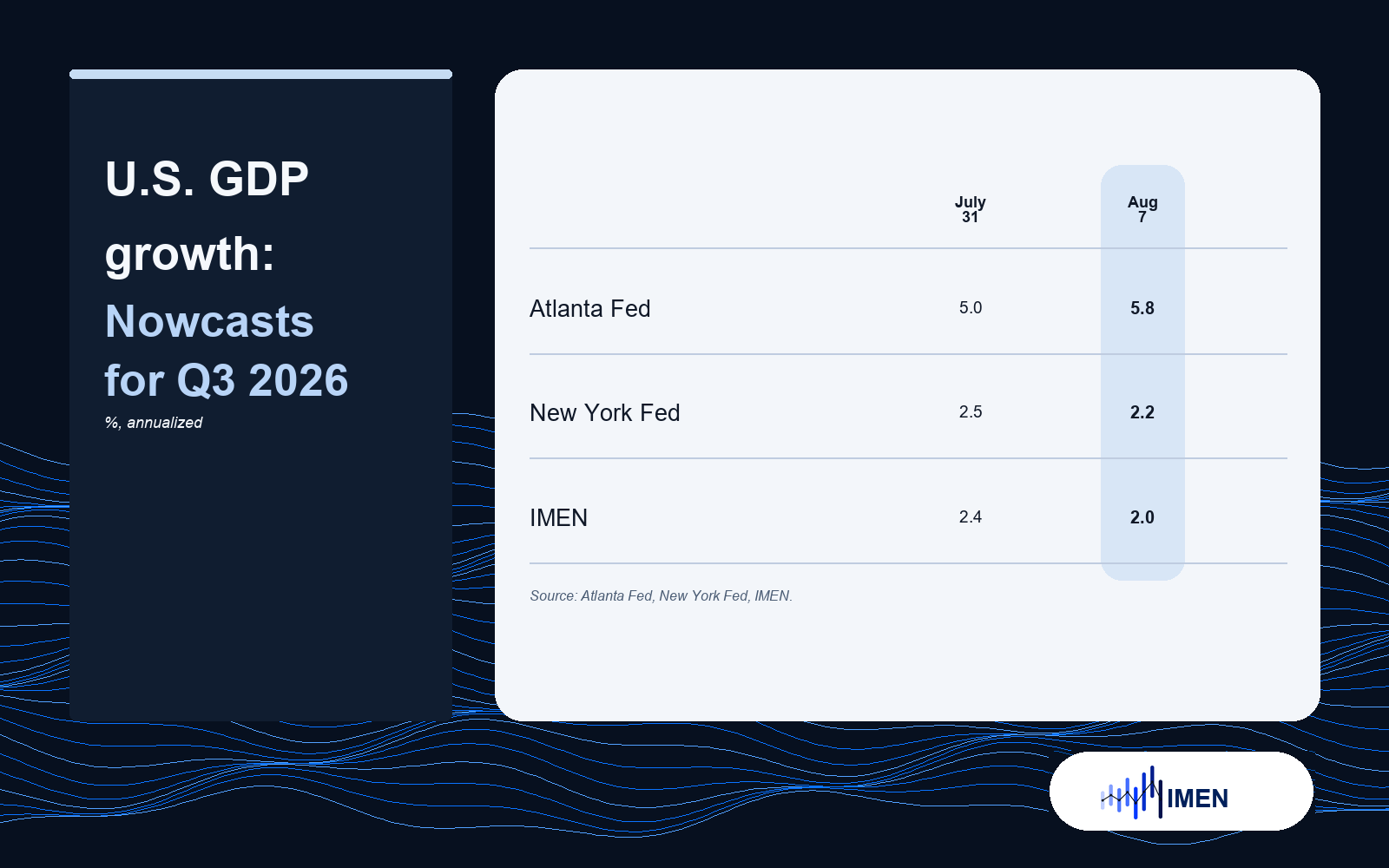
Nowcasts for U.S. GDP growth in the third quarter of 2026 currently indicate annualized growth rates between 2.0 and 5.8 percent. Early in a quarter, these nowcasts show limited reliability and will probably start to converge in September. Although the economy is facing several headwinds, GDP growth is currently expected to remain solid. However, recent data, particularly from the labor market, were worrying.
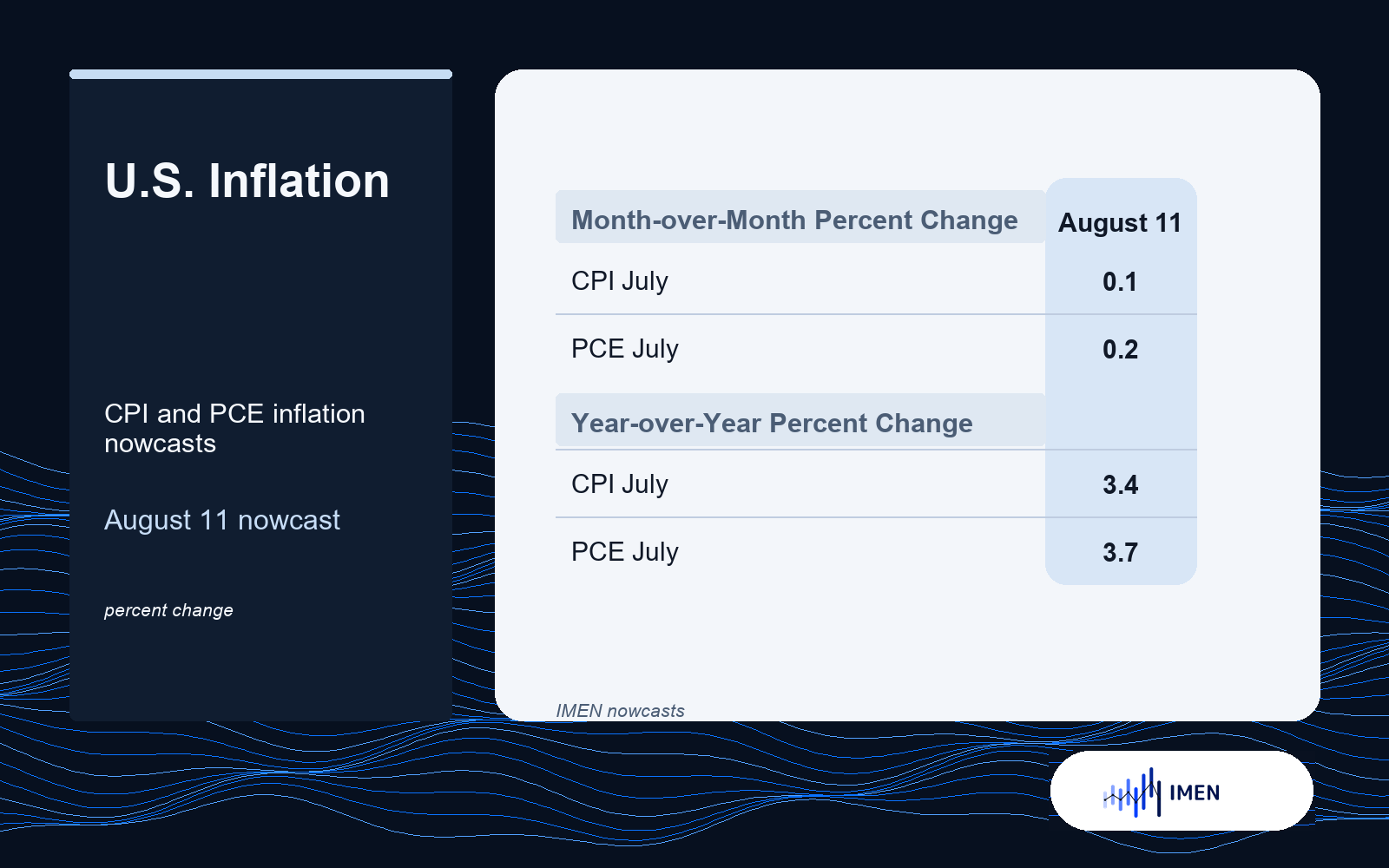
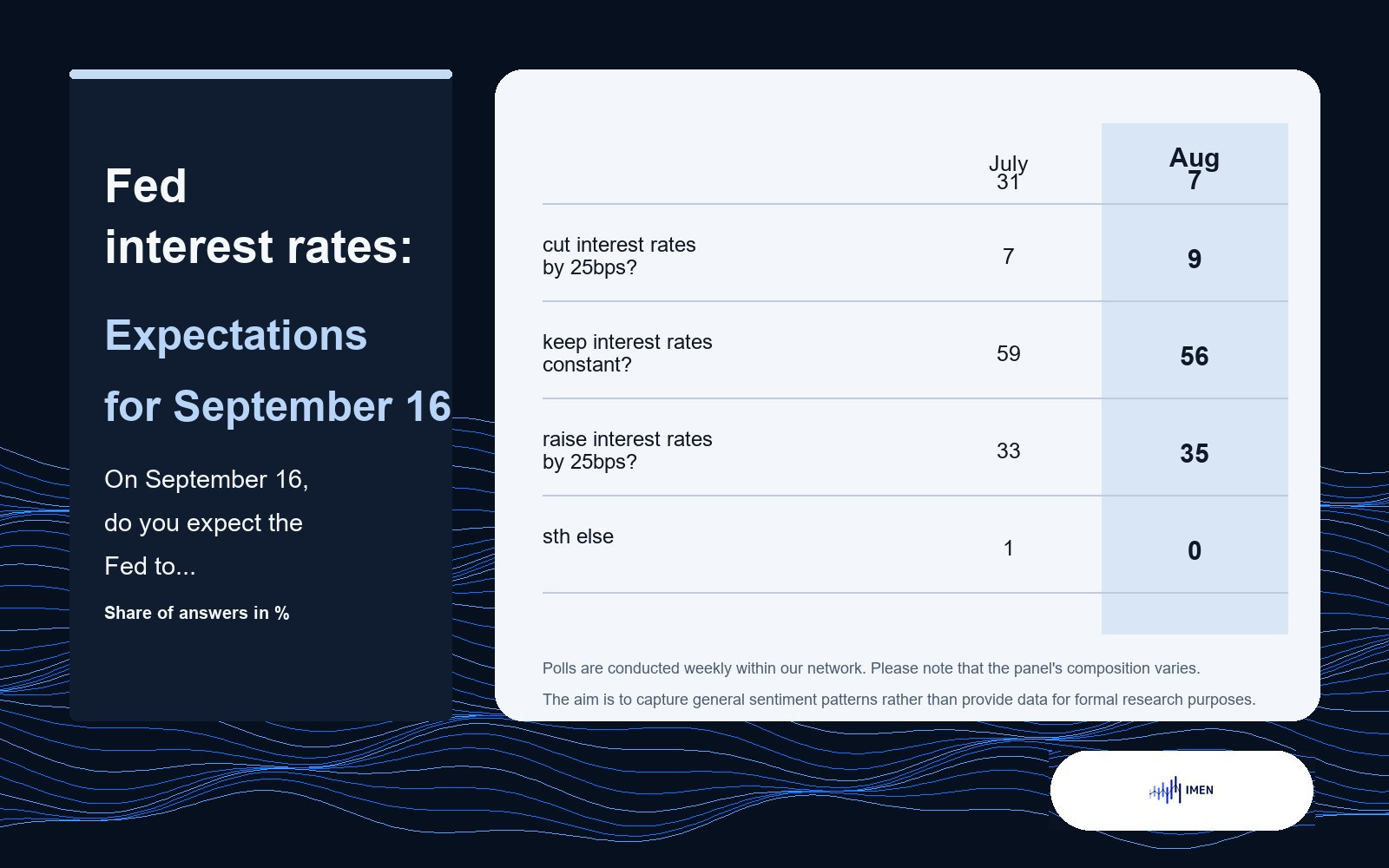
U.S. monetary policy: Most participants in our poll expect the Fed to keep interest rates constant on September 16. But one third thinks that there will be a hike.
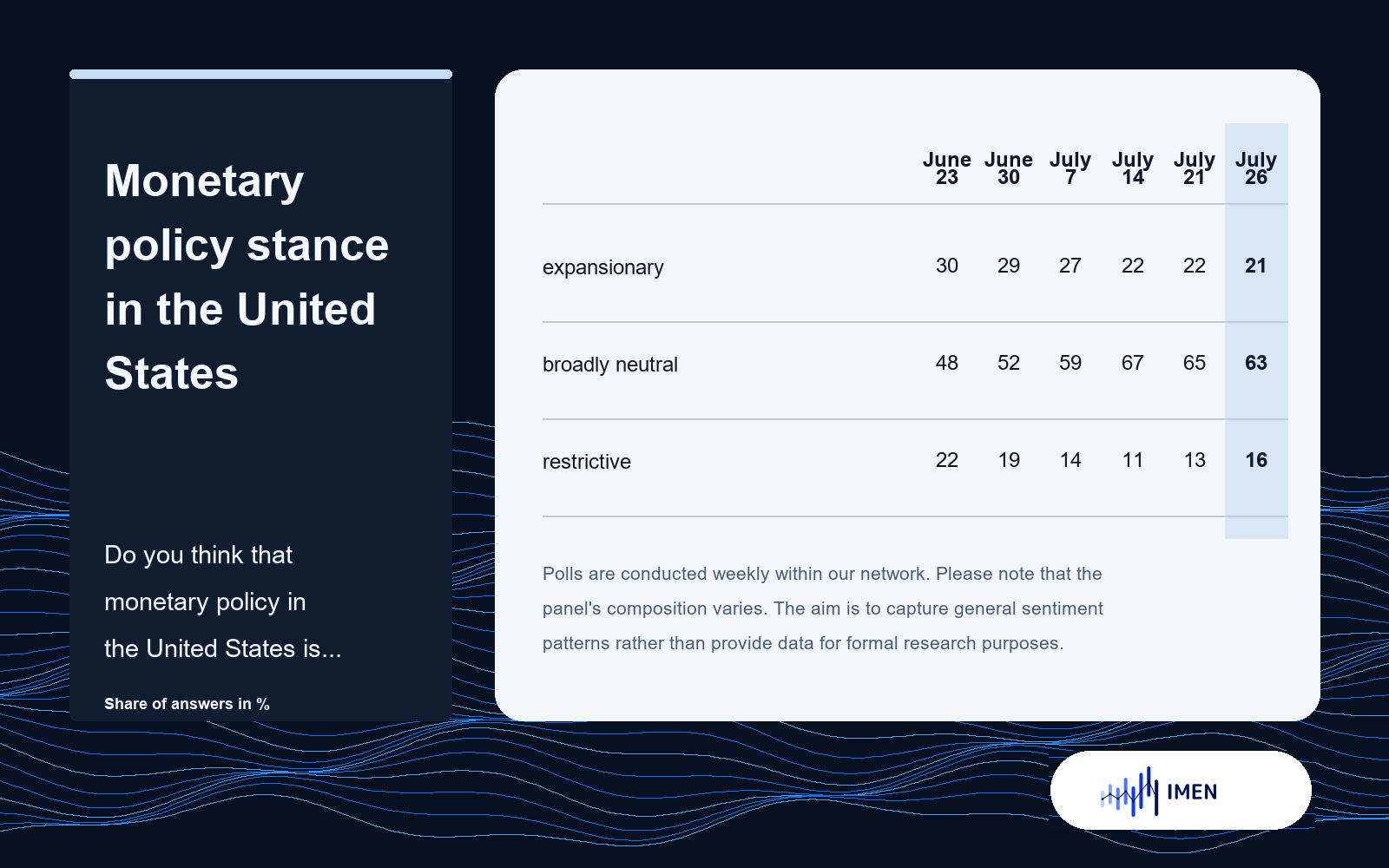
Monetary Policy Stance in the United States: Most participants in our recent poll characterize the current monetary policy stance as broadly neutral. In June, sizeable shares of respondents still had viewed policy as either expansionary or restrictive.
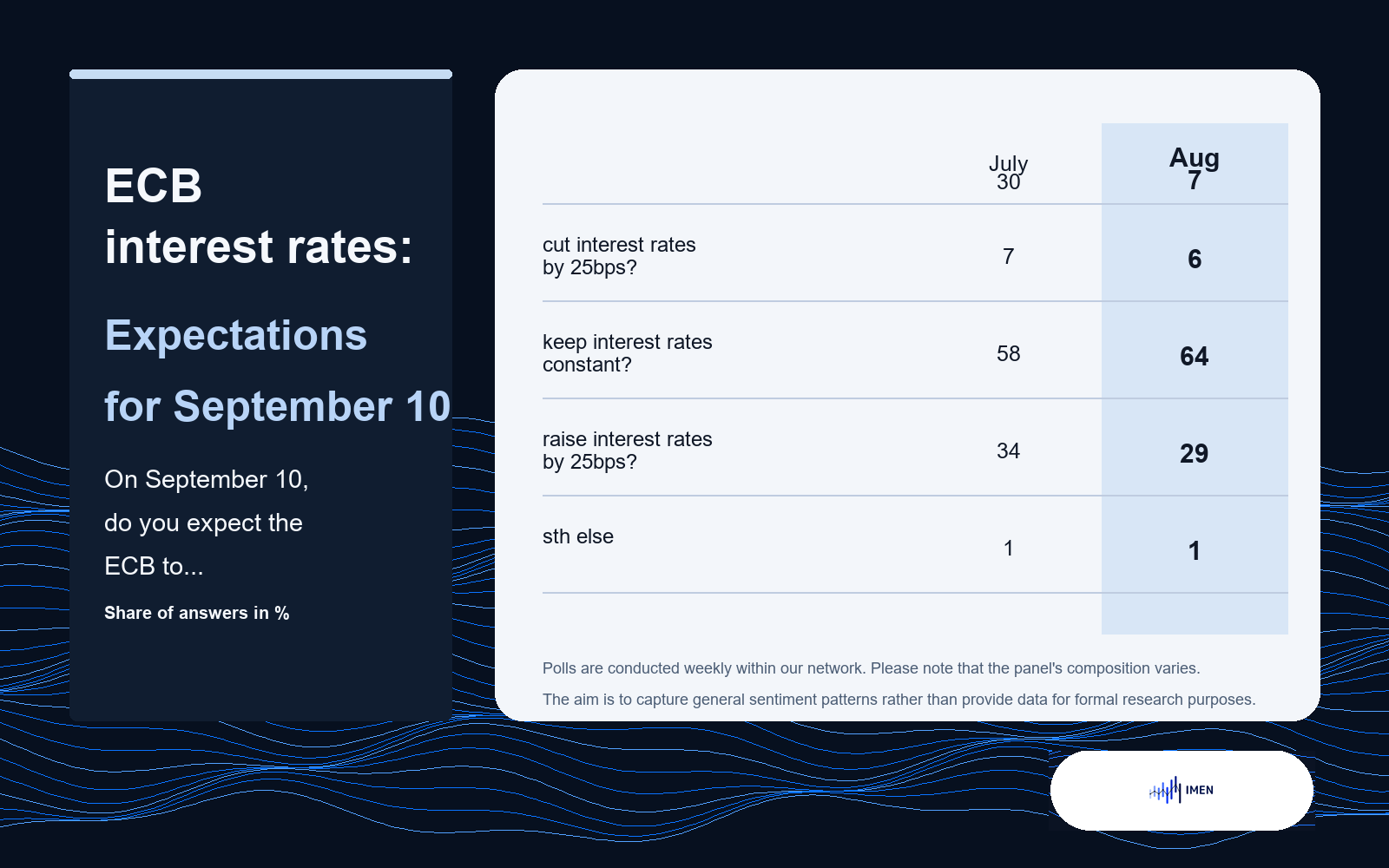
Monetary Policy in the Euro Area: Most participants in our poll expect the ECB to keep interest rates constant on September 10. But a sizeable share expects a hike.
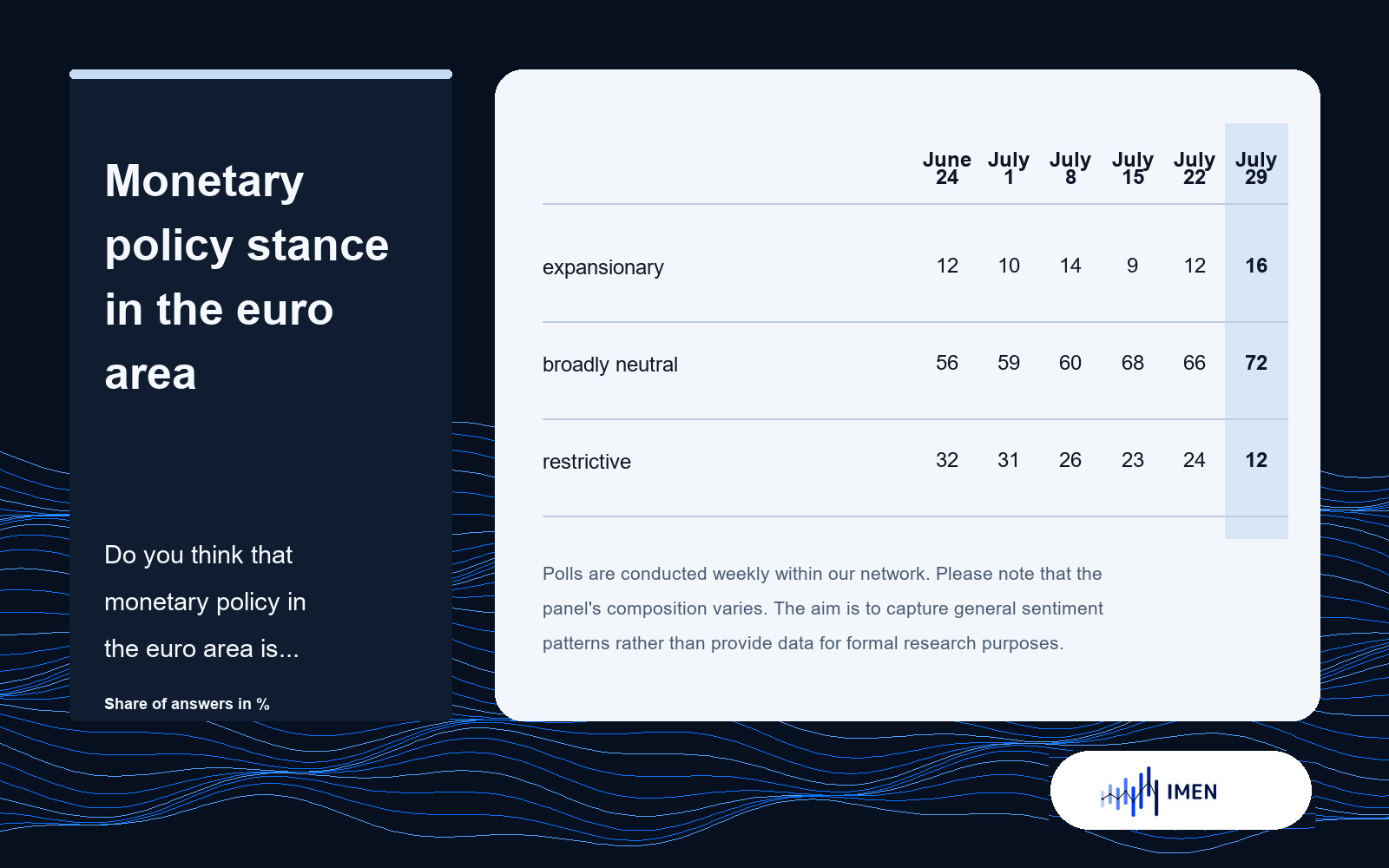
Monetary Policy Stance in the Euro Area: The ECB raised interest rates in June and kept them unchanged in July. Most participants in our recent poll characterize the current monetary policy stance as broadly neutral.
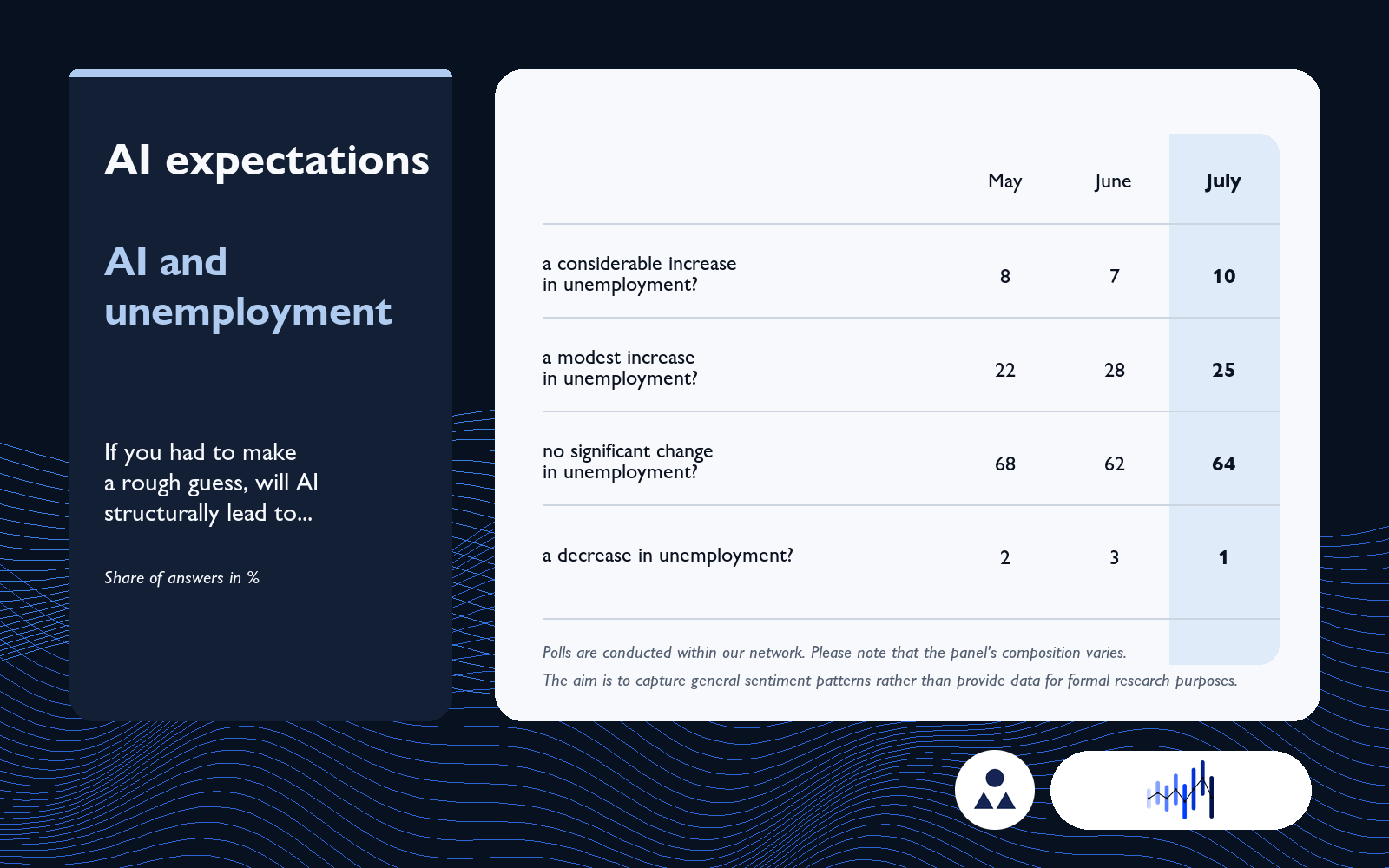
Our poll on the productivity effects of AI continues to reflect the significant uncertainty we currently face. Interestingly, there is less divergence when it comes to the unemployment effects of AI.
Would you like to present a paper in our webinar series? You can apply HERE (Please note that space is limited. We can only consider a subset of papers/topics).
Would you like to recommend an article, a working paper, a policy brief, a conference, or another event? Please use this FORM.
No posts
Comments
Nothing yet. Say the first thing.
Sign in to join the conversation.