
Did you start an impact organization because you dreamed of comparing donation platforms, writing follow-up emails, and asking for money?
Probably not. 😅
But fundraising quickly becomes part of the job, and when you’re learning on the go, it’s all too easy to make choices that cost you both time and momentum.
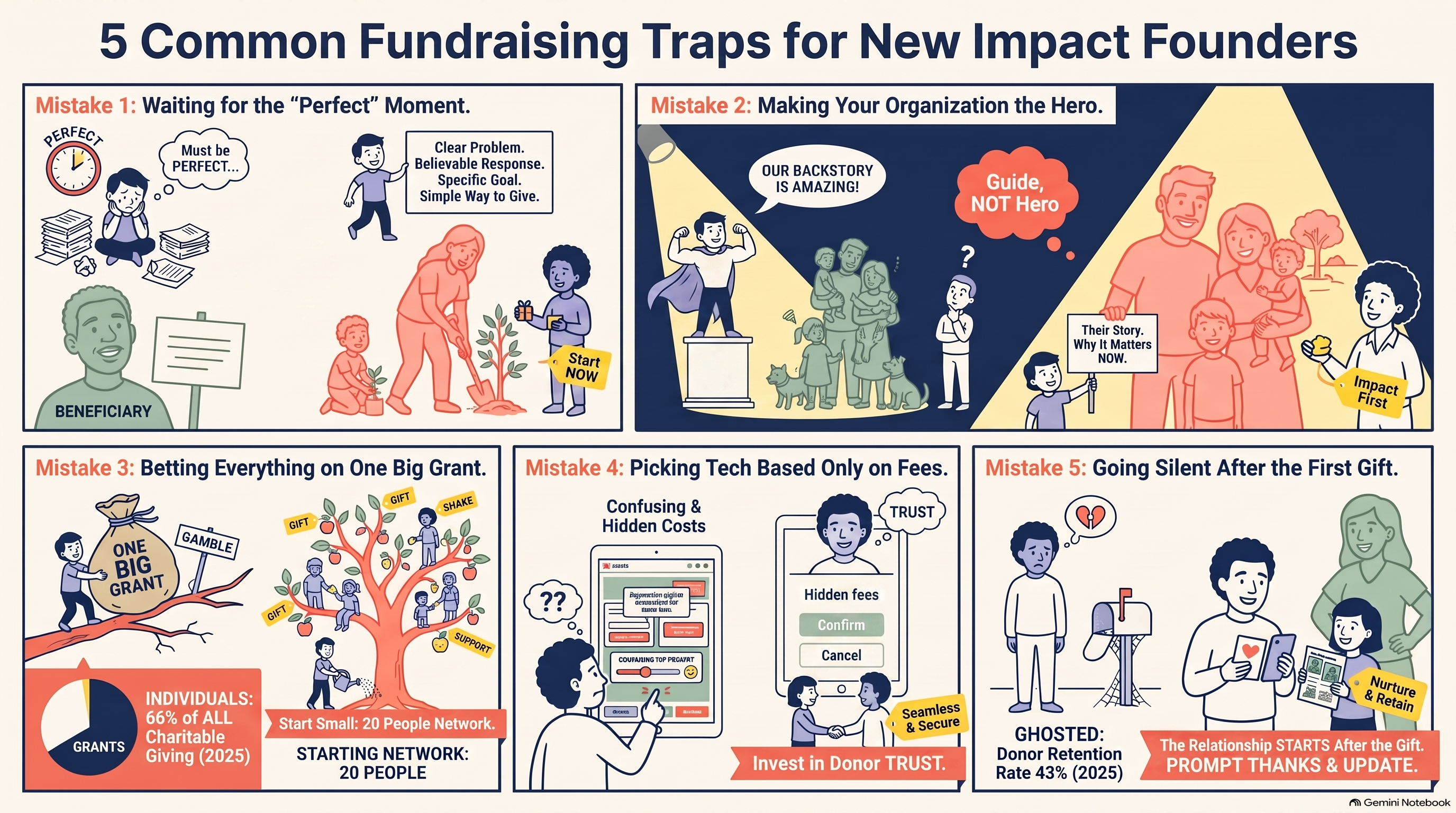
Here are five of those mistakes I see new impact founders make most often, and a few simple ways to avoid them.
Your website isn’t finished. The logo still needs work. You need better photographs. You’ve rewritten the campaign page four times, and somehow it keeps getting longer instead of clearer.
Meanwhile… nobody has actually been invited to give.
“Perfection” can feel productive because you’re technically busy doing things. It’s also a very convincing form of hiding. 👀
Trust me when I say your first campaign doesn’t have to be flawless. It just needs:
😞 A clear problem
🫶A believable response
🥅 A specific goal
💳 A simple way to give
You can improve the campaign as people begin responding to it. In fact, their questions may actually show you what needs clarifying faster than yet another afternoon spent moving paragraphs around.
At ImaginePod, we believe in Done > Perfect. Start while you are still learning. You will always be learning!
So many early fundraising appeals begin with the organization’s backstory, mission statement, and strategic vision.
All before the reader knows why they should care.
Of course your organization matters. But people usually connect with the human or animal stakes before they connect with your org’s structure.
❓Ask yourself who is affected by the problem? What are they experiencing? Why does it matter now? What could change if someone steps in?
Begin there! Instead of opening with “Our organization was founded to deliver innovative, community-led solutions to…” 🥱
Your organization still has an important role in the story, but it is usually the guide – and certainly not the hero.
Grants can be transformational! They can also take months to secure. And be restricted.
That’s why individual giving deserves a place in your fundraising plan from the beginning.
According to Giving USA, individuals contributed nearly two-thirds of all charitable giving in the US in 2025.
You don’t need thousands of donors to get started, either. Begin with the people who already understand why your work matters.
Write down 20 people who may be willing to:
Make an early gift
Introduce you to someone influential
Share your campaign
Offer useful feedback
Become a monthly supporter
Some will give. Some will open doors you didn’t know existed!🚪
When your budget is tiny, the platform with the lowest feels often feels like the most sensible choice. But “fee-free” can hide trade-offs, especially when donors are prompted to add tips they may not realize are going to the platform (or can’t intuitively adjust).
That lack of clarity can damage donor trust. It has even prompted a multistate investigation into default donor tipping practices! 🕵🏼 So look beyond the headline fee and test the full donation experience.
📖 For example:
When donors told Young Adult Survivors United that their giving process was inconvenient, the organization knew it was time to switch. They chose Donorbox to give supporters familiar ways to give seamlessly and securely.
The goal is not to find the platform that appears to cost the least today. Instead, invest in one whose pricing, donor experience, and features you’ll still feel good about six months from now.
The gift arrives! 🎁
Then, the donor receives their receipt and hears nothing more until the next fundraising campaign.
This is one of the easiest ways to lose a supporter.
In 2025, FEP reported that the overall donor retention rate sat at just over 43%. That tells us that most organizations are still, unfortunately, losing more donors than they keep.
But the donation is just the start of your relationship with a supporter! 🏁
🙏🏽 Thank the donor promptly and tell them what happens next.
✉️ Make sure to share a small update before making another ask.
🔎 Let them see the progress and some behind-the-scenes changes their gift made possible.
Your first fundraising strategy won’t be flawless. It doesn’t need to be.
Focus on the need, make a specific invitation, choose systems that make the work lighter. Then keep showing donors that their support matters.
You’ll learn what works for your community as you go.
Done > Perfect, friends.🤞🏻
Here are resources to help you in different ways with smart individual giving using the Donorbox platform:
Get a Donorbox account to try out
💡Prompt question: Which of these mistakes feels most familiar? Choose one small action you can take before Friday – then share in the comments so we can cheer you on. 📣
Comments
Nothing yet. Say the first thing.
Sign in to join the conversation.