
You want to keep going.
Almost everything seems to stop you.
But then you consider, deeply, how to carry on.
And? You discover a little French poem book that, through tiny éparpillements (scatterings) of sheer poetic pleasure, changes everything.
In the morning you now do the unflashy thing (a dull conversation book). It drops a spoonful of French into your day, but the real sugar comes in the evening…
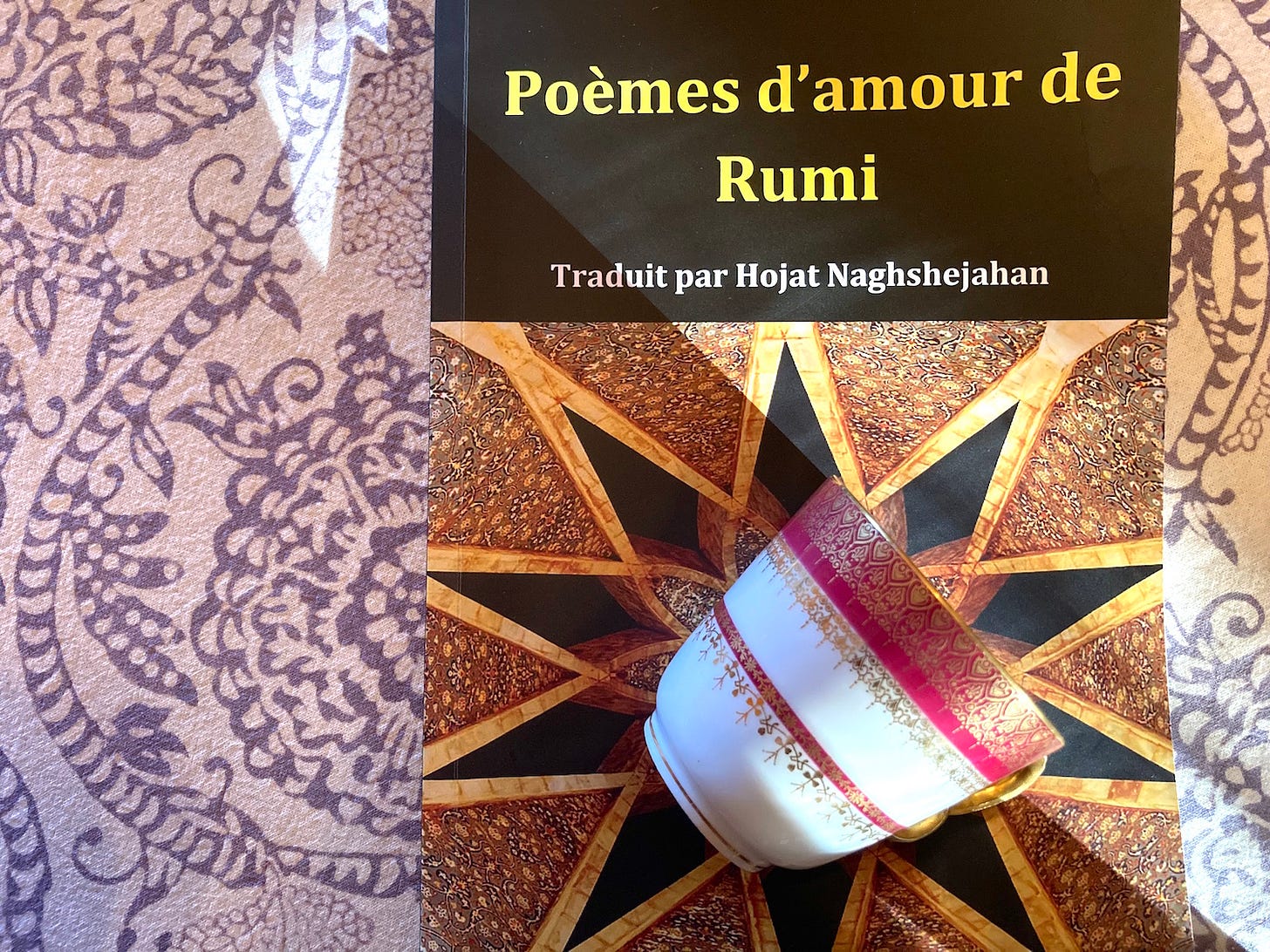
when you open your little French poem book.
With any large project, one of the main blocks is a lack of closure along the way. The project is too deep, too wide, and you can’t get a sense of having really accomplished anything in full.
With French, it’s especially frustrating. So, you translated two lines of a 40-line poem. Well, you still don’t know what the poem is doing. And unless those two lines are especially fulfilling, a sense of frustration that comes with incompleteness sets in. When this happens over and over again, because your command of the language doesn’t go far enough, you get tired. Being tired, of course you want rest. Resting, of course it can be hard to reawaken to the larger endeavor.
Here is where the words of Rumi, translated into French from Farsi, lend unexpected sweetness and a sense of completion to your French learning.
Each poem is no more than six lines.
Each poem has real depth.
You reread the ones you’ve already translated fairly easily, solidifying your memory of new words.
There’s a spiritual roundness, a wisdom, a generosity in his (ses) words that you can hold with very little translation effort.
The whole experience feels akin to a poetically-satisfying snowball you’ve begun to roll around on the endless landscape of French, adding to the gorgeous weight of what began with a single gathering of sparkling beauty that now grows larger by the day. Soon you will be dotting the landscape with French igloos. Snow sculptures. And little trails that show the shape of your journey.
You even get a tiny poem out of it, when you tell a friend about French words that stayed with you and French words that escaped. All you need now is a poem title, which you find. It’s a little edgy, but it’s yours…
Thinking of You in a Foreign Language
I remembered the word for hell.
I forgot the word for burning.
That’s all there is to say.
The words of Rumi have lasted over 750 years. Grâce à (thanks to) those who cherished ses (his) words and translated them into many languages, they are still yours.
Besides granting you a small poem, besides giving you a sense of simple closure with each brief reading, Rumi has something to say about your big French project, too—which is as endless as the many cities of Love. Who knew. ↓ ↓ ↓
“Attar has traversed the seven cities of Love, We are still at the turn of one street.”

(traduction: as always, L.L. :)
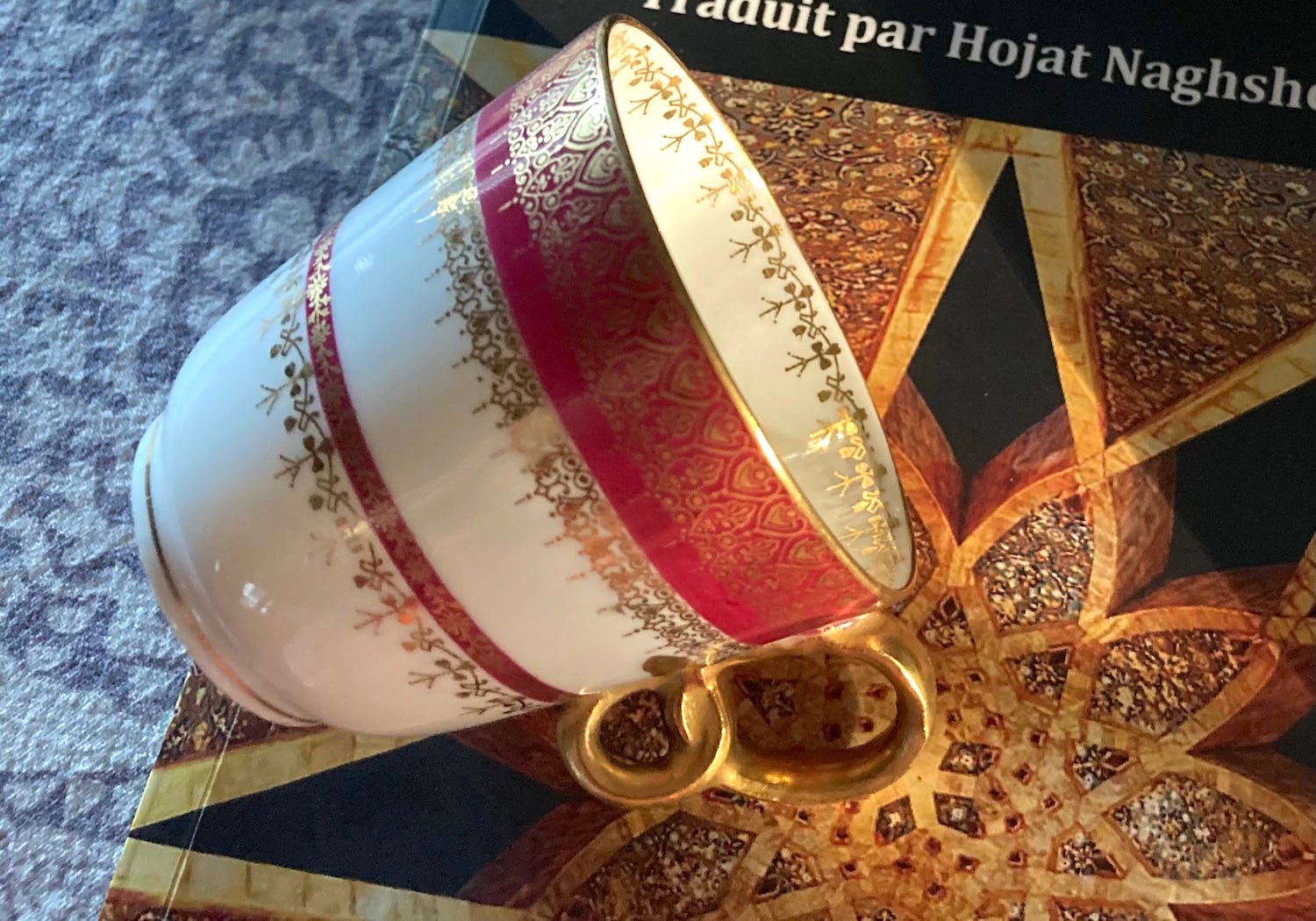
P.S. The red Limoges demitasse (French! demi (half) + tasse (cup)!) is another Etsy find. The seller was particularly gracious when I ordered a second demitasse (I didn’t want to tell her I chipped the first. So sad!). She sent me a second demitasse, plus a regular teacup, plus a two-handled teacup, closing out her full inventory of this lovely Limoges. How truly sweet. Generosity lives.
P.S.S. The word for hell in French is l’enfer. The word for burning is ardent, which was (était) so fun to learn. It lent the English word ardent new contours! The Rumi translator could have used brûlant, which is more literal, combustion, but chose ardent (fiery, burning) instead.
P.S.S.S. The Rumi quote about still being “at the turn of one street,” even after so much travel over so much ground, is from Hossein’s The Garden of Truth: The Vision and Promise of Sufism, Islam's Mystical Tradition, HarperCollins, 2008, p. 130.
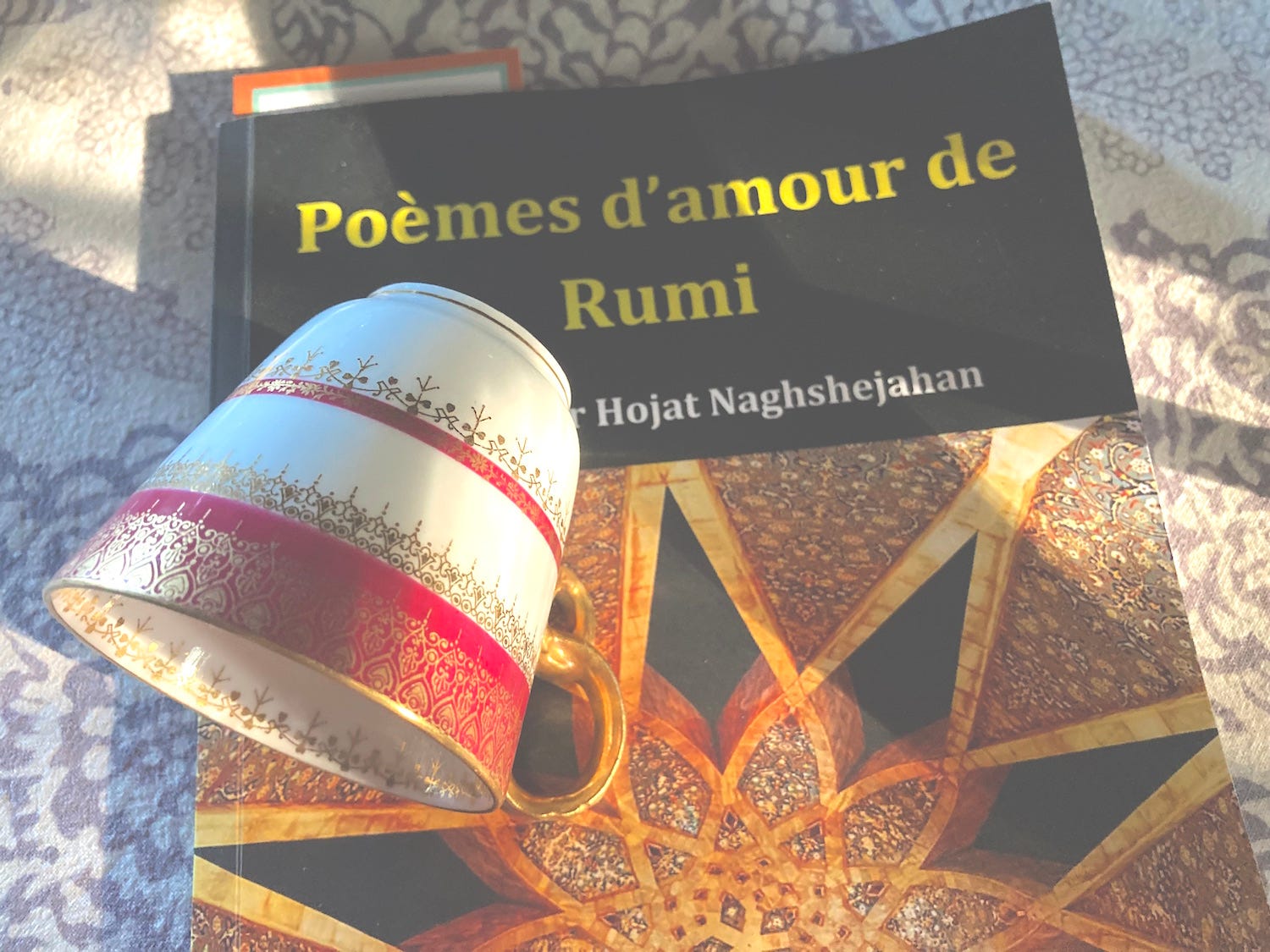
below ↓ speaking of burning, the sky here of late has been brimming with smoke, obscuring the river, the mountains, the dancing trees. i have thus been in a “hazy” mood and so created this hazy version of my limoges, lounging upon the rumi french poem book

Comments
Nothing yet. Say the first thing.
Sign in to join the conversation.