
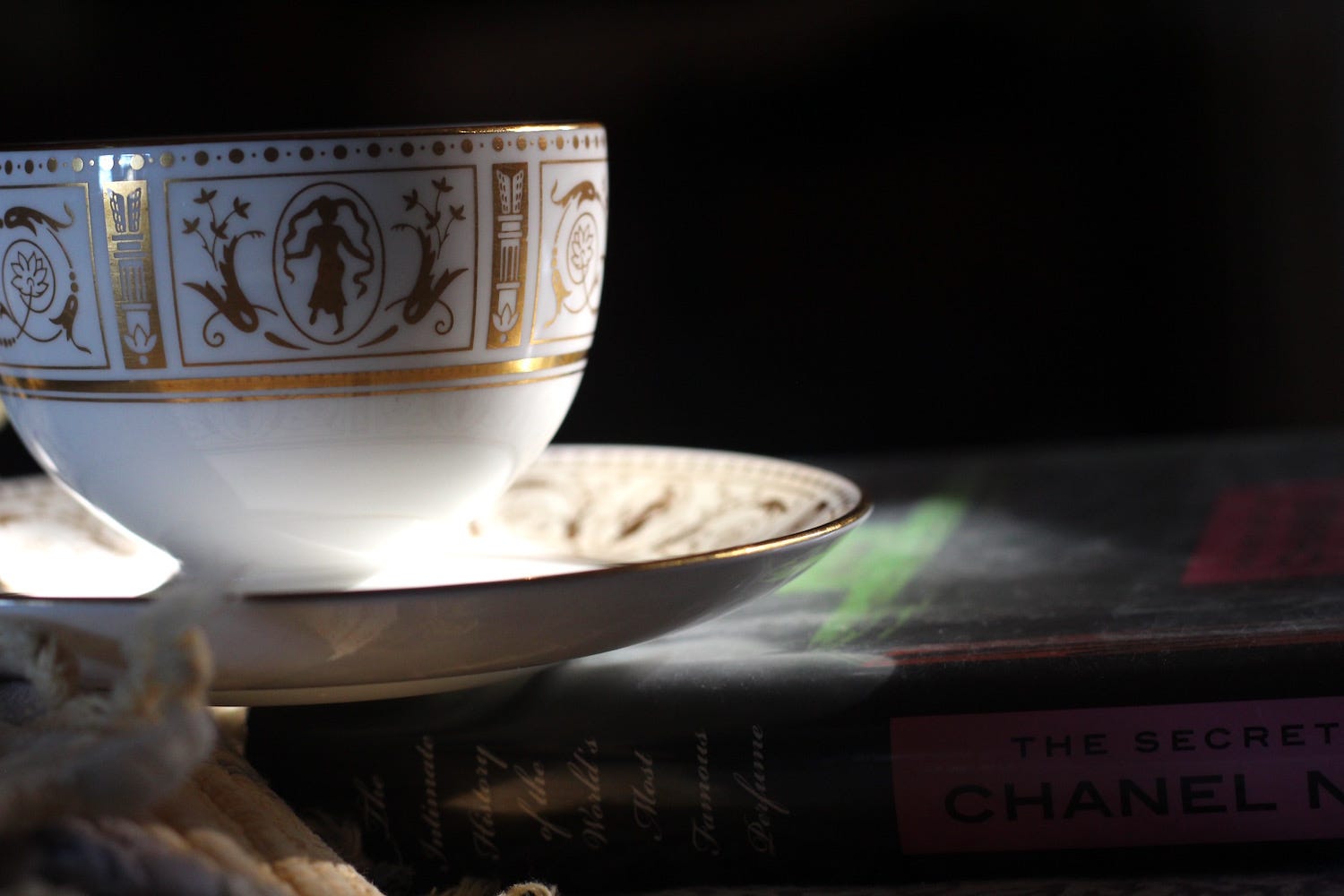
“A woman's perfume, with the scent of a woman.”
—famous words from Gabrielle (Coco) Chanel, regarding her choice of Vial Number 5, from perfumer Ernest Beaux’s samples numbered 1-5 and 20-24.
Why number five?
It was her lucky number.
The scent was both sensuous and clean.
Both were reasons enough.
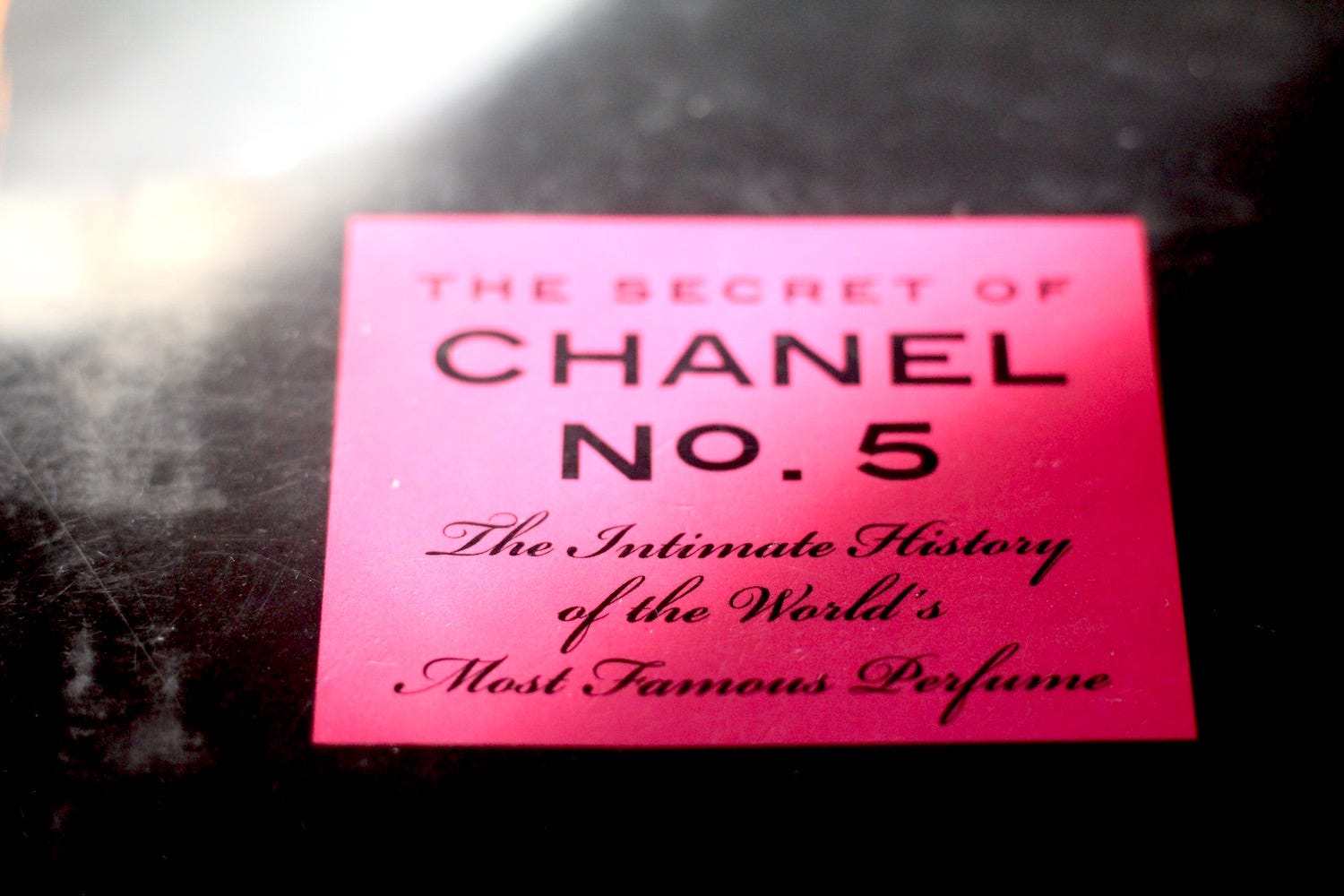
I wish (je souhaite) that I could remember the scent of No. 5. At about $350 an ounce, no one is going to casually drop the fragrance at my doorstep to refresh my memory. And, in any case, I’ve found that I cannot wear perfume. (Which is why when, once, I was gifted a bottle of Opium I passed it along to my mother. I found the bottle still sitting on her dresser when I was sorting through her things this past fall. Another souhait (wish): that I had opened the vintage Opium and experienced the fragrance before saying goodbye to the bottle forever.)

To remember the scent of Chanel No. 5, I would have to know what I was looking for. But all I recall is that the fragrance was sealed in one of the many alluring bottles on my grandmother’s aqua-blue glass dressing table. She didn’t mind that I brushed her long hair as we both smiled at one another in the full corner mirrors. She seemed proud of her perfume collection. When I was alone in the room, sometimes I would open the bottles. I’m sure she could tell. After all, a scent travels, and lingers.
It was just this method that Coco Chanel used to first introduce her No. 5 heart-child to the world of high-society women. She brought the scent with her to a restaurant and made sure to let it “travel” when the women passed by. Of course, they wanted to know: what was that heavenly, sensuous scent? Nothing but a private perfume, Coco told them. Oh, do you want it? Really, you think I should sell it? Hmm.
Secretly, she fully intended to sell it. But not before the scent began to sell itself, and linger in the air of dreams and desires.
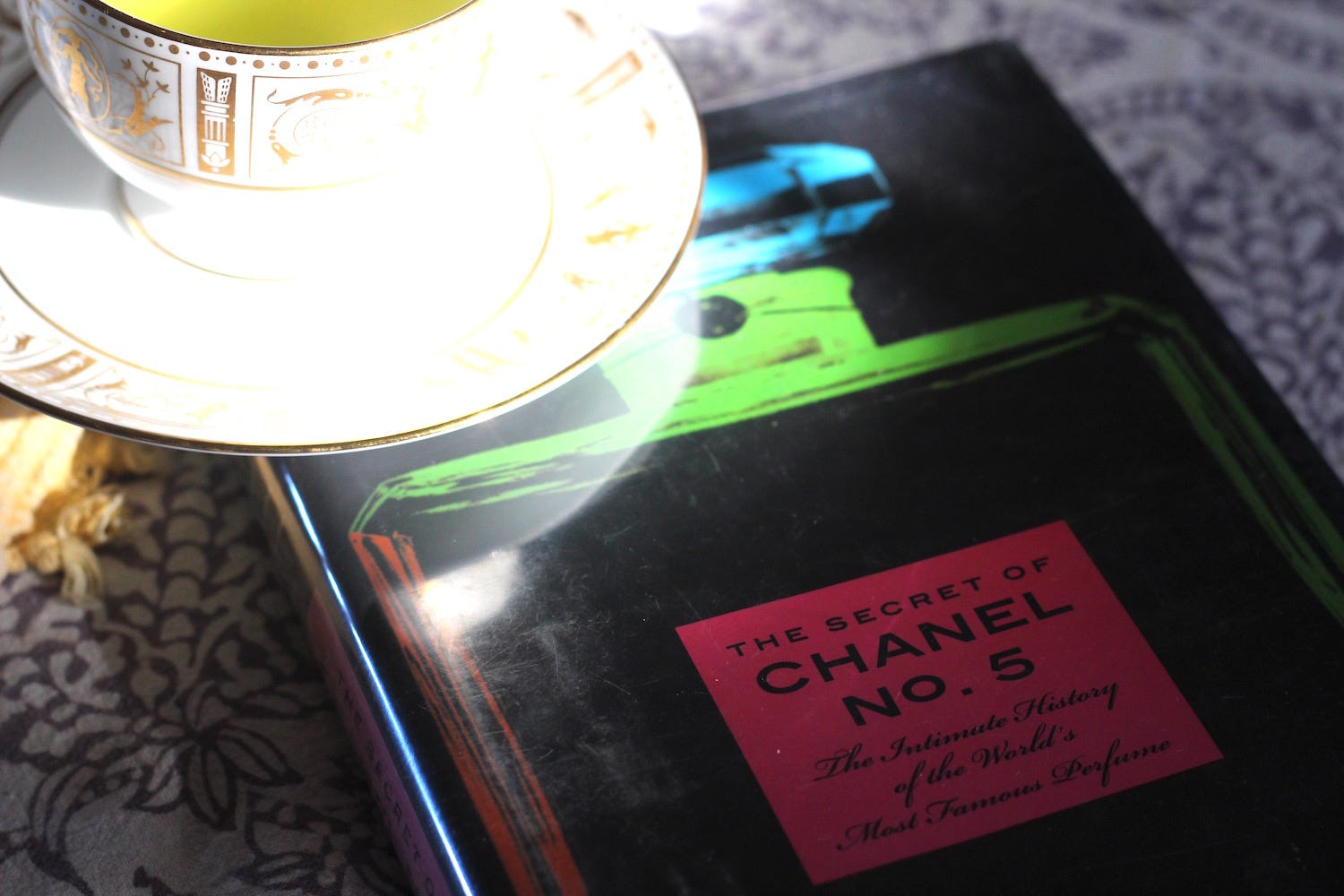
If you want a well-told tale of this famous perfume, you can find it in The Secret of Chanel No. 5. From history to romance, from conflict to couture, the book is a page-turner you might not expect to like, especially if you aren’t into perfume.
I loved the book (le livre).
What I hadn’t realized is that I would gather from it a riff on reinvention, with this culminating quote from author Tilar J. Mazzeo:
And this commitment to reinventing itself—in order to remain itself— at any cost is the reason why, generation after generation, Chanel No. 5 has persisted as a perfume and as a symbol. At any number of critical moments in the history of this fragrance, the scent that first enticed diners on a warm night in the south of France might have disappeared. It might have faded into obscurity like so many of the other great scents of that golden age of perfumery. It might have ended with the death…of the complicated woman whose name it carried….Instead, Chanel No. 5 has proven astonishingly resilient.”
There are theories as to why the perfume has proven so resilient. None of them can truly explain the phenomenon, not even those that rest on economics. Mazzeo offers no final word, except to stir a sense that we have all been in this together, keeping the cultural icon alive. One feels that the perfume has bottled more than scent: something of love and memory, longing and loss, buried deep in the fragrance itself and in those who touched it and whom it touched. You could almost attribute it to love. The kind that sees itself mirrored in a thing and will go to great lengths to keep that mirror in one brilliant and beautiful piece.
Chanel No. 5’s reinventions—in order to remain itself—have at their root relied upon people. Clever people. Daring people. Visionary people.
In your own reinventions, I wish you cleverness, daring, and vision—as well as someone to love in you what needs to remain itself.

(traduction: as always, L.L. :)
P.S. For a perfume that’s over 100 years old, there is so much to choose from when telling its story. So, just a few examples…
Of cleverness: Coco’s restaurant “whisper campaign” took a note from competitor Paul Poiret, who debuted his Nuit Persane (Persian Night) scent to high-society women at a lavish party, pretending that the scent was just a parting gift for the ladies. Coco’s spin on the stunt: no fireworks or wildly tropical birds, just an unassuming dinner out.
Of daring: Coco’s Jewish partners the Wertheimers fled to America to escape occupied France and the co-opting of their business. Taking great risk on their behalf, an American friend traveled to secure the Chanel No. 5 formula from the partners’ offices in Paris; this friend then went on to Grasse to smuggle the necessary rose and jasmine “concretes” (waxy extractions) to keep making No. 5 in Hoboken, New Jersey, for the duration of WWII. (The jasmine? 700 pounds of it—made from more than 350 million flowers!)
Of artistic vision: Creating short films to draw on the Hollywood connection of both Coco Chanel (she’d done costume design) and Marilyn Monroe (who made the perfume her own and played it up without any initial coaxing from Chanel).
And, of agricultural vision: around 1978, the flower plantations of Grasse began disappearing rapidly due to world-market pressures, and Chanel entered into an exclusive agreement with the Mul family to help their five-generation-run plantations stay in business and develop hardier versions of the jasmine plant. After all, like tea and wine, fine perfume is partly about terroir (the scent or taste lent by a particular soil and climate (terre = earth)). No other jasmine has quite the fragrance of that grown in Grasse, France. Chanel could source from elsewhere, but it wants what only Grasse can offer.
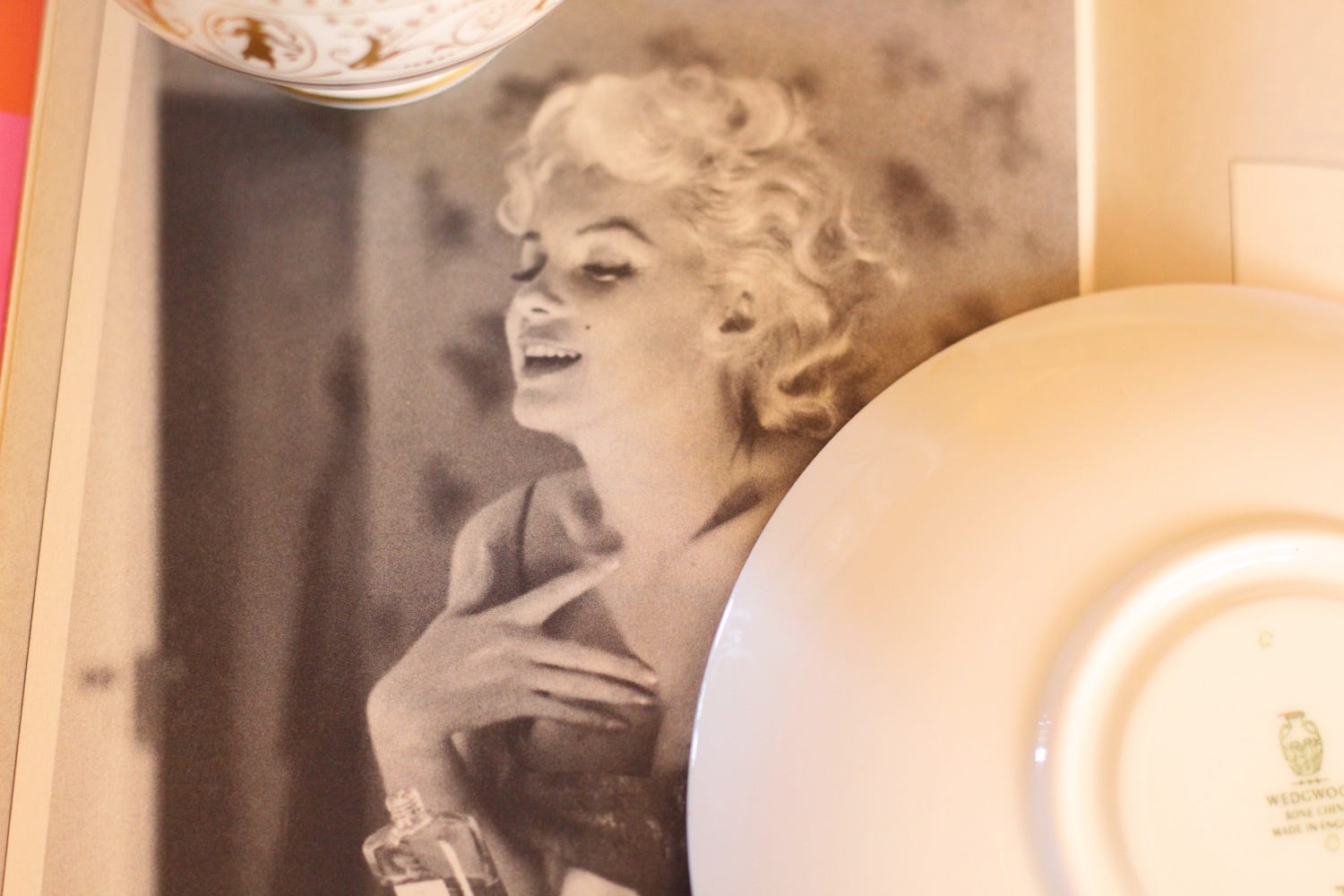
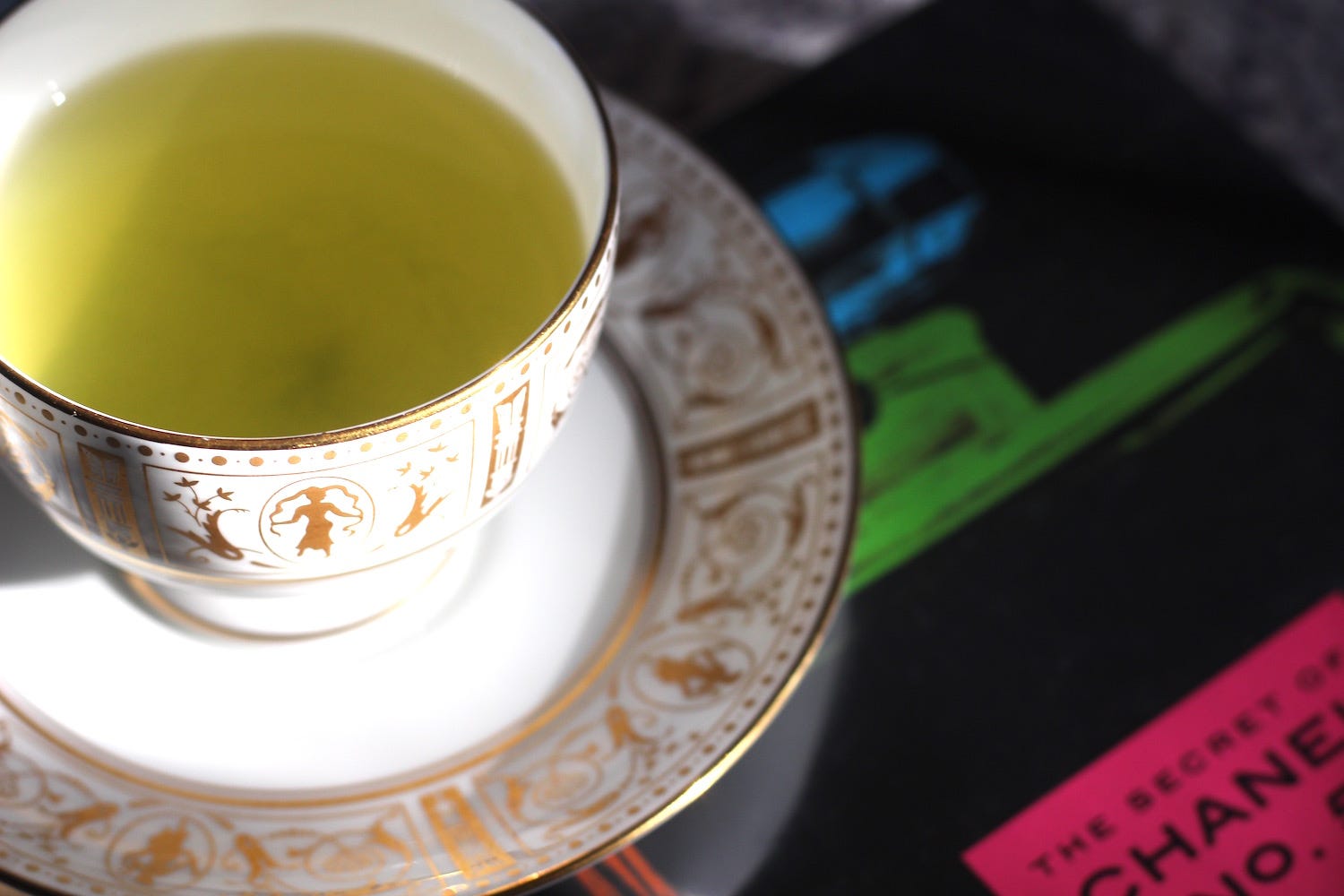
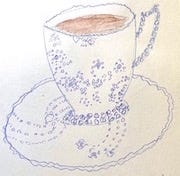
P.S.S. The teacup gracing Chanel here is a vintage Wedgwood “Grecian Gold.” It holds a Yame Gyokuro Kukicha from Todd and Holland. The Yame region is known as the “Napa Valley” of Japanese green tea—due to its ideal climate which includes protective morning fogs. Gyokuro (meaning “jade dew”) is shade grown, fine needled and dark green, with higher chlorophyll content than other teas. The kukicha harvested from this gyokuro (and mixed in with it) is a low-caffeine “twig tea”— made from the plant’s twigs and stems that are at least three years old before harvesting. You can get kukicha that is harvested from a sencha (sun grown tea), too. But the one in my teacup is just of gyokuro origin.
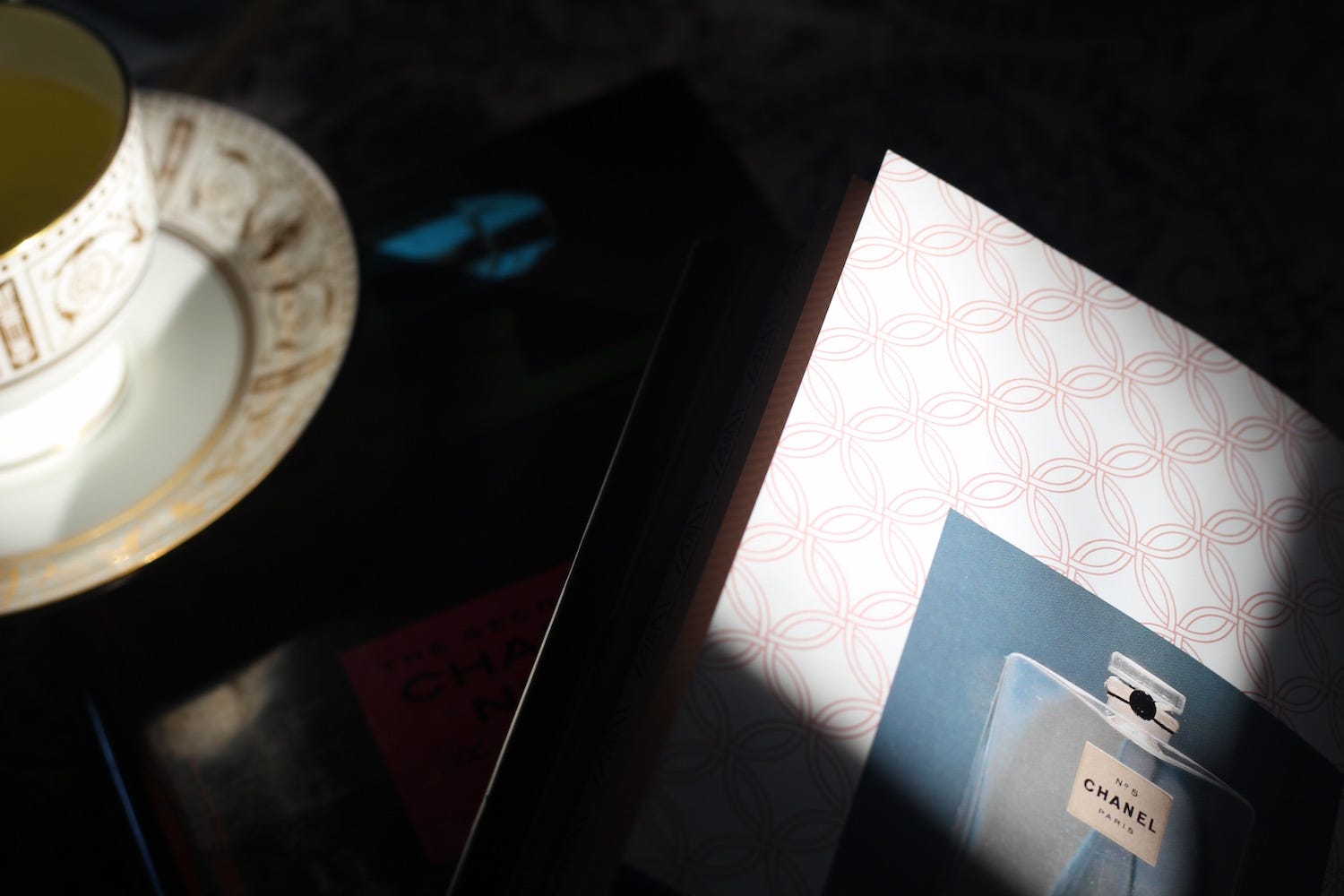
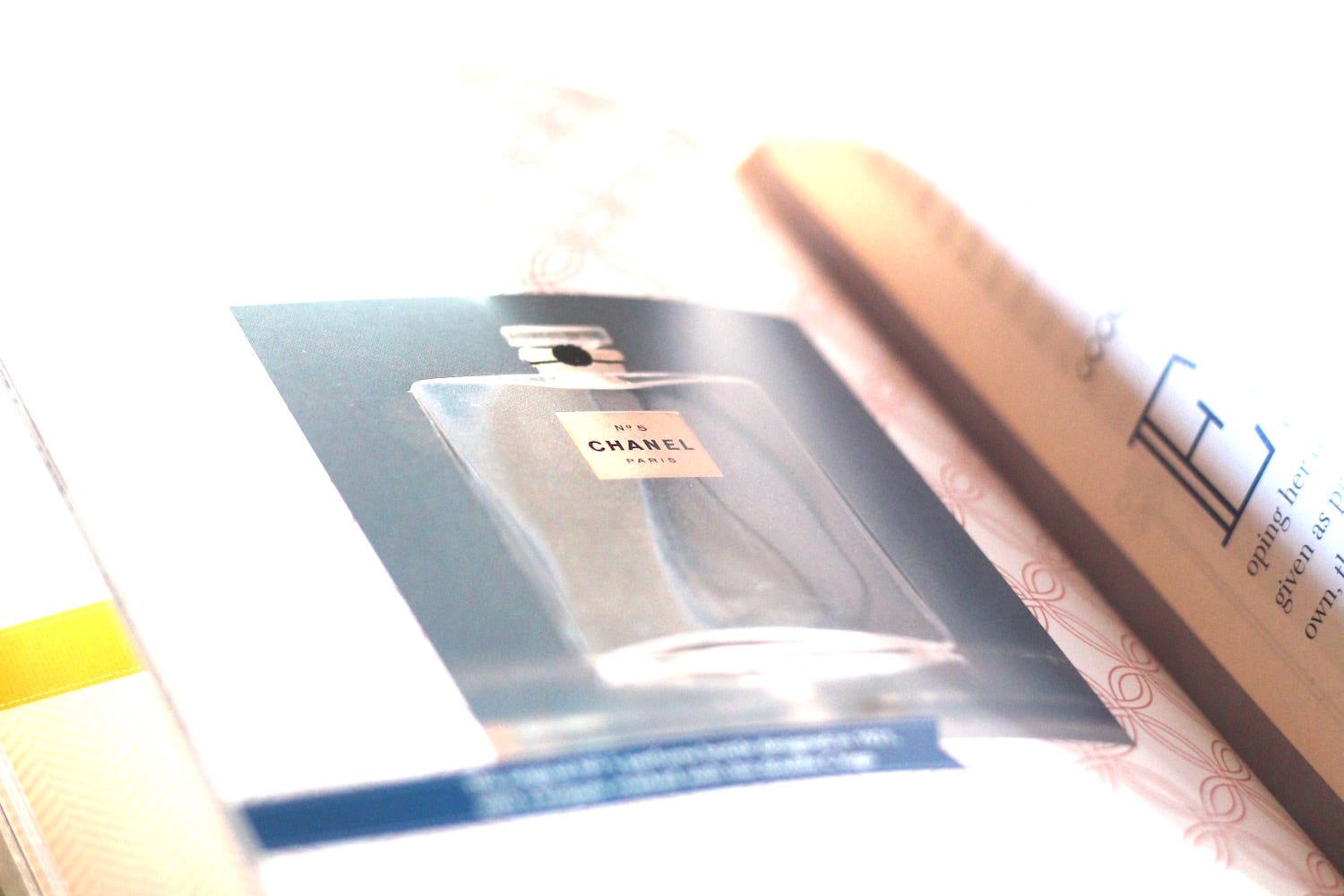
below ↓ i like how bringing the photo’s exposure up creates a lightness that mirrors the presence of “aldehydes” in chanel no. 5 (a scent twist that was new to perfumery and was added quite generously to no. 5). aldehydes are the fragrance of “clean” and play in tension with the more sensual aspects of the perfume. the bottle below is the original 1921 design (featured in le livre (the book) by susan goldman rubin called coco chanel)
All in French, but worth a listen even if you are just beginning to learn French.
Comments
Nothing yet. Say the first thing.
Sign in to join the conversation.