
In the mid-1980s, Don Valentine of Sequoia looked at a small networking startup called Cisco. Many investors had already passed, and they had passed for the same reason: the management team looked weak.
Valentine invested anyway. He thought the market for Cisco’s product was enormous. Then he replaced the founding team essentially on the spot.
Cisco went on to dominate computer networking. The story is famous among investors and infamous among entrepreneurs, and it sits at the center of the oldest unresolved argument in venture capital: do you bet on the jockey or the horse?
The classic statement comes from General George Doriot, the founder of the modern venture capital industry: give me an A management team with a B product idea, or a B management team with an A product idea, and I’ll take the first every time.
One of Greylock’s founders put the rationale well. Making an investment in an entrepreneurial company is a marathon, not a sprint. The rules of engagement will change: the competitive landscape shifts, and you have to reposition the company, not by 180 degrees but by 15 or 20, as you build it. An A team can execute that turn. A poor team, however good the initial product idea, in all likelihood cannot navigate it.
That argument is about adaptability under uncertainty, and it is genuinely powerful. Most of today’s venture capitalists agree with it. Here is what my research shows:
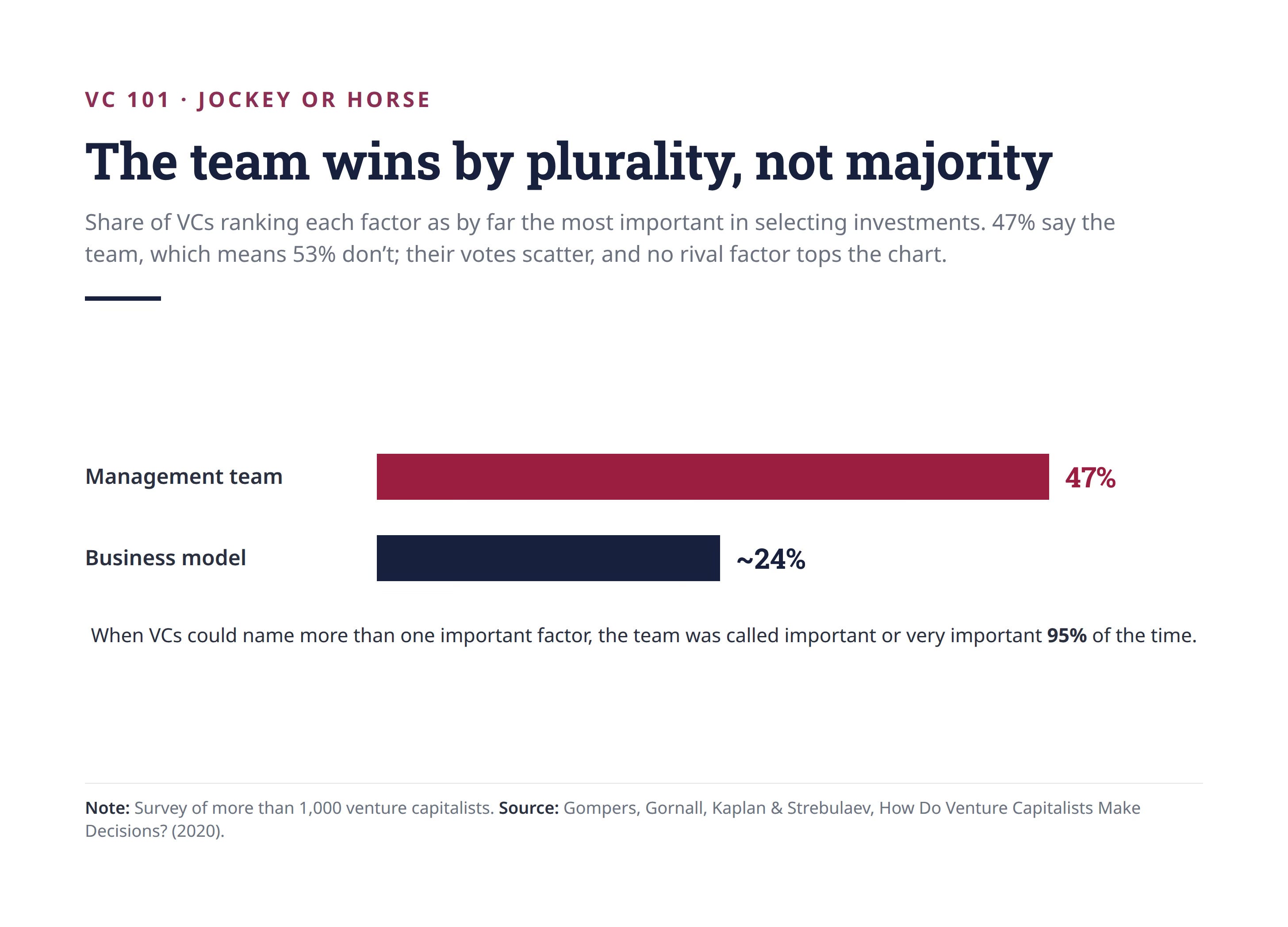
Out of more than a thousand VCs we surveyed, 47% say the team is by far the most important factor in selection. The second-place factor, business model, scores only half as many. Early-stage investors weight the team more heavily than late-stage investors, which makes intuitive sense, but even late-stage investors put it far above everything else. And not surprisingly, when we allowed VCs to identify more than one important factor, the team was identified as important or very important 95% of the time.
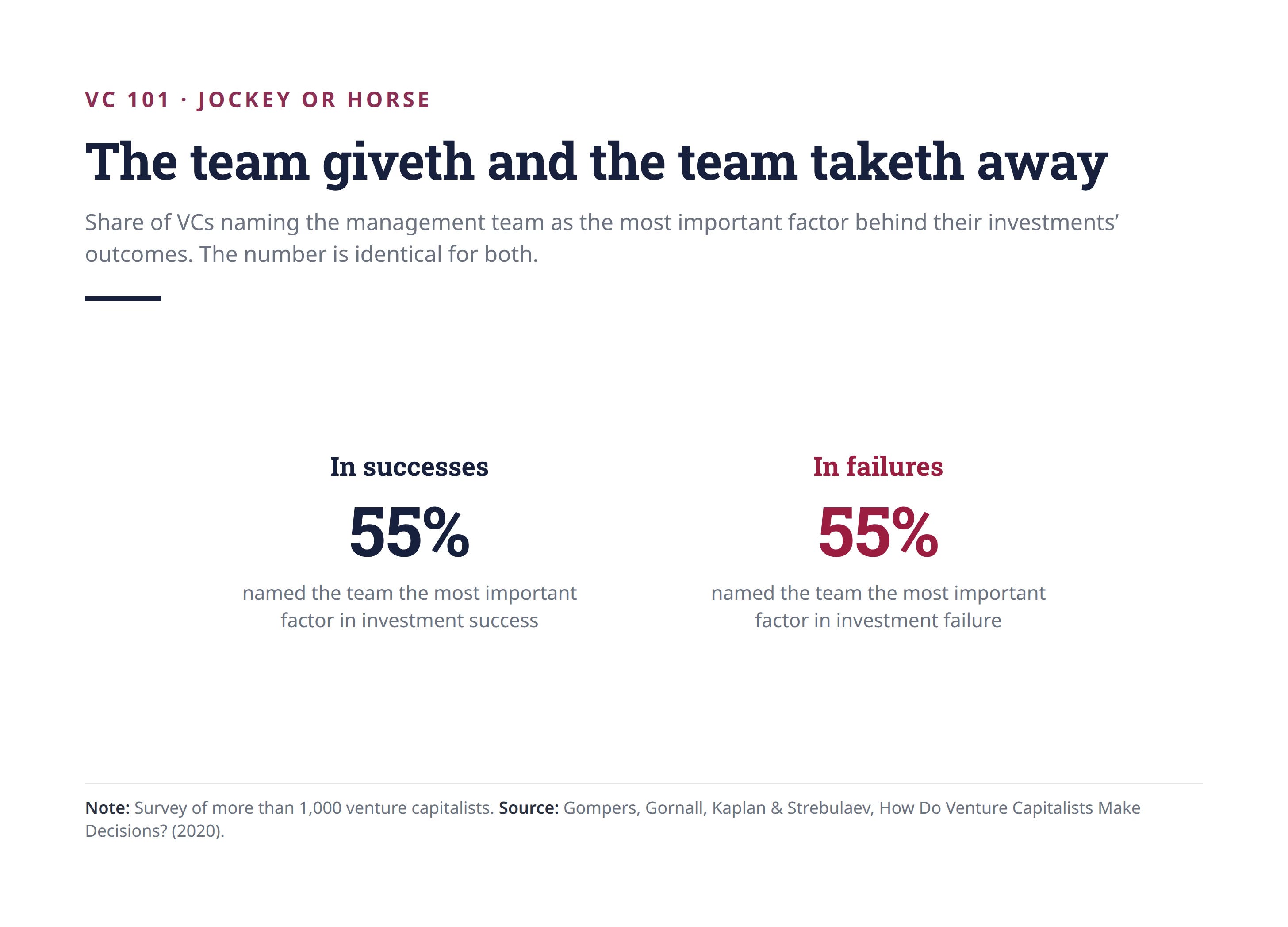
We approached the question from the other end too, asking what drives successful and failed investments. Team again, by a wide margin, and, strikingly, symmetrically. Fifty-five percent named the team as the most important factor for success, and the identical 55% named it for failure. The team giveth and the team taketh away.
Founders, note: only one group put the team in second place, healthcare VCs, and even there it was neck and neck with product. The reason is instructive. In healthcare innovation, investors expect the product to be substantially further along by the time they invest, and, bluntly, the management team is easier to replace once the product exists.
So the matter is settled. Except that it isn’t, for a reason that’s easy to miss when you read the headline number.
Forty-seven percent say the team is most important. Which means fifty-three percent don’t. They just don’t agree with each other about what does matter most, so their votes scatter across several factors and no single alternative tops the chart. The team wins by plurality, not by majority.
And some of the most storied investors in the industry are firmly in the other camp. Tom Perkins, co-founder of Kleiner Perkins, evaluated a company’s technological position above all: was the technology superior to the alternatives, and was it proprietary? Valentine’s Cisco bet was a pure market call, made in the explicit knowledge that the team was the weak part, on the theory that the team was the replaceable part.
That is the crux of the horse argument. Teams can be swapped; markets cannot.
And there is a harder version of the argument that rarely gets said out loud. In an ideal world investors would select companies with both a strong business and a strong team. In reality, that combination essentially never presents itself, and when it appears to, experienced investors assume they are missing something. What actually arrives is a company with a relatively weaker management team or a relatively weaker business. So the question is not which you prefer. It’s which weakness you are willing to underwrite.
Note also what “weaker” really means here. It covers uncertainty as much as deficiency. Far less is known about the leadership qualities of a first-time founder than about a market that already exists and can be measured. A first-time founder isn’t necessarily worse. They are harder to read. And investors making rapid decisions under time pressure systematically discount what they cannot read. On the other hand, imagine markets that don’t exist yet, as AI was until very recently. Then the market uncertainty is so large that team quality is not only more critical but also, relatively speaking, less certain. This explains why in healthcare, for example, management team quality is less important: not because team’s quality does not matter, but because the other “horse” parameters – market, product, business model – are less uncertain.
The jockey-versus-horse question is punishingly difficult to study in the field, but Steven Kaplan from the University of Chicago, Berk Sensoy, now at Vanderbilt University, and Per Strömberg, now at the Stockholm School of Economics, found an ingenious way in. They took 50 successful VC-backed companies and traced the evolution of their characteristics from the earliest business plan all the way through to IPO. What makes the study remarkable is the access: business plans at multiple points across the life cycle, which almost never survive in a form researchers can see.
A note aside: there are many great academic studies of venture capital and entrepreneurship done by my academic colleagues around the world and they should really be better known. As I am writing this, I would like to commit myself to bring more of this hard and practically relevant evidence to my Substack audience!!
The findings were lopsided. Business lines were remarkably stable. These companies competed against similar competitors and sold to similar customers at every stage. The horse, in other words, barely changed.
The jockey changed constantly. Fewer than three-quarters of the CEOs at IPO had been CEO at the time of the original VC investment. Of the next four top executives at IPO, only about half had been in senior roles at the early stage. Management turnover was substantial and routine.
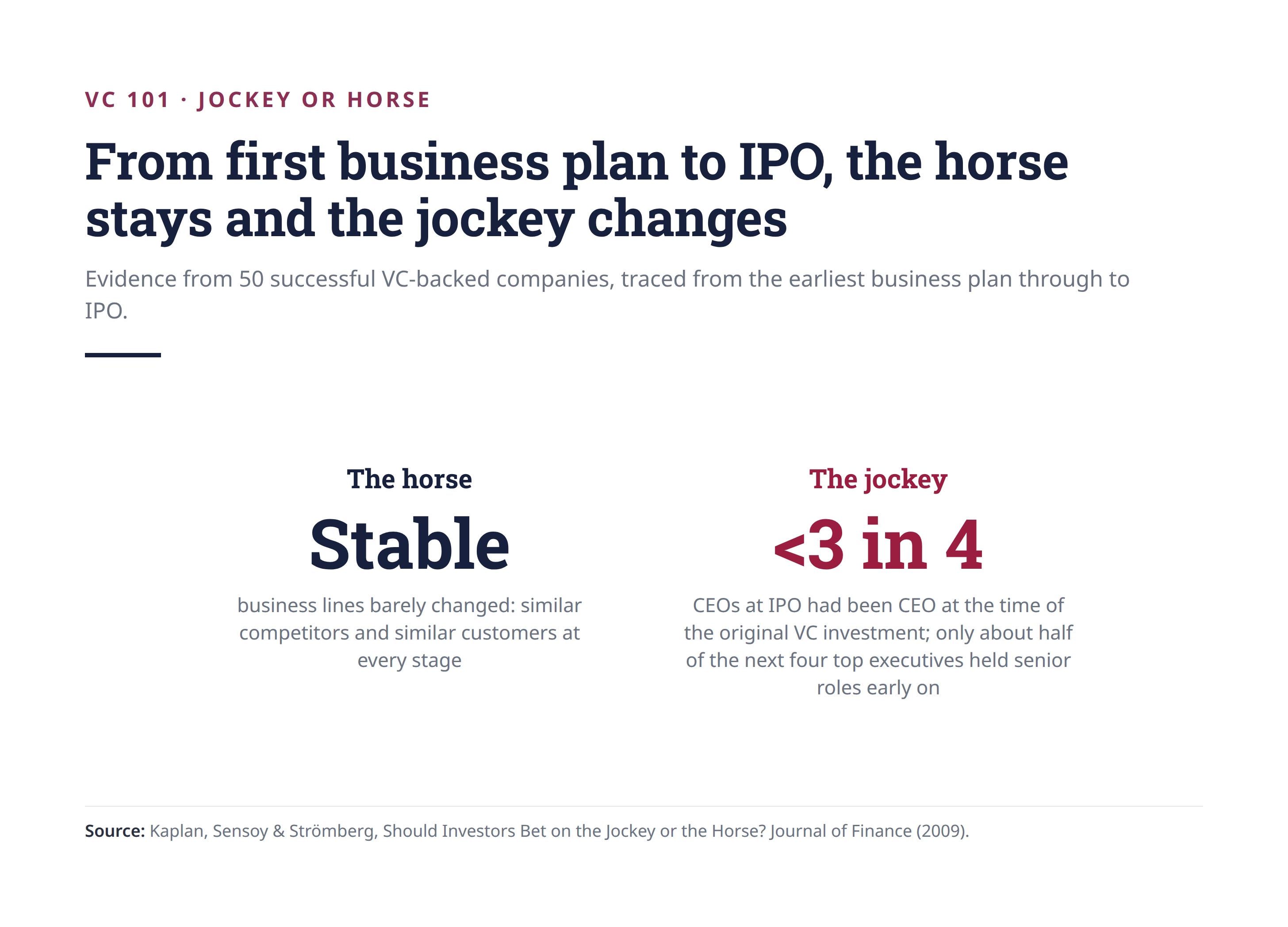
The implication cuts against what investors say about themselves: at the margin, investors in startups place more weight on the horse than on the management team, as judged by the evolution of the startups. Whatever they believe they’re doing, the businesses persist and the people get replaced.
This aligns with earlier work from the Stanford Project on Emerging Companies, a major 1990s initiative studying high-growth early-stage firms. Researchers there tracked the evolution of top management teams and found that the human capital characteristics of founding teams predicted neither venture capital financing nor going public.
These findings are not inconsistent with each other. When VCs invest, management team quality matters dramatically. But as many management teams don’t execute well, they get replaced over time. This is related to my next point. Founders and aspirational founders, pay attention!
There is one caveat to these studies that I need to discuss. The data comes from the growth stage, after the firm has been formed. In the study of 50 VC-backed companies, the median company was already 23 months old at the time of the business plan being analyzed. Nearly two years in. By then the business exists, the customers exist, and the question of who founded it has already receded.
The role of the team at the genuinely early stage is far more important, and there’s evidence for that too. Amar Bhide at Columbia University studied 100 companies from Inc. Magazine’s list of the 500 fastest-growing companies. He found that founders tended to replicate or modify an idea encountered in previous employment, and did relatively little formal planning before starting. As a result these companies were highly prone to adjusting their initial business concepts. Even though this study was done some time ago, the basic mechanism aligns with my experience.
If the business concept is fluid at formation, if the horse itself is still being chosen, then the founder is the only stable input and their quality is, so to say, less uncertain. At that stage the entrepreneur is by far the more critical resource.
So the two bodies of evidence may not conflict at all. They may simply be describing different moments. At formation, the jockey picks the horse. By month 23, the horse is running and the jockey can be substituted.
There is a way of reading all this data that I think is more useful than picking a side.
Recall from the previous post that 95% of investors say the team is an important factor. Now set that beside the 47% who rank it as most important. The gap between those two numbers, nearly half the market, is composed of investors who consider the team carefully and then decide something else matters more.
That gap is the actual structure of the market. Investors do not disagree about which factors exist; they disagree about the weights. And because they disagree about the weights, the same company genuinely is a different investment proposition to different investors, whatever the deck says. The difference sits in the evaluation function.
The healthcare exception makes this concrete. Healthcare VCs are the only group that doesn’t rank the team first, and the reason I believe is straightforward: by the time they invest, the product is more likely to be substantially developed, and a developed product makes the team more replaceable. Same investors, same instincts, different weights,driven entirely by what the asset looks like at the moment of investment.
Which suggests the honest version of the jockey-horse question isn’t “which matters more?” It’s “which matters more, at this stage, in this industry, for this deal?” That question has answers.
Several things follow which are important for founders and investors to keep in mind.
For founders, the practical fact is that investors you meet will differ substantially in the weights they place on these factors. The Doriot disciple and the Valentine disciple will run the same meeting and hear completely different things. Knowing which one you’re sitting across from is worth more than any amount of polish on your deck. Ask yourself a question too: at this stage, is my horse quality more uncertain, or my team quality? And how do the weights at this stage compare to similar companies from an investor’s perspective?
For investors, there’s a structural shift worth noticing. Founders increasingly seek funding at an earlier stage of company development, which makes the team a more critical factor than it was. I really believe this is behind the Doriot disciples winning in recent years. But this cuts both ways. The earlier you back founders, the more likely you are to encounter tension between the qualities of the management team and the eventual needs of the firm. Should we then expect higher managerial turnover? Likely. Or should we expect contractual terms to reflect the risk investors and founders are taking? Likely as well. As an investor, it is important to think about what kind of scenarios you can foresee and whether you can prepare for them now.
The team wins by plurality, not majority. Forty-seven percent of VCs call the team the most important factor, which means 53% don’t. They simply disagree with each other about the alternative, so no rival factor tops the chart. The consensus is thinner than the headline suggests.
What investors say and what happens to companies diverge. Across 50 successful VC-backed companies, business lines stayed remarkably stable while management turned over constantly: fewer than three-quarters of CEOs at IPO had held the job at first investment. At the margin, the evidence favors the horse.
The stage is doing most of the work in this argument. The studies favoring the horse examined companies that were already about two years old. Bhide’s work suggests that at genuine formation, when the business concept itself is still fluid, the founder is the only stable input. Both camps may be right about different moments.
Team is 95% considered but nowhere near 95% decisive. Nineteen of twenty investors weigh it. Under half let it decide. Founders should not assume that a strong team narrative is sufficient, and investors should not assume that citing the team is the same as having a thesis.
Know which camp your investor is in. The Doriot disciple and the Valentine disciple will sit through the identical pitch and evaluate you on different axes. That is knowable before the meeting, and it should shape what you lead with.
Next post: Inside the Investment Committee. How VCs actually make decisions. Investment memos, why most VCs skip DCF entirely, the Monday partner meeting, and the evidence that unanimity is quietly destroying returns.
No posts
Comments
Nothing yet. Say the first thing.
Sign in to join the conversation.