
Below, a new writing project, an excerpt from a writing fragment, and some proof of life in my sketchbook. What brings you here?
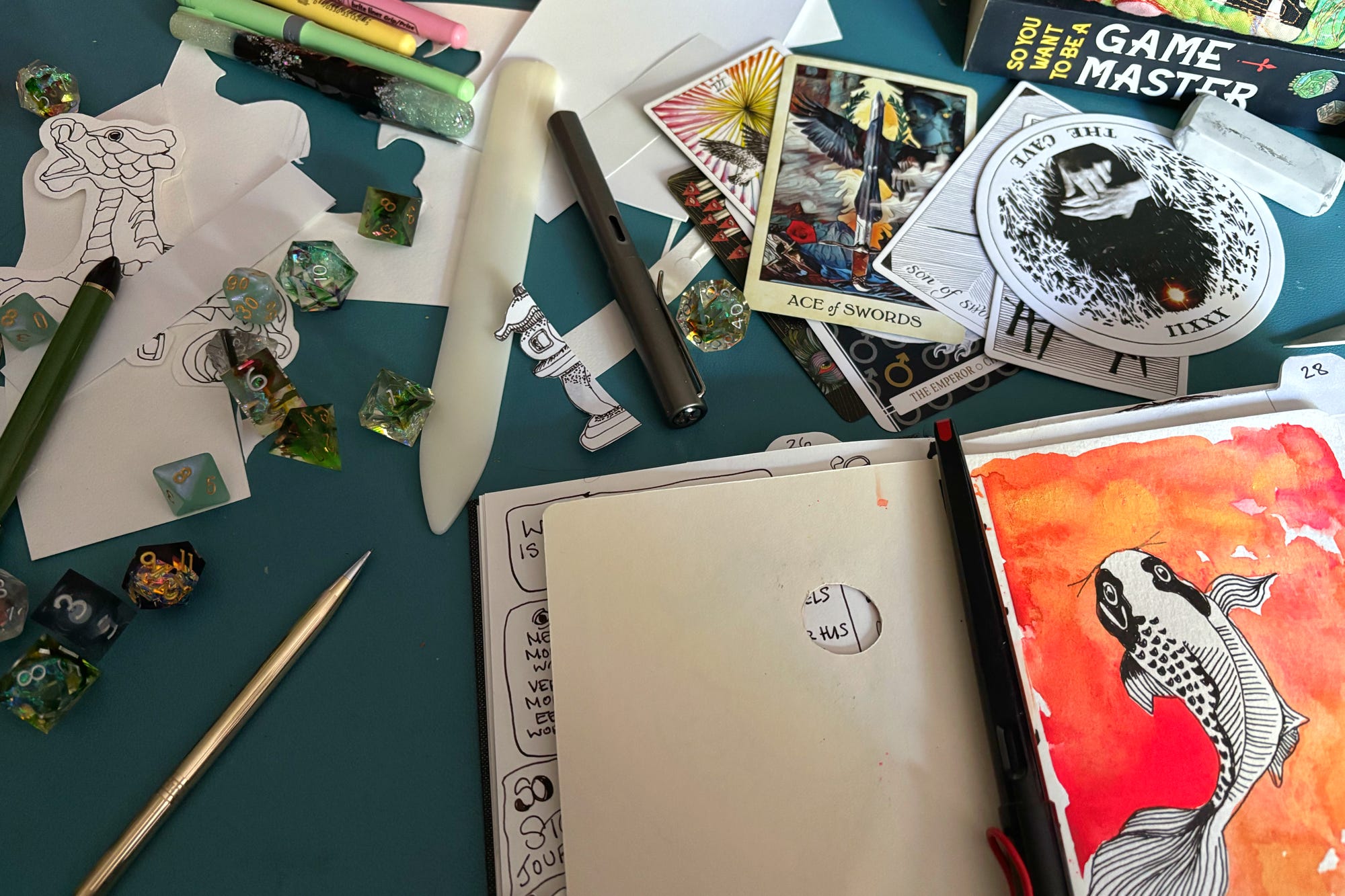
“Do I dare
Disturb the universe?
In a minute there is time
For decisions and revisions which a minute will reverse.
…
But as if a magic lantern threw the nerves in patterns on a screen:
Would it have been worth while
If one, settling a pillow or throwing off a shawl,
And turning toward the window, should say:
’That is not it at all,
That is not what I meant, at all.’”
”The Love Song of J. Alfred Prufrock” by T. S. Eliot
🎯 Thank you to those who support this space
with monthly or annual subscriptions, donations, or gifts of dice, paint, ink,
and scraps for making nests, filling snow globes, and keeping lanterns lit.
I hope you are inspired to make time each day for your creative habits, to value the documentation of your journey, and to explore your relationship with memory.
Thank you to those who read, comment, ❤️, and share.
I had no idea what Millcreek Village was when I saw a post that Millcreek Village had openings. Maybe it hit me at just the right moment. Maybe I was taking a break from work on a too-quiet day.
I studied the map and got caught up in the idea of moving, of taking up space somewhere where I could explore beyond expectations, where I could open myself to the uncanny, even somewhere deliberately small.
(I’ve removed a too-long, too-me, philosophical and meta discussion about my current exploration of hybrid work beyond my typical creative nonfiction, the catalyst, and the fear. You should probably be glad.)
This week, I saw that Millcreek Village was accepting new residents.
I was curious.
I felt a flicker.
I wondered if the imaginative work I’ve been doing might enjoy a house, a town to map, shared worldbuilding, and… neighbors.
I told my visiting son, who was working on a D&D campaign, about the idea. I showed him the map. I pointed out the house near the park, a tiny square on the map, more “in-town” than others, but in proximity to a lake. My outsider self was also intrigued by a residence on the very edge of the village, one marked only by a question mark. There was an art studio available, but somehow the little square called to me.
All day while I worked, I kept going back to the map. I poked around, and I could sense the magic and the whimsy. I kept wondering if this was a moment of synchronicity and, more importantly, could I do it?
I wondered at my wonder, but I was still thinking about it when I went to bed and when I woke the next day, even though I wasn’t sure who my character would be or what name she would have or what companion would go with me. It was immediately clear that saying yes was opening me up to many decisions that I needed to overthink in a hurry.
I decided to take a chance.
I put my name down for the small square… and moved in. I arrived, only to realize there was a welcome party. You can read that story here:
I’ll be trying to find my footing and my character, whose name is Az, each week as part of the community and as I “meet” the other residents. I’m looking forward to some exploration, hoping to maybe draw some people or their companions, and curious about the house itself.
Did I finally publish my arrival post, drop my URL in the required spot, and then cover my head? Metaphorically speaking, yep. I found myself far more worried about not fitting in than I had realized I might. This is already pushing me in new directions, but so far, I’m excited, and I’m loving the work of other writers who are creating in this space.
I hope you will follow along with Az.
Millcreek Village is a collaborative worldbuilding experiment hosted by Maryellen Brady.
(This content available only to those subscribed to Illustrated Life.)
The weekly Illustrate Your Week prompt series continues, and I have started to offer a bit more scaffolding in places. It is wonderful to see those of you using the prompts in your journals.
Thank you for reading.
I encourage you to join in the conversation in whatever way feels comfortable. I have such appreciation for those of you who take time to comment each week and let me know you’ve read.
Clicking the heart or restacking is also very much appreciated.
(Following the AI-scanning debate at Substack?1)
Paid options are available for those who find value and inspiration in the weekly posts here and want to support Illustrated Life and the #illustrateyourweek prompt series. Subscriptions not your thing? One-time tip jar donations or wish-list treats are always appreciated.
Unless otherwise noted, all images in this post are © A. Cowen. All rights reserved.
Links to books and products at Amazon.com are affiliate links. Always use your library when possible.
I do think I read about 812 notes or posts this week about the great AI-scanning debate happening at Substack. I’ve seen human-only writers outraged, unabashed AI-assisted writers arguing the difference between final form and thought, and a host of writers milling somewhere in between.
It’s been an uncomfortable week, and Substack’s most recent post (a follow-up to the original announcement) was truly disappointing and more heavily one-sided than they tried to pass it off as. (At least they quickly changed the flow so that writers can, if they choose, opt out without first having to do the scan. But what does opting out look like from a reader’s perspective? Guilt by omission? See how quickly the discourse and available mechanisms devolve and quickly normalize checking, labeling, and devaluing work based on the result of an AI scan?
I have no desire to enter the debate, and I don’t really want to waste space here talking about AI. But I don’t like what I’m watching, and I don’t like the “feeling” of it.
Unlike many in my community, I am not anti-AI.
But AI does not write for me.
(Reducing AI to “writer replacement” is simply that, a reductionist view. It is short-sighted.)
What I do want to highlight about the Substack-Pangram debacle is human behavior. I have been shocked at how quickly it became the norm to click the button to check, how instinctive it is, the desire to know if a writer’s text is 100% human. I have been shocked, too, at how many examples have been shared of the system getting it wrong, at the pervasive mistrust of how our writing is really being used when fed into the model, which suggests pervasive mistrust of the leadership behind our publication home, at the abundance of virtue signaling, and the ways in which witch hunt has felt like the exact metaphor.
(On the surface level, Hester Prynne and her scarlet A has been running around in my head, too, just as a visible “badge” of that which is not accepted, that which is suspect, or that which is rejected.)
This has nothing to do with how I think about and interact with AI. In some communities, AI is so polarizing that conversations tend to be closed-minded, full of assumptions, self-righteous, and sanctimonious. I find that sad. I often find that it says more about those unwilling to accept that there is more to it than about those who are using and engaging with technology in thoughtful ways. (In some cases, the same people making snap judgments and virtue signaling or expressing shock, outrage, and dismay that someone admits they have ever talked to a chatbot often expect openness in terms of politics, acceptance of difference, lifestyle choices, and an awareness that individual context and choice always matter.)
But the conversation this week is about writing. I don’t write with AI, but I think the AI-scanning button is dangerous, shortsighted, and misguided. Again, the stories of writing being labeled human, a typo being corrected, and an updated scan labeling the same writing (minus the typo) as heavily or all AI-assisted should worry everyone. Being sanctimonious about the issue and framing your 100%-human badge as a mark of virtue won’t make a difference if it happens to you.
I’ve also read multiple posts about the granularity of the language being used, non-transparent changes in the document that governs the use of our work here, and more.
I don’t know what the right answer is, but I encourage you to really think about the writers you enjoy. If a scan shows a percentage of AI-assistance, does that change the fact that you already enjoy their writing? Or is it that you might feel deceived? Or you might feel embarrassed that you didn’t realize? But you already enjoyed the writing. The label changes how you will relate to the writer, even though it’s been shown that the label can be wrong?
In many cases, you can tell when something is AI. In some cases, the crossover is less obvious. The whole conversation is a can of worms and one the writing community clearly seems unable to have.
I know I’ve been frustrated with posts that are obviously AI. I know I’ve been skeptical of bestseller accounts that read like AI. I also know that I read AI-focused publications that are about AI, but I don’t think any of these accounts are going to worry about not passing the scan.
If you are looking at the button as a “gotcha,” I encourage you to think about it. There are a number of valid reasons people may write with AI, and there are a vast number of ways to do that. The issue may not be as simple as it first appears.
Comments
Nothing yet. Say the first thing.
Sign in to join the conversation.