
I think it might be my favourite anatomical aspect that all of our important organs come in a bag. A case could be made (and has been, via various pop culture references that took me on a far-too-sidetracky internet hole so I won’t share them) that our entire bodies are, in fact, just a bag for our organs.
Your brain is no exception. Except, that it being your brain and therefore quite important and integrated in the running of your body, its bag has a few layers, each with their own specialised function. There’s also a bunch of fluid and stuff to stop your brain from bonking around loose inside your skull.
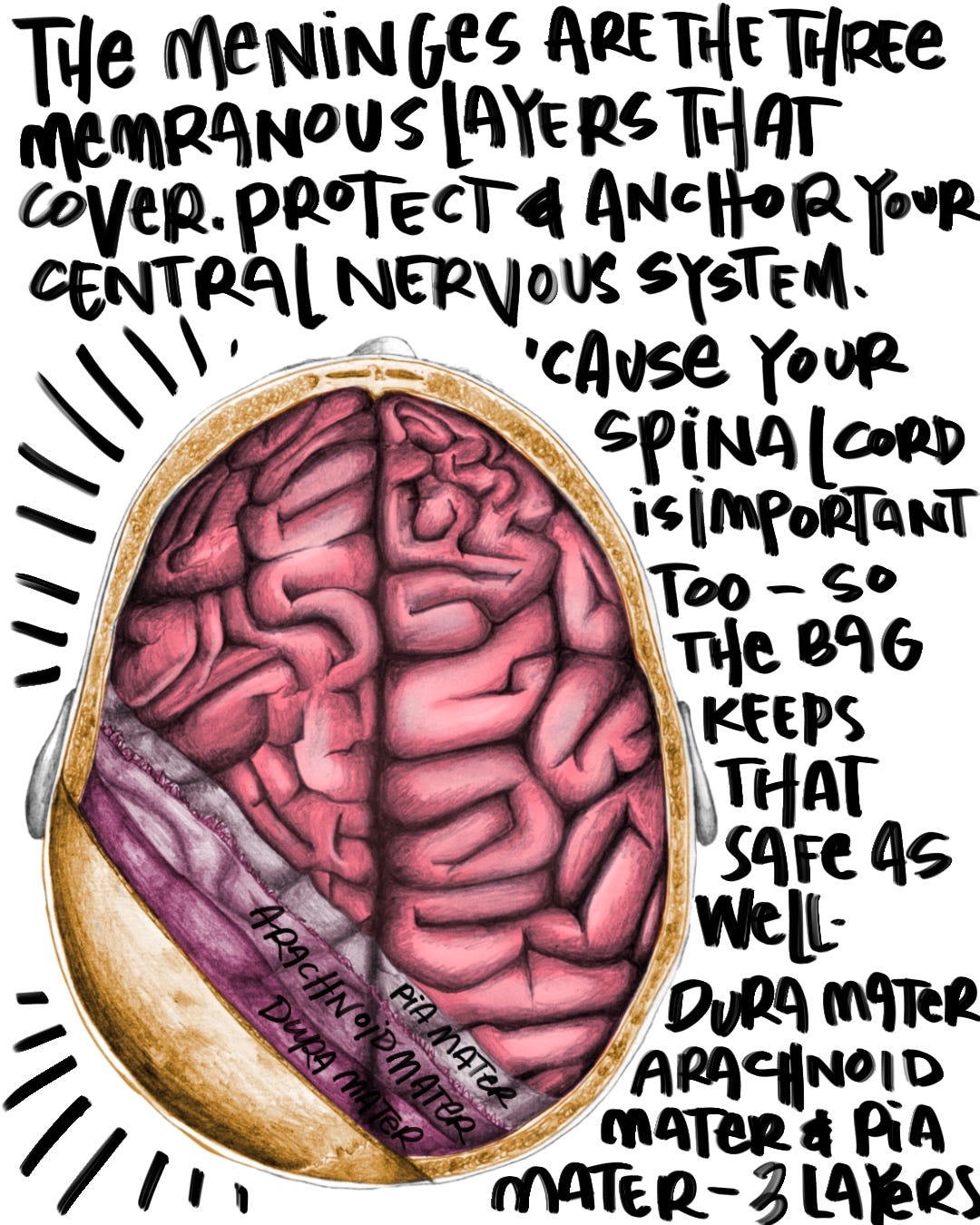
(sidebar: “itis” in medical terminology refers to inflammation. Meningitis? Inflammation of the meninges.)
The dura mater, also known as the pachymeninx, is the outermost layer. It’s actually two, one that connects with the skull (the periosteal layer) and one that connects with the internal meninges (the inner meringeal layer). It’s thick, tough and fibrous, and very tightly fused together, except where there are a few spaces to let blood vessels through. Dura mater means “hard mother” or “tough mother” in Latin.
The arachnoid mater (arachnoid - spider. We’re all up in the etymology today aren’t we?! I do love it) is named for its spiderweb-like structure. It’s thin, transparent, and encases the brain and spinal cord like a loose bag. But it’s not attached to either, as it’s surrounded by the subdural space and the subarachnoid space. The subarachnoid space is filled with spinal fluid, and the subdural space isn’t actually a space at all… unless something bad happens like trauma when it can fill with blood. The arachnoid mater has occasional protrusions that poke into the dura mater, acting as a one-way valve for cerebrospinal fluid to pass through.
The pia mater is the closest layer to the brain, and hugs all its contours so you can see all the brain ridges. (I’ve had dresses that do that but I imagine it’s much more favourable in a meninge.) It’s highly vascularised by a network of blood vessels.
And that’s your brain bag! This image is the beginning of a wee series of anatomical images that I’m planning to turn into a new collection of cards. What do you reckon, anatomical cards? What bit of the body would you like on a card?
And next week’s fact, I’m thinking limpets? But I reserve the right to completely change my mind.
No posts
Comments
Nothing yet. Say the first thing.
Sign in to join the conversation.