
When AI agents first emerged, executives believed documentation would become obsolete. The promise was seductive: AI would simply figure it out, adapting on the fly, making human-written guidelines unnecessary.
That fantasy lasted about six months. (or maybe even shorter?)
Now, organizations are discovering a counterintuitive truth: AI doesn’t eliminate the need for structured processes and clear guidelines, but exponentially increases that need. Without proper AI workflow management, teams are drowning in what researchers call “AI slop”: low-quality outputs costing companies roughly $900,000 per year per 1,000 employees in lost productivity. According to recent research on AI governance, organizations without coordinated AI frameworks spend disproportionate time reconciling conflicting outputs rather than making decisions.
Without shared workflows and clear guidelines, everyone’s generating their own versions of everything. Proposals. Analysis. Recommendations. All polished on the surface, hollow at the core.
Merriam-Webster just named “slop” their 2025 Word of the Year. It refers to high-volume, low-quality AI content produced with minimal oversight. In enterprises, it costs companies roughly $900,000 per year per 1,000 employees in time spent fixing, verifying, and redoing subpar AI outputs.
The problem isn’t the AI itself. It’s the absence of shared operating context.
When you give AI a well-structured brief versus a vague prompt, the difference in output quality is immediately apparent. Organizations with structured AI processes see productivity gains 4.8 times higher than those winging it.
Pre-AI, investing two weeks in documentation might reduce a six-month project to four months. But the feedback loop was too long to prove the value.
AI changed everything. Now you see the impact of good documentation within hours, not quarters. The investment in proper inputs shows measurable ROI in weeks rather than years.
The teams winning with AI aren’t generating more content. They’re preparing better inputs.
They master what we call the “pre-generation stage.” Before asking AI to create anything, they invest time in:
Structuring the context: What background does AI need?
Defining the constraints: What are the boundaries?
Clarifying success criteria: What defines quality output?
This seems like overhead until you realize: documented processes become organizational assets that compound value over time. The same AI models everyone has access to produce dramatically different results depending on the quality of inputs they receive.
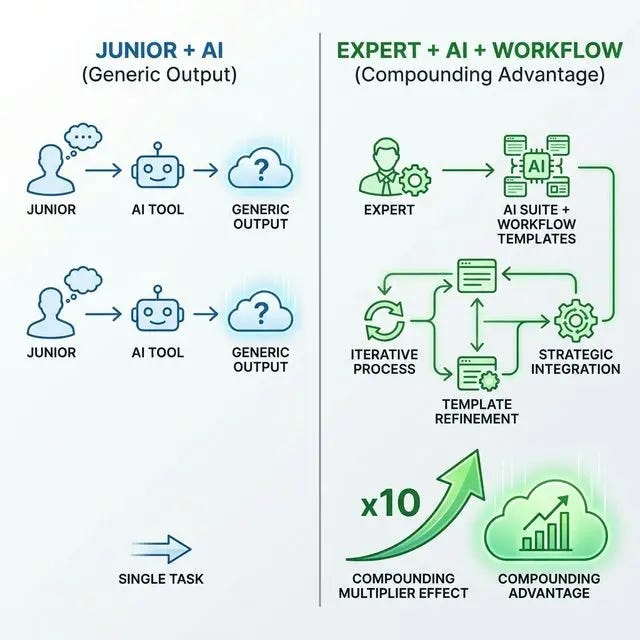
The prevailing narrative suggested AI would level the playing field between newcomers and seasoned professionals.
The reality is proving exactly opposite.
Senior professionals with deep domain knowledge are becoming more valuable because they can design effective processes, provide rich context, and structure workflows that produce consistently excellent outputs.
A junior person using AI without guidance generates generic outputs. An expert using AI with structured processes compounds their existing advantage.
The new competitive moat isn’t what you know. It’s your ability to articulate what you know in ways that translate into reproducible, AI-enhanced workflows.
1. Flip your performance metrics Reward the quality of shared processes and documentation, not just individual output volume. The person who creates a workflow that makes the entire team more effective is more valuable than the person who individually produces twice as much work.
2. Make workflow documentation non-negotiable Every significant project should produce two deliverables: the actual output and the documented process for creating it.
3. Build a culture that values process sharing Stop incentivizing people to hoard their productivity secrets. When high performers share their workflows, their value increases as they become architects of organizational capability.
Every day you delay building proper AI workflow infrastructure is a day your coordination problems compound.
The organizations that treated AI as a replacement for process discipline are drowning in coordination chaos and mounting AI slop.
The ones that recognized AI as an amplifier of existing processes are pulling ahead.
The paradox resolves itself once you accept it: AI doesn’t make documentation less important. It makes documentation exponentially more valuable.
The faster AI gets, the more important the slow work of building proper foundations becomes.
At illumi, we’re building the collaborative workspace designed for this reality. Not another individual AI chat interface, but a platform where teams can structure context, document workflows, and coordinate AI-enhanced work together.
Want the full deep-dive? Read the complete guide here.
No posts
Comments
Nothing yet. Say the first thing.
Sign in to join the conversation.