
Last Friday, the Belgian Royal Academy of Dutch language and letters, KANTL, organised a day of lectures and discussion about the work of the author Daniël Robberechts in Ghent. Robberechts was part of a loose cluster of authors sometimes called the ‘neo-avant-garde’. In many ways they continued the project of the historical avant-garde, to create an art that strips away ideological distortion instead of reproducing it. The avant-garde project, though far from naturalistic in appearance, is ultimately about realism. But it is a realism that eschews mimesis.
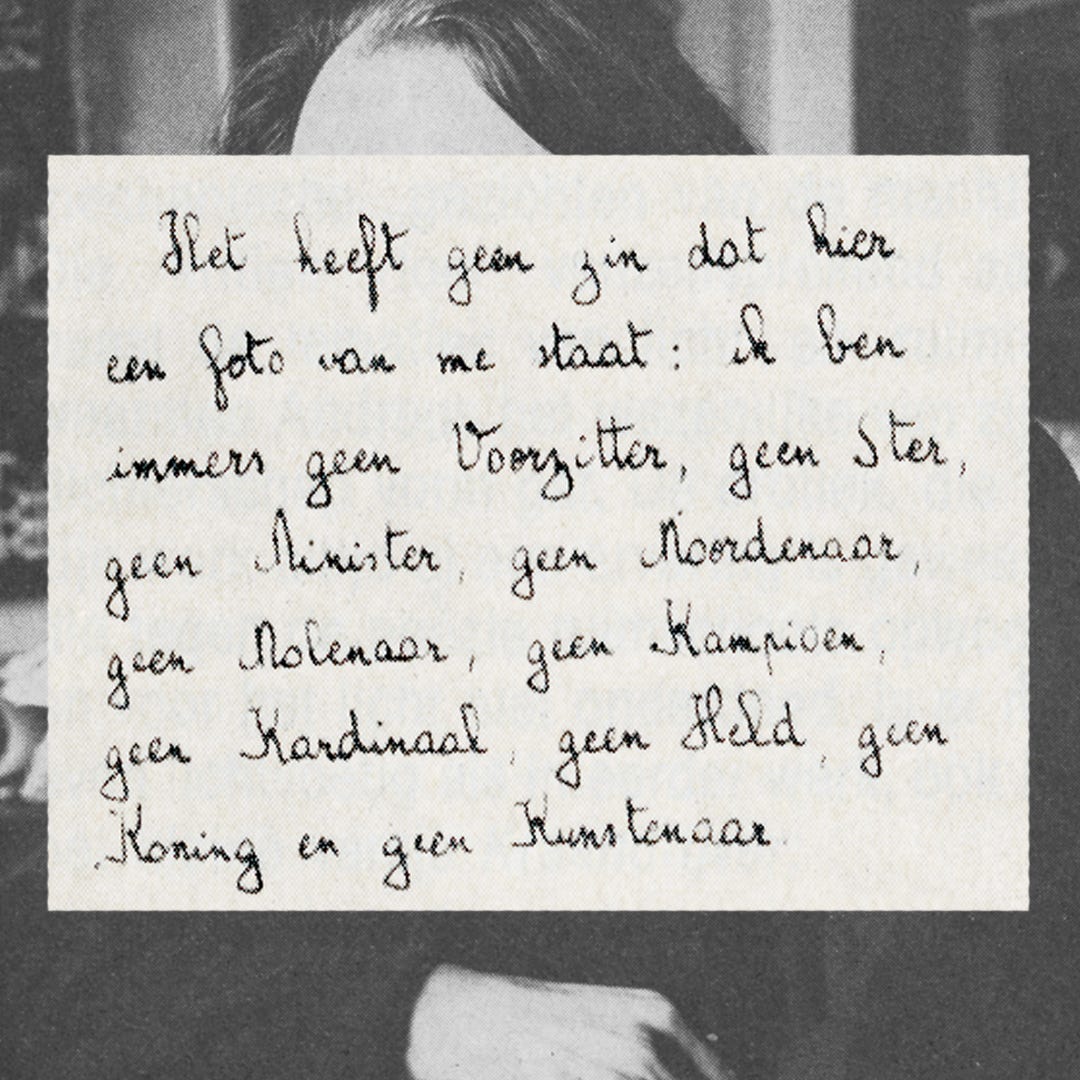
I came across Daniël Robberechts through my personal research into the possibilities of democratic prose. I felt constrained by the obvious paths in literary prose; dissatisfied with formulaic novels about another despairing middle class subject (my own first novel was no exception), I longed for a different prose. I was drawn to the ideas of Marxist authors who wanted to reconcile their commitment to class struggle with their literary work, such as Jacq F. Vogelaar and Lidy van Marissing. In the 1960s and 1970s they had outspoken ideas about how literature should be done differently. Their connection to the historical avant-garde of the low lands was made explicit by the Sybren Polet, who made Theo van Doesburg (of De Stijl fame) and Lidy van Marissing the bookends of Ander Proza (different prose), his anthology of experimental writing.
Operating in the 60’s and 70’s, radical writers were faced with the ubiquitous engine of ideological distortion that is consumer capitalism. The work of authors like Lidy van Marissing, Jacq F. Vogelaar and Robberechts can be read specifically as a response to the co-optation of literary techniques by marketing, rather than an internal critique of literature. Yes, literature has all kinds of tricks to pull the wool over your eyes, but what is more relevant in then sixties is how those tricks are used to turn the public into consumers. Their literary origin notwithstanding, the methods of advertising were suited to sell just about anything, but least of all books. This was the onset of a crisis of legitimacy in literature, which has only deepened in the sixty years since then.
The exploded individual
Robberechts responds to this crisis, albeit in a different way from his contemporaries. Where Van Marissing tackles the commercialisation of communication with a kind of media critique, and points to the collective reality behind marketed individual consumption, Robberechts explodes the individual perspective. Diaries, ‘self description’ through various unconventional lenses (reminiscent of Bernadette Mayer’s list of journal ideas), incredibly detailed accounts of his youth, down to train schedules. ’Realistically, we can only tell one story: our own,’ he writes in his Diary ‘68-’69. There are few poetic statements that are further from my own poetics. But by ‘telling his own story’, as Robberechts does in his almost exclusively autobiographical prose, he claims a realism that is far removed from the traditional ‘realistic novel’, but also from most memoirs and literary diaries: not an account of the heroic, brilliant individual, but a description of life with an eye for the aspects of individual reality that are cut out in the stylisation of the realistic novel: daily activities and thoughts, transport, waiting, pornography, the weather. He is concerned with literature with ‘the heartbeat of life.’ A more radical realism.
My favourite among his books is translated into English: Writing Prague (Praag Schrijven). It starts as an attempt of the author to write about himself through a place he’s never visited and has next to nothing to do with: the city of Prague in the Czechoslovak Socialist Republic. When he landed upon this subject in the winter of 1967, Prague was mainly the birthplace of Franz Kafka, and a place his father had visited as a youth with his gymnastics team. The author describes how he spends the day in his isolated, snowy rural town, looking for descriptions of the place in his father’s letters and piecing together his trajectory through the city with the help of a map and an old postcard. But come spring ’68, the whole world was looking at Prague. Writing Prague is a wonderful day-by-day account of world history from the internal perspective of the Western European left. Far from being one guy’s thoughts about the news, the diary contains long excerpts from news reports, interviews, essays by intellectuals who fled the Russian invasion. It’s life lived with history. It was one of the few books (that weren’t about Palestine) that felt relevant to read during the Palestinian genocide.
Hostile to literature
The dream of many writers is to effectively intervene in reality by changing the consciousness of readers. This is also where the aforementioned literature crisis spoils the party: if there are no readers, the entire democratisation plan falls through. In his Diary ‘68-69, Robberechts expresses his concerns about the ‘artificiality of literary culture’, in which the writer must appear in a way that denies the essence of reading and writing: as a physical person, as a role model instead of the intimate voice that speaks from the page, cleansed of ‘accent, pity or disgust for a physical disability, suspicion or sympathy’ and all other phenomena that ‘can harm a good understanding.’ As a left-wing intellectual, Robberechts is critical of the commercialisation of literature, in which a need for literature is artificially created by means that he sees as hostile to literature, such as having writers appear at events, on television, in magazine interviews, etc. The fact that in our time this is happening less than ever, and that we as writers have to fight for a place in the increasingly thin culture sections in newspapers, shows the failure of the commercial strategy for the book trade. Ultimately, as Robberechts also writes, the entertainment industry offers much more direct ways of satisfying desires, including the desire for stories. Even the most polished literary establishment cannot compete with that.
I wonder what I would have thought of Robberechts’s work if I hadn’t lived in a time when the autobiographical was so embraced by the market that the ‘personal story’ is a sales strategy writers can hardly escape. The expectation is that the author will bare all, and that her life coincides with the worlds she sketches, based on a kind of misplaced epistemological-political assumption that your imaginings of a reality you do not live yourself are, at best, limited and, at worst, immoral. Perhaps these circumstances have shaped my aversion to anything that smacks of confessional literature. In a sense, this also applies to Robberechts’s prose. Though I loved Praag Schrijven, most of Robberechts’s other autobiographical writing made me feel the way that autobiographical writing always makes me feel: personally concerned for the narrator rather than interested in what they have to tell me. What ultimately dissatisfies me in Robberechts’s conception of realism is the underlying assumption that writing must be a representation of human life. That reality is synonymous with people’s lives. That limitation bores me.
At the same time, his refusal to play along with the game of ‘literary culture’ appeals to me. But I think that the space for writers to refuse in this way and still remain writers has only shrunk as the ego-aspect has become a more important part of the literary works themselves. Anti-commercial literature would give writers the freedom to make as much or as little of their lives public as they deem necessary. The question is whether there is an audience for such literature, and whether that matters. I now believe that the democratisation of literature cannot be achieved by literary means alone.
No posts
Comments
Nothing yet. Say the first thing.
Sign in to join the conversation.