
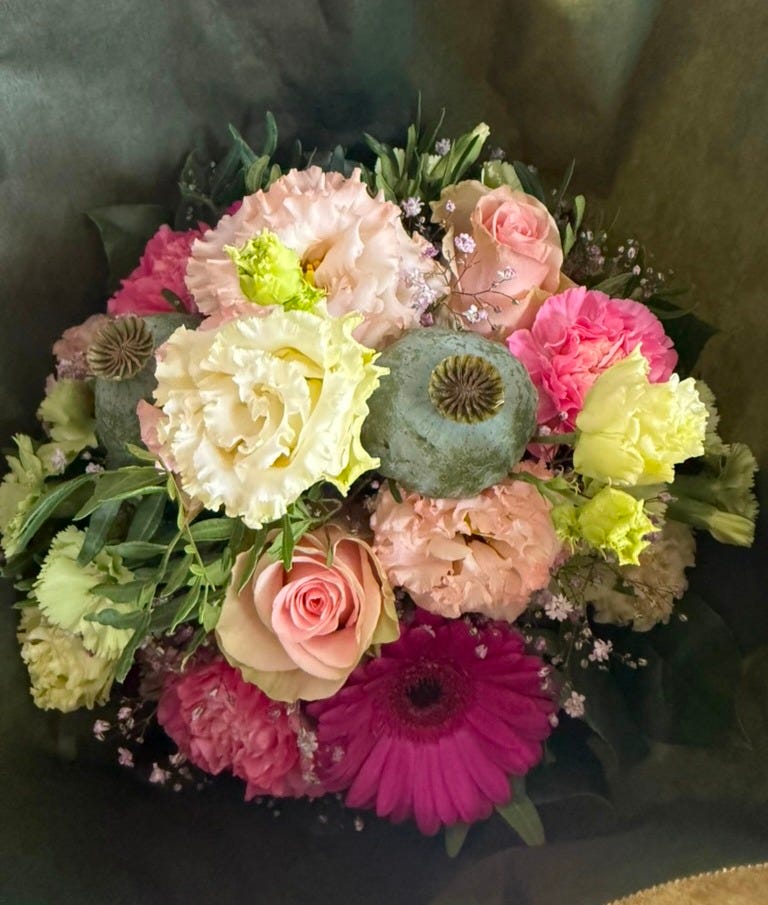
The bouquet arrived a week before my last day.
We have all worked remotely for years, so when my team wanted to mark my leaving, they did the only thing the setup allows: flowers to my door, and a card. The strange part was the timing. My last day was still a week off — I was still in the morning calls, still handing things over, still, on paper, the person doing the job. And there on the table sat a farewell bouquet, already dropping its first petals, counting down faster than I was.
I stood in my hallway holding it and did the thing I had not done once in the entire long year of leaving.
I cried.
Not the polite tear or two of the week before. The real kind.
Then,because we are remote, because a bouquet no one sees might as well not exist, I photographed the flowers, posted the picture in the Teams chat, and typed out a thank-you. And somewhere in that thank-you, for the first time, I told them the truth. That it hurt. That I wished I had come to this team earlier. That I would have stayed, if staying had been mine to choose.
I could feel the surprise coming back through the screen.
There is a particular strangeness to being sent off while you are still in the room. Anyone who has had the card passed around, the drinks, the warm little speech — and then had to sit back down and keep working — knows the exact temperature of it.
The mask they didn’t know I was wearing
Because by every visible measure, I had been fine. Accurate to the last. Praised for the handover — and it was a beautiful handover; I do good handovers the way some people do latte art. I worked into the final week as though there were a whole year still coming. Nobody on those calls knew there was a person under the competence who had been quietly coming apart for months.
That is the strange arithmetic of the professional mask: the better you wear it, the more alone you are behind it. Everyone believes the composed version, so everyone talks to the composed version, and the actual you — tired, grieving, unsure — sits in a room nobody thinks to look into.
You know the version. The one who types “all good!” into the team chat and means none of it. Who stays late to leave cleanly, who ends up reassuring other people about your own departure.
Someone would ask — a colleague, a friend, my own manager — “Excited?” And I would hear myself say it: “Yeah. Honestly, cannot wait.” Bright, frictionless, in the voice I keep for exactly these moments. Fine. All good. The two most useful words in professional life.
Holding a face that does not match what is under it is quietly exhausting in a way no one ever bills you for — unpaid overtime in a currency no payroll tracks. I had been clocking it for a year.
Why it’s the kindness that breaks you
What surprised me was the timing of the collapse.
I had braced for the hard parts. The dissolved team, the year of not landing anywhere, the last login. I was ready to be strong for all of it. What I had not armoured myself against was a bunch of flowers and a card that said thank you.
It is not the hardship that breaks your composure at the end. It is the kindness.
Cruelty you can stand against — it gives you something to push back on. But someone being gentle with you, right at the moment you are losing the thing, walks straight past the guard and sits down in the middle of everything you have been holding. The mask is built for adversity. It has no setting for tenderness.
The two countdowns
Meanwhile, everyone I love is counting.
“Only two weeks.” “One week — you’ve nearly made it.” My partner has a countdown running like it’s a holiday. My friends text me the shrinking number as good news, because to them it plainly is.
And I keep wanting to ask: made what?
They are already living in the after. They can see me free, light, out. I am still in the before — in the actual leaving — and from in here it does not feel like a finish line. It feels like standing in a doorway I keep expecting to feel triumphant in, and mostly just feeling the draught.
There is a reason the two of us are out of step, and it is oddly comforting. Anthropologists describe every big life change as a rite of passage with three stages: separation, the threshold, and arrival. The people around you have already filed you under arrival — new life, congratulations. You are still on the threshold. The old word for threshold is limen, which is where we get liminal — and, not by accident, why I keep calling this place the Hallway.
So if the celebration around you feels lonely, that is not ingratitude. It is a mismatch in timing. You are allowed to still be leaving while everyone else has decided you have arrived.
The thing I’m actually taking with me
I will not pretend the last week is elegant. I sleep like a champion and wake with the energy of a houseplant. I cried on a call with a colleague who — kindly, reasonably — wanted one more handover, and I had simply nothing left to hand over. Very professional. Full marks for composure.
But underneath the tiredness I have noticed the one thing I’d want you to keep.
For years my days had a shape I did not have to build. Meetings, calls, the morning message, the structure a company hands you for free. We barely notice it, because it is invisible — but that scaffolding does more than organise the hours. Psychologists call these external cues Zeitgeber, “time-givers.” They do not only tell you when. Quietly, they also tell you who: you are the person with the 9 a.m., the deadline, the team that needs the file.
Take the scaffolding away and it is not only your calendar that empties. Part of the answer to who am I goes with it.
Which is why the hardest thing this week is not the goodbye. It is knowing that next week nobody hands me the shape of my day — I build it myself, one small anchor at a time. And that, I am choosing to believe, is also the good news. For the first time in a very long time, the scaffolding gets to be mine.
I kept the mask on for a year, and it held. It took a bouquet to make me finally set it down. And setting it down did not make me weaker. It made me, for the first time in months, honest.
If you are in your own last week — still performing fine while everyone counts down to your freedom — you do not have to hold the face until the door clicks shut. You are allowed to tell one person the truth before you go.
The flowers are still on my table, dropping petals one by one. I am keeping them until they are done. For once, it feels right to let something be openly, visibly over.
Ilka 🫶🏻
P.S. This week is the end of a long, quiet year of not being able to move. If you're somewhere inside that year — knowing the work is over but frozen at the door, unable to tell whether it's fear or grief holding you there — that's who I built Leaving Well for. It's the 21-page workbook I wish someone had handed me back when I still couldn't move. → [link]
Comments
Nothing yet. Say the first thing.
Sign in to join the conversation.