
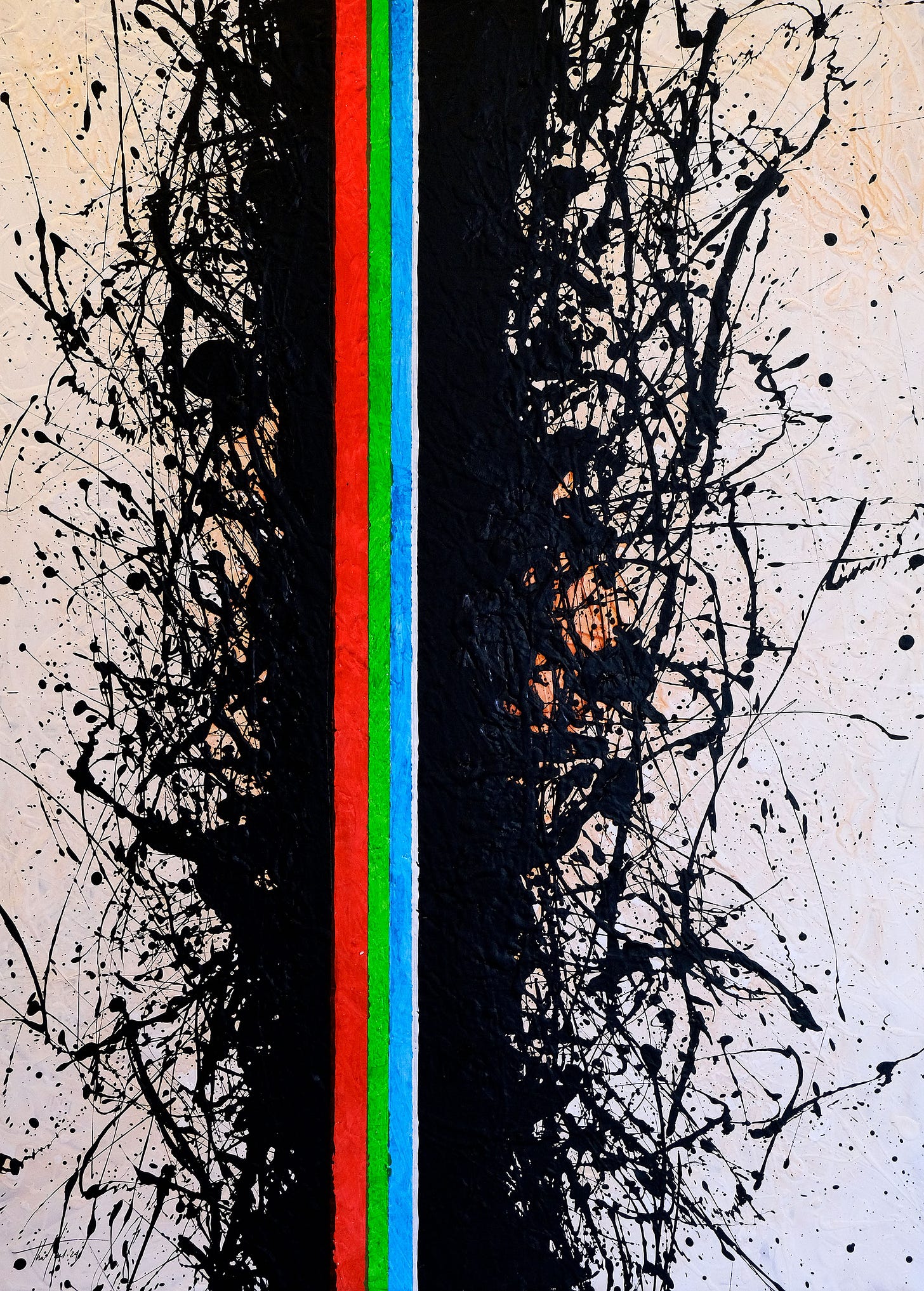
I did not come to art through conviction. I came to it through failure — not failure in the conventional sense of inability or collapsed ambition, but failure in the structural sense: the moment when the systems you have been trained to rely on continue to function, continue to execute, continue to produce outcomes — yet cease entirely to explain what you are experiencing.
My formation was not in art. It was in architecture, design, and strategic thinking — fields that demand precision, that operate within constraints, and that measure success through execution and legibility of outcome. These disciplines are not incidental to my trajectory. They shaped how I think, how I observe, and how I approach problems. They trained me to organize complexity into systems that can be built, evaluated, and refined. They are, in the best sense, disciplines of clarity.
And yet, over time, I began to encounter a limit that no amount of refinement or expertise could resolve. The systems I was working within could describe form, function, and performance with considerable sophistication, but they could not account for experience in any meaningful sense beyond utility. They could tell you how something works, but not what it means to encounter it. They could produce environments of extraordinary precision, but they could not explain the internal state of inhabiting them — what it feels like to be inside a space, what that space does to the mind, why certain thresholds produce a shift in awareness that cannot be written into a specification.
This gap did not present itself as a dramatic rupture. It appeared gradually, as a persistent misalignment between what could be articulated and what was actually being experienced. The tools I had were effective. But they were not sufficient.
At the same time, it became clear that this limitation was not confined to my field. It extended outward. The broader systems that structure contemporary life — political, economic, technological — exhibited the same pattern. They continued to operate, often with increasing efficiency and speed, but they no longer provided orientation. They generated activity without coherence, information without meaning, movement without direction.
We live in a condition where the production of knowledge has dramatically outpaced the capacity to integrate it.
This is not an abstract problem. It is lived as a form of dislocation — a persistent, low-frequency anxiety that most people carry without being able to name. The language through which meaning is traditionally articulated — truth, identity, purpose, belonging — has been stretched across so many competing frameworks, so many contending narratives, that it no longer stabilizes understanding. These terms are used constantly, but without a shared structure beneath them, they become unstable signals. When language becomes unstable, thought loses its precision. When thought loses its precision, action becomes reactive rather than intentional. We respond to surfaces rather than engaging with depths.
The result is a form of restlessness that is not always visible but is deeply embedded in contemporary life. It is the sense that something is unresolved without being able to identify what that something is. It is the feeling of being perpetually informed but somehow less oriented. It is the exhaustion of consuming meaning rather than constructing it.
It was within this condition — within this specific failure of the systems I had been trained to trust — that art became not a choice but a necessity. Not as an alternative to the disciplines I knew, but as an extension into a domain those disciplines could not reach. My work at Iliad Terra Studio — across the series I call Mind, Veil, Ether, and Matter — grew out of this necessity. It did not begin with a concept. It began with a recognition that something remained unaddressed by every other mode of working I had.
The dominant narrative around art positions it as expression — as if its primary function were to communicate an already formed idea, to transmit a resolved interior state outward into the world. This assumption is not only incomplete. It is misleading in ways that fundamentally distort what art can do and what it is for.
If art is expression, then the artist is someone who conveys meaning that already exists. The work is a container for prior understanding. The viewer receives what the artist has already determined. The relationship is essentially didactic, even when the content is emotional or abstract.
My experience has been the opposite of this, and I suspect that the experience of anyone who has worked seriously in any medium confirms the opposite.
Art begins where clarity is absent. It is not the communication of a resolved idea; it is the process through which something unresolved becomes perceptible. The work is not the endpoint of thought. It is part of its formation. It is not what you say after you understand something. It is how you come to understand it at all.
This distinction is critical because it changes the role of the artist, the nature of the work, and the function of the viewer’s encounter with it. It shifts art from a domain of transmission to a domain of inquiry. It positions the studio not as a factory for meaning, but as a laboratory for its investigation.
Carl Jung’s exploration of the unconscious — particularly his concept of the collective unconscious — provides one of the most useful frameworks for understanding why this shift matters. Jung’s insight was that a significant portion of human experience exists outside the domain of conscious articulation. These domains are not chaotic. They are structured, but their structure is symbolic rather than logical. They operate through image, through pattern, through resonance — not through propositional statement.
Symbolic structures do not follow the same rules as rational ones. They cannot be fully reduced to language without losing something essential to them. They cannot be summarized without being transformed into something else — something less. They must be encountered in their own register, engaged with on their own terms.
Art operates within this symbolic domain. It provides a medium through which elements of experience that resist direct articulation can take form — not as fixed representations, not as illustrations of ideas, but as configurations that can be engaged with over time, that yield different aspects of themselves at different moments, and that change their meaning in relation to who encounters them and when.
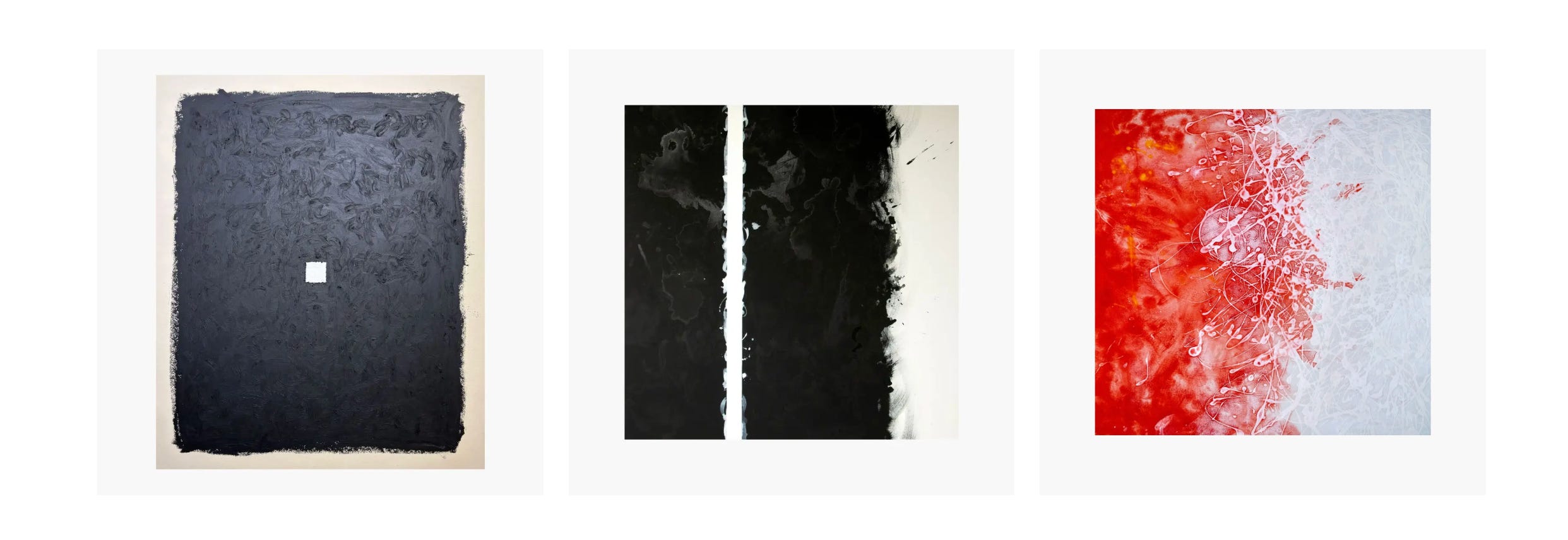
This is the domain my practice inhabits. The Veil Series — which I describe as an interior odyssey into the nature of consciousness — operates precisely here. These works are not depictions of consciousness. They are visual fields in which consciousness can encounter aspects of itself that do not surface in ordinary looking.
The Ether Series moves further into this territory, crossing into what I describe as quantum fields and spiritual dimensions — not as metaphors borrowed from science, but as genuine attempts to render visible the forces and currents that move through experience without usually being seen.
This kind of work requires a different discipline than the one I was trained in. It is not the discipline of control or resolution. It is the discipline of attention — the ability to remain with something that is not yet clear, to resist the impulse to impose premature structure, to allow meaning to emerge through engagement rather than forcing it into legibility before it is ready. It is highly active work, but its activity is not oriented toward immediate results. And in a culture that equates productivity with speed, this slowness can feel like risk.
One of the structural limitations that became increasingly apparent to me — in my architectural practice, in my engagement with strategic and institutional contexts, and eventually in my own interior life — is the division between rationality and emotion. This division is embedded in educational systems, professional practices, and cultural expectations with a thoroughness that makes it almost invisible. Rationality is positioned as authoritative, reliable, and sufficient. Emotion is treated as secondary, as noise in the signal, as something to be acknowledged briefly before moving on to the real work.
This distinction does not withstand examination.
Emotion is not the opposite of rationality.
It is part of the conditions under which rationality operates. Perception is profoundly influenced by affective states — what we are feeling shapes what we are able to see. Memory is encoded through emotional intensity — the moments that are retained with the greatest clarity are almost always those with the greatest emotional charge. Decision-making, even in its most formalized and proceduralized forms, relies on value systems that are not themselves derived from logic. They precede logic. They determine what logic is applied to.
Jung’s work complicates this further by demonstrating that the psyche is not a unified entity moving in a single direction. It is composed of interacting layers, some conscious and some not, that cannot be reduced to a single mode of operation without distorting the whole. The attempt to isolate rationality from this broader field does not produce clarity. It produces fragmentation — a condition in which the rational mind operates in increasing isolation from the larger organism of which it is a part, making increasingly precise decisions on the basis of increasingly incomplete information.
The art I have found most compelling — in my own work and in the work of others — does not participate in this fragmentation. It operates across the rational and emotional simultaneously. A work can provoke an immediate response that precedes any analysis, while also sustaining extended analytical engagement that deepens rather than replaces that initial encounter. Its power lies precisely in its ability to engage multiple registers of perception at once, to address the whole person rather than a selected portion of them.
This has direct implications for how I construct work. I am not interested in producing objects that can be resolved through a single interpretive framework — that yield fully to one mode of reading and then become inert. I am interested in creating conditions where perception must remain active over time, where understanding develops through engagement rather than immediate recognition, where the work gives something different at each return.
If the internal structure of perception is complex and layered, the external world in which that perception operates is no less so. The assumption that reality is stable and directly accessible — that what we perceive corresponds in a reliable way to what is there — has become increasingly difficult to maintain. This is not a new philosophical problem. But it has taken on a new urgency and a new texture in the present moment.
The work of Philip K. Dick is particularly relevant here, and not merely as science fiction. Dick’s writing consistently interrogates the nature of reality — not as an abstract philosophical puzzle, but as a lived condition, experienced from the inside, by characters who must continue to make decisions and form relationships within environments where perception cannot be trusted, where memory is unreliable, and where identity is provisional. His questions were written in the register of speculative fiction, but the conditions they describe have become the conditions of ordinary life.
We inhabit environments shaped by layers of mediation that operate largely beyond our awareness. Algorithmic filtering determines what information we encounter — not based on truth or importance, but based on engagement and retention. Images are manipulated not only by bad actors but by the ordinary operations of platform design and incentive structure. Narratives are constructed and distributed at scale, often without accountability to their accuracy or their effects on the people who receive them. Under these conditions, perception is not neutral. It is continuously shaped by systems that have their own interests, their own logics, and their own momentum.
This does not eliminate reality. It complicates access to it. It introduces a gap — sometimes barely perceptible, sometimes enormous — between what is presented and what is the case.
And it requires a different kind of attention than the one we are habituated to: not the passive reception of information, but an active, ongoing interrogation of how that information has been shaped, filtered, and arranged before it reached us.
Art does not resolve this complication. But it can engage with it in ways that other domains cannot. It can expose the mechanisms through which perception is shaped — the framing, the selection, the arrangement of elements that determines what is seen and what remains invisible. It can create an encounter with uncertainty that is not immediately resolved into false clarity. It can make visible the constructed nature of what appears natural.
This is not a political act in the narrow sense, though it has political implications. It is a perceptual act. It is about expanding the range of what can be seen, and therefore the range of what can be thought, and therefore the range of what can be done.
In my own work, the encounter with mediation is not only a subject but a formal principle. The layering of materials — paint over text over surface, image over image, the visible over the obscured — enacts at the level of the work’s construction the same condition it is exploring conceptually. Nothing in my paintings presents itself as simply present. Everything is present in relation to something else, inflected by what lies beneath it, altered by what surrounds it. The viewer is required to negotiate this layering actively, to make choices about what to attend to, and in doing so, to become aware of the fact that they are making those choices — that perception is not passive reception but active construction.
As I moved deeper into these questions — through my architectural practice, through the encounter with my father’s death and its aftermath, through the sustained process of making work that could not be evaluated by the criteria I was trained to apply — it became clear that modern frameworks alone were insufficient. They could describe processes and model systems, but they could not provide orientation. They could tell you what is happening but not what it means or what to do with it.
This led me, not by plan but by necessity, to myth — not as narrative content, not as a collection of stories from before modernity, but as structural insight into how human beings navigate transformation, encounter the unknown, and reconstruct meaning after the dissolution of prior frameworks.
Joseph Campbell’s analysis of the Hero’s Journey reveals patterns that persist across cultures and across centuries because they are not cultural artifacts. They are maps of a process that is embedded in experience itself. The movement from the known into the unknown, the encounter with disorientation and challenge, the crossing of thresholds that cannot be crossed without cost, and the transformation that follows — these are not confined to stories. They are the structure of any genuine development, any encounter with what lies beyond the current limits of understanding.
What is often overlooked in the popularization of Campbell’s framework is the role of failure within it. The Hero’s Journey is not a success narrative. It is a transformation narrative, and transformation is not possible without the dissolution of what precedes it.
The figure of Parsifal — the Grail Knight from the medieval Arthurian cycle — is instructive in this regard, and has been central to my thinking for years. Parsifal does not fail because he lacks courage or strength. He fails because he lacks perception. He encounters the Fisher King’s suffering — the wounded king, the wasteland, the Grail castle and its mysterious ceremony — but he does not ask the question that would heal everything. He sees what is in front of him but does not grasp what it requires of him. He has the capacity for compassion but has not yet developed the awareness to activate it in the right form, at the right moment.
What transforms Parsifal is not the acquisition of new information or new power. It is the development of a different quality of attention. He must go through the experience of having been present at the decisive moment and failed to act correctly. He must carry that failure, live with it, continue to move through the world with it, until the pattern it reveals has been fully understood. The transformation occurs not through achievement but through awareness — a distinction that has become one of the central organizing principles of how I understand my own work and the role of art more broadly.
I am not interested in producing clarity as an immediate outcome. I am not interested in work that answers the questions it raises before the viewer has had a chance to sit with them. I am interested in creating conditions where perception must evolve — where the encounter with the work initiates a process that continues beyond the gallery, beyond the screen, beyond the moment of first looking.
If the first movement of this inquiry establishes the conditions under which art becomes necessary, the next step is to ground those conditions in the specific textures of practice. Without that grounding, the discussion risks remaining in the domain of ideas — interesting, perhaps important, but disconnected from the processes through which meaning is actually constructed. Philosophy that cannot be traced back to experience becomes another form of abstraction, another system that operates without accounting for the particular.
For me, that grounding begins with memory — not as a concept, not as a psychological category, but as a specific event that altered the structure of how I work.
When my father passed away, I was in Tokyo. In his library — not a curated archive but a lived space, accumulated over decades, containing the residue of thought and habit and interest in all its particularity — I selected a single book to carry with me: Speak, Memory by Vladimir Nabokov. At the time, the choice did not present itself as significant. It was a single object among many, made quickly, without explicit intention. There was no plan attached to it.
But in retrospect, it established a trajectory that would unfold over years — not because of what the book says, though what it says is extraordinary, but because of what it became as an object. Nabokov’s treatment of memory in that book does not conform to linear narrative. It does not move through a life chronologically, assembling events into a legible sequence. It moves through recollection as a field — returning to moments, reframing them, attending to detail with an intensity that resists simplification. What Nabokov demonstrates, through the texture of the prose itself rather than through any argument, is that memory is not retrieval. It is reconstruction. Every act of remembering is also an act of remaking, shaped by everything that has happened between the original experience and the present moment of recall.
This distinction became central to my work. But not immediately, and not through conscious decision. For a period of time, the book remained intact, carried across locations and contexts, accumulating its own history through proximity and use. It became an object that bore witness to a period of my life. It developed a kind of presence that was inseparable from everything it had passed through.
The shift came gradually and from the inside, as the most significant shifts tend to. I began to work with the book physically — tearing pages, layering them, embedding them into painted surfaces. This was not an act of destruction in the sense of negation or disrespect. It was a reconfiguration — a way of releasing the book from its function as a sequential narrative and transforming it into something that could exist simultaneously across its own content. The pages ceased to be pages and became material, carrying everything they had been while becoming something different.
What this process revealed — and it was a revelation in the precise sense, something that had not been understood before — was that memory is not confined to cognition. Memory exists in material form. It is distributed across objects, spaces, and physical traces that carry associations beyond their immediate visible properties. When those materials are altered, memory is not erased. It is reconfigured — released from one form of organization and made available for another.
The fragmented pages of Speak, Memory embedded in paint and ground do not lose the content of Nabokov’s writing. They carry it in a different register — present but not readable, accessible but not through normal channels. The viewer who knows the book encounters it differently than the viewer who does not. The work holds both encounters simultaneously, neither requiring nor excluding the knowledge.
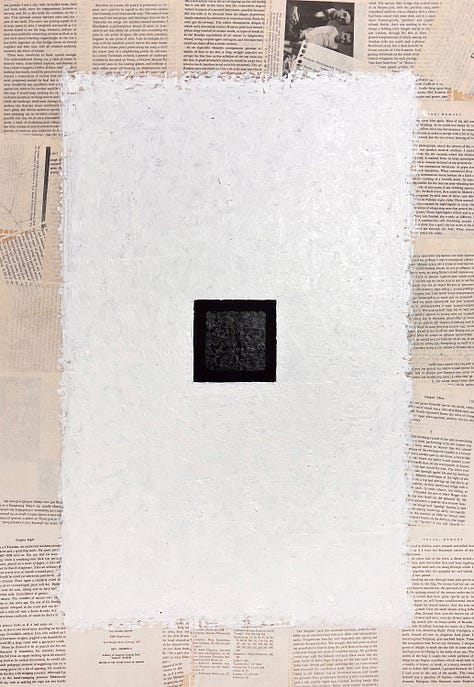
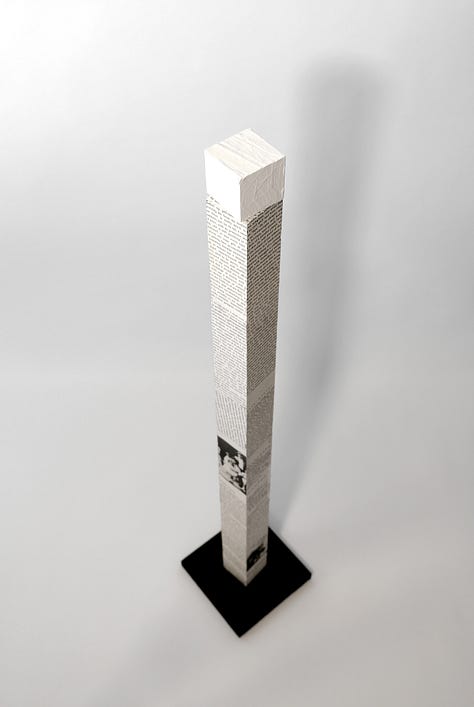
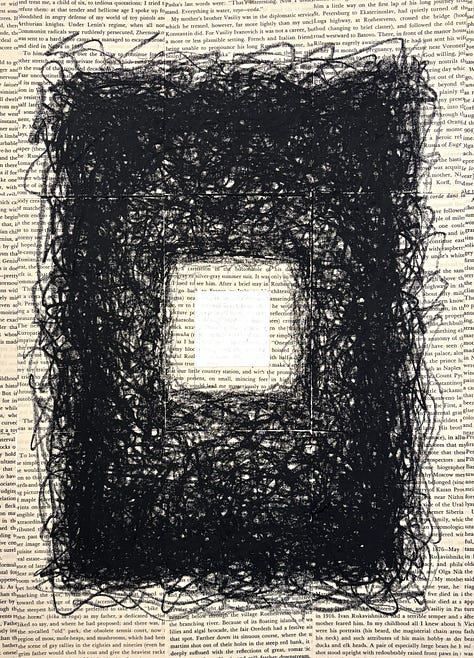
The use of material in my work is never neutral, because material is never neutral. Everything carries history. Material is memory. Everything carries associations that extend beyond its immediate visible properties and that cannot be fully controlled by intention. When materials enter a work, they do not surrender those associations. They interact with them, bringing them into relation with the other elements present.
The pages from Nabokov’s text carry not only the content of the writing — the specific words, the sentences, the passage of argument and image — but the context in which they existed. My father’s library. The Tokyo apartment in the period immediately following his death. The years during which the book was carried, handled, returned to in different circumstances, read and reread. These layers are not visible in a literal sense. They cannot be pointed to. But they are present in the work, the way the structure of a building is present in it even when the walls are finished and you cannot see the framing within them.
When those pages are torn and layered and embedded in paint, these histories are not erased. They are reconfigured. They enter into relation with other elements — with the surface they inhabit, with the gesture of the paint, with whatever else the composition holds — and in doing so, they produce a form of meaning that cannot be generated by any of those elements alone.
This approach requires accepting that the meaning of the work is not fully controlled by the artist. The work is shaped by multiple factors, some of which extend well beyond intention. The specific quality of a torn edge. The way a layer of paint absorbs or resists the surface beneath it. The associations a viewer brings to materials they recognize from other contexts. These are not accidents to be minimized. They are part of the process — the way the work participates in a field larger than any individual act of making.
My painting process reflects this understanding. I describe it elsewhere as co-creation — working with the canvas rather than on it, allowing the paint and the surface to establish directions that I then respond to, rather than imposing a predetermined outcome. It is analogous to casting an oracle, in the sense that I am working with forces and tendencies that exist independently of my will, reading what emerges, and making decisions in response to what I find rather than what I planned. This does not mean that the work is random or that intention plays no role. It means that intention operates within a field it does not control, and that the most interesting results tend to emerge at the intersection of intention and what exceeds it.
If memory and material form one axis of this work, education forms another — not as an abstract category, but as the specific structure that shapes what any of us are able to perceive, and therefore what we are able to make.
Education is often treated as a neutral process — the transmission of knowledge from those who have it to those who need it. This characterization is incomplete in a way that has significant consequences. Education is not only about what is taught but how it is taught, and within what framework the material being taught is considered valid, useful, or worth knowing. The form of education shapes not only the content of understanding but the structure of the mind that receives it.
The etymology is worth attending to. The Latin roots of the word point in two directions: educare, meaning to train or mold, and educere, meaning to draw out or lead forth. These are genuinely different operations. One shapes the individual according to established structures. The other reveals what is already latent within them. In practice, formal education has historically emphasized the first function over the second — producing minds capable of operating within existing systems, rather than minds capable of perceiving what lies beyond those systems, or of questioning whether those systems are the right ones.
The systems I moved through emphasized clarity, resolution, and the production of outcomes that could be evaluated according to predefined criteria. This is not without value — in architecture and design, decisions have material consequences, and the discipline that comes from having to produce something that works is genuinely formative. But this structure also creates a persistent bias toward forms of knowledge that can be stabilized quickly, that yield to established evaluation criteria, that fit within existing frameworks of understanding.
Questions that do not yield to immediate resolution tend to be marginalized in these systems — not because they are unimportant, but because they are difficult to evaluate, difficult to score, difficult to include in a curriculum that must account for itself in terms of measurable outcomes. The student who lingers in ambiguity, who is troubled by questions that don’t resolve, who is more interested in the space between the established answers than in the answers themselves — this student is often indistinguishable from the student who simply hasn’t learned the material yet. The system has difficulty telling them apart.
Art operates differently. It creates a space in which ambiguity is not a failure but a condition — not a temporary state to be resolved, but a quality of attention to be sustained. The discipline it requires is not the discipline of resolution but the discipline of remaining — of staying with something that is not yet clear, of continuing to engage with what has not yet disclosed itself, of trusting that the sustained encounter with uncertainty is itself productive. This shift — from resolution to inquiry, from outcome to process, from answer to question — required a reorientation in how I approach work that continues to unfold. It is not a shift that happens once and is complete. It has to be actively chosen, repeatedly, against the pull of the earlier training that equates productivity with determinacy.
One consequence of educational and cultural conditioning is that perception itself becomes conditioned. We learn not only what to see but how to see — not only the content of visual experience but its grammar, the habits of interpretation that determine what gets noticed and what gets passed over without recognition.
These habits are not arbitrary. They develop in response to real demands — the demands of navigation, of social interaction, of professional function. The ability to process visual information quickly, to categorize efficiently, to extract what is relevant to current purposes and set aside what is not — these are genuine capacities, and they are valuable. But they come at a cost. The more developed these habits of efficient processing become, the more difficult it is to perceive what falls outside their categories. Efficiency in processing means reduced sensitivity to what doesn’t conform to what is already expected.
Art can intervene in this process, and when it works, that is essentially what it does. A work that operates at a high level does not simply present an image that confirms existing expectations. It disrupts habitual patterns of recognition — introduces elements that cannot be immediately categorized, holds the attention in a way that resists quick resolution, requires the viewer to adjust their mode of perception rather than applying the mode they arrived with.
This adjustment is not always comfortable. It can produce a sense of disorientation — the mild vertigo of encountering something that does not fit the available frameworks. But this disorientation is not a failure of the work or of the viewer. It is an indication that perception is being reconfigured, that the encounter is doing what it needs to do.
When I describe my practice as exploring the inner landscapes of mind — the phrase that sits at the center of iliadterra.com — this is what I mean. The landscapes are interior. They are the structures of perception and memory and understanding that we inhabit without usually examining, because they are the medium of examination rather than its object. To turn attention toward these structures — to make them visible as structures rather than simply using them as transparent windows onto the world — is the central work of what I do.
At a certain point in this inquiry — through the work, through the years of practice, through the sustained encounter with questions that my architectural training had not prepared me to address — I found myself needing a framework that could hold what I was working with without reducing it. Not a theory, not a system in the sense of a closed set of propositions, but a set of relationships that could orient engagement without determining its outcomes in advance.
The framework that emerged — which now organizes the four series of my practice — is built around four terms: Mind, Veil, Ether, and Matter.
Mind is not the individual rational intellect. It is the broader field of awareness — the territory within which all experience, all perception, all thought and feeling and intuition occur. It is the medium rather than the content, the space within which everything else takes place. The Mind Series, still developing, is perhaps the most ambitious aspect of the practice — an attempt to create conditions in which awareness can encounter its own structures, can perceive the architecture of perception itself.
Veil is the term I use for the structures — cultural, perceptual, conceptual, historical — that mediate awareness. The veil is not simply an obstacle. It is also a filter, a lens, a pattern through which experience is organized and made navigable. Without some veil, perception would be overwhelmed — undifferentiated, unnavigable, formless. But the veil can also obscure, can impose frameworks that limit more than they enable, can make invisible things that are actually present and available. The Veil Series explores this double function — the way that what enables vision also constrains it, the way that what makes understanding possible also determines its limits.
Ether refers to the domain of potential — what is not yet fully formed but is present, the unmanifest that precedes and exceeds any particular manifestation. In the Ether Series, I work with myth, cosmology, and what I call sacred geometry — not as decorative references to established traditions, but as maps of the forces and currents that move through experience without usually being visible. These paintings oscillate, as I have described them elsewhere, between aerial flights and deep dives — between the perspective from above and the perspective from within, between the macro and the intimate, between the cosmic and the utterly personal.
Matter is the term for the manifestation of these dynamics in physical form — the world as we encounter it materially, with all its density, its weight, its resistance, its particular and irreducible specificity. Matter is where everything lands. It is also where everything begins, in the sense that our access to Mind, Veil, and Ether is always mediated through material experience — through what the body encounters, through the specific surfaces and textures and resistances of the physical world.
Each work I make becomes a site in which these four terms interact — not as a diagram of the relationships between them, but as a field in which those relationships can be felt, encountered, negotiated. The material carries history. The composition introduces structure. The viewer brings their own perception, their own history, their own quality of attention. The result is not predetermined by any of these factors alone. It emerges through their interaction.
Language is an essential tool, and I use it — in essays like this one, in the notes and statements that accompany the work, in the conversations I have with collectors and institutions and collaborators. But language has limits that are structural, not incidental. It stabilizes what it describes. It imposes linearity on what may be fundamentally non-linear. It requires that things be said one at a time, in sequence, when what is being described may be simultaneous, multi-directional, structured by relationships that do not reduce to sequence.
Art operates differently. It allows for simultaneous engagement — for multiple elements to be present at once, in relation to each other, without requiring that they be experienced sequentially. It allows for communication that is not reducible to propositional statement — that delivers something real without specifying what that something is in advance of the delivery.
This does not mean that art is beyond analysis or beyond language. A work can be analyzed, contextualized, historicized, interpreted — and all of these operations are legitimate and often valuable. But those analyses do not exhaust the work. They circle around it. They describe aspects of it. They do not constitute it or contain it.
The work exists prior to its description. And this priority is not a mystical claim. It is a structural observation about the relationship between experience and its articulation. The description of a physical sensation is not the sensation. The analysis of an encounter is not the encounter. Something is always remainder — always exceeds the frame put around it. One of the central functions of my practice is to inhabit this remainder — to work in the territory that analysis and description point toward but cannot fully occupy.
What remains, at this stage of the essay, is to address the implications of this condition more directly — not in theoretical terms, but in terms of what it means to make work under these circumstances, and what that work is responsible to.
The condition we are operating within is not temporary. It is not a momentary disruption that will resolve into a previous form of stability once the current turbulence subsides. The erosion of shared frameworks of meaning is structural. The systems that once provided coherent orientation — religion, nation, progress, science as singular authority — have not disappeared, but they no longer function as singular organizing principles. They coexist, often in tension, frequently in contradiction, without producing a unified orientation capable of grounding collective action or individual purpose.
This creates a condition in which meaning is no longer inherited in a stable form. It must be constructed. And the difficulty is that the tools available for this construction are themselves unstable. Language is contested. Images are mediated. Narratives are produced at scale, often without accountability to their effects on the people who receive them. Under these conditions, the construction of meaning is both the most necessary work and the most uncertain. Art does not resolve this uncertainty. It operates within it. It acknowledges it. It makes it available for examination rather than hiding it behind a more comfortable surface. And this is where I believe its significance lies — not in providing answers to questions that do not have stable answers, but in creating conditions in which those questions can be engaged honestly, without the premature resolution that would make them seem settled when they are not.
The work I produce is not intended to function as a statement in the conventional sense. It does not present a fixed position that can be agreed with or rejected, endorsed or critiqued. It operates as a site of negotiation — a field within which multiple possibilities remain active, within which the viewer’s engagement is not guided toward a predetermined conclusion but is left genuinely open.
This means that the work is structured in such a way that it requires active engagement. It does not provide a single entry point, a clear sequence of elements, or an unambiguous visual hierarchy that tells the viewer what to look at first and what comes next. It introduces elements that resist immediate categorization, that do not resolve into a unified narrative, that remain productive in their ambiguity rather than clarifying into a single reading.
This is not an aesthetic preference, though it has aesthetic consequences. It is a reflection of the condition being addressed. If meaning is no longer stable, then a work that presents itself as fully resolved — that closes its own questions before the viewer has encountered them — misrepresents that condition. It offers the comfort of coherence in exchange for the engagement with what is actually present. And that exchange, however comforting, is a form of dishonesty. The openness I maintain in the work places a different kind of demand on the viewer than most contemporary image environments do. It requires attention. It requires time. It requires a willingness to remain with something that does not immediately yield to interpretation — to resist the reflex of quick categorization and allow something else to emerge.
At this point, the question of responsibility becomes unavoidable, and I want to address it directly.
If perception can be shaped — and it can, demonstrably, in ways we are only beginning to understand — then any act that deliberately shapes perception carries ethical weight. This does not mean that art must adhere to a prescribed moral framework, must advocate for particular positions, or must serve explicit social purposes. It means that the act of making work that intervenes in how people see requires thinking about what that intervention does and what it is for.
What does the work do to perception? Does it reinforce existing patterns, allowing the viewer to remain within familiar modes of interpretation, confirming what was already believed or expected? Or does it disrupt those patterns — require a reconfiguration of how the encounter is approached, create conditions for a different quality of attention to emerge?
Does it simplify experience, reducing complex conditions to recognizable elements that can be processed quickly and set aside? Or does it introduce complexity that cannot be immediately resolved — that demands continued engagement, that changes as the engagement deepens? Does it produce the feeling of understanding without the substance of it — the satisfying sense that something meaningful has been communicated, without the accompanying shift in awareness that would indicate that something has actually been encountered?
These questions cannot be answered abstractly or in advance. They must be answered through the work itself, in the specific choices made at each stage of its making — choices about scale, about material, about the relationship between elements, about what is allowed to remain unresolved and what is guided toward resolution. In my practice, the intention is not to direct the viewer toward a specific conclusion but to create conditions in which perception becomes more active — in which the encounter with the work initiates a process of attention that continues after the viewing ends. The work does not instruct. It engages. And the distinction between these two modes of operation is, I believe, one of the most significant distinctions available to an artist working in the present moment.
There is a quality of moment — in a life, in a studio, in the encounter between a work and a viewer — that I want to try to describe with some precision, because it is the moment around which everything else in this essay orbits.
It is the moment of threshold.
Architecture gave me this concept before art did, and it has remained central to how I think about both. In spatial terms, a threshold is the place between two conditions — inside and outside, before and after, the known space and the unknown one. It is not quite either. It belongs to both and fully to neither. Its function is passage, but passage is not automatic. The threshold must be crossed, and the crossing changes something.
What I found, over years of designing spaces and then of inhabiting my own practice more fully, is that the most significant thresholds are not always the most architecturally prominent. The doorway that announces itself with grandeur can be crossed without anything changing, because its drama is external — it tells you that something significant is happening, and you receive the telling without experiencing the significance. The threshold that does its deepest work is often barely marked — a change in material underfoot, a shift in the quality of light, a compression of the ceiling height before a release into volume. These subtler thresholds engage the body before they engage the mind, and they can produce a shift in awareness that a more obvious announcement cannot.
This understanding has been central to how I think about the immersive installation work — the Void / Prism environment — and also to how I think about the encounter with painting. The threshold into the matte black chamber is, in part, a literal architectural threshold. You pass through it from the white gallery space — ambient light, social noise, the familiar cues of the institutional art environment — into a space that has evacuated those cues. The darkness is not decorative. It is functional. It creates the conditions for a different quality of attention by removing the conditions that support the habitual quality of attention.
But the threshold I am most interested in is not the one at the door of the installation. It is the one that happens inside the person who is standing in the dark, waiting for their perception to adjust, noticing that it cannot adjust in the way it normally does. That interior threshold — the moment when the habitual mode of processing runs out of material and must pause, must wait, must allow something other than its usual operation to occur — is the threshold the work is built to create.
Anne Truitt, under whom I studied Fine Arts, understood the threshold in her own way and medium. Her columns — those spare, geometrically precise painted forms that refuse the dramatic, that offer nothing immediately obvious to hold onto — are threshold objects. They create a situation in which the viewer must bring something of their own, must remain long enough for their own perceptual habits to run their course and something quieter to emerge. What emerges in that quieter space, Truitt seems to have understood, is more genuinely the viewer’s own than anything that could have been delivered more directly.
I think about this often in relation to my own work. The layered surfaces of the Veil paintings, the atmospheric fields of the Ether works — these are also threshold structures. They are not difficult in the sense of being obscure or requiring specialized knowledge. They are difficult in the sense of requiring patience, of not yielding everything in the first moment of looking, of revealing themselves through sustained encounter in ways they cannot reveal themselves through quick consumption.
In a culture structured around the capture and monetization of attention — where the fundamental unit of commercial value is the moment of engagement, and where the entire architecture of digital experience is designed to produce the maximum number of those moments in the minimum amount of time — this kind of work is structurally counter-cultural. Not because it is trying to be oppositional, but because it is trying to do something that the dominant economy of attention makes increasingly difficult: to create conditions for the slow encounter, the patient return, the development of relationship with a work over time. This is not nostalgia for a different era. It is a recognition that certain capacities — certain qualities of attention, certain modes of perception — are genuinely endangered by the environment we have built, and that their cultivation requires active conditions that support rather than undermine them. Art can be one of those conditions. The studio can be one of those conditions. The act of sustained engagement with a work that does not resolve quickly — whether as maker or as viewer — is a practice that keeps these capacities alive.
Any essay written in this moment that does not engage with the question of artificial intelligence and its relationship to creative practice is deliberately avoiding the most pressing question in the field. I want to engage with it, though not in the terms that most of the current discussion occupies.
The debate around AI and art tends to organize itself around questions of authorship, originality, and the economic consequences of automated image production for working artists. These questions are real and deserve serious attention. But they operate on the surface of something deeper, and engaging only with the surface leaves the deeper question unaddressed.
The deeper question is about what art is for, and therefore what it is in danger of losing.
If art is essentially the production of images — of visual outputs that match certain criteria of quality, novelty, or style — then the development of systems capable of generating such outputs at scale is indeed a fundamental disruption. If the value of art lies primarily in the image produced, then the labor of producing the image is what is threatened, and the threat is real.
But if art is, as I have been arguing throughout this essay, primarily a practice of inquiry — a mode of engaging with experience that produces understanding through the act of making rather than simply communicating understanding that already exists — then the automated generation of images is a disruption of a different, and in some ways more tractable, kind. It threatens the commercial market for certain kinds of image production. It does not threaten the practice of genuine inquiry through making.
What cannot be automated is the encounter with genuine uncertainty — the moment in the studio when you do not know what you are doing and must find out, when the material resists and you must negotiate with that resistance, when the work reveals something you did not intend and you must decide what to do with the revelation. These are not inefficiencies to be eliminated from the creative process. They are the process. They are where the understanding that makes the work meaningful is generated.
My own work at the intersection of traditional media and emerging digital tools — the NFT projects, the animated and motion graphic work, the investigation of what happens when sacred geometry and symbolic structure are rendered through computational means — has convinced me that the digital and the material are not opposed domains. They are different registers of the same inquiry, with different affordances and different limitations. The digital allows for a kind of reproducibility and distribution that the material cannot. The material allows for a kind of presence and particularity that the digital cannot replicate. The practice that can move between them, that can use each for what it is best suited to, is richer than either alone.
What I resist is the assumption that the digital is inherently more advanced, or that the movement from material to digital practice represents progress in any meaningful sense. The experience of standing in front of a physical painting — the scale, the texture, the way the light falls across the surface at different times of day, the quality of presence that accumulates in an object that has been made by a particular person at a particular moment under particular conditions — is not replicable by any current or foreseeable technology. It is not simply a delivery mechanism for visual information. It is an encounter with a specific instance of materialized consciousness, and that specificity matters in ways that are difficult to articulate but immediately felt.
The Mind Series — the unfolding cube project that exists at the intersection of the digital and the philosophical — is an attempt to hold this tension without resolving it. The cube opens progressively, revealing portals into interior spaces, posing collective inquiries: Who are we? Where does the mind reside? These are not rhetorical questions. They are genuine ones, and the work is an attempt to create conditions in which the asking of them becomes shared, participatory, collective. The NFT structure that supports this project is not a commercial strategy dressed up as art. It is an attempt to use the affordances of a new medium — the capacity for shared ownership, for collective holding of something that remains singular — to create a new kind of relationship between the work and the people who engage with it. Whether that attempt succeeds is not something I can determine in advance of the encounters that will either confirm or challenge it. That uncertainty is not a failure of the project. It is the project.
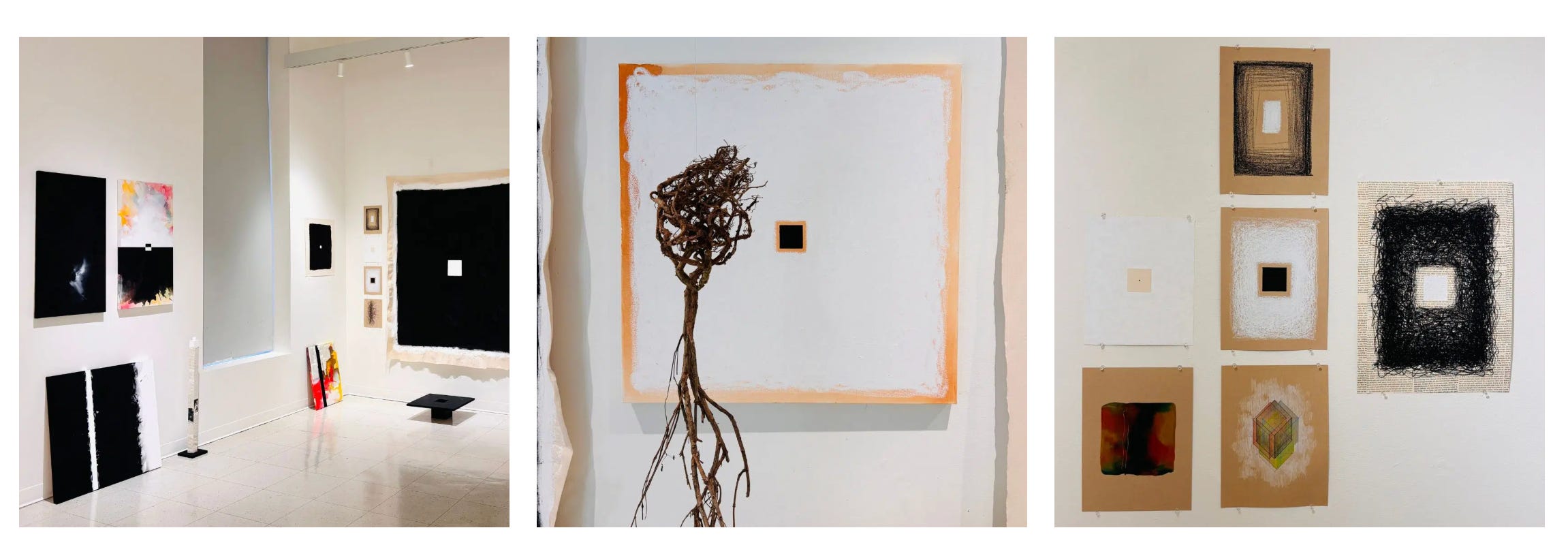
Having moved through these various territories — perception and its conditioning, memory and its material form, education and its structural biases, the ethics of the encounter — it is useful to return to the figures who have most significantly informed this inquiry. Not to summarize their contributions separately, but to see how they converge, how they illuminate different aspects of the same field.
Carl Jung establishes that the psyche is not fully accessible through conscious reasoning — that there are layers of experience that operate symbolically, that require forms of engagement different from rational analysis, and that cannot be bypassed without cost. The unconscious is not a deficiency to be corrected but a dimension of the psyche that carries its own intelligence, its own structures, its own contributions to the whole. To work without access to this dimension is to work with a significant portion of the available resources unavailable.
Philip K. Dick demonstrates that reality itself is not a stable given — that it is mediated, constructed, and subject to manipulation at every level. His contribution is not pessimism but perceptual honesty. He insists on looking directly at the conditions of mediation rather than pretending they are not there, and he demonstrates through his fiction that the destabilization of what was thought to be certain can be the beginning of a more accurate engagement with what is actually present.
Joseph Campbell, along with the mythic traditions he analyzes — and specifically the narrative of Parsifal, which I return to repeatedly — provides a structural framework for understanding transformation as a process that necessarily involves disorientation, failure, and the development of perception. The hero’s journey is not a story of invulnerability and triumph. It is a story of development through encounter with what exceeds the current limits of understanding.
These are not separate domains, and the work I make does not draw on them as separate reference points. They converge into a single field: the recognition that the instability of reality, the layered structure of the psyche, and the necessity of transformation are all aspects of the same condition — the condition of being a conscious being in a world that perpetually exceeds the current capacity to account for it. Art operates within this convergence. It is not an illustration of any of these ideas. It is a practice within the same territory they map.
One of the most important implications of this convergence is that failure must be understood differently than the professional and educational systems I was trained within allowed.
In structured disciplines, failure is defined in relation to outcome. A project fails if it does not meet its objectives. A design fails if it does not perform as specified. A strategy fails if it does not produce the intended results. This definition is necessary and appropriate in contexts where outcomes are critical and where the cost of failure is real and material.
In art — in practice oriented toward genuine inquiry rather than the demonstration of already-held knowledge — this definition is insufficient and can be actively misleading. Failure is not the absence of success. It is a stage in the process of understanding. The work that does not immediately resolve, that resists interpretation, that produces uncertainty rather than satisfaction — this work is not necessarily failing. It may be operating exactly as it needs to in order to do what it needs to do.
The example of Parsifal is directly relevant here. His initial failure is not a terminal condition. It is a necessary stage without which the subsequent transformation could not occur. He must have been present at the decisive moment and failed to respond correctly. He must carry that failure, continue in the world with it, allow it to work on him until its meaning has been fully metabolized. Only then does the capacity for the right response become available to him.
In my own practice, failure is not something to be avoided or managed but something to be engaged — something to be allowed to do its work. A work that does not succeed by immediate criteria can be the beginning of understanding what would constitute success. A process that does not produce the expected outcome can reveal something about what was expected that the expectation had kept invisible. The studio is, among other things, a place for this kind of productive failure — a place where it is possible to learn from what doesn’t work in ways that the pressure to always produce what works makes impossible.
This does not mean that anything can be justified as process. Not all failure is productive. The distinction is between failure that closes down inquiry — that produces discouragement, that generates no further question — and failure that opens it up, that reveals something about the territory being worked in that success would have concealed.
The final element in this structure is the role of the viewer — and I want to be specific about this, because the language of ‘audience engagement’ in contemporary art and culture is often used in ways that flatten what is at stake.
The viewer is not an external observer of completed meaning. They are a participant in its construction. This participation is not optional — it is not an additional mode of engagement available to those who want to go deeper. It is a structural condition of how the work operates. The meaning of the work does not exist independently of the interaction between the work and the person encountering it. It emerges from that interaction, and it is different in different encounters, for different people, at different moments.
This is not relativism in the sense that all responses are equally valid, or that the work means whatever anyone decides it means. The work has structure. It has material properties. It has a history of making that shapes what it holds and how it holds it. These structures constrain the possibilities of encounter without determining them in advance.
What they cannot do is produce the encounter itself. That requires the viewer. And the viewer who approaches the work with genuine attention — who remains with it long enough for its structures to become apparent, who brings their own history and perception and quality of awareness to the encounter — this viewer produces something that no other viewer produces, and that the artist alone could not produce.
This understanding has practical implications for how I present work and what I consider the work to be. The painting on the wall is not the complete work. It is one element in a larger event — the event of its encounter with a particular consciousness at a particular moment. What happens in that encounter, what is produced by it, is the work in its full sense.
The Void / Prism installation — the immersive environment I have been developing, built around a floor-to-ceiling acoustic chamber that absorbs light and sound, with a single prismatic cube at its center — is perhaps the clearest expression of this understanding in my practice. The space strips away the environmental scaffolding through which we habitually construct orientation. The darkness, the silence, the absorption of the familiar cues that tell us where we are and what to expect — these are not theatrical effects. They are structural interventions in the conditions of perception. They create a situation in which what usually happens automatically cannot happen automatically, in which the viewer is thrown back on their own awareness in a way that ordinary environments do not require.
In that space, the small prismatic cube at the center — pulsing, refracting, sometimes sending laser light through fog that makes the movement of air visible — is not a light source in the ordinary sense. It is a site of encounter. It is the point at which the stripped-back space finds its organizing element, and the viewer must decide what to make of that — must bring something to the encounter that the space itself cannot provide. This is the most direct expression of what the practice is about: creating conditions in which the viewer must be present in a way that is not habitually required of them, in which the construction of meaning cannot be outsourced to the environment or the work itself, in which something must be brought to the encounter that can only come from the particular quality of awareness that the particular viewer carries.
I want to conclude with something that is not a conclusion in the conventional sense — not a summary of what has been established, not a resolution of the tensions that have been explored, but a position. A statement of where I stand in relation to what has been described, and why.
We are not operating within a condition where meaning is inherited in a stable form. This is not a catastrophe, though it can feel like one. It is a condition that has existed at other historical moments — moments of genuine transition, when the frameworks that had organized experience became insufficient and new ones had not yet taken shape. These are uncomfortable moments to live through. They are also, consistently, moments of extraordinary creative possibility.
The construction of meaning — under conditions where it cannot be inherited, where it must be actively built from whatever materials are available, in the absence of the stable frameworks that would make the building automatic — is the central challenge of living thoughtfully in the present. And it is a challenge that art is uniquely positioned to engage with, precisely because it does not require the elimination of uncertainty before it can proceed. It works with uncertainty. It makes uncertainty productive. It creates structures that can hold what has not yet resolved without collapsing it prematurely into false clarity.
I do not approach my work as a means of providing answers. The questions I am working with — about consciousness, about the structures of perception, about the relationship between what is material and what exceeds material, about what it means to be a mind inhabiting a body inhabiting a world — do not have answers in any form that would be satisfying if delivered as propositions. What they have are encounters. What they have are moments of recognition that cannot be fully articulated but that alter something in the person who has them.
My work — the paintings in the Veil and Ether series, the developing Mind project with its unfolding cube and its inquiry into the architecture of awareness, the immersive installation environment of Void / Prism — is an attempt to create conditions for those moments. Not to produce them on demand, not to guarantee them, but to establish the circumstances in which they become more likely, in which the quality of attention required for them is less difficult to sustain.
This is a position of engagement rather than neutrality. It is not a position of certainty. It does not rest on the conviction that I have understood something that others have missed, or that the framework I work within is the correct one. It rests on the conviction that the sustained engagement with questions that do not resolve — the willingness to remain with what is unfinished, uncertain, not yet clear — is itself a form of fidelity to experience. That this fidelity is necessary. That its absence is what produces the anxiety and dislocation that characterizes so much of contemporary life.
What remains, at the end of all this, is not certainty. It is not a resolved position, a completed understanding, a map of the territory that can be followed without further adjustment. What remains is the practice itself — the ongoing engagement with what is not yet resolved, the continuation of the work even in the absence of clear criteria for its success, the willingness to enter the studio again each day and begin again from what is actually present rather than from what was expected.
That is the bridge between worlds — not a fixed structure, not an architecture of certainty connecting a stable here to a stable there. It is a practice of crossing. It is the sustained act of moving between what is known and what exceeds knowing, between the material world and the dimensions that move through it without being captured by it, between the self that arrives at the beginning of the encounter and the self that has been altered by having been in it.
The bridge is built in the crossing.
And the crossing, as Parsifal knew — as every figure who has moved through genuine transformation has known — requires nothing other than the willingness to ask, with full sincerity and full attention, the question that the moment requires.
About the Author
Iliad Terra is a visionary artist, architect, and creative practitioner based in Potomac, MD. His work spans painting, mixed media, and immersive installation, organized around four interconnected series: Mind, Veil, Ether, and Matter. He studied Fine Arts under minimalist master Anne Truitt and holds a Master’s in Architecture. He is currently collaborating with the School of the Art Institute as part of his MFA. His work is held in private collections internationally.
Explore the full practice at iliadterra.com
No posts
Comments
Nothing yet. Say the first thing.
Sign in to join the conversation.