
Last week, I visited Israel and the Palestinian Territories as part of a J Street policymaker delegation. Jeremy Ben-Ami has already shared some of his key observations, but I came away with two main takeaways of my own.
First, there is a sharp disconnect between the Israeli government’s position on Gaza and the rest of the world’s – coupled with a complete lack of understanding of how profoundly this policy is damaging Israel’s standing internationally.
Second, I saw firsthand how Smotrich and Ben Gvir are using the levers of power to shape Israeli policy in the West Bank and Jerusalem, and the dangerous impact of their actions.
None of this changes the conclusions I drew on my previous trip in May: that a reckoning has already begun within Israeli society in response to the October 7 attacks and the war in Gaza – one that could eventually open the door to a better path forward. But in the near term, as long as this government remains in power, likely for the next year, the outlook is grim.
The Israeli Government Doubling Down on a Failed Gaza Policy
Before my trip to Israel, it felt like there was a fundamental shift underway in the U.S. and internationally regarding the humanitarian crisis in Gaza. One by one, close Israeli partners are committing to recognizing a Palestinian state. Germany, perhaps Israel’s closest European ally, recently announced it would stop selling weapons to Israel that could be used in Gaza. 27 Senators—more than half of the Democratic Caucus—voted to block one or two arms sales to Israel. Debates about whether Israel is committing genocide becoming part of mainstream discourse in the American Jewish community. Only 8% of Democrats and 25% of Independents support Israel’s policies in Gaza. Israel is as isolated internationally as it has ever been.
Yet you wouldn’t know this from talking to the Israeli government or the IDF. During our visit, the Netanyahu government doubled down on plans to occupy nearly all of Gaza. IDF briefings insisted Israel must continue attacking Hamas: “We’ve eliminated 95% of Hamas’s fighting capability, which gives us an A, but we must get to an A+.” On the other hand, a different official claimed there are still 20,000 Hamas fighters in Gaza—roughly the same number we heard a year ago when I was still in government. That doesn’t sound like an “A.” So, which is it? Briefings on the humanitarian situation only mentioned how many tons of aid had been delivered over the past two years—numbers without context on what’s actually needed to feed 2.2 million people. And the images coming out of Gaza and the reporting on the ground seem to indicate that whatever the numbers are, the aid getting in is totally inadequate. As for an endgame, nearly two years into the war Israeli officials could only articulate a vague hope for a new governing entity in Gaza that’s neither Hamas nor the PA.
The killing of Al Jazeera journalist Anas al-Sharif this week is a stark example of how the Israeli government has lost the plot. Israel alleges he was a Hamas operative – an unproven claim that demands more evidence. Even if, for the sake of argument, one accepts the allegation, Israeli leaders had to know the international backlash such a strike would provoke. How could they possibly weigh the costs and benefits and conclude that killing an alleged mid-level Hamas figure, on tenuous evidence, was worth the diplomatic damage? Only a government utterly mired in its own political and ideological blinders could make such a calculation.
The good news is that the Israeli public seems to get it. The overwhelming majority now supports ending the war. Opposition leaders like Yair Lapid and Yair Golan and analysts such as former national security advisor to Naftali Bennet Eyal Hulata understand that this war is doing more harm than good. They believe Israel should declare victory and negotiate to bring the hostages home, instead of holding out for unrealistic terms like a Hamas surrender. But realistically, those voices are unlikely to lead the government for at least a year, with elections probably coming in the first half of 2026. In the meantime, the Israeli government is likely to continue digging itself deeper.
Ben Gvir and Smotrich Use the Tools of Government to Further Their Extremist Agenda
The second major development I saw on this trip was clear evidence of just how much Ben Gvir and Smotrich are turning the IDF and the police into tools that further their annexationist and extremist agenda. Even as a veteran observer of these issues some of these events were stunning.
On the Temple Mount/Haram Al Sharif (TM/HAS) I witnessed clear violations of the long-standing status quo, enabled by Israeli police under the authority of Ben Gvir as Minister of National Security. The TM/HAS – the holiest site in Judaism and the third holiest in Islam – has always been the most sensitive point in the conflict, where territory, religion, and nationalism collide. In 2000, a visit by Ariel Sharon helped spark the Second Intifada; in 2021, tensions there contributed to the outbreak of a short war between Israel and Hamas in Gaza.
Since 1967, Israeli policy to keep the peace has been to maintain a status quo: Muslims and non-Muslims may visit, but only Muslims may pray on the TM/HAS, while Jews pray at the Western Wall. This also aligned with most Orthodox Jewish teachings, which prohibit Jews from entering the site lest they inadvertently step on the “Holy of Holies” – the most sacred space in Judaism, once entered only by the High Priest on certain holy days.
Over the past decade, extremist nationalists have begun visiting and secretly praying, pretending to be talking to someone or speaking on the phone. In the past, Israeli police would stop this, aware of how provocative it was and how Muslims might view it as an attempt to take over their prayer space.
On this visit, I saw something entirely different. Within thirty minutes, I witnessed three separate groups – from a few individuals to about twenty – openly praying on the Temple Mount. The Israeli police did not intervene. In fact, they provided armed escorts. Netanyahu insists the status quo remains in place, but this is pure gaslighting – and a recipe for a dangerous spark.
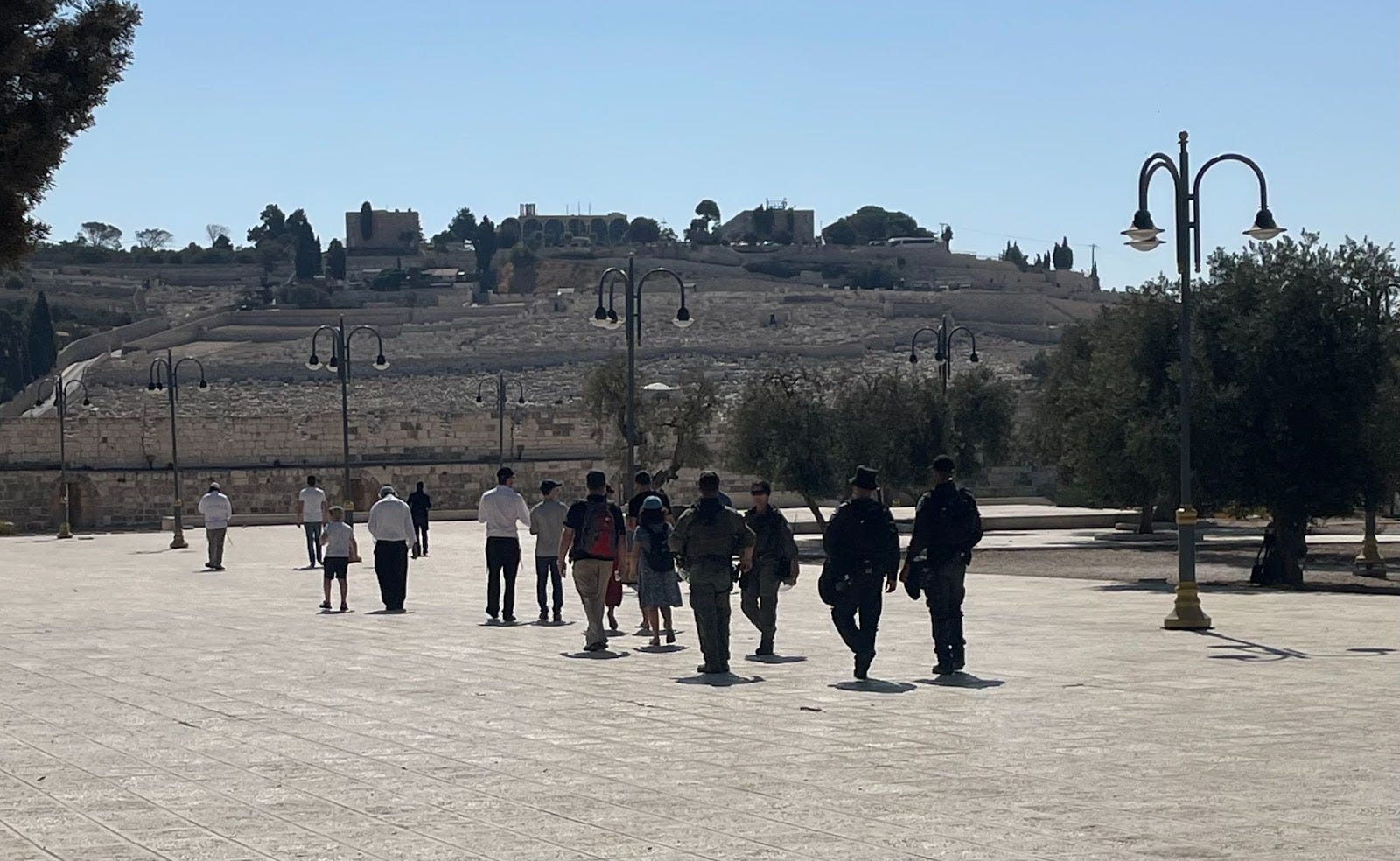
A picture of Jewish worshipers on the Temple Mount/Haram Al Sharif being escorted to prayers by Israeli police
We also visited the Palestinian village of Um al Khair, where activist Awdah Hathaleen had been killed just days earlier. Video and other compelling evidence strongly indicated that the killer was Yinon Levy – a violent extremist settler previously sanctioned by the Biden Administration.
Levy lives on a farm that is an illegal outpost. From a distance, it appears fully connected to the West Bank’s power grid and water system. He is not a misguided teenager wandering the hills; he owns a construction company and, along with his associates, has carried out violent attacks and issued threats to Palestinians, with the goal of driving them from their land.
In this case, Levy and his accomplices spent the day working farmland near Um al Khair, then deliberately drove a bulldozer across village land, causing damage. When villagers tried to stop him, a confrontation ensued. Levy pulled a gun and fired, killing Hathaleen.
The Israeli government and IDF response was telling: within a day, Levy was released to house arrest, free to continue his activities. Hathaleen’s body was held for over a week as authorities tried to pressure the family into accepting a small, overnight funeral. Meanwhile, Palestinians accused of throwing rocks were arrested the next day, and some remained in detention ten days later, when we visited.
We also visited one of the small villages from which Levy’s supporters had expelled residents before destroying it. A court order had been issued to bar Israelis from the site, in an effort to protect Palestinians from repeated settler incursions. During our visit, the IDF and police arrived and ordered us – international visitors there at the invitation of Palestinian residents – to leave, citing the court order. On our way out, we saw what appeared to be one of Levy’s associates watching us. It seemed likely he had tipped off the IDF about our presence.
No posts
Comments
Nothing yet. Say the first thing.
Sign in to join the conversation.