
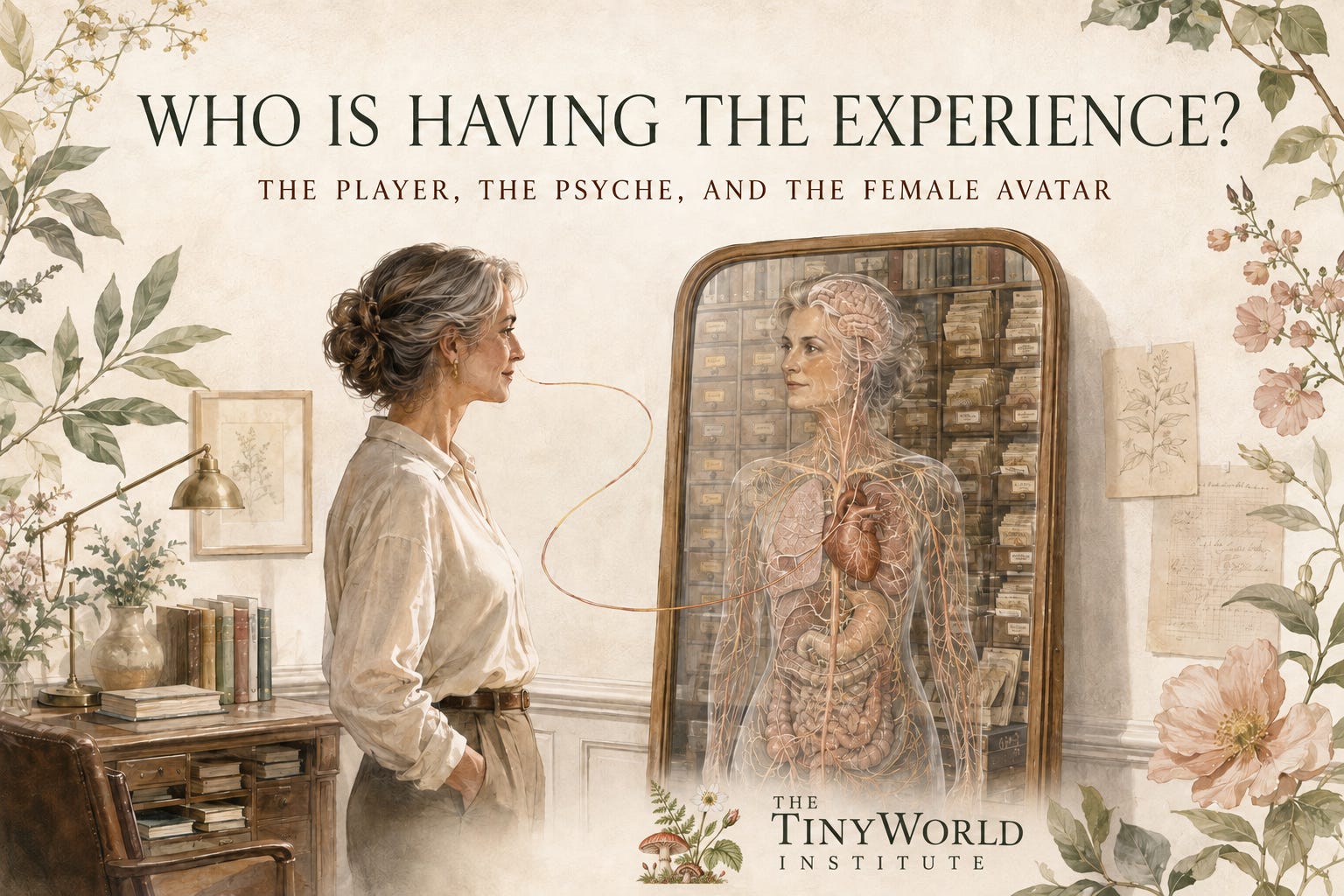
This article develops its argument in full so that observation, established biological material, and TinyWorld Institute theory remain properly distinguished. A concise TL;DR appears at the end.
Women commonly describe significant moments by saying, “I knew,” “my body knew,” “I felt it before I could explain it,” or “my body responded even though I did not understand why.” These statements point toward a recognizable phenomenon: experience may become biologically active before it becomes consciously legible. Yet they do not tell us which part of the woman knew, what was registered, or how that registration became available.
Discussions of lived experience routinely move among consciousness, psyche, brain, body, feeling, behaviour, and biological response as though these were either interchangeable or entirely separate. One account reduces the experience to the body. Another treats the body as an object carrying out instructions from a disembodied mind. Neither adequately describes a living system in which an event may be registered biologically, enacted physically, retained over time, retrieved through a track, and later brought into conscious understanding.
The TinyWorld Institute proposes a layered model to clarify these distinctions without dividing the living occurrence into unrelated parts. Its governing question is: Who is having the experience, and through what instrument?
Germanische Heilkunde establishes that a DHS begins with a highly acute, unexpected, isolating event registered through the singular biological perception of the individual. The event, its perception, and its biological meaning are not interchangeable. Two people may encounter similar outward circumstances while registering different biological conflicts because the organism responds to the meaning perceived at the moment of impact.
The DHS occurs as one unified biological event across the psyche, brain, and corresponding organ. It is not a sequence in which the psyche forms an interpretation, sends instructions to the brain, and commands the organ to respond. The brain relay participates in the same unified biological program expressed through the psyche and corresponding organ. The resulting Significant Biological Special Program unfolds through time according to its biological purpose.
GHK therefore provides an ordered map of how the biological avatar adapts. It establishes the DHS, the two-phase nature of Significant Biological Special Programs, the relationships among germ layers, brain relays, and organs, the role of tracks, and the meaningful biological order expressed through the Quintessence.
GHK does not establish the Player, physical matter reality, the psyche as a living library, or attention as a governing resource. Those elements belong to the larger architecture being developed by the TinyWorld Institute. They are intended to place GHK within an account of one human life, not to revise the biological laws or attribute the Institute’s ontology to Dr. Hamer.
The Institute uses the term Player for the consciousness participating through one human life. The Player is not reducible to the avatar, but neither does the Player participate in physical matter reality independently of it. The avatar supplies the sensory, biological, developmental, and material conditions through which participation becomes possible.
Physical matter reality, or PMR, is the shared, rule-bound environment in which the avatar exists. It includes bodies, objects, geography, sequence, duration, relationships, consequences, and the limits imposed by physical form. The Player encounters this environment through the living interface of the avatar.
Within this model, female names the architecture of the avatar rather than a limitation placed upon the Player. The Player participates through a sexed biological instrument. That instrument affects what can be sensed, registered, enacted, carried, and made biologically significant within a particular life. The female avatar is therefore not incidental to the experience. It is the form through which the experience becomes embodied.
The avatar also makes its changing condition available through energy, sensation, function, attention, orientation, behaviour, and biological signalling. A woman may notice a bodily change without knowing the event to which it corresponds. She may recognize that her attention repeatedly returns to a particular person or condition. She may perceive a pattern only after several experiences have been cross-referenced. The absence of an immediate conscious explanation does not mean that the biological response occurred without meaning. It means that biological registration and conscious legibility are not necessarily simultaneous.
When a woman says, “my body knew,” she is not necessarily proposing that the body possesses a separate consciousness competing with the Player. She may be identifying that the avatar registered biological meaning and began responding before the information became consciously articulable. The purpose of inquiry is not to assign her words a fixed meaning from outside. It is to preserve the distinctions long enough for the structure of her experience to become visible.
The TinyWorld Institute proposes the psyche as the living library of meaningfully encoded experience. This does not position the psyche as a separate metaphysical mind outside the avatar. It identifies a functional layer through which lived experience remains available as biological meaning, association, pattern, and later cross-reference.
An event may end in physical time while its registration remains active within the life of the avatar. A track can retrieve some feature associated with the original DHS, including a person, place, sensation, phrase, season, or relational configuration. The later encounter does not reproduce the original event objectively. It reactivates information connected to the original biological registration.
The library metaphor is useful because experience is not filed as a neutral chronological record. Material remains connected according to relevance. One event may become associated with several later experiences through a common biological meaning, while two outwardly similar events may remain separate because they were registered differently. What appears to consciousness as a response to one present circumstance may therefore include a much larger body of associated information.
The psyche does not select or direct the biological program independently of the brain and organ. GHK requires their unity to remain intact. The Institute distinguishes these layers only to make their contributions legible. They continue operating as one living occurrence.
The Institute proposes attention as the finite governing resource through which information becomes available to the Player. Attention may be occupied by immediate conditions, redirected toward unresolved registration, distributed across competing responsibilities, or returned deliberately to material that has become ready for inquiry.
The relationship among Player, psyche, brain, and organs is therefore not a one-way chain. A lived event is registered through the avatar according to its singular biological meaning. The corresponding program changes the conditions of the avatar, affecting sensation, energy, function, behaviour, and attention. The experience remains available within the psyche for later cross-reference. A track or present condition may retrieve the associated material, returning attention to what has not yet become fully legible.
This return does not erase the history, force resolution, or make conscious understanding the cause of the original response. It allows the Player to encounter what the avatar has already registered, distinguish present conditions from associated material, and enlarge the space within which choice becomes possible.
What begins as involuntary biological adaptation may eventually contribute to conscious competence. A woman who has repeatedly encountered one form of biological urgency may develop unusual sensitivity to its patterns. Once the information becomes legible, that sensitivity may become discernment, language, teaching, provision, or stewardship. The adaptation need not be idealized for the knowledge developed through it to become usable.
This is the distinction contained within statements such as “I knew before I could explain it.” The avatar registered and adapted. The experience remained available for cross-reference. Attention returned to the information. The Player eventually acquired language for something already active within the living system.
Through the Quintessence, no part of this system needs to be treated as meaningless or as working against the woman. The Player’s lack of immediate understanding does not make the avatar’s response irrational. The Significant Biological Special Program remains ordered according to the singular registration through which it began.
The Institute extends this inquiry by asking what a conflict may reveal about the intact architecture of the avatar. Identity conflict presupposes some reference to identity integrity. Territorial disturbance presupposes conditions under which the territory supports the organism. Loss of orientation presupposes an orienting reference. The conflict and the structural true can therefore make one another legible without becoming interchangeable.
This layered model is necessary for developing a positive architecture of the female avatar. Innocence, serenity, discernment, receptivity, wanting, choice, and radiance do not all occupy the same position within the system. Some describe conditions of the avatar, some become available as registrations through the psyche, and some describe what becomes possible when the Player can participate consciously in what has been registered. Those relationships remain under inquiry.
The purpose of the model is not to assign every experience permanently to one compartment. It is to prevent consciousness, biological registration, organ adaptation, and later interpretation from being collapsed into one undifferentiated idea. The layers are separated for study, but they belong to one continuous life.
A woman’s lived experience is the participation of consciousness through one sexed biological instrument, within one immediate world, across time.
The Player is the consciousness participating through one human life. The female avatar is the sexed biological instrument through which that participation occurs in physical matter reality. Within GHK, a biological conflict is registered as one unified occurrence across the psyche, brain, and corresponding organ, initiating a purposeful Significant Biological Special Program.
The TinyWorld Institute proposes the psyche as a living library of meaningfully encoded experience and attention as the governing resource through which that information can return to conscious inquiry. The model is continuous rather than sequential: the avatar registers and adapts, the experience remains available for cross-reference, and attention may later return the material to the Player. This accounts for how biological response can precede conscious explanation while preserving the distinction between established GHK material and the Institute’s larger experiential architecture.
Comments
Nothing yet. Say the first thing.
Sign in to join the conversation.