
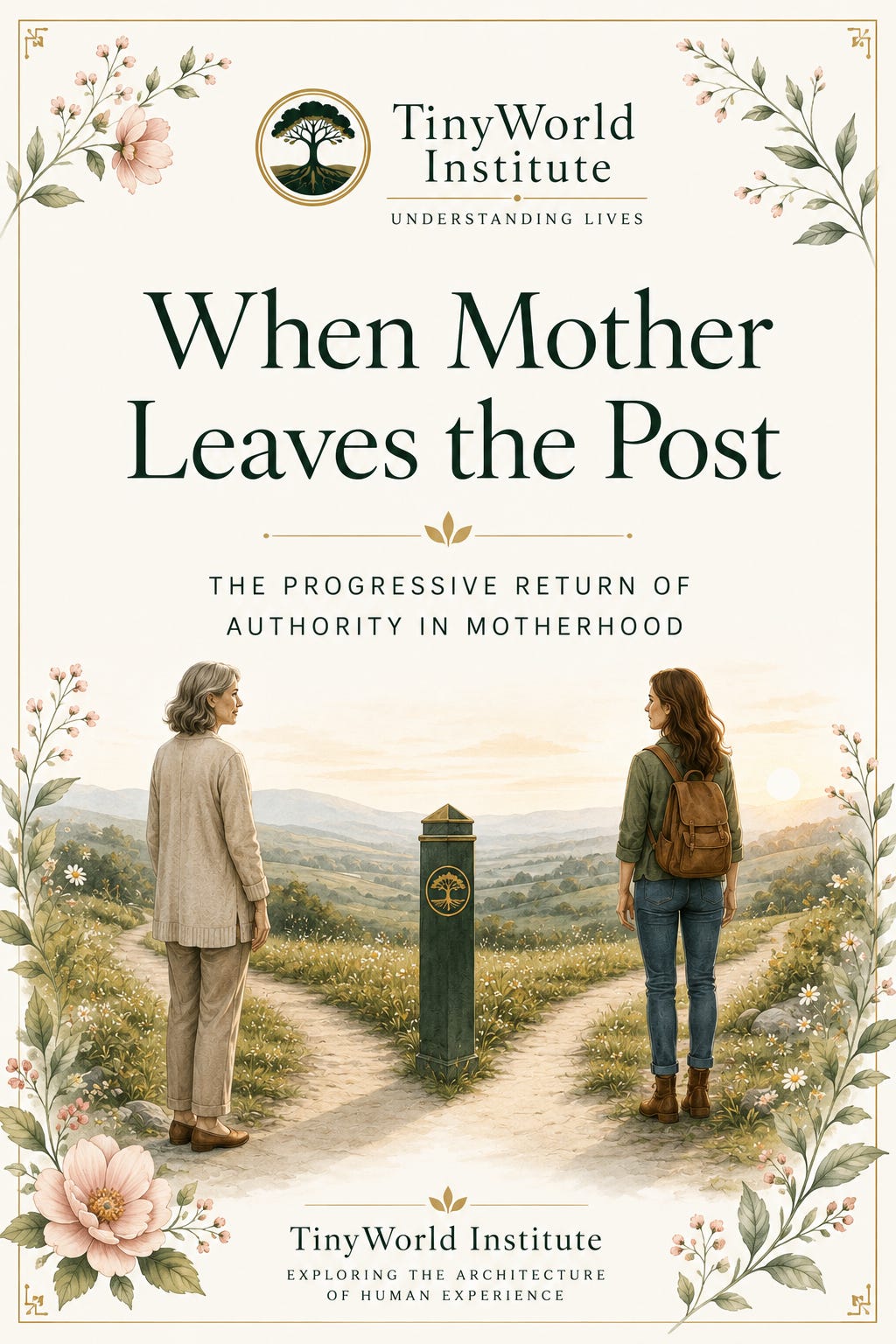
There is a stage of motherhood for which the usual language of boundaries is inadequate. A daughter has become developmentally capable of making decisions, organizing relationships, solving problems, and constructing a life beyond childhood, yet her mother may remain deeply involved in functions that once properly belonged to maternal provision. She receives distress, anticipates difficulties, organizes solutions, supplies companionship, and remains available whenever the daughter appears unable to mobilize on her own behalf. Each individual act may be loving and reasonable. Taken together, however, they can preserve a developmental arrangement whose time has passed.
The problem is often described as an inability to “let go.” This misses something important. The developmental work of motherhood is not simply to hold a child and eventually release her. It is to progressively return authority as the daughter becomes capable of exercising it. When this occurs gradually, maternal provision changes form alongside the daughter’s development. When it is delayed, both women can arrive in adulthood occupying positions that no longer fit them.
The TinyWorld Institute proposes that this progressive return of authority is central to understanding the architecture of adult motherhood.
A young child cannot author the conditions of her own life. Adults necessarily determine where she lives, what resources are available to her, which environments she may enter, and which decisions she can reasonably make. The child’s decision space is initially small because the surrounding adult structure carries responsibility for consequences she cannot yet comprehend or manage.
Maternal provision is therefore not an intrusion upon childhood autonomy. It is one of the structures that makes childhood possible.
Established GHK recognizes the mother-child relationship as biologically significant within its conflict architecture and understands biological processes according to meaningful biological function. It does not, however, provide a detailed developmental theory describing how relational authority migrates between mother and daughter as the girl approaches adulthood.
What follows is therefore a TinyWorld Institute extension.
The Institute proposes that healthy maternal provision contains within it an eventual transfer. Mother does not merely provide for the girl. She gradually provides the girl with increasing jurisdiction over herself.
Early in life, Mother necessarily authors most of the daughter’s decision space. The child exercises preference and choice within a perimeter she did not create.
As competence develops, that perimeter expands. The girl chooses more of what she wears, how she spends her time, whom she befriends, what interests she pursues, and eventually how she organizes increasingly consequential parts of her life. Mother’s authority moves progressively toward the perimeter while the daughter’s authority expands within it.
By later adolescence, most ordinary decisions should already belong to the daughter within a considerably enlarged decision space. Mother still carries legitimate responsibility where the girl has not yet reached full adult jurisdiction, but she does not override merely because she would have chosen differently.
Adulthood therefore represents the completion of a transfer already underway. The adult daughter no longer occupies a decision space created unilaterally by Mother. Any continuing maternal authority must arise through an agreed decision space whose purpose and limits are understood by both women.
Mother may advise, assist, provide substantial practical support, or temporarily assume authority over a particular matter when explicitly invited to do so. But the adult daughter remains the author of the life being supported.
The difficulty arises when Mother continues carrying functions because her daughter appears not to be carrying them herself.
The daughter may have few friends, little daily structure, difficulty making decisions, persistent dissatisfaction, or problems that remain unresolved. Mother observes that nothing seems to change unless she intervenes. The conclusion appears obvious: she still needs me.
Mother therefore fills the gaps. She provides companionship because the daughter is lonely. She organizes because the daughter is disorganized. She solves because the daughter appears stuck. The daughter remains uncomfortable despite considerable maternal provision, while Mother becomes increasingly depleted or resentful.
If repeatedly filling the gap were the provision required for the daughter to assume greater authorship, continued provision should eventually produce greater authorship. When the same arrangement persists while both women become increasingly distressed by it, another possibility must be considered.
Mother may be carrying the very functions the daughter needs to encounter as hers.
When Mother stops performing a function she has carried beyond its appropriate developmental period, the function does not disappear.
If she stops supplying companionship, loneliness may become more visible. If she stops organizing solutions, unresolved problems remain unresolved. If she stops providing continuous witness, the daughter may discover that she lacks sufficient peers. If Mother stops deciding what should happen next, uncertainty remains.
This can look like evidence that Mother has withdrawn too soon.
The TinyWorld Institute proposes instead that the vacancy may represent returned ownership.
What Mother had continued to carry becomes perceptible to the daughter because Mother is no longer preventing its full registration. The discomfort can then require a response from the person to whom the problem belongs. The daughter may discover that she wants companionship, structure, intimacy, greater competence, a different daily life, or somewhere for her ideas and experiences to go.
These registrations create the possibility of movement.
Mother cannot produce that movement for her. She can only stop preventing the daughter from encountering the conditions around which her own movement might organize.
This is not a theory of independence. An adult daughter need not solve every problem alone in order to author her life. Human beings remain relational, and an adult woman may draw extensively upon family, partners, friends, communities, colleagues, and older generations.
The distinction lies in who authors the life being supported.
An adult daughter can identify the outcome she wants, recognize where she requires assistance, and invite Mother into a defined portion of the problem. Mother has then been considered. Her time, experience, energy, and authority have not been presumed.
Mother can say yes, no, or negotiate the terms of her participation. If she agrees, both women understand what Mother has been asked to do and where her authority ends. If the arrangement stops working, the decision space itself can be reviewed.
Rescue reverses this sequence. The daughter’s suffering becomes the summons. Mother begins mobilizing before the daughter has defined an outcome, claimed the problem, or determined what assistance she wants. The daughter’s discomfort thereby reorganizes Mother’s energy.
This pattern has an intelligible developmental origin. A crying infant cannot define an outcome and assemble a support structure. Her distress appropriately mobilizes adults. Mother attempts to discover what she needs, and successful maternal action often ends with the child’s distress subsiding.
But a response appropriate to infancy cannot remain the definition of good motherhood indefinitely.
As authority migrates toward the daughter, maternal care must change with it. Mother can remain empathetic, responsive, and available without appropriating the daughter’s authority in order to end her discomfort. Her responsibility becomes supporting the daughter toward her own solutions without taking away the authority required to find them.
The return of authority does not require Mother to become unreliable. Adult motherhood can instead become more explicit.
Mother may reliably help with grandchildren, remain available for advice, share a weekly date, provide practical assistance, or establish additional agreements during periods when greater support is required. These commitments can be dependable precisely because they have been chosen.
Consideration becomes reciprocal. Daughter considers Mother by recognizing maternal participation as a resource rather than an entitlement. Mother considers Daughter by being reliable within the commitments she has genuinely made.
The relationship remains connected without requiring continuous access.
The old architecture is revealed particularly clearly by a maternal fantasy: When she finds a partner, I will finally be able to stop.
Perhaps a boyfriend will provide companionship. Perhaps friends will become her primary witnesses. Perhaps work will organize her time. Perhaps a community will absorb enough of her attention that Mother can finally feel released.
Embedded in this hope is the assumption that somebody must always occupy the post.
But an adult daughter does not require transfer from one holder to another. Mother does not hand her to a partner, peer group, employer, or community. She returns authority to the person to whom it belongs.
This may require tolerating a period in which nobody replaces Mother. The daughter may remain lonely, disorganized, dissatisfied, or uncertain. She may dislike Mother’s changed availability. The intensity of those conditions does not, by itself, return jurisdiction to Mother.
Otherwise Mother continues preventing her daughter from discovering what she needs by automatically becoming it.
The false structure is not care itself. It is care extended beyond its proper developmental jurisdiction.
Maternal provision is true in infancy and childhood because the girl genuinely requires an adult structure around her. The distortion occurs when the same form of provision continues after its developmental purpose has changed.
The true maternal movement is therefore not provision followed by withdrawal. It is provision followed by the progressive return of authority, while relationship remains.
The young girl is held inside a largely authored world. The developing girl receives an expanding decision space. The adolescent increasingly governs herself within a remaining perimeter. The adult woman authors her own life and deliberately recruits support into it.
Mother changes alongside her. She moves from author, to perimeter, to adviser, resource, grandmother, companion, and reliable participant in explicitly shared spaces. Her importance need not disappear. Her jurisdiction changes.
When this transfer has been delayed, the resulting vacancy serves both women. The daughter encounters what she must now own and receives the opportunity to mobilize around it. Mother encounters the energy she had been directing toward another adult life and can return it to the authorship of her own.
Mother does not need to ensure that somebody else is ready to take her place. The daughter does not need to demonstrate that she can live without Mother.
Mother returns what belongs to the daughter, keeps what belongs to Mother, and remains reliably available within the spaces they deliberately choose to share.
That is not the end of motherhood. It is its adult form.
Comments
Nothing yet. Say the first thing.
Sign in to join the conversation.