
Audio narration by David Marlow
0:00
-7:05
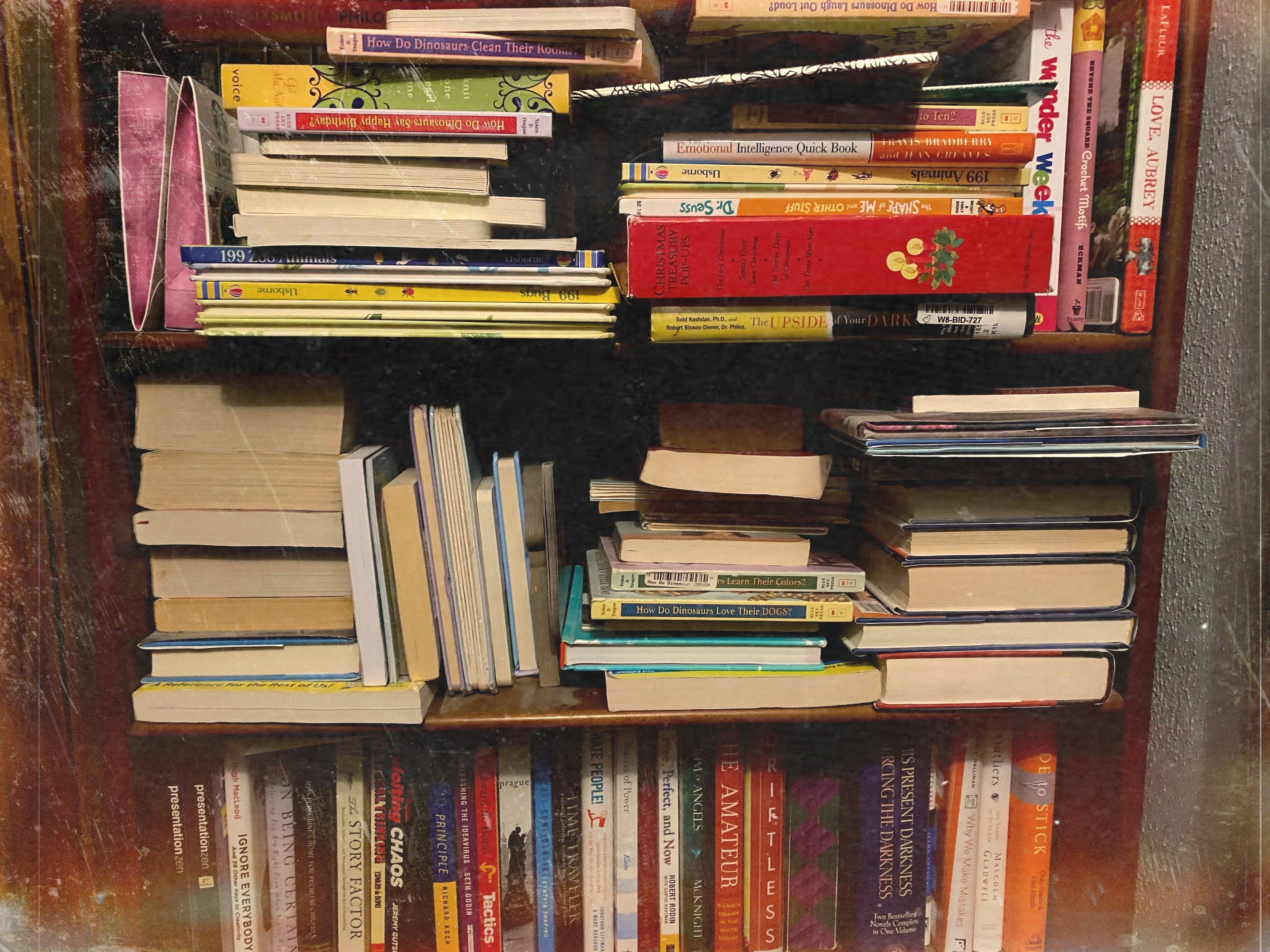

Are you like me with a habit of picking up books and then never quite getting around to reading all of them? If this sounds like you, you might be unwittingly engaging in...
📚 Tsundoku
Like Ikigai, Tsundoku is a Japanese combination word.
📕 Tsun in tsundoku originates in tsumu - a word meaning ‘to pile up.’
📘 Doku, when used as a verb, means reading.
When combined, tsundoku means buying reading material and piling it up. Are you one of those people?
☕️ Hi, I’m Dave and I buy a lot of books…
For example, as I type this, near me is a pile of five books I purchased…this week alone! They are sitting next to the pile of maybe ten other books I am ‘reading’ currently.
I felt guilty about this habit until I read that there are many benefits to owning lots of books, even if you never read them. Studies have shown that owning books leads to significantly greater readership, even those you never read.
One such study found that children who grew up in homes with between 80 and 350 books showed improved academic performance.
Things like higher literacy, numeracy, and information communication technology skills as adults.
Research suggests exposure to books boosts cognitive abilities by making reading a part of life’s routines and practices.
The presence of books alone magnifies all the benefits of reading.
Jessica Stillman, who has written on the topic, says, “All those books you haven’t read are indeed a sign of your ignorance. But if you know how ignorant you are, you’re way ahead of the vast majority of other people.”1
This brings to mind something from Karl Popper2, who said…
The more we learn about the world, and the deeper our learning, the more conscious, specific, and articulate will be our knowledge of what we do not know, our knowledge of our ignorance. The main source of our ignorance lies in the fact that our knowledge can only be finite, while our ignorance must necessarily be infinite.
Here’s to embracing our infinite ignorance! Buy those books and free yourself from guilt, even if you never read them. It’s a good thing; even science says so.
Hopefully, one of those books you buy will be a certain book about Ikigai by an author you know.

About the time I first learned of Tsundoku, my family embarked on a minimalist challenge. We all committed to progressively getting rid of something every day for thirty days. Day one, 1 thing, day two, 2 things, and so on.
I converted several books to digital and got rid of many others. It forced me to think long and hard about what books I wanted around. While I got rid of over 100, I kept twice that many.
There is a fine line between imposing judgment on ourselves and ignoring inharmonious behaviors.
Ikigai is about experiencing harmony, the vital things. Stuff is not harmonious and rarely vital. The important thing is to ponder what you value. If books are higher on the value scale, have them and get rid or don’t buy other things.
Regardless, cut yourself some slack once in a while.

/DEE-pi-tee/
1: A statement that appears profound because it is ambiguous between a true but trivial reading and a false or empty one that would be significant if true.
2: An utterance that trades on this double sense to sound wise while remaining shallow.
Coined by philosopher Daniel Dennett in the early 2000s from “deep” + the abstract-noun ending “-ity.”A deepity does not deepen understanding; it deepens the impression of understanding.
The surface truth is ordinary, the deeper claim does not hold, and the gap between them is what the listener mistakes for insight. The form is especially common in political rhetoric and media soundbites, where the appearance of depth is more the point than actual clarity.
Like a trompe-l’œil painting (“tromp-LOY”) it works only so long as no one steps close enough to touch.
This week’s Ikigai Thought for Today: Good Job!
One of the things I learned through studying Lean and other Continuous Improvement practices, you have to acknowledge a success to energize the next.
Sometimes the improvements we’ve made become background noise or the norm. Celebrate them.
This week’s Coffee Contemplation: That’s Curious
We cannot uncover and live out our Ikigai without curiosity.
Curiosity is the key to almost all growth as an adult.
This special Coffee Contemplation was available to all subscribers. From the messages I’ve received since, many of you enjoyed it. Ikiquest+ subscribers can always listen to it in audio narration or read the transcription.
If you aren’t yet an Ikiquest+ Subscriber, give it a try for free by clicking the box here. The choice is yours.
This week's thought is from Bruce on what Ikiquest has meant to him…
“This blog has changed my life over the last few years, where I was looking for what to do next, and to reconnect with my own purpose properly, after some years of drift. I have had an incredibly fruitful 2 years, at least in part inspired by your work!”
It is hard to express how much this meant to me to read. As much as I enjoy writing, I enjoy changing lives through my writing even more because ultimately that is what it is all about.
This thought is from Aleksandr Solzhenitsyn3…
“Untouched by the breath of God, unrestricted by human conscience, both capitalism and socialism are repulsive.”
There is no change if you can’t sustain, and there is no way to sustain without a moral foundation.

Curious, free, exposing ourselves to new ideas with intention…all while staying grounded in time-tested values and principles.
Seems like a recipe for living Ikigai. I may have to write another book about that.
Quest well.

Karl R. Popper, Conjectures and Refutations: The Growth of Scientific Knowledge (London: Routledge and Kegan Paul, 1963), 28–30 (or the equivalent pages in later editions for the section “On the Sources of Knowledge and of Ignorance”).
Aleksandr Solzhenitsyn, interview by Joseph Pearce, St. Austin Review 2, no. 2 (February 2003).
Comments
Nothing yet. Say the first thing.
Sign in to join the conversation.