
Written 2023-04-13 - “The Ike Street Journal – the weekly diary of the American nightmare”
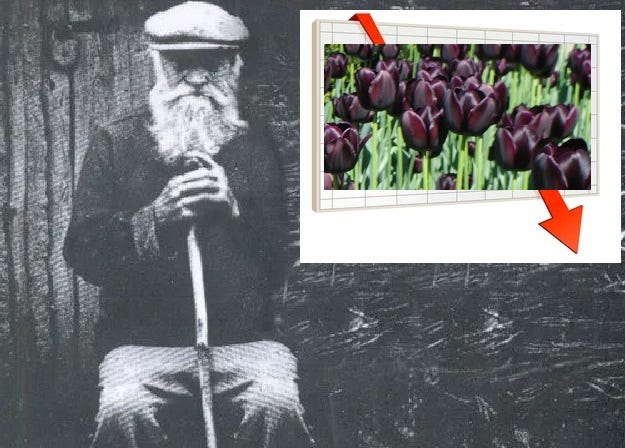
Introduction: For those readers who have been living under a rock, the Dutch Tulip Bubble was a fascinating episode in 17th Century Holland, when speculation ran amok on that most unlikely of subjects, the tulip bulb: “In 1634, the rage among the Dutch to possess them was so great that the ordinary industry of the country was neglected, and the population, even to its lowest dregs, embarked in the tulip trade.” Single bulbs of desirable varieties such as Semper Augustus sold for thousands of florin – roughly equivalent to hundreds of thousands of dollars. The mania peaked in November of 1636, after which came a terrible crash: “prices fell, and never rose again. Confidence was destroyed … The cry of distress resounded everywhere, and each man accused his neighbor … the commerce of the country suffered a severe shock, from which it was many years ere it recovered.”
If you think (as I do) that we’re currently in a period of extreme speculative insanity, it might behoove us to study up on the finer points of previous speculative manias. I therefore thought it might be useful to collect some lesser-known tales from the Dutch tulpenwoede (tulip madness):
The Elusive Black Tulip. One of the rarest and most sought-after tulips of the time was a perfectly black one. It's told that one man, after long and arduous labor, finally succeeded in producing a single such tulip. Ecstatic, he took the bulb to be sold and found an eager buyer who paid a small fortune for it. Immediately upon payment, the buyer took the bulb and smashed it under his boot! Of course, it turned out he had developed his own black tulip and didn't want the competition. The first man is said to have died of a broken heart. Note: for a much longer variation on the same theme, check out The Black Tulip by Alexandre Dumas (more famous for The Three Musketeers) – it’s set during the tulip mania, and a large factor in the plot is a high-stakes contest to grow a perfect black tulip.
Momentum vs. Value Investing (in tulips). While we may think of tulip mania participants as a single undifferentiated gibbering mass, it turns out there were at least two schools of thought, corresponding to today's value investors and technical or momentum traders. The momentum group predicted prices just based on previous market action, while the value group looked down their noses at this nonsense, and instead attempted to rationally calculate an intrinsic value for the tulip based on its characteristics (coloring, symmetry, etc). The more things change …
The Fateful Herring. A wealthy merchant received an important message delivered by a sailor, and rewarded him with a fine herring for breakfast. The sailor, spying a bulb very much like an onion on the merchant's counter, and probably thinking it out of place among the other valuables there, swiped it as an accompaniment for his newly acquired herring. He went off happily to the docks to eat his meal. Shortly thereafter, the merchant noticed the sudden absence of his priceless Semper Augustus tulip bulb. After a frantic search, someone thought of the sailor. He was found innocently finishing the last morsels of the bulb, and spent the next several months in prison on a felony charge brought by the merchant.
The Bumbling Botanist. A variation on the last tale concerns a visiting Englishman and amateur botanist who noticed a tulip bulb lying in the garden of a wealthy Dutchman. Ignorant of its value, he commenced a thorough dissection of the bulb, making many learned remarks on its singular appearance. Suddenly the owner appeared and furiously asked him what he thought he was doing. “Peeling a most extraordinary onion,” replied the scientist. “Hundred tausend duyvel!” roared the Dutchman, “it's an Admiral Van der Eyck!” “Why, thank you!” replied the Englishman, “are these admirals common in your country?” “Come to court” said the Dutchman, seizing him by the collar, “and you'll find out,” … and the Englishman spent several months in prison until he could arrange to repay the damages.
Sources: the quotes in the first paragraph are from Extraordinary Popular Delusions and the Madness of Crowds, by Mackay, originally published in 1841 but still a pretty good read today. The first two stories are from The True Story of Flower Power, by Rigby, in Management Today, June 1997; the next two are from Mackay.
No posts
Comments
Nothing yet. Say the first thing.
Sign in to join the conversation.