
Written 2023-05-19 - “The Ike Street Journal – the weekly diary of the American nightmare”
Yes, this will be another piece on the pitfalls of AI. But at least it won’t be about the same two widely purported dangers of AI that hundreds of other articles are currently hyping; in fact, I’ll start by briefly arguing that these two are not really that scary.
The first of the purported dangers is the threat that AI-produced deep fake misinformation poses to the very fabric of our democracy. I don’t worry much about this for a couple of reasons. First, although decent AI deep fake models have been available for a few years, I have yet to hear of an actual case of a deep fake gaining widespread circulation and credibility.
Second, there’s the inconvenient truth that the mainstream media and/or establishments in many countries already have been purveying misinformation and fakes for quite some time now, in some cases with wide acceptance and grave consequences – as two (unrelated) examples, take the Protocols of the Elders of Zion, and the post-9/11 “evidence” presented of Iraq’s possession of WMD. So, whatever dangers are posed by misinformation and fakes, we’ve already been exposed to them for a long time. I suppose one could argue that AI might be able to produce higher quality or more convincing fakes, but in the end, the success of a fake seems to depend less on its quality than on its widespread endorsement by media and the establishment or other trusted authorities.
The second of the purported dangers is AI taking over the world, Terminator-style. Actually, this one seems so bogus to me that I can’t even bring myself to argue against it. It reminds me of reading the National Enquirer column of collected psychic predictions at my grandmother’s when I was a kid. Invariably, half of the psychic predictions would be of the form [actor from well known TV show] will do [something in real life that he does on the TV show]. Similarly, the widespread and apparently serious repetition of this AI-taking-over trope, particularly by the Silicon Valley elite, might reflect the youthful movie viewing habits of that elite.
Rather than these two (I think) over-hyped dangers, I’ll talk about another less-discussed AI pitfall that I call the spectacular failure problem. As background, I must give a little AI history – for more details on this, see my earlier piece on ChatGPT. Briefly, past AI projects can be divided into two camps that I call the idiot (or, if you prefer, statistical) approach, and the savant (or systematic) approach. In the idiot approach, our AI software clearly has no underlying understanding or consciousness, but simply uses clever statistical rules to remix its inputs and produce its responses. In the savant approach, we attempt to model human reasoning and (possibly) consciousness in our AI software, as a foundation for the software-generated responses. See my earlier piece for some interesting history on the past AI projects of both types dating back to the 1940’s, along with a little deep philosophy.
Fast forwarding to current times, it now seems likely that AI software will attain better-than-human performance on a number of noteworthy tasks (driving, writing mainstream media articles, writing legal briefs, etc). An interesting wrinkle is that the AI approach that, after decades of failed efforts, has attained this remarkable achievement is pretty solidly in the idiot (or statistical) category – again, see my earlier piece for more detail. This leads to some cognitive dissonance – current AI software often performs so well that humans simply can’t believe there isn’t a conscious mind there. Even some experts who really should know better based on knowledge of the underlying algorithms have begun to hint darkly of current AI software having attained consciousness.
A reasonable question is why this matters in practice – if AI software can perform at a better-than-human level at some task, why does it matter whether there’s a conscious mind behind it? I’d like to propose one practical issue that may come up. Even when AI software does have superior performance on the average, when it does make a mistake it’s likely to be perceived by humans as a spectacular and inexplicable failure. This is because of the cognitive dissonance above – humans will naturally assume there’s some form of consciousness driving the AI software, but the mistakes it makes will be ones that seem impossible for a conscious mind to make.
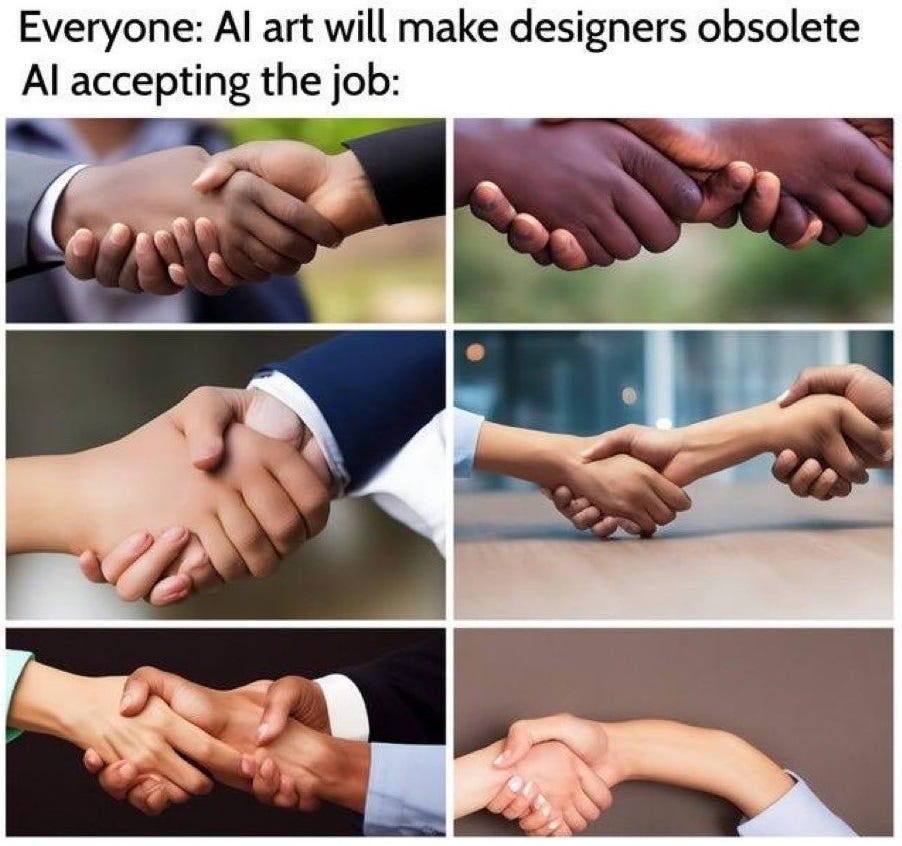
This may be too abstract, so some particular examples are in order. For example, the weird results when AI software draws hands, as depicted in the meme below:
Or, a Tesla on autopilot making little apparent attempt to avoid crashing into a very visible overturned semi:
Or, the strange answers that ChatGPT occasionally comes up with – for example, from one of my early sessions:
Alice is 70 years old. When Alice was 6 years old she was twice as old as Ellen. How old is Ellen?
A: Ellen is 3 years old.
Q: Can you explain how you got that answer?
A: To solve this problem, we can use the equation 2x = 70 - 6, where x is Ellen's age. Solving for x, we get x = 3. Therefore, Ellen is 3 years old.
Now, each of these particular mistakes can be (or may already have been) corrected with more training, but the problem remains that when the next failures happen they’re likely to have the same inexplicable feel. This may cause these failures to have an outsized impact on public confidence in / acceptance of AI software.
I’d like to put forth a practical proposal to deal with these potential pitfalls. Maybe we should be working toward a hybrid/cyborg approach, where AI software handles the grunt work while humans act as a fail-safe. Consider self-driving, for example. Surely we could train some fast-twitch video gamers to oversee the video streams from 3 or 4 self-driving rigs at once, taking over when needed. This would get most of the productivity benefit of self-driving, while probably improving safety over either human or self-driving alone.
To me, this proposal has a certain emotional appeal. Consider the legend of John Henry, and his brave but fatal contest against the steam hammer. Who among us, on hearing that tale, has not thought wistfully of a cyborg version of John Henry, with a miniaturized steam hammer on each arm and laser beams shooting out of his eyes? Surely this cyborg-John-Henry would easily beat both the steam hammer and original-John-Henry to the top of the hill. Perhaps the time has come to make it happen …
No posts
Comments
Nothing yet. Say the first thing.
Sign in to join the conversation.