
Written 2023-06-07 - “The Ike Street Journal – the weekly diary of the American nightmare”
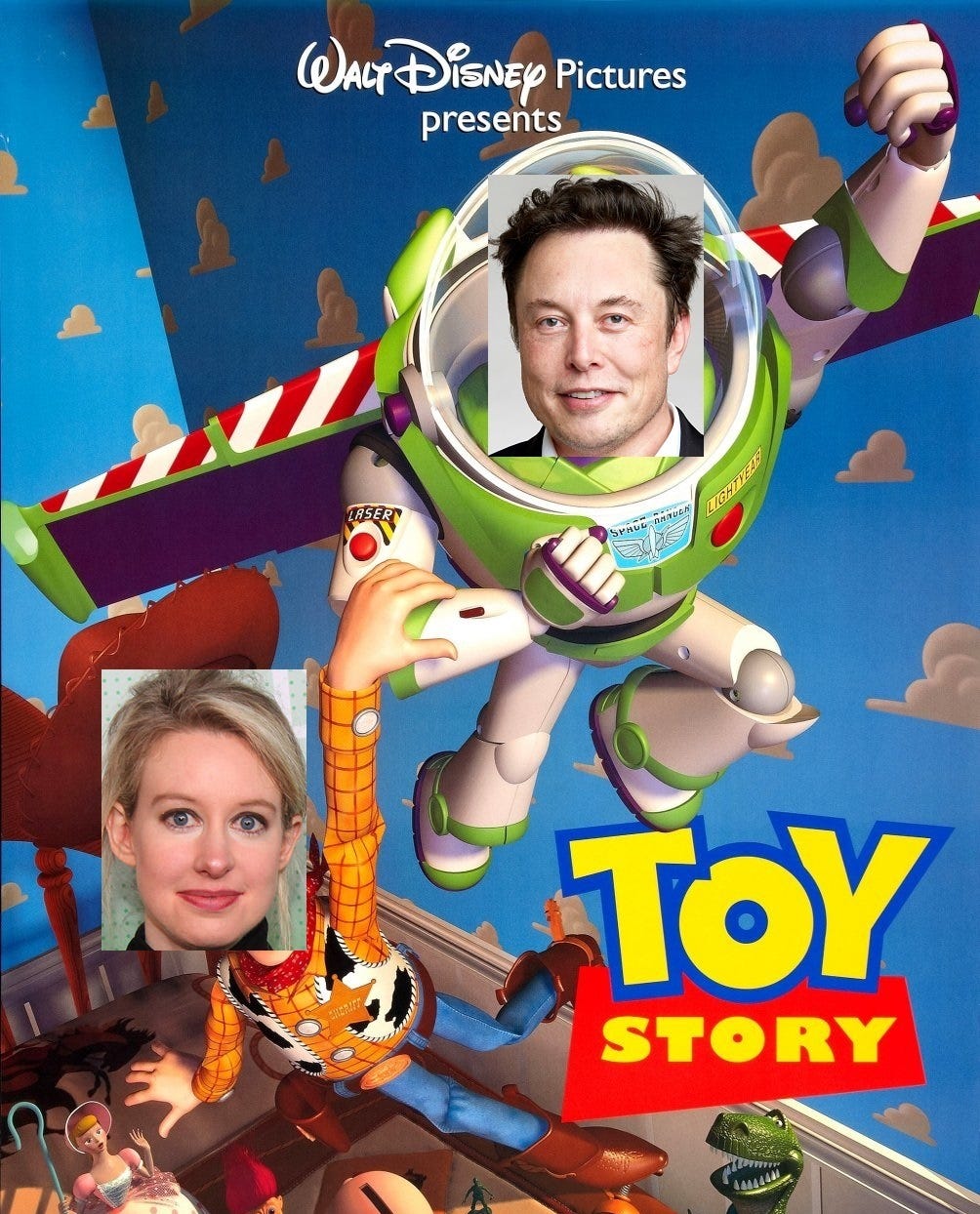
Warning: None of the following is investment advice. Do your own research and make your own decisions!
The subject of my rant this week is the Silicon Valley startup culture – I’ll mostly use Elon Musk and Elizabeth Holmes as instructive examples, but I think the ideas are more widely applicable. I’ve been motivated to write this because it feels like a lot of media coverage betrays basic ignorance of how this startup culture actually works. Furthermore, I think a better understanding can be helpful with investing in this area, should you be so inclined.
Take Elizabeth Holmes, for example. I’m not justifying or defending her behavior, but at the same time I’m pretty sure this behavior is standard for Silicon Valley: to wit, say you’ve got something working before it’s actually working, and then crack the whip on your indentured-servant engineers to get it done. This has been done since time immemorial (or at least the 1980’s), by the most prominent of Silicon Valley titans – Oracle, Microsoft, etc. Indeed, this is where the word “vaporware” originated – companies would announce new products with cool features before they existed (often to counter competitors who were about to deliver said features), and then work frantically behind the scenes to actually create said new products, with mixed results. Granted, one could argue that Holmes was particularly bad because she operated in healthcare, where this behavior could endanger lives. There’s some truth to this, but many other tech companies operate in mission-critical areas where malfunctions can also have grave consequences.
Another trope that I often see that betrays ignorance about Silicon Valley is the long and detailed expose of a founder’s supposed lack of technical competence or aptitude (I see this a lot about Musk in particular). Again, regardless of the expose’s truth, this situation is not at all uncommon in Silicon Valley – for example, it’s generally accepted that Steve Jobs was not highly skilled technically.
So where do we begin our journey to understanding? Let’s open with two inconvenient truths:
An elite exists in our society that has practically unlimited access to capital. This may be uncomfortable to acknowledge since it runs against the approved narrative that our society is the most meritocratic ever to exist. However, with a little sober reflection you should realize, that, for example, a non-elite-class 19-year-old with no track record or qualifications wouldn’t have access to hundreds of millions of dollars in startup capital simply because she had a cool-sounding idea, as Elizabeth Holmes did.
Members of this aforementioned elite, like most of us, have watched a bunch of cool science fiction movies in their youth. Therefore, when starting up a company using their access to almost unlimited capital, it’s natural that they would try to manifest in real life the cool visions that they viewed in their formative years.
For example, looking at Elizabeth Holmes, the original concept for Theranos was similar to the “tricorder” from Star Trek – an instrument that both diagnosed medical conditions and dispensed the appropriate treatment. And, of course, several of Elon Musk’s startup concepts are easily traceable to cool science fiction movies of his youth (reusable vertical-landing rockets, colonies on Mars, mind-controlled devices, humanoid robots, etc).
Thus far, this may seem like a sour-grapes complaint about elitism. Well, it is that, but there’s also an interesting investing angle. When a member of the unlimited-capital-elite starts up one of these sci-fi vision companies, something truly interesting can happen. In some fateful cases (electric cars, for example), it turns out the barrier to the sci-fi vision was less substantial than it seemed – in fact, it was made up less of real obstacles than the reluctance of established companies to endanger their existing nice comfortable businesses and, in the bargain, risk large amounts of capital scaling up new ones – or, as The Sopranos puts it, to “go into the unknown not knowin’.” This is where the unlimited-capital-elite can play a really productive role – their access to a huge amount of capital, combined with a Butch Cassidy-like willingness to jump off a cliff with that capital and see if they survive, can give some industries a badly needed kick in the ass.
Digression: Failure to understand this dynamic has led quite a few Tesla bears astray. I’ve seen many predictions over the past few years to the effect that Tesla will be in serious trouble in a year or two when established car makers start producing the snazzy new electric car models they’ve just announced. This betrays ignorance of the powerful forces that impede established car makers from competing successfully at EVs. In fact, a little historical research would have revealed that the established car makers have been trotting out cool concept EVs for decades, without ever being serious about them (more accurately, they’ve alternated between cool concept EVs and cool concept hydrogen cars). Any troublesome competition for Tesla is, therefore, much more likely to come from Chinese EV startups.
So how do we start to think about investing in this sci-fi-vision category of company? I find a useful way is, fittingly, as a video game, with a series of levels that have to be cleared to win. These levels include:
Is-it-physically-possible level – can you make working prototypes?
Artisanal level – can you make and sell a few copies?
Scale-up level – can you make and sell many copies?
As with a video game at your local arcade, if it becomes clear that one of these levels is going to be extremely hard to survive, it’s probably best to try another game.
With this viewpoint, you can start to usefully think about what level a startup is currently at, and how hard each level is likely to be. For the first level, for example, a good question may be: does the idea run into some fundamental physical obstacles? Looking at the case of Theranos, the idea of doing a bunch of tests based on a single drop of blood from a fingertip faced two tough hurdles:
Blood from a fingertip (capillaries) is quite different from that taken from a vein, so all the existing tests would have to be recalibrated/revalidated.
Getting results from a much smaller volume inevitably introduces lots of random noise, making consistent accuracy much harder to attain.
In the case of Tesla, on the other hand, EVs were clearly physically possible – they had been made a hundred years earlier – so you could move on to thinking about whether the next levels were winnable (for some of Musk’s other startups, the answer may be mixed – for example, some of SpaceX’s objectives seemed physically possible but others, such as a viable human colony on Mars, seem extremely unlikely to me).
Evaluating subsequent levels may require some qualitative judgement about the founder. As alluded to earlier, technical aptitude is often not crucial. Some more important qualities may include:
ability to hire good talent
ability to motivate that talent
good instincts about marketing and product design
Digression: once a company has passed the first level, a good pattern for getting through the next two is to start at the high-end of the market and work your way down (as Apple did with the iPhone, or Tesla with the roadster, then Model S/X, then Model 3/Y). This can form a good match between demand/sales prices and production capacity/cost over time, as opposed to trying to scale up quickly as many startups do.
Finally, an interesting note: from an investing viewpoint, the best risk-reward opportunity in these sci-fi-vision companies may come well after the IPO. In the past decade, companies have often gone public without even getting through the first (is-it-physically-possible) level, but with sky-high valuations thanks to the hype over their particular sci-fi vision, combined with the general flood of easy money engineered by the Fed. After a few years of grinding away, a company may have actually passed through a level or two, and have a decent shot at completing the game – but their valuation may have been beaten down dramatically because it’s taken longer than initially predicted or because the hot money has decamped for the next hot sci-fi-vision (for example, look at Tesla around the time of scaling up Model 3 production). Thus, you may be buying a better chance of winning the game – at a cheaper price!
No posts
Comments
Nothing yet. Say the first thing.
Sign in to join the conversation.