
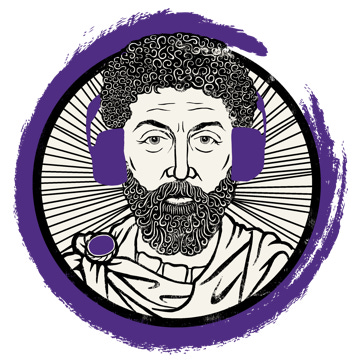
THE STOIC EMPEROR AND THE ART OF LIVING A VIRTUOUS LIFE
We’d say Marcus Aurelius was a rock star philosopher, but that would fly in the face of what being a Stoic is all about. Imagine being the most powerful person in the world yet taking time every night to jot notes to yourself about how to be a better person. That’s the kind of guy Aurelius was, and it’s also why his wisdom on navigating life’s complexities is as relevant to this day as they were in his time — and clearly something to, well, meditate on.
What Aurelius’ famed “Meditations” really were — and why his deeply personal observations weren’t meant to be shared
Why the mind is the battlefield that this Roman Emperor was most focused upon, even as he led the Romans through 12 years of war (the Roman–Parthian War of 161–66 and the Marcomannic Wars)
The dance between the ebb and flow of nature and that of the will of human beings… and how that impacts the future
How Aurelius embraced the Stoic doctrine and how he deviated from it (Hint: Cue the song “Feelings” by Morris Albert)
The best way to handle anger (along with all of your impulses and emotions)
Plus a few biggies: how to find true happiness, what’s the purpose of life, and what the heck he meant by “the universe is transformation: life is opinion”
Scroll to the very bottom for the transcript. And please note: I Hear Dead People™ is designed to be heard. If you are able, we strongly encourage you to listen to the audio, which includes emotion and emphasis that's not on the page. Transcripts are generated using a combination of speech recognition software and human transcribers, and may contain errors. Please check the corresponding audio before quoting in print.
Again, thanks for accompanying us on this journey! And we wholeheartedly hope that you’ll tell all of your truth-seeking friends and family members about the podcast.
Until next time, stay spirited and… laugh a little! 🤣
P.S. We’d love a five star review on Apple Podcasts. It really helps us get the word out. Click here to leave a review.
Thank you for supporting our show.
TRANSCRIPT
Dorion: Welcome back to I Hear Dead People, the podcast that celebrates the joy of seeking truth for its own sake. I’m Dorian Positano.
Tom: And I’m Tom Asacker. At the top of the Capitoline Hill in Rome, Italy, the steepest of the storied seven hills of ancient Rome, is Michelangelo’s beautifully redesigned Piazza del Campidoglio. At its center, a massive statue of antiquity’s great philosopher-emperor stands in the open air. Marcus Aurelius Antoninus Augustus sits coolly astride his intense-looking warhorse, his right arm raised in calm acknowledgment of the city below. On today’s show, this last of the five good emperors of Rome, the five rulers who presided over the most majestic days of the Roman Empire, comes down from his high horse to talk with us about his many challenges, the thinkers and ideas that influenced him, and his outlook on life, which is revealed in a collection of personal writings known as “Meditations.”
Dorion: High horse? I thought you told me he wasn’t the least bit arrogant or prideful.
Tom: I’m talking about the bronze horse in the piazza. It’s more than 12 feet tall!
Dorion: You’re something else.
Tom: Thanks. Listen, learn, and laugh a little.
Theme music
Dorion: The great Stoic philosopher Marcus Aurelius.
Tom: Who was born Marcus Annius Verus, April 26, 121 A.D. in Rome, Italy.
Dorion: April 26th? So he was a Taurus. Didn’t you tell me that the Romans invented astrology?
Tom: I did. They also believed that the Earth was the center of the universe.
Dorion: So how long was Marcus’s reign as emperor and how old was he when he died?
Tom: He was the 16th emperor of Rome and ruled from 161 to 180 AD. So from the age of 39 until his death at age 58.
Dorion: Hm.
Tom: 19 long years.
Dorion: And how did he die?
Tom: We’re not exactly sure. He died while on a military campaign against barbarians in the north. But the cause of his death is believed to be natural, possibly from the Antonine Plague.
Dorion: Why was it called the Antonine Plague? And what was it? Does anyone know?
Tom: It was named after the Antonine dynasty, which was the ruling dynasty at that time, and specifically after Marcus Aurelius Antoninus, who was the emperor during the outbreak.
Dorion: Oh.
Tom: Some scholars believe that it may have been either smallpox or measles. Whatever it was, it was one of the deadliest pandemics in history and is estimated to have killed between 5 and 10 million people, devastating Rome and Marcus’s military and wiping out entire villages and towns during the last 14 years of his life.
Dorion: Wow. Sounds terrible. So I’m guessing he leaned pretty heavily into his Stoic philosophy.
Tom: Yeah, no doubt. In order to deal with the uncertainty and anxiety, and to cope with the brutal horrors of war. It was a very dark and stressful period.
Dorion: Hey, by the way, how did he get involved with Stoicism in the first place?
Tom: He was likely introduced to it at a young age by his tutor, the philosopher Junius Rusticus. In addition to Rusticus, Marcus was also influenced by other Stoic philosophers of his time, including Epictetus and Seneca. He studied their writings and incorporated their ideas into his own philosophical outlook.
Dorion: I see.
Tom: In fact, it was in the middle of the plague when Marcus began writing down his personal reflections, which later became the popular and influential book, “Meditations.” I’m sure you'll be discussing it with him during your interview.
Dorion: Hmm, I didn't know that. And yes, we’ll be diving into that book and his various insights. I’m interested to talk with him considering that we’re also living in pretty stressful times with the effects of our own pandemic, economic uncertainty, war, natural disasters, and political and social turmoil. Gee, have I missed anything? Don’t answer that.
Tom: Okay, I won’t. Anyway, there hasn’t really been another human being like him. He was the most powerful man in the world, the leader of the global superpower, and he was wise and virtuous, an honest and benevolent king. Think about that for a second. This guy was the absolute ruler of the entire Roman Empire, the greatest empire the world had ever known, which, by the way, included being the head of the Roman state religion. His word was law. He had the power of life and death over anyone for any reason, and he had no external constraint whatsoever over his desires. He could have or do whatever he wanted, whenever he wanted.
Dorion: Hm.
Tom: I mean, try to imagine what that’s like. It’s a mind-boggling temptation. You want wealth? You can have as much as you want, in any form. You’re bored? You can have any kind of food, substance, sex, entertainment, whatever, with whoever you want, whenever you want. Someone pisses you off? You can do whatever you want to them, no questions asked.
Dorion: Is that right? I’ve heard that power attracts the worst and corrupts the best. I can’t wait to understand how his philosophy flipped that idea on its head.
Tom: There’s so much wisdom in that little book, you’ll never run out of things to talk about. I mean, my copy has more highlights than not.
Dorion: Kinda defeats the purpose, wouldn’t you say?
Tom: Yeah, I get it. If it’s all highlighted, then none of it is highlighted. Look, just try to remember, this guy is not going to pull any punches with you. If you ask him a question, expect to get a serious-minded, matter-of-fact answer.
Dorion: I hear ya. And so I should probably try to be a bit more stoic myself.
Tom: Yeah, good luck with that. You are both Italians.
Dorion: Hey, that’s stereotyping. And anyway, I’m half British.
Tom: Yeah, and that’s stereotyping too. But it should help.
Dorion: Marcus Aurelius Antoninus. Welcome to the show.
Marcus: Greetings, my friend.
Dorion: So, there’s a saying that I really like: Great minds discuss ideas, average minds discuss events, and small minds discuss people. In the spirit of that adage, I’d like to spend the bulk of our time together discussing your ideas, specifically the ones in your book, “Meditations.” And I suppose a good place to start is to ask you why you wrote the book in the first place.
Marcus: I appreciate that maxim, and your interest in my ideas. But my personal notes were never intended to be shared.
Dorion: Huh. Well, your book is filled with tweet-sized advice. And I’m sorry, I didn’t know they were private.
Marcus: Of course you didn’t know. And it’s fine. For what difference does it make? Accept the things to which fate binds you, and love the people with whom fate brings you together.
Dorion: Wonderful. Then, before you leave today, would you mind autographing my copy of “Meditations?”
Marcus: I’ll meditate on it.
Dorion: Hm.
Marcus: I’m just kidding. Of course I will. And please do not be misled by its pretentious title. The words written in your so-called book were not my theories or deeply considered reflections on life. They were simply diary entries with affirmations, as a way for me to remind myself through ink on parchment that which should remain preeminent in my daily life.
Dorion: I see. Basic principles to guide your thinking through what appears to me to be various observations or aphorisms.
Marcus: And internal debates, yes. On ideas like vanity, mortality, and, of course, Nature’s delight, in order to build up my life, action by action.
Dorion: I see.
Marcus: The wise and virtuous Socrates was once asked, “How would you climb Mount Olympus?” And he replied, “I would make sure every step I took was in that direction.”
Dorion: Well, that makes perfect sense. You know, what was striking to me after reading it is that I didn’t see much about how to be happy. I mean, you seem to be focused on how not to be unhappy. In fact, you wrote, “The art of living is more like wrestling than dancing, because an artful life requires being prepared to meet and withstand sudden and unexpected attacks.” That sounds a bit bleak to me.
Marcus: Hm. Very little is needed to make a happy life. It is all within yourself, in your way of thinking. And, if anyone can show to me and prove that I think and act in error, I will gladly change it. For I seek the truth by which no one has ever been harmed. The one who is harmed is the one who abides in deceit and ignorance.
Dorion: Okay then, let’s assume you’re correct. Are you essentially saying that we should be a bit paranoid about life? Always on guard? And look, I get it. As the leader of the Roman Empire, you probably had to be.
Marcus: The greatest empire is the empire of the self, my friend. And so, yes, I was always on guard with that empire. And so too should you be. Be aware of your own impulses, thoughts, and actions. Joy for human beings lies in proper human work, and proper human work consists in disdain for the stirrings of the senses, identifying trustworthy impressions, and contemplating the natural order, and all that happens in keeping with it.
Dorion: Hm. And as you’ve also made clear, acts of kindness to other human beings.
Marcus: Mm-hmm.
Dorion: Now, I want to unpack those principles with you, but before we do, I’d like to read something and get your reaction to it.
Marcus: Sure.
Dorion: It’s from one of the greatest English poems ever written, John Milton’s Paradise Lost: “The mind is its own place and in itself can make a heaven of hell or a hell of heaven.” It seems to me that Milton summed up your philosophy in that one lyrical line.
Marcus: Indeed, the energy of the mind is the essence of life. Our life and the world is what our thoughts make it. Realize this, and you will find strength. You need to avoid certain things in your train of thought, everything random, everything irrelevant, and certainly everything self-important or malicious. You need to get used to winnowing your thoughts, so that if someone says, “What are you thinking about?” you can respond at once, without reservation and trustfully, that you are thinking this or thinking that.
Dorion: I suppose the real battlefield is the mind. That said, the Roman Empire was a source of a lot of actual pain for you, not only during your 12 years at war, but also with chronic illness and the deaths of several close family members, including your wife and several children. Did you ever wish that your life had turned out differently?
Marcus: I have certainly felt the emotional shock of painful events, and I have wept at the loss of family and friends as well as the many tragedies that have befallen my people. However, I have never considered the thought of a different life, for although the swings of fortune may appear senseless or bad, the universe is a single living organism, possessed of one substance and one soul, holding all things suspended in a single consciousness and creating all things with the single purpose that they might work together, spinning and weaving and knotting whatever comes to pass. And so we must welcome every experience the looms of fate may weave for us.
Dorion: A single consciousness and a single purpose. You know, it sounds like you believe in determinism and the acceptance of fate. On the other hand, you emphasize the importance of personal agency and making choices in accordance with reason and virtue. So, are you a compatibilist?
Marcus: I am not familiar with that term.
Dorion: Well, compatibilists argue that even though we’re suspended in a single consciousness, working together to a single purpose, as you say, individually, we still have free will. And in your notes, you say to remember the Stoic philosopher Heraclitus. And Heraclitus wrote, “Character is destiny,” which seems to imply that fate is not a predetermined outside force.
Marcus: The Logos, the Divine, infuses and directs all things in nature, as well as the rational mind that is found in every person. So, yes, everything that happens is predetermined by the Divine, and human beings should accept their fate with equanimity and strive to live in accordance with reason and virtue, to use their rational faculties to make choices that align with the natural order of things. However, I do not believe in a fixed, predetermined future.
Dorion: Hm. So free will exists?
Marcus: There is most certainly a will, which is directed by right reason in accordance with Nature. And so, our actions may be impeded, but there can be no impeding our intentions or dispositions, because we can use reason to accommodate and adapt.
Dorion: I see. And those actions are necessarily a part of the natural order of things.
Marcus: If they arise from nature, from reason, the fundamental and divine force that governs the universe, and not from one’s personal deliberations. Nature working through an aware and receptive man, one whose own reasoning is aligned with the wisdom of the universe, is integral to its weaving and unfolding. An unfolding, however, that one will never understand. Consider my personal notes to myself. They were never intended for distribution or for teaching, and yet, here we are.
Dorion: Here we are indeed. And thank you again for being here. But it’s still a bit confusing. I read somewhere that man is like a dog tied to a moving wagon. And if the dog refuses to run along with the wagon, he’ll be dragged by it. And yet the choice remains his: to run or be dragged.
Marcus: That is very interesting. However, the wagon should be seen as the natural order of things. We are not passive puppets whose strings are moved by the forces of Nature. We have freedom on the strings, and so we have a choice in how we respond to the challenges and circumstances of life. We can choose to take responsibility for our own lives and make the choice to participate fully in it, to move forward with the wagon of fate, to go along with Nature and reason, or we can resist and then be dragged along.
Dorion: Interesting. Kind of reminds me of what William Shakespeare wrote. In King Lear, he wrote, “It is the stars, the stars above us, govern our conditions.” But in Julius Caesar, he has Cassius say, “The fault, dear Brutus, is not in our stars, but in ourselves.”
Marcus: Who is this William person and how does he know what Cassius said to his brother-in-law?
Dorion: He’s a renowned English playwright and I have no idea. He probably made it up for dramatic effect.
Marcus: I see. We should approach such entertainment with discernment and guard against becoming too emotionally entangled in various stories and dramas.
Dorion: Yeah, Plato made the same point when he was on the podcast. And so look, if I’m hearing you correctly, you believe that everything is interconnected and that the Logos permeates everything in it. But what you are not saying is that it has a telos, a particular intention or aim, like the telos of an acorn is an oak tree. Is that correct?
Marcus: Does the acorn have a premeditated goal of becoming an oak tree? Of course not. Its telos is growth and flourishing. The nature of it spontaneously arises out of the conditions of the environment and the intelligence of the universe combined. And the same is true of the wagon to which man is tied. And that is why it is important to live in accordance with Nature and to develop a great human environment, cultivated through reason, inner peace, and contentment.
Dorion: I see. And with regards to inner peace and contentment, you said that you wept at various losses of family and friends, right?
Marcus: Yes, of course.
Dorion: Okay, but that sentimental suffering doesn’t seem to square with what I’ve read about the Stoics and their philosophy.
Marcus: What does that have to do with me?
Dorion: Well, you know, you’re one of the most well-known Stoic philosophers.
Marcus: I have gathered wisdom from the Stoics, especially from the former slave Epictetus, for there is much that is true and of the greatest value in his writings. The Stoics teach us to regard all external things as of little moment, and to cultivate a sense of self-respect and self-reliance. But I don’t identify with any doctrine, for like Nature, they are constantly evolving.
Dorion: But when it comes to weeping, didn’t Epictetus say, hold on, let me find it in my notes. All right, “If you kiss your child or wife, say that you only kiss things which are human and thus you will not be disturbed if either of them dies.” It seems he’s implying that they’re nothing special. Anyway, honestly, the guy sounds like a sociopath to me.
Marcus: I have learned that many people say outrageous things for effect. Try to understand what is meant as opposed to what is said. The goal is not to turn us into men of stone.
Dorion: I assume you mean people of stone, and I agree with you there. You also said that we must welcome every experience the looms of fate weave for us, and would you say that applies to the weavings of our enemies as well? You know the line? “Oh, what a tangled web we weave, when first we practice to deceive.”
Marcus: That’s a beautiful turn-off phrase. I wish I had written it. The best way to deal with enemies is to simply not become like them. Rather than seeking revenge, understand their nature and respond with kindness and dignity. Life is short. Focus on your life and do not waste time worrying about them. By living our lives to the fullest, we can show our enemies that they have no power over us.
Dorion: What do you mean by understand their nature?
Marcus: Human beings are social animals and are inherently weak and imperfect. They are like this because they cannot tell good from evil, and so they are often tempted by their desires, emotions and external circumstances. But again, the best way to avenge yourself is not to become like the wrongdoer. Our innate social nature is meant to be a source of strength, support, and comfort. So embrace that nature and adapt yourself to the things among which your lot has been cast, and love sincerely the fellow creatures with whom destiny has ordained that you shall live.
Dorion: Hm. Easier said than done.
Marcus: Life is easier said than done. However, if you don’t deal with what you know you need to deal with, then life will deal with you.
Dorion: Oh.
Marcus: And please don't let your imagination be crushed by life as a whole. Don’t try to picture everything bad that could possibly happen. Stick with the situation at hand and ask, why is this so unbearable? Why can’t I endure it? You’ll be embarrassed to answer.
Dorion: I see.
Marcus: So when you wake up in the morning, tell yourself, the people I deal with today will be meddling, ungrateful, arrogant, dishonest, jealous and surly. But we were born to work together like feet, hands and eyes, like the two rows of teeth, upper and lower. To obstruct each other is unnatural. To feel anger at someone, to turn your back on them, these are obstructions.
Dorion: Okay, hold on. Are you telling me that you didn’t feel anger at the barbarians’ invasions and their impact on the Roman Empire? I mean, no disrespect, but I find it hard to believe that four straight years of bloody battles with the Germanic tribes didn’t get to you. Plus, isn’t anger important? Doesn’t it help energize people to initiate some kind of action against evil?
Marcus: Of course it got to me. It is totally understandable that wrongdoings may anger a man temporarily, but I never harbored hatred towards the barbarians, nor to my political opponents who sought to undermine my rule, for I have seen the beauty of good and the ugliness of evil, and have recognized that the wrongdoer has a nature related to my own, not of the same blood or birth, but the same mind, and possessing a share of the Divine.
Dorion: That reminds me of something the poet Longfellow said: “If we could read the secret history of our enemies, we should find in each man’s life sorrow and suffering enough to disarm all hostility.”
Marcus: Interesting. That fellow was long in wisdom. And to answer your other question, yes, a situation may result in anger, but it is important to be mindful of that emotion. Allow it to inform you, but not to influence your inner state. Since anger, if not restrained, is frequently more hurtful to us than the injury that provokes it.
Dorion: I see.
Marcus: Yes, you should assert yourself in life, but never be aggressive. Do not demonize people and do not remain in anger, since it will surely outleap reason. If you’re angry or frightened, you will not have access to the natural order of things and be able to take appropriate action.
Dorion: I see.
Marcus: Have you ever witnessed a combatant on the battlefield who was filled with uncontrolled rage?
Dorion: Can’t say I have.
Marcus: You are quite fortunate, young man. I have witnessed it far too often, and if they did not maintain their focus and composure with the sword in the midst of danger, they ultimately suffered horrendous consequences. Remember, anyone who angers you, conquers you.
Dorion: I see. A good friend of mine is always telling me to interrogate my thoughts by pausing and asking, is it useful? So I suppose I should be asking myself if my anger is useful as well.
Marcus: That is a good way to look at all your impulses and emotions. Whenever you lose your temper or become upset about something, you’re forgetting that everything serves the purpose of the whole. That another’s wrong is not your concern and that whatever causes you to be upset has always happened and will always happen and even now is happening everywhere. You’re forgetting too that everyone’s mind is of God and flows from the same divine source. Finally, you’re forgetting that everything is what your opinion makes it and that the present moment is all you have to live and to lose.
Dorion: Well, thank you. I’ll try not to forget. But I have to be honest, when I look at your ideas as a whole, and please don’t take this the wrong way, it appears that you consciously created your own obstructions, especially to life’s pleasures. For example, in your notes, you wrote: “How useful when roasted meats and other foods are before you to see them in your mind as, here the dead body of a fish, there the dead body of a bird or a pig. What a useful perceptual image it is. It goes to the heart of things and pierces right through them, so that you see things for what they are.” Now, no offense, but that way of thinking would kinda kill the vibe at The Capital Grille.
Marcus: Is that right? Meat is a dead animal, is it not? Or have you forgotten because the pig is shaped like a small, thin plate and called mortadella? Relationship to the earth and to each other is our nature as human beings. We are working together, a unified whole. Ignorance, comfort and pleasure is not the answer to life’s challenges. We must come face-to-face with facts.
Dorion: Okay, fine. I can’t argue with you there. We certainly don’t treat animals or the environment the way we should. That said, you also wrote that we should think of sexual intercourse as internal rubbing accompanied by the spasmodic ejection of mucus.
Marcus: Isn’t that an enticing thought? And to be honest, I don’t remember writing it. I was probably exhausted after a long day of battle and searching for a way to deal with my various impulses. Because, believe it or not, there were times when even I have craved things. But I knew the gratification would be fleeting and the suffering prolonged.
Dorion: Depends on who you’re having sex with. Then again, I’m not married to my cousin and sister. No offense.
Marcus: None taken. For the record, my wife Faustina and I were only siblings because her father adopted me. Probably because he knew my views on intercourse, he must have figured his daughter would stay relatively pure. But then again, we were blessed with the gift of 14 children together. So, you do the math.
Dorion: Okay, so you’re not saying you’re against pleasure?
Marcus: Of course we can enjoy things, but it is more important to be good and to make wise decisions. True happiness and well-being come from living in accordance with Nature and virtue, rather than from the temporary pleasures of external circumstances or possessions.
Dorion: Alright, but everyone needs a reprieve now and then, no?
Marcus: Sure. Pleasure which arises is fine. But pleasure that is pursued as a means of finding a reprieve leads to prolonged suffering.
Dorion: Is that right?
Marcus: People try to get away from it all, to the country, to the beach, to the mountains. You always wish that you could too, which is idiotic. You can get away from it anytime you like, by going within.
Dorion: Really?
Marcus: Yes. Nowhere you can go is more peaceful, more free of interruptions than your own soul.
Dorion: Perhaps for you. And it seems to me that your philosophy of life is more like a psychological tool to help kinda maintain self-control and create inner stability, especially in a chaotic and challenging environment. I’ve read that your notes have proven to be quite useful to the military, actually, as well as with professional athletes and even entrepreneurs. People who need to know how to suffer the slings and arrows of outrageous fortune, so to speak.
Marcus: Hm. Another interesting choice of words. Who said that?
Dorion: It was Shakespeare again. The full line is, “Whether tis nobler in the mind to suffer the slings and arrows of outrageous fortune, or to take arms against a sea of troubles, and by opposing, end them.”
Marcus: Hmm. To suffer fortune, or to oppose it? Passively endure hardship, or take action and change one’s circumstances? Very interesting. And why are those the only two options?
Dorion: What do you mean?
Marcus: Why can’t we monitor the impressions and evaluations we make of fortune and realize that our suffering isn’t due to the thing itself, but to our estimate of it? Accept the inevitability of fate and focus instead on changing what you can while living a virtuous life.
Dorion: It’s as if you’re encouraging us to become the ultimate life hackers, recognizing that it’s not the cards we’re dealt, but how we perceive and play them that truly matters.
Marcus: The ultimate goal is not about hacking life for momentary gain, but rather cultivating a deeper, more profound understanding of oneself and one’s place in the world. And regarding your idea that my way of looking at life is some type of coping strategy or that my notes are lessons for self-sufficiency, please understand that this has nothing to do with advancing one’s personal goals and status. It’s about our shared humanity in which we are all connected.
Dorion: So they were to help you be more responsible to others and to the world.
Marcus: I would not say responsible. It is not about answering to another, for whom would I, an emperor, need to answer to. Rather, it is to help me remain aware of my relationship to nature and to cultivate positive emotions so that I continue to respect and love all aspects of life.
Dorion: You know, you say that your way of looking at life has nothing to do with advancing one’s personal goals and status. And I understand that, and I agree that if anyone leverages stoicism for personal gain, then that person has completely missed the point from the get-go.
Marcus: You’re right.
Dorion: So, what would you say to someone who uses your philosophies to enable individualistic goals and desires?
Marcus: Again, my philosophy of life is not a tool like a knife to be used for one’s particular purposes. It is a way of being in all situations. My notes were not about helping me tune out the outside world or to be tough and resilient, so that I could focus on and advance my individual concerns. They were about helping me become more conscious and fully engaged so as to flourish in the world, to live a harmonious and meaningful life with others and in accordance with Nature. An individual’s character is shaped by all the interactions and experiences they have with the world around them.
Dorion: I see. So let me ask you this. Is this outlook of yours simply the luck of the genetic draw? Or is it an attitude that the rest of us can cultivate? And I’m sure this is a sensitive topic, so I apologize in advance if it strikes a nerve with you. But your son, Commodus, I mean, he’s regarded as one of the worst emperors in Roman history. Cruel, incompetent...
Marcus: There’s no need to go further. I know all about my dear son’s shortcomings, as a leader and as a man. Commodus did have great potential, and I wanted him to be virtuous and just, but it simply was not to be.
Dorion: Right. I see.
Marcus: He became consumed by worldly fascinations, and for what it’s worth, I had my concerns about both his character and his ability to rule. So perhaps I should have adopted an heir to the imperial throne. One can never know.
Dorion: Perhaps, but at least it’s good to see that you’re human, that you make mistakes too. Plus, it really makes you wonder about how much parents actually shape a child’s life, wouldn’t you say?
Marcus: We can only try to create the right conditions for our children’s connection to Nature and to their growth. They have their own unique guardian spirits that influence their thoughts and actions. And like all human beings, my knowledge was limited. What I had imagined for my son and what he became were two very different things. Plus, am I not a part of the whole which is governed by Nature? Of course. And by remembering that, I am content with what has happened.
Dorion: So, no guilt then?
Marcus: Emotions like guilt should be in accordance with reason.
Dorion: I see.
Marcus: On the battlefield, I have seen a hand, a foot, or perhaps a head severed from its body and lying some distance away. Such is the state a man brings himself to, as far as he is able, when he refuses to accept what befalls him. He becomes an outcast from the unity of Nature. Though born of it, his own hand has cut him from it. Yet, here is the beautiful proviso. It lies within everyone’s power to join Nature once again. God has not granted such favor to any other part of creation. Once you have been separated, once you have been cleft asunder, he will, at any moment, allow you to return.
Dorion: Well, that’s good to know. And the best way to go about that return?
Marcus: Again, by employing reason. Start your day off with the proper outlook, and end it the same way. Let go of the past, and remember, you have power over your mind, not outside events.
Dorion: I see.
Marcus: So, focus on what is truly important, which is not you and your desires, and eliminate distractions and you will remain free.
Dorion: Distractions, right, like social media. So literally put it out of sight and then it will be out of mind.
Marcus: It works. Simply compare the cleanliness of the bowls on the serving table to the ones on the bottom shelves in the servants’ kitchen.
Dorion: Or your countertops to the top of your refrigerator.
Marcus: Whatever. The point is, stop letting yourself be pulled in all directions. Make time for yourself to learn something worthwhile, and then concentrate every minute on doing what’s in front of you with precise and genuine seriousness, tenderly, willingly, and with justice. You can free yourself from other distractions if you do everything as if it were the last thing you were doing in your life.
Dorion: Yeah, sure. I mean, if it’s a sword whooshing past your head, you’re probably not thinking about your stock portfolio. But yeah, I hear ya.
Marcus: Do you hear me? At dawn, when you have trouble getting out of bed, tell yourself, I have to go to work as a human being. What do I have to complain of if I’m going to do what I was born for, the things I was brought into the world to do? Or is this what I was created for? To huddle under the blankets and stay warm? So, you were born to feel nice, instead of doing things and experiencing them? Don’t you see the plants, the birds, the ants, and spiders and bees going around their individual tasks, putting the world in order as best they can? And you’re not willing to do your job as a human being? Why aren’t you running to do what your nature demands? You don’t love yourself enough, or you’d love your nature too, and what it demands of you.
Dorion: Well, a lot of people feel like staying in bed because they haven’t found the job they were born for, as you say.
Marcus: I see. And that is because they lack both the understanding and the courage to accept whatever fate befalls them. The purpose of life is to live in accordance with reason and virtue, and to achieve inner peace and tranquility by living a life of moral excellence. And so, it doesn’t matter what they are doing. They must accept fate, without attachment to material possessions or worldly success, and cultivate virtues, such as wisdom and duty to others. If they do that, Nature will ensure that live fulfilling and meaningful lives.
Dorion: So, put my head down and, as they say, do the work. Or rather, do my work.
Marcus: Yes, but make sure you guard against the other kind of confusion. People who labor all their lives but have no purpose to direct every thought and impulse toward. They’re wasting their time, even when hard at work.
Dorion: I suppose doing stuff can simply be another way to tune out your true feelings and numb yourself to life.
Marcus: I agree.
Dorion: So, I guess the insight is don’t jump from one hamster wheel to the next.
Marcus: Right.
Dorion: Got it. Alright, well let’s switch gears. I’d like to know your thoughts about the stoic fork.
Marcus: The stoic fork?
Dorion: Yeah, it refers to Epictetus’s idea that all things can be divided into two categories, things that are within our control and are therefore up to us, and things that are outside of our control, so are not up to us. And I’m guessing the term had something to do with the fact that you ate with two-pronged forks back in the day. I imagine scooping up a side of risotto was sort of a pain in the ass. But anyway, I’ve also heard the idea referred to as the dichotomy of control, and people often compare it to something called the Serenity Prayer: “God, grant me the serenity to accept things I cannot change, courage to change the things I can, and wisdom to know the difference.”
Marcus: What would you like to know?
Dorion: Well, so I get it that, you know, in principle, Epictetus believed that people should focus their energy and attention on the things that are within their control, such as their thoughts, emotions, and actions, and let go of the things that are outside of their control, such as unexpected events or people’s opinions of them. But here’s the thing. If I don’t keep an eye on what’s going on around me, especially people who can have an effect on my life and my career, then it feels like I’m deluding myself and being a bit naive, I guess.
Marcus: Didn’t you just make it clear, with the example of me and my son Commodus, that no one can know the soul of another, nor can they control them? So, do not waste what remains of your life in speculating about your neighbors, unless with a view to some mutual benefit. To wonder what so-and-so is doing and why, or what it is saying, or thinking, or scheming, in a word, anything that distracts you from fidelity to the ruler within you, means a loss of opportunity for some other task.
Dorion: Okay, but the idea still seems overly simplistic to me. Honestly, you seem to have a pureness of heart and a pureness of intention that I’m not sure would suit you so well in today’s world. I mean, if you’re not watching out for your own interests, people will walk all over you. And there could be various factors that impact a particular situation, and you may not always know what’s in your sphere of influence and what’s not.
Marcus: In today’s world? Have you forgotten about the Ides of March?
Dorion: Right, right. When Cassius and Brutus and the other senators assassinated Julius Caesar.
Marcus: Yes, and that was many years before my time. You see, we must always see things for what they are at the time and rise to our potential through reason, cooperation, and selflessness. If you see wrongdoings or suffering with an individual or with a group, be generous with your time and your heart, but do so with a sense of restraint and act with compassion and justice. As I said before, be assertive but not aggressive.
Dorion: Hm. So, no easy answers then.
Marcus: In fact, the answer is easy: Do the right thing. Act virtuously. Fulfill your duties and let the outcomes take care of themselves. Nothing can bring you inner peace. You must bring yourself to it. And you do that by staying true to your inner values. Let your actions be directed to a worthy end, and let your thoughts be pure. The truth of a man lies in his heart.
Dorion: The truth of a person lies in his heart, no doubt. But we’re living during what many consider to be an unprecedented period of rapid change and complexity. And that’s creating a lot of uncertainty and anxiety. People feel compelled to do something, to make a difference.
Marcus: So then, do something! And why do you keep correcting me? When I speak of man, I am referring to all human beings who are equal in their rational capacities and moral worth.
Dorion: Okay, I hear ya.
Marcus: And with regards to complexity and change, remember that it is inevitable and we must learn to accept it. Time is a sort of river of passing events, and strong is its current. No sooner is a thing brought to sight than it is swept by and another takes its place, and this too will be swept away. The infinity of past and future gapes before us, a chasm whose depths we cannot see.
Dorion: Right. Well, you wrote that the universe is transformation. Life is opinion.
Marcus: We don’t see things as they are, but rather as we interpret them based on our beliefs and biases. Our experience of the world is constantly changing, and is subjective and influenced by our own perceptions.
Dorion: Very true.
Marcus: So maintain an open mind and be aware of your own perspective as you navigate through life. And keep in mind how fast things pass by and are gone, those that are now and those to come. The what of existence is in constant flux, and the why has a thousand variations. Nothing is stable, not even what’s right here.
Dorion: I can certainly attest to that. And what’s right here now is that our time together is coming to an end. So it seems fitting to discuss the ultimate end, what you refer to in your book as Memento Mori.
Marcus: Yes, consider yourself dead and the life you have lived till now gone. Now count the rest of your days as a reprieve from death and live according to Nature.
Dorion: Well, I’ve heard that before. Be here now. Beginner’s mind. Presence.
Marcus: Of course. Is there any other reality? And realize that death is not the end. It is a natural part of the human experience and we must accept its inevitability. It is not death that a man should fear, but he should fear never beginning to live.
Dorion: So don’t try to live forever like the life extensionists. You know, pop hundreds of pills, stem cell replacement therapy, freeze your head, upload your brain to the cloud.
Marcus: Who are you people? The fantasy of forever is misguided. It distracts us from living fully in the present moment and appreciating the beauty and complexity of our finite existence. Instead, focus on cultivating deep connections and contributing to the world in meaningful ways. By doing so, we honor Nature.
Dorion: Okay, but there’s nothing wrong with trying to live as long as possible, right?
Marcus: Even if you are going to live 3,000 more years or ten times that, remember, you cannot lose another life than the one you are living now, or live another one than the one you’re losing. The longest amounts to the same as the shortest. The present is the same for everyone. Its loss is the same for everyone, and it should be clear that a brief instant is all that is lost. For you can’t lose either the past or the future. How could you lose what you don’t have?
Dorion: That reminds me of what I think is a Tibetan maxim: It is better to be a tiger for one day than a sheep for a thousand years.
Marcus: I agree.
Dorion: And so what we do in each moment is what truly matters.
Marcus: Remember two things. One, that everything has always been the same and keeps recurring, and it makes no difference whether you see the same things recur in a hundred years or two hundred or in an infinite period. And two, that the longest lived and those who will die soonest lose the same thing. The present is all that they can give up, since that is all you have, and what you do not have, you cannot lose. And so, you should bear in mind constantly that death has come to men of all kinds, men with varied occupations and various ethnicities. We too will inevitably end up where so many of our heroes have gone. Heraclitus, Pythagoras, Socrates, brilliant intellectuals, high-minded men, hard workers, men of ingenuity, self-confident men, men who mocked the very transience and impermanence of human life, men long dead and buried. One only thing is important: to behave throughout your life toward the liars and crooks around you with kindness, honesty, and justice.
Dorion: Well, I think that’s a perfect place for us to conclude. But before we do, we like to ask each of our guests one final question as a way of trying to sum up their philosophy of life. So, here goes. If you could place a short message on a marquee sign in front of every school in the world, what would it say?
Marcus: Since we’re on the topic, I would write, We all die. It is how we live that matters. And if I thought people could read it while galloping past on their horse, I would add, You could leave life right now, so let that determine what you do and say and think.
Dorion: And in the spirit of that thought, let me just say that you are an amazing human being, and it has been an absolute privilege to be in conversation with you. So thank you.
Marcus: Thank you. And please remember, do not act as if you had 10,000 years to live. The inescapable is hanging over your head. While you have life in you, while you still can, make yourself good.
Dorion: I won’t. I mean, I will.
Marcus: Valeas.
Dorion: Well. Thanks everyone for tuning in to this episode of I Hear Dead People. You can subscribe to the show on Apple Podcasts, Spotify, or your favorite podcast app. If you like the podcast, please share it with your friends and consider giving us a rating and leaving a review on iTunes. Five stars would be great. This helps other listeners find the show. And please let us know what you think by visiting our website at iheardeadpeople.com. You can submit comments and questions, give us suggestions for future dead guests, and learn more about and support the show. In our next episode, we'll be unpacking our conversation with Marcus, so please tune in. And until then, Memento Mori.
Comments
Nothing yet. Say the first thing.
Sign in to join the conversation.