
There is a moment that happens before almost every Holocaust play begins, and it happens before the lights even go down.
The audience buttons up.
Not as a choice they make. More like something the body does on its own. They read the program, they settle into their seats, and somewhere inside a small arrangement occurs. The sorting comes first: they decide, without knowing they are deciding, which people they are about to watch belong in the column of victims and which belong in the column of perpetrators. And once the sorting is done, the armor follows. They know their job. They know where to direct their grief and where to direct their horror. They sit there, protected, waiting.
And once the audience has buttoned up, the play cannot reach them.
As theater makers, this is not something audiences do to us. This is something we produce in them. Through our staging choices, through the story we decide to tell and how we decide to tell it. The buttoning up is not their failure. It is ours.
Almost every production of this kind of material leads the audience sort. It signals, through costume and staging and the specific quality of cruelty on display, which column is which. And there is mercy in this. It makes the unbearable bearable.
It also makes the play a lie.
Because Our Class will not let you sort. Not through a dramatic reversal. Not through a moment where the columns flip. It works more slowly than that, and in a way the audience cannot defend against.
The play follows ten Polish classmates, five Jewish and five Catholic, from the 1920s into the war years. You watch them become people. Specific, funny, flawed, recognizable people who want what you want. And then in 1941, one half of the class burns the other half alive in a barn. It was not the Nazis who did it. It was the neighbors. And then you watch some of them make one small choice under pressure, and then another, and then another. You keep waiting for the moment they cross over. The moment you can move them to the other column and be free of them. The moment never comes. Because there was no single moment. That is what will not let you go.
I understand why directors explain. You are staging something incomprehensible and you want the audience inside it. So you build a case. Here is the childhood. Here is the wound. Here is the moment the ideology took hold. And sometimes that case is even true. Sometimes what happened to a person does lead somewhere terrible. The problem is not that the explanation is wrong. The problem is that it is always incomplete. And the audience, receiving it, uses it as an exit. I do not have that wound. I did not have that childhood. I would not have done that. And they sort. And they button up. And they leave.
The why matters. The why that closes the door and provides an explanation does not. Because explaining why is not the same as understanding who. And the why, however carefully constructed, always narrows. It makes the character smaller, not larger. More explicable, not more human. Good and evil are not distributed according to biography. They coexist in everyone, always, without needing a reason. Theater’s job is to hold that coexistence open. The moment you close it with an explanation, the audience can breathe again. And that breath is the play dying.
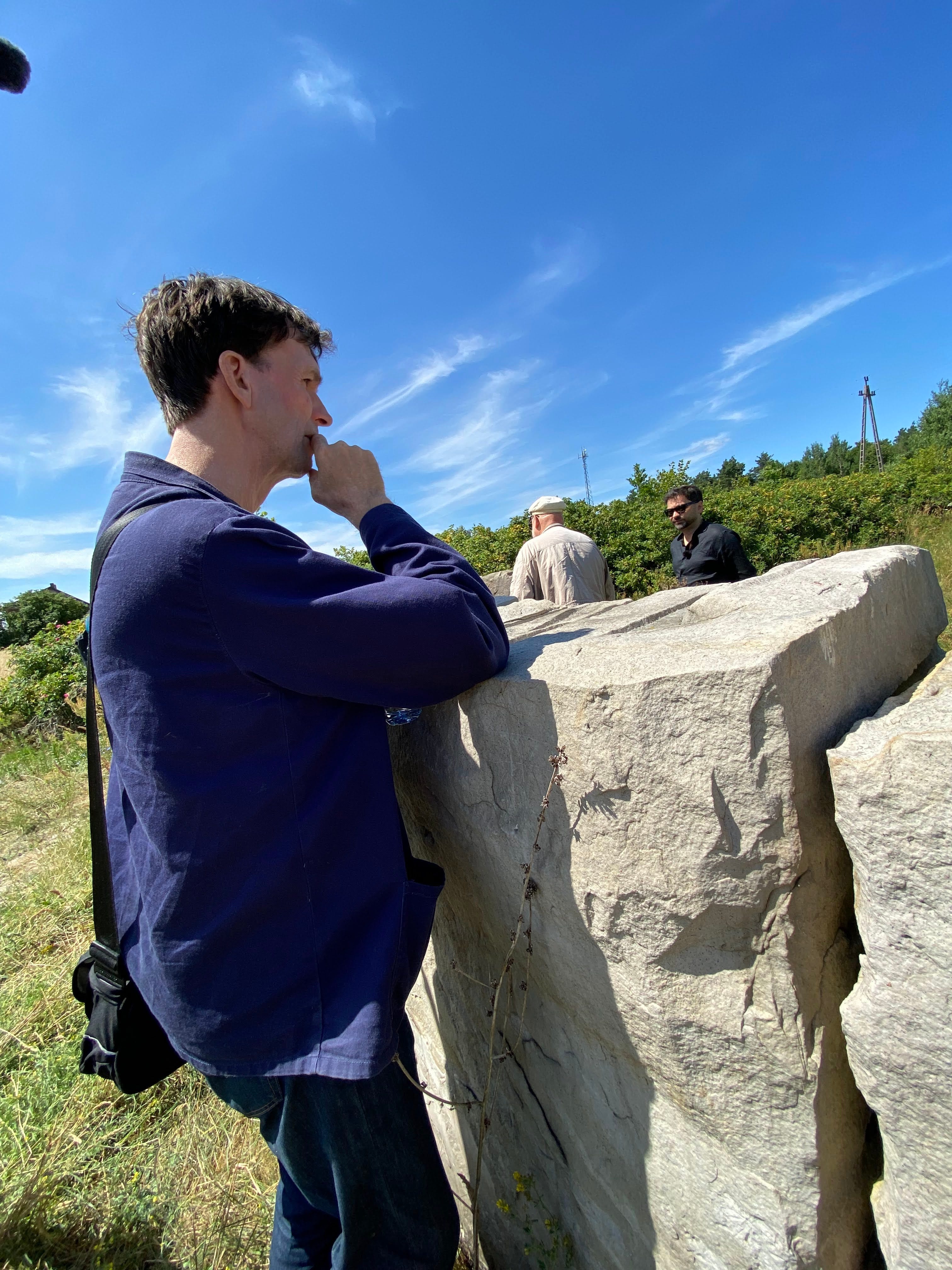
In the summer of 2023, I traveled to Poland with the playwright Tadeusz Slobodzianek and our scenographer Jan Pappelbaum, the head designer at the Schaubühne in Berlin. A German, a Pole, and a Jew, walking through Jedwabne.
Jan is a very tall, quiet man. At the site of the pogrom, he sat for a long time, photographing. Then he stopped. He looked at me and said: do you still want to do this with me?
I have not stopped thinking about that question.
We stood where the barn had been. The view was extraordinary. Peaceful hills, forest, light moving across water somewhere below. Unbelievably beautiful. And standing there I understood something that the play then confirms inside the theater: the world does not organize itself around our tragedies. The beauty was there before the barn burned. It is there now. The hills do not know what they witnessed. Horror and beauty do not sort themselves into separate columns. They coexist without apology. And that coexistence, that refusal to separate, is exactly what this play asks the audience to hold. Not as an idea. As an experience.
There is a monument at the site. For decades the original read: killed by Gestapo and Nazi soldiers. Then a book came out proving it was the neighbors. They replaced the monument. The new inscription honors the dead. It does not name who killed them. The neighbors are not mentioned. Not denied. Simply absent.
As if unknown.
The town is still sorting. Still protecting itself from the implication that it was them, ordinary neighbors, people who had shared meals and classrooms and celebrations with the people they burned. Not a lie this time. Something quieter. A careful silence where the perpetrators should be. The monument honors the dead while protecting the living. That is what sorting looks like when it gets built into stone. That is what this play will not let you have.
There is a character in the play named Jacob Katz. He is one of the Jewish students. He is the first one killed.
I have a son named Jacob. He is seven years old.
In rehearsal, when an actor says that name on stage, I cannot button up. I do not think I am the only one in the theater for whom a name lands that way.
One night at BAM, after a performance, the audience stayed in their seats for a long time. Gradually, people began to leave. One woman remained. She was in her seventies. When I approached her she had a quality I can only describe as a light gaze, almost enlightened. I asked if she was all right.
She said: no part of my family died in that barn. But I am so touched by this. And so thankful to be in the company of others.
She was not connected to this history by blood. She had no relatives to grieve. She stayed because of the room. Because for a few minutes more she was still in it with the people around her, still in the company of strangers who had just had the same thing happen to them.
I have thought about her more than about any review this production has received.
This is what you are building when you refuse the explanation. Not a lesson. A room. A room full of people who cannot sort, who cannot find the line, who are sitting in the dark with the same open question and nowhere comfortable to put it. That is the only thing theater can make that nothing else can. Not understanding. Not answers. A room where strangers discover they are not alone with what they cannot resolve.
Stop explaining why they did it. Stage who they are. The warmth and the horror. The same person. Always.
Our Class | Z Space | San Francisco | March 27 - April 5
No posts
Comments
Nothing yet. Say the first thing.
Sign in to join the conversation.