
I know I will be excommunicated from the world of theater for saying this, but every actor who thinks their job is to tell a story is slowly killing their work. And if you have spent years believing that it is your job, someone has stolen something from you, and I want you to have it back. That belief is not a small misunderstanding you can correct at the edges. It is the whole problem. It is the reason a perfectly good actor can stand on stage, say every word correctly, hit every moment, and leave me feeling absolutely nothing, like watching a very beautiful, very elaborate funeral for something that was never allowed to be born.
The strange thing is, it comes from the right place. The impulse to communicate, to make sure the audience understands, that is not a bad instinct. It just happens to be the wrong job. And nobody told you that. So you keep doing it, getting better and better at something that is quietly working against you the whole time.
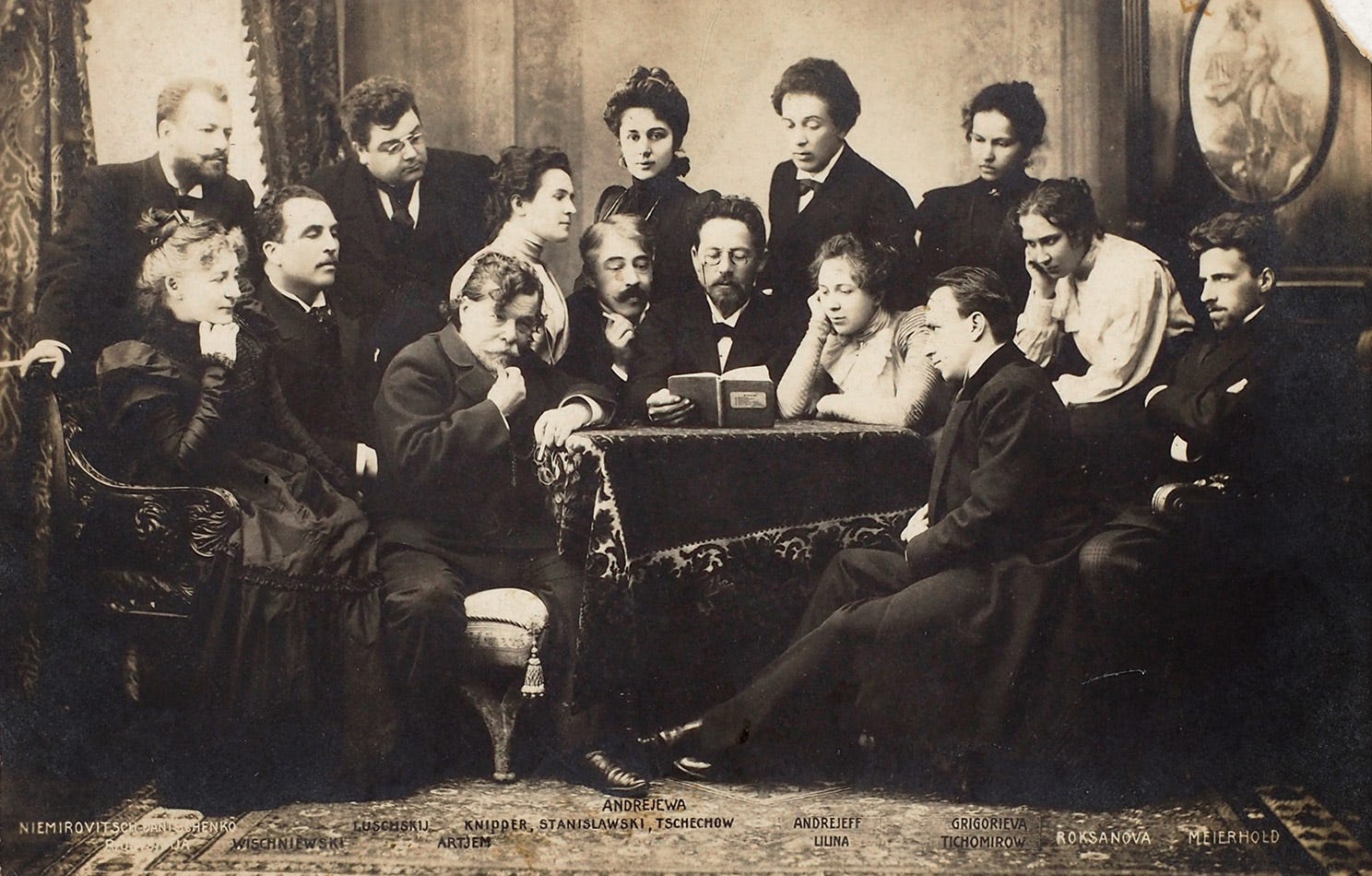
Here is what is actually happening when an actor decides to tell me the story. They pick up the text and treat it like scripture. Every stage direction, every pause Chekhov wrote, every indication of how a character moves or speaks, they follow it to the letter because Chekhov wrote it and Chekhov is Chekhov. But even Stanislavsky fell into this trap. When he was rehearsing The Cherry Orchard, he filled it with pauses, following everything on the page exactly as written, and Chekhov stopped him. These are not external pauses, Chekhov told him. This is something internal. He wasn’t leaving instructions. He was leaving traces of an inner life. There is a difference between the letter of the text and the spirit of it, and the actor who cannot tell them apart will execute everything correctly and understand nothing.
Because the text is not the job. The text is evidence. It is clues at a crime scene. And your job is not to recite the clues back to me, it is to investigate what actually happened in that room before anyone said a single word.
Don’t trust the characters either, by the way. Characters lie. They deceive themselves. When Constantine tells his mother his wound is healing, he is not reporting a fact. He is trying to protect her, make her feel better, from the weight of what actually happened. The words and the situation underneath the words are almost never the same thing. That gap, that is where the whole play lives. And the actor who is busy telling me the story never finds it, because they are too busy on the surface, making sure the surface is clear and readable and correct. So boring!
And then there is speed. What I see, especially in the opening third of a play, is actors sprinting. Getting rid of lines quickly, barely hearing each other, because somewhere they decided that this part is just setup, that the real play starts later. So they apologize for the beginning. They apologize for the relationships, for the atmosphere, for everything that hasn’t become dramatic yet. Speed is a form of apology. It is an actor saying: I’m sorry to be taking up your time, I’ll get through this as fast as I can. And in that apology, everything that the play is actually built on quietly collapses.
The shift is this: you are not here to tell me a story. You are here to create a human being.
That is the whole job. And a human being is not executing anything. A human being is trying to get what they want in a specific situation with specific obstacles in front of them, and failing, and trying again, and lying to themselves about why they want it, and saying the wrong thing to the wrong person because they cannot help it, because the right person is too frightening.
When you stop trying to tell me the story and start actually living in the situation, something else begins to happen. The subconscious starts giving you things you did not plan. Your body does something your brain did not decide to do. Your partner moves and you mirror them without meaning to, because something real is passing between you. And we, in the audience, are no longer watching a performance. We are watching a person. And we recognize them. And that recognition is what breaks your heart open in the good way.
We have never seen you as this character. That is the whole point. Not a generic version, not the version someone else would play, but yours, with your weirdness and your subconscious and your specific pain walking through that specific door. By executing a role you are killing it. The role does not exist yet. It has never existed. You are the one who creates it, and if you are busy delivering it to me instead of creating it, nobody creates it. It just gets delivered. Empty.
Take Chekhov off the pedestal. He is not going on stage. You are.
When Stanislavsky staged The Seagull, he put the actors with their backs to the audience. At that time, this was simply not done. It was against every convention of how theater worked, and it hit the audience like a shock because of that. It cracked something open. But if you did the exact same thing today, nobody would flinch. Not because it isn’t interesting, but because turning actors’ backs to the audience is no longer a violation of anything. The convention that made it revolutionary no longer exists. The gesture is the same. The world around it has changed. And so it means nothing.
That is the trap of staging Chekhov today as it was staged before. You are repeating the answer to a question nobody is asking anymore. What we have to find is not Stanislavsky’s solution. What we have to find is Stanislavsky’s hunger. That refusal to accept the theatrical language of his time as the only possible language. That obsessive search for a form that could hold something true about human beings that no existing form could hold yet. What does that search look like now, in this world, with these audiences, in this moment? That is the only question worth asking. And you cannot answer it by looking backward.
A tradition is not the passing of ashes. It is the passing of a flame. And a flame cannot be copied. It can only be lit.
Stop telling me the story. Create the human being.
No posts
Comments
Nothing yet. Say the first thing.
Sign in to join the conversation.