
Patricio Ortiz, August 2026.
The rise of growth equity as a distinct asset class flushed the markets with liquidity that hadn’t existed before. Capital raised by mid to late-stage companies grew from US$15.7 B in 2016 to over US$114 B in 2025 and accounts for 40% of all venture financing. Such an abundance of late-stage capital gave founders the option to defer their IPOs and capture value privately.
In addition, the growing popularity of secondary markets has reduced the pressure founders felt from VCs looking for an exit through IPO. That’s largely because platforms like Nasdaq Private Market, where investors can find buyers willing to acquire startup shares (typically at a discount) and give VCs a way to cash out on their own timeline, rather than waiting for the company to go public.
Lastly, going public imposes significant compliance requirements that demand dedicated resources. KPMG estimates average annual compliance costs reached US$2.3 MM in 2024, money that buys a founder nothing they can’t already get privately, given how readily growth equity is available today. Faced with that choice, founders are choosing to put the money into scaling the business instead.
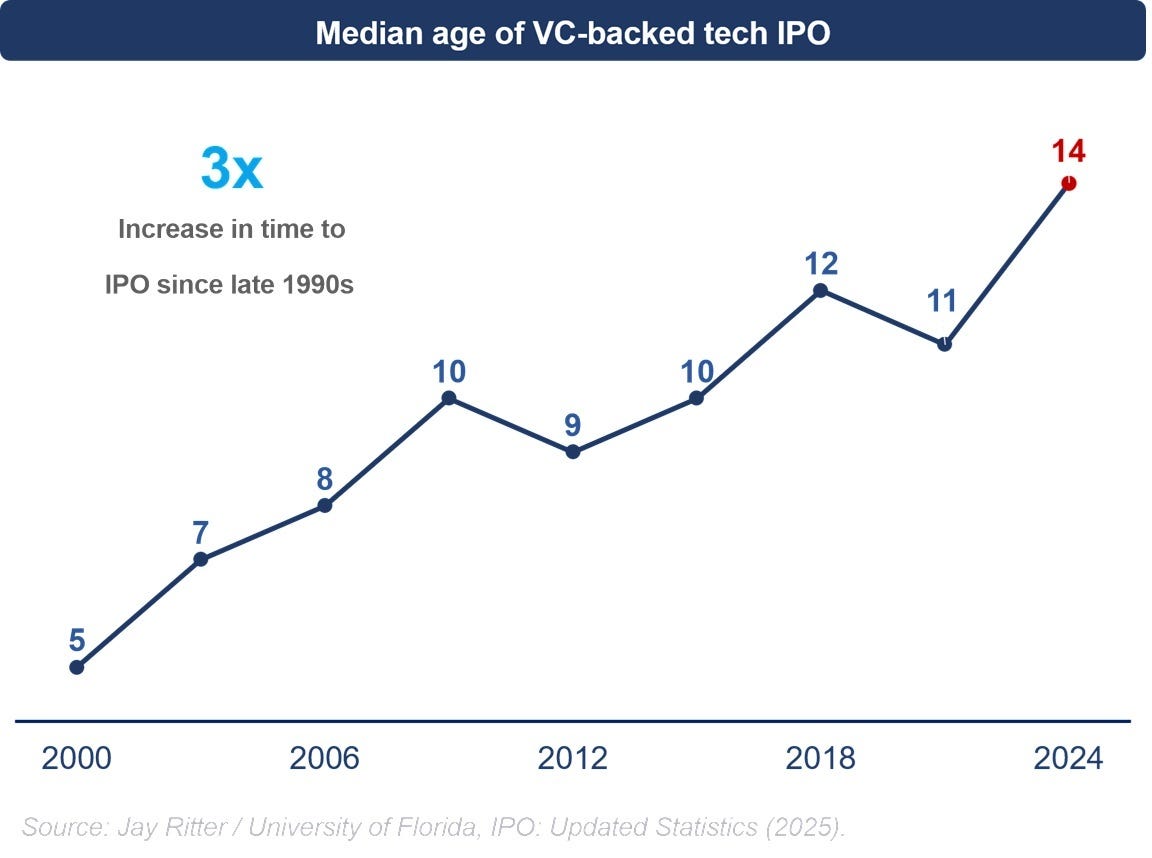
There are transparent forces driving the change in the age of companies to IPO over the last 20 years, yet early-stage VCs have kept operating and raising funds on the same 10-year horizon, as if liquidity events still stood within that time frame. This time horizon was popularized by lawyers at Wilson Sonsini Goodrich & Rosati, who standardized limited partnership agreements through the 1970s. At that time, the 10-year horizon was a reasonable fit, as the median age of a venture-backed company at IPO was around 6 years, leaving partners ample room to invest and exit within the fund’s life.
As a result, fund life extensions are now standard practice, and most Limited Partnership Agreements in developed markets already include two one-year extensions. According to CFA Institute and PitchBook data, roughly 80% of funds still require beyond 12 years to fully liquidate, and only 7% liquidate within the traditional 10-year time frame. A 2026 Stanford Law School study by Bartlett and Ramella found that 47% of 2005-2009 vintage funds were still distributing capital after 15 years, up from 27% for 1995-1999 vintages two decades earlier, nearly a 75% increase.
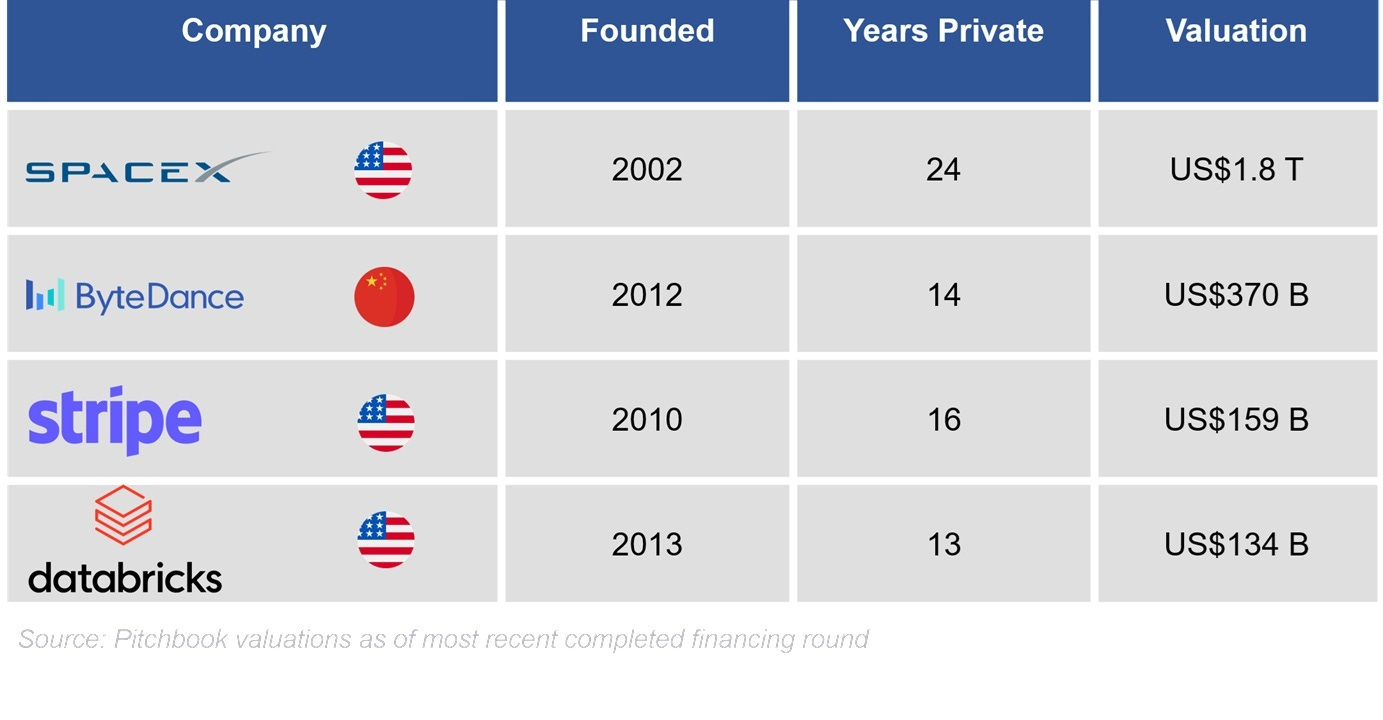
SpaceX, ByteDance, Stripe, and Databricks all have something in common: they all stayed private for more than 12 years, long enough that no 10-year fund could have captured the value in full. Sequoia invested in Stripe in 2010, and a16z invested in Databricks in 2013 and keeps investing in follow-on rounds today. But of every company on that list, none makes the case for patience like Peter Thiel’s Founders Fund and its 2008 investment in SpaceX.
Founders Fund was SpaceX’s first institutional backer in 2008 with a US$20 MM investment, made when the company had just suffered three consecutive Falcon 1 failures and was near-bankrupt. The firm has kept backing each stage of the business ever since, from rocket launches to Starlink to data centers. The position illustrates a deliberate conviction strategy: identify transformative technology companies early, maintain ownership through liquidity windows, and resist pressure to distribute prematurely.
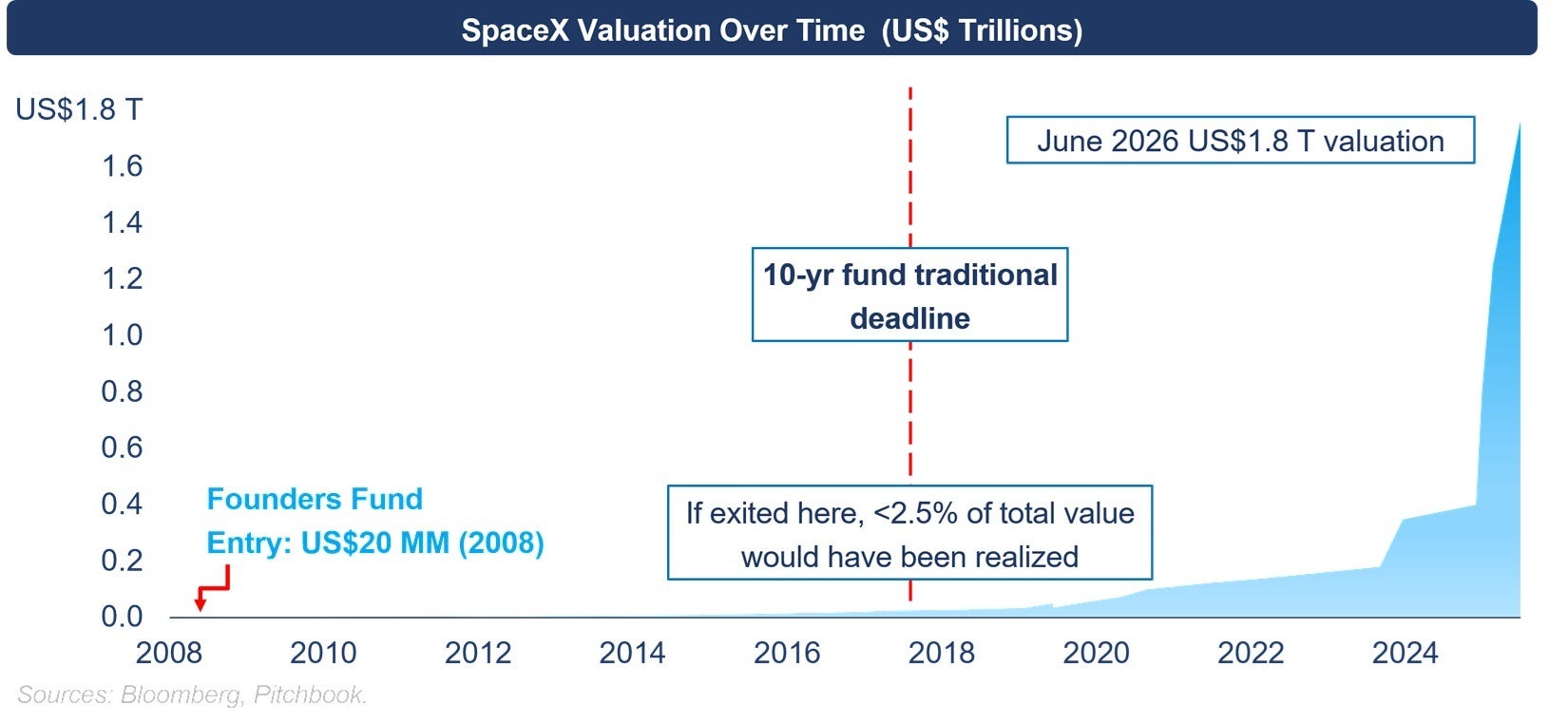
Eighteen years later, Founders Fund’s US$600 MM cumulative investment had become a roughly 3% stake worth more than US$50 B at SpaceX’s June 2026 IPO, at a US$1.8 T valuation. It’s the largest single dollar gain in venture capital history.
What’s more important is that 97% of the value came after the 10-year deadline. Founders Fund would have exited the position in 2018 at the 10-year traditional deadline at a US$24.5 B valuation. It was only because of a combination of patience and conviction that the fund was able to return an 80x MOIC to its investors, who were the ultimate beneficiaries of that patience. Its limited partners base is reported to include endowments such as Duke and Stanford, life insurers such as New York Life and Zurich, and foundations such as the Mellon Foundation, all of which held on past the point where a standard ten-year fund would have already cashed out.
In 2021, Sequoia’s partner Roelof Botha decided to take a stance and change the way the fund operated. “As chips shrank and software flew to the cloud, venture capital kept operating on the business equivalent of floppy disks”, he said. Thus, the fund transitioned into an evergreen structure, which has a permanent capital base with no fixed termination date, and where periodic tender events let LPs choose to cash out or roll their stake forward. Such an investment vehicle has allowed Sequoia to support founders without the time frame constraint, while offering liquidity to limited partners at the same time.
Global GP-led secondaries (transactions where a GP creates a continuation vehicle to hold a trophy asset longer while still giving LPs an exit) hit a record US$115 B in 2025, up 53% year over year and equal to roughly 48% of total global secondary market volume, according to Jefferies’ Global Secondary Market Review.
Latin America accounts for about 4% of the global GP-led transaction value, according to a 2026 study by Nicolas Santana and the International Bar Association. This figure tells an interesting story when put into context with the fact that LatAm’s share of global VC activity in 2025 was roughly 1%. LatAm accounts for roughly 5 times more of the world’s GP-led secondary activity than it does of the world’s VC activity generally.
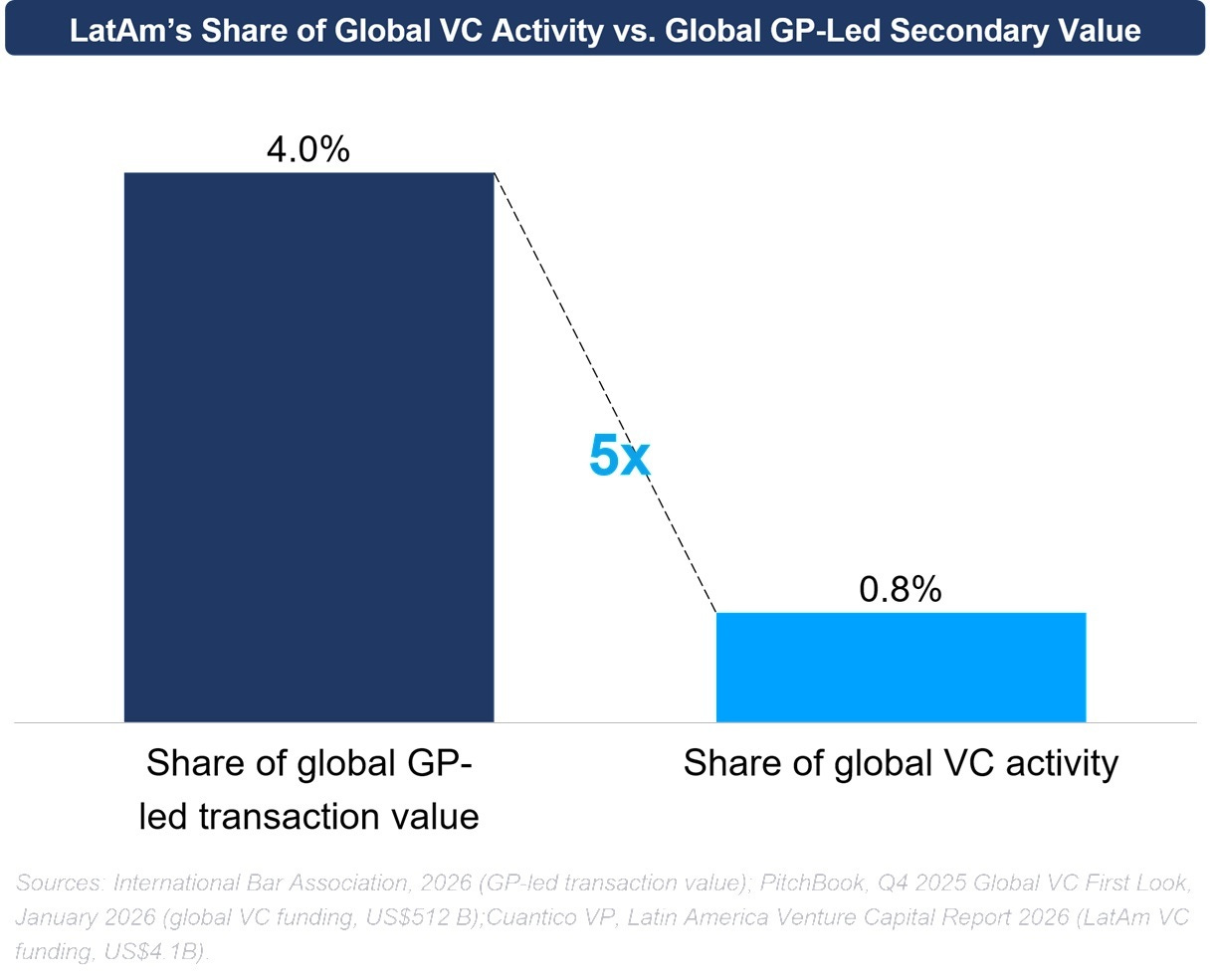
This contrast may reflect GPs’ search for liquidity as 2014-2016 vintages reach maturity, in a market where LPs have been less willing to extend fund durations than their developed market counterparts.
Spectra Investments’ (one of Brazil’s most established secondaries specialists across VC, PE, and special situations) deepening its allocation into secondaries is a clear example of how often GPs are forced to find liquidity through these transactions. The asset manager closed its sixth flagship vehicle at US$302 MM, with 45% of that capital dedicated specifically for secondary transactions, a larger allocation than any of its five prior funds.
The need for investment vehicles that give GPs room to operate, LPs sustained returns, and businesses uncapped growth is clear, and Brazil’s market shows how far the region is still from it. The direct fix is already available, and mature markets are already using it: a longer fund term, without a secondary buyer in between.
IGNIA is built around the premise of supporting businesses capable of reshaping entire industries, even if they take fifteen to twenty years to fully express their value. We believe the terms of a fund should be adjusted to match the actual timeline of the businesses it backs, not the other way around.
Comments
Nothing yet. Say the first thing.
Sign in to join the conversation.