
Welcome back to the Decoding Success series. Today we're diving into part 4 of our deep dive on Jeremy Raper, the investor behind Raper Capital who achieved a 130x return on his portfolio over 11 years. Today we proceed with the normal format of covering 7 stock pitches from the years right before Covid. Notably, this article covers JR's NIO short, on which he lost a lot of money.
📖 Covered in Part 1
Elizabeth Arden – Short – June 2014
Aeropostale – Short – July 2014
GT Advanced Technology – Short – October 2014
Quicksilver Corp – Short – December 2014
Tuesday Morning – Short – February 2015
Chegg – Short – July 2014 (Selected "mistake pitch")
📖  Covered Part 2
Avolon – Long – March 2015
Afren Plc – Short – March 2015
Aercap – Long – October 2015
Peabody Energy – Short – March 2016
Universal Entertainment – Long – May 2016
📖  Covered Part 3
Toshiba Corp – Short – June 2016
📍 Covered in Today's article
Sharp Corporation – Short – July 2017
Japan Display – Short – July 2017
Rezidor – Long – January 2018
Maxwell Technologies – Short – February 2019
Nio – Short – March 2019
Hexo – Short – October 2019
K+S Aktiengesellschaft – Short – November 2019
🔮 Coming in Future Articles
Tupperware bonds – Short – February 2020
Endor – Long – May 2020
Metlifecare NZ – Long – May 2020
Haier equity arb – Spread – December 2020
Automated Banking Services – Long – January 2021
Harbor Diversified – Long – February 2021
Hunter Douglas – Long – April 2021
Cardno – Long – September 2021
FAR Limited – Long – February 2022
Shell Midstream – Long – June 2022
Twitter #1 – Long – July 2022
Twitter #2 – Long – September 2022
Danakali – Long – October 2022
Montero Mining – Long – February 2024
Stock Price: 4,000 JPY | Market Cap: ¥18.5bn | P/E: 50
JR had been short Sharp before. After the recapitalization by Hon Hai and some cost-cutting, the now-diluted equity rose 550%. This led to Sharp having an EV double that of its most direct competitor LG, while only having a quarter of the profits. JR thought this was unsustainable and shorted the stock based on its overvaluation.
Meanwhile all of Sharp’s business lines were commoditized: screens (40%), microwaves, printers, etc.
The largest segment, LCD panels, was facing huge problems according to JR:
Shift to OLED
Sharp is behind on OLED tech and cannot compete
If Sharp loses Apple as a customer that would be dire
JR believed the stock had done well recently because both panel and large LCD screen prices had experienced a recent spike. Also the borrow had been tight, with many hedge funds holding their previous shorts through the recap, leading to some shorts being squeezed out. Finally, he believed the stock was being pushed up by retail participants.
But there were plenty of catalysts to push the stock lower again:
Roll-over of prices in end markets
Hon Hai selling (part of) their stake so the company can uplist
Equity issuance to buy JP Display (would expose the valuation gap for similar assets)
JR thought the stock was not worth much more than book (50-60 JPY a share), but being generous and saying it should trade at 20x PE, the stock was still overvalued by 50%.
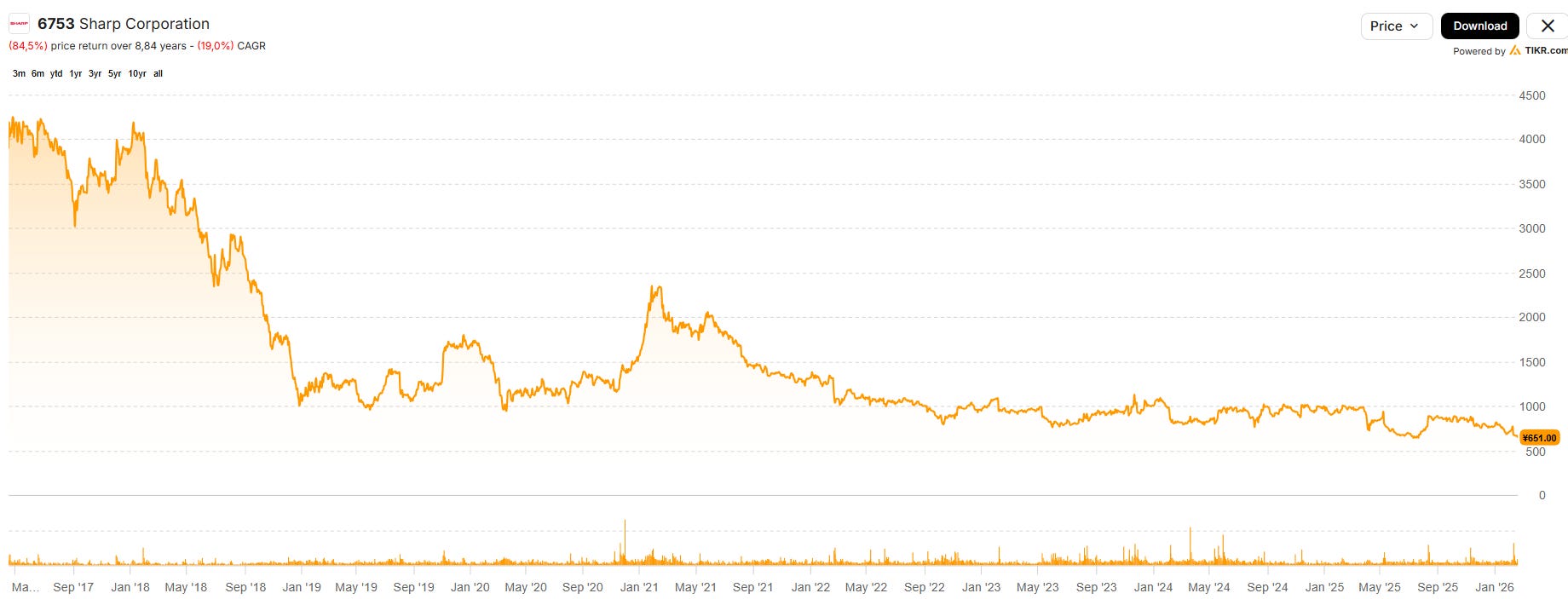
The stock did okay for the first couple of quarters on very positively spun quarterly results, as well as being readmitted to the Tokyo main board. But soon after, the stock started doing poorly.
JR’s thesis worked out nicely over the rest of 2018 as the growth multiple faded and the market realized this was not lasting. JR exited on 17 December 2018, saying he thought the risk/reward had changed with the stock now at a normal multiple.
Long term, Sharp never recovered much and most points in the core thesis played out. Chinese state-backed competitors dominated the LCD market. The relationship with Apple became much less important as Sharp was never able to provide OLED screens at size. None of the other commoditized business lines produced extraordinary profits. Making Sharp a long-term laggard.
Sharp was a clearly overvalued company facing huge competitive pressures, which made it a good mid-term short.
Stock Price: 200 JPY | Market Cap: ¥125bn | P/B: 0.4x | EV/EBITDA: 3x
JDI is in the same line as Sharp and in a similarly bad situation. With the switch to OLED coming, it had no OLED capacity and not the capital to convert. The company had also been performing very badly over its whole lifetime as a public company, only accumulating large net losses.
Against a market cap of 125bn yen, JR modeled that the company would have a total cash need of about 100bn over the next year.
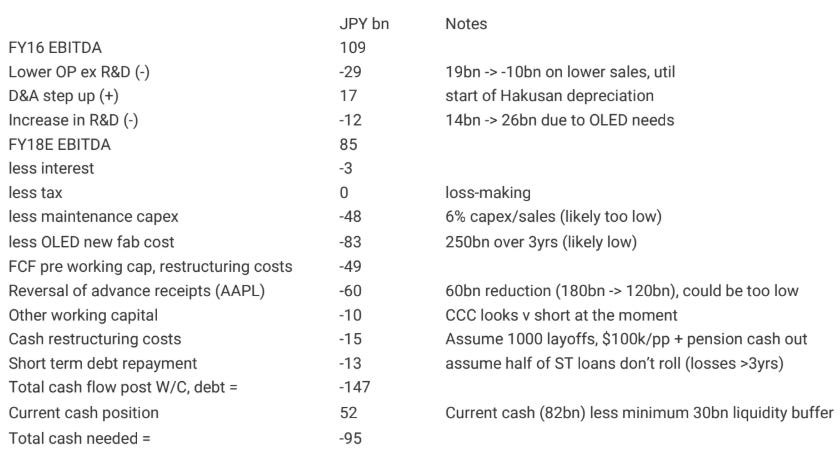
JR argued it would be very hard for JDI to find that cash. They already had some short-term debt, but given 3 years of straight losses he suspected they might even have trouble refinancing that. So where would it get its money from? JR saw 3 options:
Innovation Network Corporation of Japan (INCJ) would put in money (again…). The INCJ is a public-private partnership aimed at protecting important Japanese technology. This network had bailed out JDI already 2 times, and JR suspected there would not be a third big bailout.
A (Chinese) OEM would fund their cash needs and help them transition to OLED. This also seemed unlikely given the plentiful options in China itself.
The INCJ would broker some lowball deal with Sharp. But given Sharp’s own problems in having no exposure to OLED, adding more LCD capacity by buying JDI seemed like a poor move.
Based on this, JR modeled out two scenarios. He thought in a normal bankruptcy the stock is a 0, given they would have to pay severance for 16,000 employees and the LCD plants aren’t worth much. He believed that if someone acquired JDI it would have to be at a very low multiple of book, 50-60% lower than where it was trading at the moment.
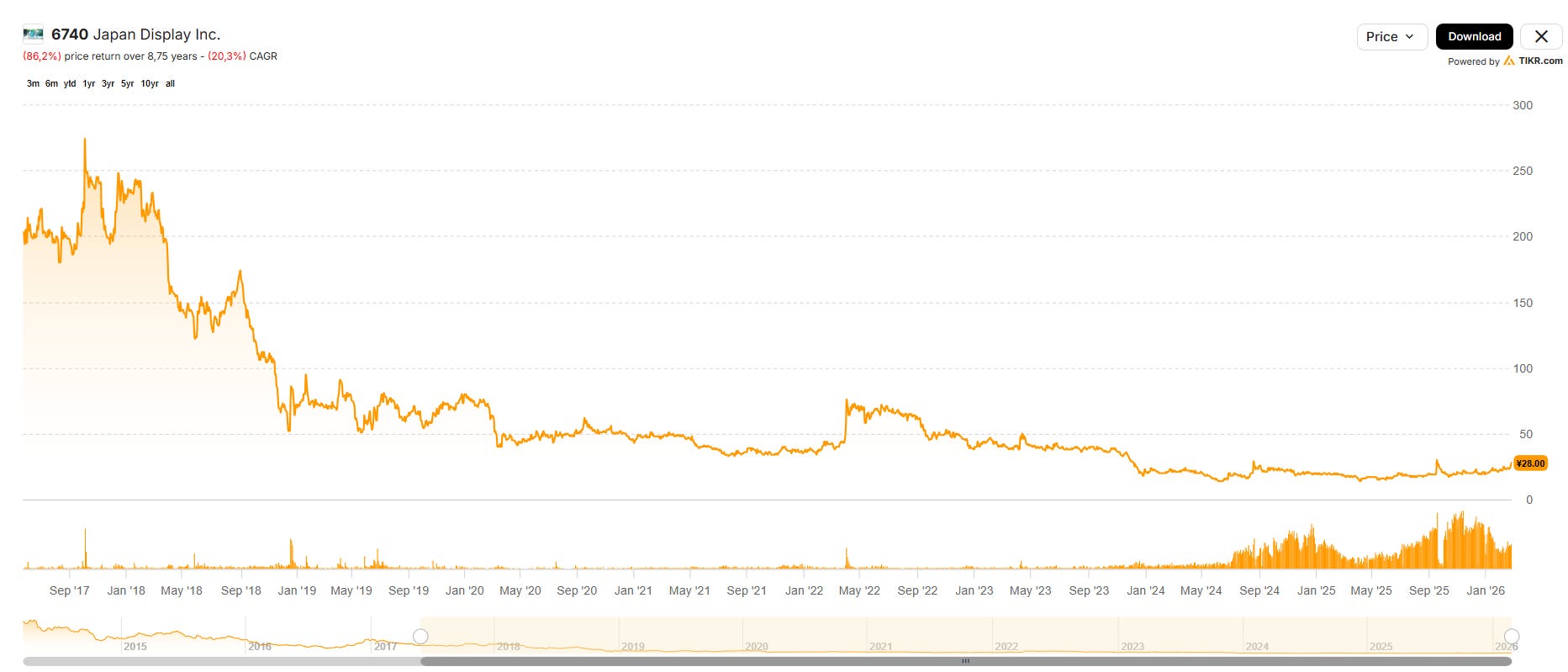
As Apple started to shift to OLED at the end of 2017, earnings started to drop massively and the already unprofitable company started to hemorrhage money over 2017 and 2018, burning 80bn yen over the two years. By mid-2018 the stock was already down 30% vs the Nikkei up 14%.
But the situation became really interesting in 2019 when a sort of rescue deal was structured with Chinese investors, who would put in 80bn in equity and new bond debt. JR was clearly surprised by somebody being willing to prop up this company, but still thought this deal was not enough and was actually highly dilutive. Hence he added to his position, as he believed after the dilution book value per share would be only 24 JPY. Shares were trading at ~80 at the time and JR believed the stock was worth substantially below book.
JR exited at 65 in October of 2019. The short had become expensive (25%) and both Apple and INCJ went to extraordinary lengths to keep this company alive.
I think one good learning here is that you can make money based on one insight across multiple stocks, as both JDI and Sharp were facing the same OLED problem. Furthermore, this is another great example of how tough shorting can be if the state wants to keep a company alive. This was clearly a 0 but the INCJ just kept writing check after check. Still, the original entry was good enough that JR made 40% net of borrow.
Stock Price: 25.5 SEK | Market Cap: 5.4bn SEK | EV/EBITDA: 4x | P/FCF: 10x
JR pitched Rezidor, the 15th largest hotelier in the world, listed in Sweden. The main thesis was that REZT traded at a large discount to global comps, trading at 4x EV/EBITDA vs the sector at 13-14x, as well as an attractive absolute valuation of 10x FCF. JR believed this was a classic deep value setup that could catalyze 50-100% upside.
While not carrying any leverage, this was one of the cheapest stocks in the sector. JR believed this was the result of technical pressure caused by the uncertainty about the majority owner HNA. HNA had originally bought out the previous 50% holder and also managed to tender for another 20% of the shares at 35 SEK.
HNA, however, had run into liquidity problems post this acquisition. This led to fears that the entire 70% ownership stake would end up in the hands of a price-agnostic seller like a bank. The stock was fairly illiquid at 500k a day vs a 3bn market cap, so any major dump of this 70% stake would decimate the stock.
However, this was not about the fundamentals, and with the stock very cheap JR believed there were multiple ways to make money here:
HNA sells their stake in REZT in an orderly fashion
Status quo maintains but HNA risk dissipates
Operational improvement
Merger with another chain, which would make the valuation discount obvious
Given the non-core nature of the asset to HNA, JR believed one of the above situations was likely to materialize in 2018.
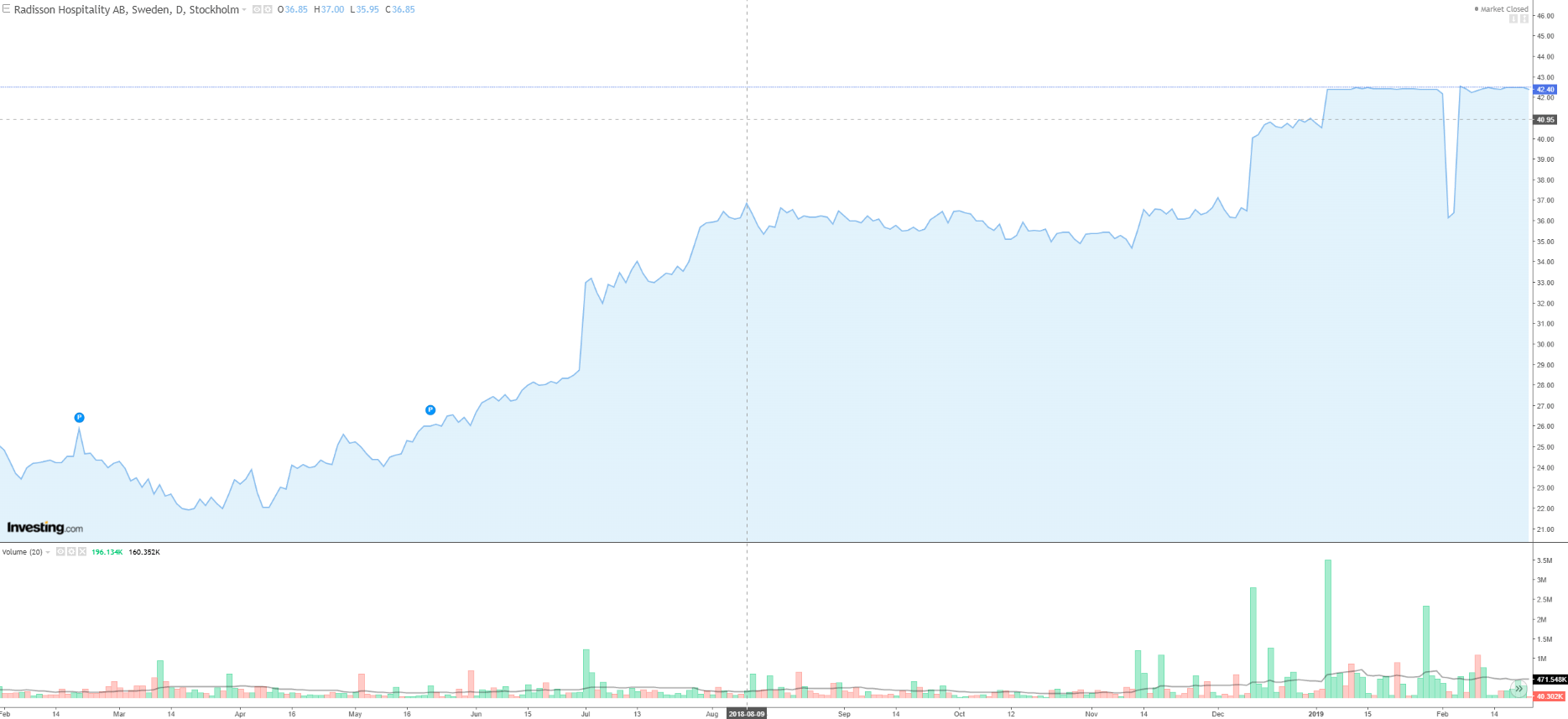
Basically, option one materialized mid-2018. In August 2018 Jin Jiang, another Chinese conglomerate, had agreed to buy the 70% stake from HNA at 35 SEK a share. This placed them in a position where they were mandated to bid for the minority stake (with a floor price of 35 SEK). They needed to get to 90% to squeeze out the minority, so they bid about 40 SEK, a premium to what they paid for the large block. At first the independent committee recommended shareholders not accept this proposal, and JR also agreed 40 was too low. Soon Jin Jiang came back with a revised bid of 42.5 SEK per share. JR saw the writing on the wall that this offer would be enough to reach 90% for the squeeze-out, so he exited his position for a nice gain of 67% in 1 year.
I think this was a very attractive setup as the stock was only cheap for non-fundamental reasons.
Stock Price: $4.74 | Market Cap: $220m
JR pitched shorting Maxwell Technologies, a historically loss-making battery tech company that was being acquired in an all-stock deal by Tesla. JR believed that MXWL was a very low-risk short, as the stock was trading just 0.2% below the maximum upside of the deal. Meanwhile, JR believed there was still substantial downside possible. This is because the deal was structured as follows:
MXWL shareholders would receive $4.75 worth of Tesla shares if Tesla’s share price was above $246 in the 5 days before the deal closed. Below that price the set value disappeared and MXWL holders would get 0.0193 TSLA shares per MXWL share. This would be exactly the deal price at $246, but a linear decline if Tesla shares dropped any further.
With very limited risk of the stock going higher, there were multiple ways you could make money on the short. The clear one was if Tesla stock dropped, something JR believed likely as he was also short Tesla at the time. But another interesting scenario not priced in was if the deal did not go through. Namely, JR believed there was a decent chance Tesla would not be allowed to issue the stock, as they hadn’t issued stock in the last 12 months and needed permission from the SEC, and at exactly this time Elon Musk was in trouble with the SEC for his Twitter behavior. If the deal broke, JR believed MXWL would trade back to the pre-deal price, or around $3.80.
In the end, Tesla was able to issue the shares around mid-May and JR closed his short when MXWL stock had traded down to $4.54, so JR made about a 4.5% profit over 3.5 months. Similar to what the market did over that period.
I think it was a smart idea, given the negligible downside. But I find the case so specific that I don't know if something similar will ever happen again.
Stock Price: $5 | Market Cap: $2b
JR pitched going short NIO in March of 2019. His pitch was simple: NIO was a terrible business burning lots of cash in a very competitive market (Chinese Battery Electric Vehicles). Combine this with some yellow flags of this being a Chinese company raising money overseas, and JR thought this to be a compelling short.
NIO had at the time an especially terrible business model. Because they didn’t own a production plant, they outsourced all their manufacturing. But the bizarre part was that they paid a fixed per-vehicle fee, still kept most of the commodities and inputs on their balance sheet, and they would compensate the manufacturer for any losses. This gave NIO the capital intensity of an OEM without any of the upside of volume creating operating leverage.
Furthermore, China was at the time the world’s most crowded EV market, and at the same time NIO was IPO’ing, about 15 other competitors were also trying to list. NIO also seemed to have an incredibly bloated R&D footprint, with huge offices in Silicon Valley, Munich and Manchester, without clear ambition to sell their car abroad.
This all translated into a huge cash burn. The company had already burned $5b in the last 4 years of operating and was now burning about $500m a quarter, so run rate $2b (on a $5b market cap). Even after raising $1b from the US IPO, the company had to rush to offer $700m in convertible bonds to shore up liquidity. This was a real cash incinerator. JR estimated they would need to raise another $1b in the next 6 months, a good catalyst for the stock to go lower.
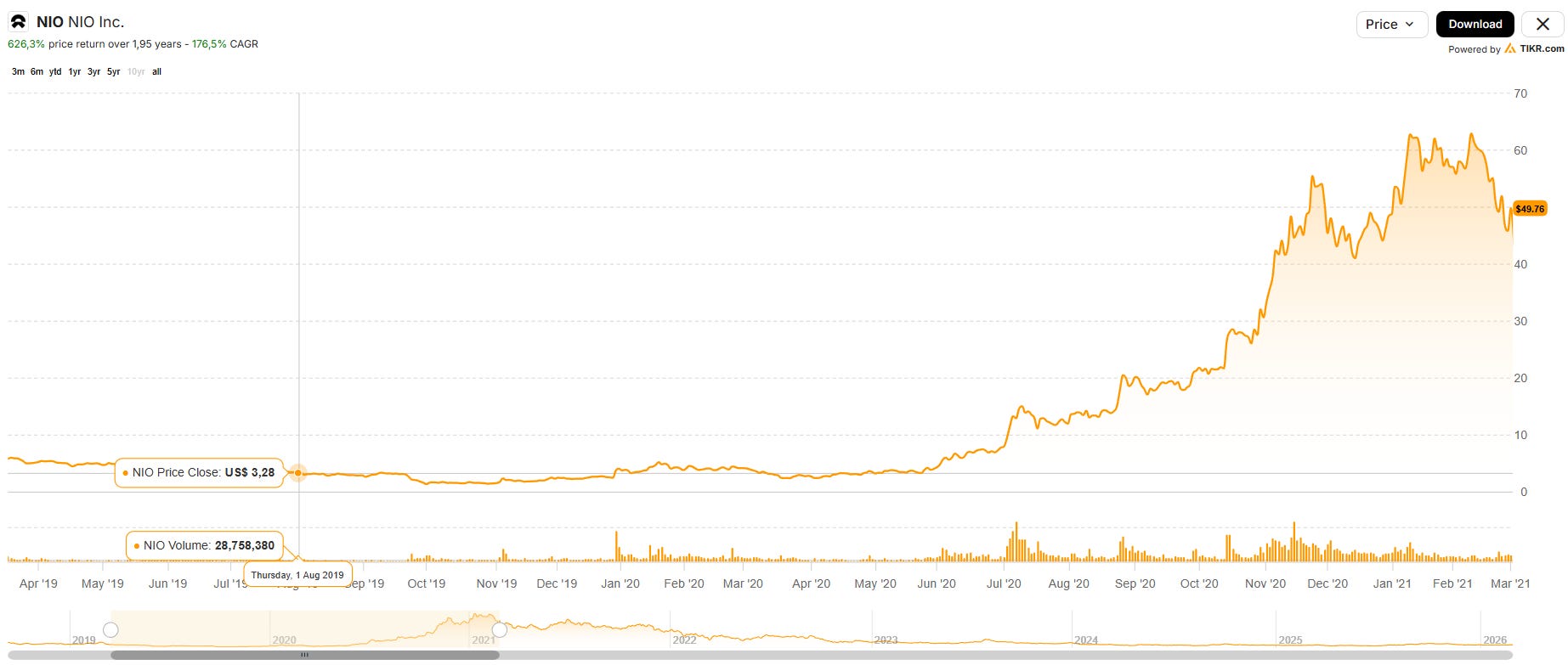
What happened next is one of the crazier stories in capital markets. Most of JR’s pitch was right and cash burn was even worse than expected, and NIO struggled during 2019 to find liquidity. But nothing much of this mattered for the US-listed ADR.
Things really became insane when the cash-incinerating NIO became a darling for US retail investors during the Covid boom, and the stock 10x’d from where JR initiated his short. Judging by his comments on VIC he covered somewhere in 2020, but if we look at his returns page we only see the position closed in 2021 for a 680% loss.
So JR was right but lost a lot of money on this pitch (and Tesla). What can we learn from it? I really liked one of the comments on VIC already in 2019, way before the stock blew up:
“If a new going concern warning cannot prevent the stock from going up 20%, should us shorts just accept defeat and move on?”
This was really the time of funny money and the market was misbehaving. If something like that ever happens again, we have to take note that some of the normal rules might not apply.
Stock Price: 3.6 CAD | Market Cap: $1bn
JR pitched going short HEXO Corp, a Canadian cannabis grower. His thesis was simple: the newly legalized cannabis sector in Canada was one of the most oversupplied markets of all time. At the time the article was finished, inventories sat at 5x monthly consumption and work in progress at 25x. Basically, there was a lot of weed that no one wanted to buy. This meant that prices likely had to drop. HEXO itself fired the first shot by launching its own bulk discount brand at a 55% discount to most legal competitors. This while the company was already not profitable.
HEXO had other idiosyncratic problems, like the high-profile CFO leaving. JR thought this was because he wanted nothing to do with the coming financial crisis. This coming crisis was obvious for two reasons: HEXO was burning $55m a quarter and probably even more the coming Q. He estimated that HEXO would enter the next fiscal year with only one year of run-rate cash. Even worse was the fact that in January of 2020, HEXO had to start complying with the covenants on its existing debt. These were a simple >1.25x fixed charge coverage and net debt below 3x EBITDA. However, HEXO was still EBITDA negative, so there was no way for them to comply with this.
Putting the worsening macro together with HEXO’s own terrible financial position, JR believed it was at serious risk of being impaired. He put his short-term target at 60% of book, but noted he thought the end destination was much lower.
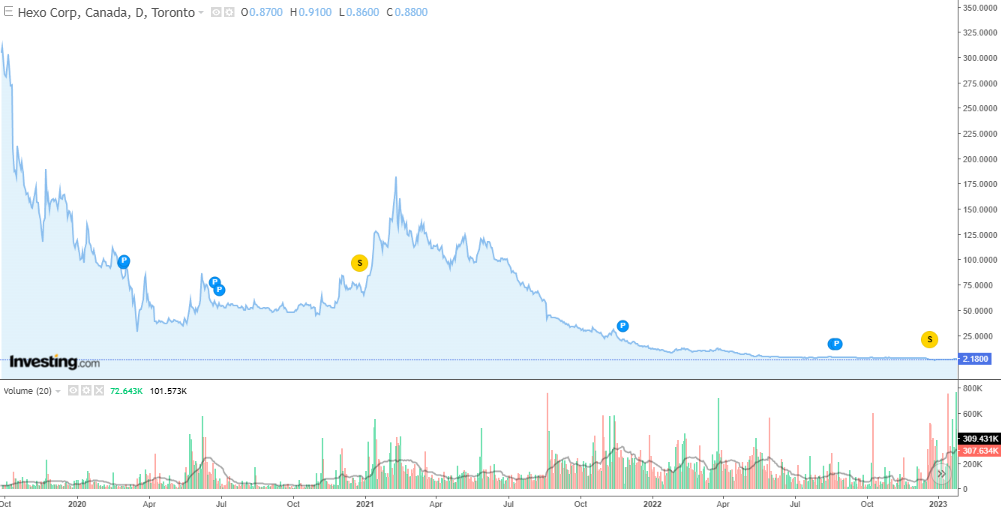
Very shortly after the pitch, the company already had to offer a convertible bond at dilutive terms to insiders. This was a clear sign of distress to JR, who added to his short. Q4 results were even worse than expected, with the company burning $113m, way more than even JR expected. HEXO did a toxic equity raise at a 15% discount in December 2019 at the by then already much lower $1.67 share price.
In January of 2020 JR exited most of his position for a 45% gain in 70 days, as borrow had become very expensive at 80%. He shortly re-shorted in February of 2020, where he likely made another good bit of money.
Mix of sector-wide macro concerns with company-specific problems made for a great setup..
Stock Price: €13 | Market Cap: €2.5bn
JR recommended going short K+S, the highest-cost potash producer in the market. He believed the potash market was going through a downturn and K+S was way too levered going into that downturn while facing near-term maturities. He believed potash prices would crash as they were already dropping, even while some of the other major players in the market were still ramping production. He believed this would significantly eat into K+S’s EBITDA.
K+S had a €2.5bn market cap with €3.1bn in debt and around €1.2bn in mining and pension liabilities. On JR’s estimated €700m EBITDA, the stock was 4.5x levered to debt and 6x adding the other liabilities. With upcoming maturities and a potential downturn, he believed this could lead to serious problems.
K+S was especially sensitive to a downturn in potash prices: every 10% drop would result in €80m in EBITDA lost. In such a scenario, JR saw EBITDA going as low as €650m. That would be 5.2x levered to debt and more than 7x to all other liabilities.
JR explained that with the broader fertilizer/potash names trading around 8-9x forward EV/EBITDA, and none were anywhere close to as levered as K+S, and while most all possessed superior cost bases and were not burning cash, he really thought SDF equity had a chance at being fully impaired.
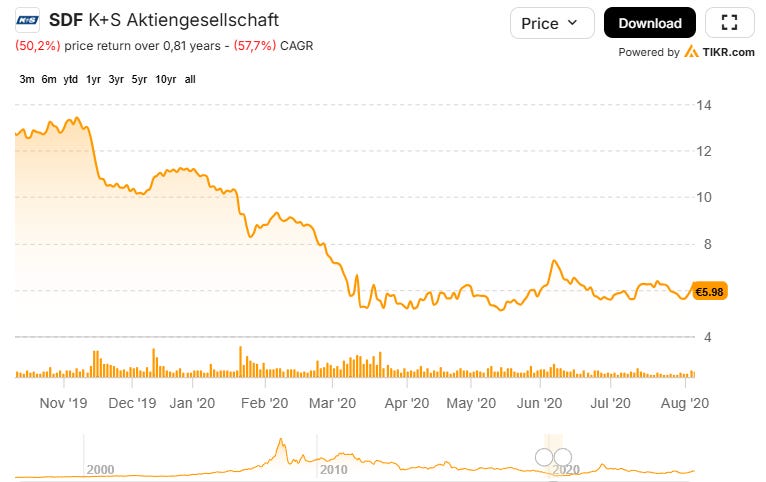
This pitch worked out excellently. Already in November, 14 days after the pitch, the company cut guidance to €650m in EBITDA, JR’s estimated number from the article. JR reiterated his short, and the stock dropped. JR added some to the short around €9 in February 2020, because with the coronavirus in China, Chinese demand for potash would be muted, further putting pressure on the market. JR closed his short around €7.15, saying the pitch had largely played out. He made 45% in 4 months vs the DAX, which was down 9%.
Interestingly, he re-entered in March 2020 when oil went negative. We don’t get any further updates, but if he didn’t quickly close that short he could have lost quite a bit of money, with the stock bottoming around that period and going on a huge run after that.
I think this was a great pitch, underlining how tough it is to be the highest-cost producer in an industry that already has mediocre/cyclical dynamics.
[Part1]
[Part 2]
[Part 3]
No posts
Comments
Nothing yet. Say the first thing.
Sign in to join the conversation.