
In early drafts of the AA Big Book, “you” was often changed to “we,” which effectively turned assumptions into collective confessions. “Half measures will avail you nothing. You stand at the turning point” became, in waxy red pencil script, “Half measures availed us nothing. We stood at the turning point.” In moving from you have to stop drinking to we had to stop drinking, the grammar implies a certain humility: We can’t know your story; we can only speak our own.
—Leslie Jamison, The Recovering: Intoxication and Its Aftermath
Today we’re taking a break from Bill’s Story to get started on the remix / rewriting of The Big Book according to IFS principles.
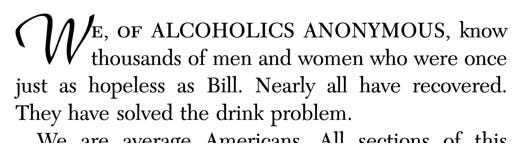
We
—Alcoholics Anonymous, p. 17
This post won’t get past the first word of the Big Book!
The “we” of the Big Book are all of us alcoholics. The “we” of IFS are my Self and my parts.
When I first entertained the notion that I might “join” AA to try to give up drinking, not all of my parts were happy about this momentous decision.
At first, it was a Manager part of me who got curious about AA. This is what I call my ⚫️Self-Like Manager⁕ (SLM). He wants what he thinks the 🔵Self🌼 should want, and goes about pressuring the other parts to do it, whether they want to or not. This is not the solution! Parts can’t be badgered into cooperation.
A couple of my parts were terrified and angry, and rebelled by diving into drinking with a renewed gusto. These were Firefighter parts, reacting to something scary.
It took a couple months of regular parts work to ask my Innermost Self whether it could lead the journey of recovery. Could 🔵Self🌼 follow up this curiosity about sobriety and AA with courage and capability? More importantly, could my parts trust my Self that it was not going to ignore them, shame them, exile them, or force them to do what they didn’t want to do?
Several months before AA came on my radar and before I admitted that I might need to stop drinking for good, I was planning to quit drinking for a period of several months so I could 🔴Get Things Done☑️.
Say “Hi” to: 🔴GTD☑️ is a Manager part who likes to set goals, set up workflows, make and tick off to-do lists, and be productive.
None of my parts was happy about this. We had a meeting about it and I asked them what they were thinking and feeling. What were they afraid of? This is a screenshot from my parts journal:
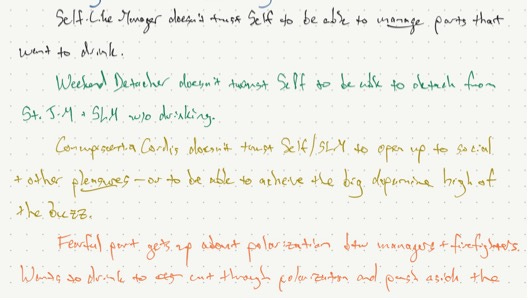
Here’s what they said (I’m reporting what they said, which isn’t always the right way to journal; other times it’s more helpful to let the parts speak in the first-person):
⚫️Self-Like Manager⁕ doesn't trust 🔵Self🌼 to be able to manage parts that want to drink. Doesn't want to drink b/c it sets me back in so many ways.
🟢 Weekend Detacher/Resetter🪂 doesn't trust 🔵Self🌼 to be able to detach from GTD + SLM w/o drinking.
🟤📺 Concupiscentia Cordis doesn't trust 🔵Self🌼 or ⚫️SLM⁕ to open up to social + other pleasures—or to be able to achieve the big dopamine high of the buzz.
🟠Fearful☢️ part gets up about polarization btw managers + firefighters. Wants to drink to cut through polarization and push aside the managers. Also afraid 🔵Self🌼 can't sustain the intensity of week after week of being on. Cannot turn off. Cannot sustain the weight of 🔵Self🌼 (but maybe confusing 🔵Self🌼 with ⚫️SLM⁕.)
🟣 Sleepy☔️ is not up right now, but it often desires completely turning off, shutting down, turning inwards.
If these parts could be converted, what would they be converted into? What new roles would they play?
🟢 Weekend Detacher🪂 could (and sometimes does) switch to climbing--esp. social climbing--or cooking or some other exercise.
How could 🔵Self🌼 adapt to meet these parts' needs? Too much seems to depend on courage. Courage seems to just activate ⚫️SLM⁕, white-knuckling.
You can see that many of my parts are alcoholics. “We” were already starting to admit that our life had become unmanageable.
For my entire drinking life, I had dismissed AA. Not because I knew anything about it. Here’s what I imagined AA was before I knew anything about it: a bunch of former alcoholics sitting around telling current alcoholics what to do if they didn’t want to be miserable. A bunch of good people telling the bad people in their midst that they could only be good if they gave up drinking for the rest of their lives.
I didn’t even know what the 12 Steps were until I read Leslie Jamison’s brilliant The Recovering. I was drawn into the book by the story of a drinking life that was a writer’s life. But I perked up about AA when Jamison called attention to the we-language of the Big Book. Jamison expressed her resistance to AA’s insistence that alcoholics are far more like each other than they are different. She recoiled with shame from the line, “Many of us thought we were special.” She had to acknowledge, “The plural subject already holds the argument: Even the belief in singularity is common.”
But what made me perk up was something different. In Jamison’s realization that she was not singular, I heard my own awakening to the multiplicity of my parts when I was first discovering IFS. I resonated with her existential discomfort: “Giving up on singularity was like giving up on the edges of my own body. What would I be, if I wasn’t singular?”
Bill Wilson and the other authors and editors of the Big Book framed it in the first-person plural because they knew from experience that recovery works a lot better in community than it does when one hero of sobriety tells a drunk to get sober.
The we-language assures us that we are all in this together. I’ve never heard in an AA meeting, “I’m so-and-so, and I’m a hero of sobriety.” No, even the Old Timers--who might be justified in saying, “I’m recovered and I’m no longer an alcoholic”—even they say the same thing the rest of us say: “. . . and I’m an alcoholic.”
As the cliché goes (and Jamison has a wonderful section on David Foster Wallace and his embrace of AA clichés), “We are all in this together.”
This echoes a basic principle of IFS, which is that happiness is the harmony of all our parts, working together with the leadership of the Self. There are, as Richard Schwartz famously said, no bad parts. The AA meeting doesn’t kick somebody out because she is still an alcoholic. There are no bad alcoholics in AA because we are all alcoholics. Happiness does not look like annihilating or exiling the alcoholic.
It works the same way in our internal systems. Often one or more of our Managers will recognize that drinking is a problem and blame it on a Firefighter part. If only that Firefighter part wouldn’t drink to blackout when she was in a new social situation, everything would be fine. If only we could just get rid of that Firefighter part, we would be happy.
If we want to bring healing and harmony to our inner system, each part of us, including the Self, needs to be able to say, “I am an alcoholic.” None of us can break away and be sober on its own.
To start out on our adventure of sobriety, we have to do it all together. A Manager can’t just decide that the rest of us are going to do AA. That’s not “how it works.” If the Manager tries to force it, the rest of us are going to double down on our habitual behaviors. My depressive part is going to hole up with a bottle and a violent TV show, silence my phone, and pull the blinds. My party-loving parts are going to go on a world-historical binge.
Instead, our 🔵Innermost Self🌼 needs to lead with calm and compassion, curious about each of our parts’ fears and motivations and good intentions.
This doesn’t mean that we can’t start the journey of sobriety until every part is gung-ho. At minimum, though, we need all of our parts’ consent to explore sobriety and AA. Some will grudgingly consent, but it’s the openness that counts. Others will be more willing, even if they remain fearful and doubtful.
It’s like a family vacation: one kid hates the beach, another really wishes he could go to that concert with his friends, and another can’t wait to try out his surfboard. If the parents scold the reluctant ones and tell them to get over it, they are probably going to make the vacation miserable for everybody. But if the parents can acknowledge the kids’ desires and try to meet them where they are at (permission to avoid the beach? some kind of concert with the family?), they might at least be willing to try to enjoy the time together as a family—not by giving up their desires, but by opening up with curiosity to the unforeseen possibilities of a week to spend more time with their parents.
One day at a time, check in with your reluctant and fearful parts. How are they doing today? What do they want you to know about how hard things are for them? What would they suggest to help each other tomorrow? You will be surprised by how encouraged your parts can be when you include them in this simple way.
Our parts all want what they think is best for us; they just sometimes have some crazy ideas what that looks like!
Do you have a Firefighter part that is trying to help you by drinking? Ask it, “What are you trying to accomplish for us?”
Ask a reluctant part, “What are you afraid would happen if you stopped trying to help us by drinking?”
If your Self can hear this with some degree of calm and compassion, repeat back to the part what you hear it saying.
Thank your part for how it is trying to help you.
Let your part know that you cannot do this without its help, even if none of you can quite see what it would look like for that part to help you.
Do you have a Manager part who is frustrated and impatient with your parts who are reluctant to stop drinking?
Ask it, “What do you think those reluctant parts want you to know?”
Ask it, “Would you be able to give me, the Self, a chance to try to lead the part that frustrates you?”
“What would you need from me to trust my leadership of the other parts?”
No hurry to share this Substack—at this rate, it’ll still be going in 2100! But I promise we will do more than one word next time, so if that’s something to look forward to, maybe do think about sharing?
Comments
Nothing yet. Say the first thing.
Sign in to join the conversation.