
My son’s first word is “uh oh,” typically followed by something falling down the stairs.
“Uh oh!” He exclaims from the other room, and I can’t hold back a little grin.
I’d be exasperated, but it’s too much fun to hear my child say something. Instead, I have to stop myself from prompting him “uh oh, uh oh, uh oh,” all the time, turning it back into babbled sound.
One day in November, I ask my toddler at the dinner table if he would like more pizza, tapping my fingers together subconsciously — and he signs it back.
“Okay, then.” Flabbergasted, I slide another pizza sliver onto his plate.
In the next days, he repeats the trick. He also starts to wave “all done.” There’s a light flicking on behind his eyes: this gesture gets results. This is better than play.
Toddlers make a stream of sounds: babbling, with occasional hits. Does he mean it? Probably. Definitely some of the time. Soon after “uh oh” comes “hot,” and he shows me by touching: the radiator, dinner, my mug of tea.
“More” is a pretty abstract concept for an early word. I watch him test its boundaries: does it get him seconds, or milk in the night? Where does it show up in our speech?
One day, I’m spinning him around in a dance. When I stop, he does the “more” sign. Is he hungry, or does he really mean “more”? I reinforce by spinning him again.
By Christmas, he’s signing “milk,” “hungry,” “water,” “fruit.” The signs aren’t quite right. “Water” is meant to use a sign language “W” with his fingers — but the L shape his limited motor skills can manage is close enough.
I get excited and start trying to teach him signs for specific foods: orange, pear, banana. When this results in a confused jumble of signs, I backtrack. That’s okay, the sign for his favorite fruit, pomegranate, is a disappointing “P-O-M” anyway — too complicated even for me to bother. Plus, the little twisting gesture next to his cheek (“fruit”) is really, really, cute.
Babbling is developing at the same time. All the repetitive mouth sounds are muscle practice: “Babababa” is a great warm-up for “ball”: a beach ball we find in my sister’s front yard.
“Ball,” he says consistently, seeking the toy.
We don’t know how much of our speech he processes, but it’s certainly more than he can communicate. He signs for “milk” when we say the word around him, and begins to react to “outside.”
In January’s fourteen-month developmental survey, the Health Visitors ask us if the child knows four words beyond “mama” and “dada.” Robert and I exchange glances. Certainly, but those two are not in his chosen vocabulary.
We choose to interpret this as a sign of his security. This notion is reinforced when he does develop a happy “Dada!” response at the sound of keys in the downstairs lock, while “mama” sounds remain the reserve of sleepy protest — as in, “aamamamamamama…” I am almost never out of his presence.
Then one week, he starts saying “mama” and meaning it: you, specific entity, I desire your attention. It’s a quick change, from off to on: my son has given me a name.
It’s not just words: he’s starting to understand representations. A picture is not the thing itself. And yet, he points to the ball on each page of a library book, telling us “ball” each time.
“Doo-daa-doo-daa-” he chants, vehement in his excitement.
“Rreerr uh oh. Woof, bubah drdl,” he points at no apparent object.
Words arrive one at a time, then faster. For weeks, “nana” isn’t banana necessarily, but it’s certainly fruit. But his repertoire grows: a surprisingly eloquent “a-pple”, quiet “perr”, abbreviated but functional “sraws” when the local Lidl starts stocking good strawberries. He arfs at dogs, meows at cats, and buzzes to indicate any insect.
“Are you getting enough water?” I ask my mostly pre-verbal child.
He signs “water” with his hand and walks into the hallway to drink from his water bottle.
My favorite is when he wakes: some word surfaces: “ball” or “dada” or “orange”.
My son’s eyes flutter open and he sits up.
“Cheese,” he identifies, recovering a spat-out Babybel from the floor beside the bed. He crams it into his mouth, murmuring, “apple,” conversationally. His foot lifts, and bare toes wiggle. “Sock,” he says. Then he drops back down to cuddle.
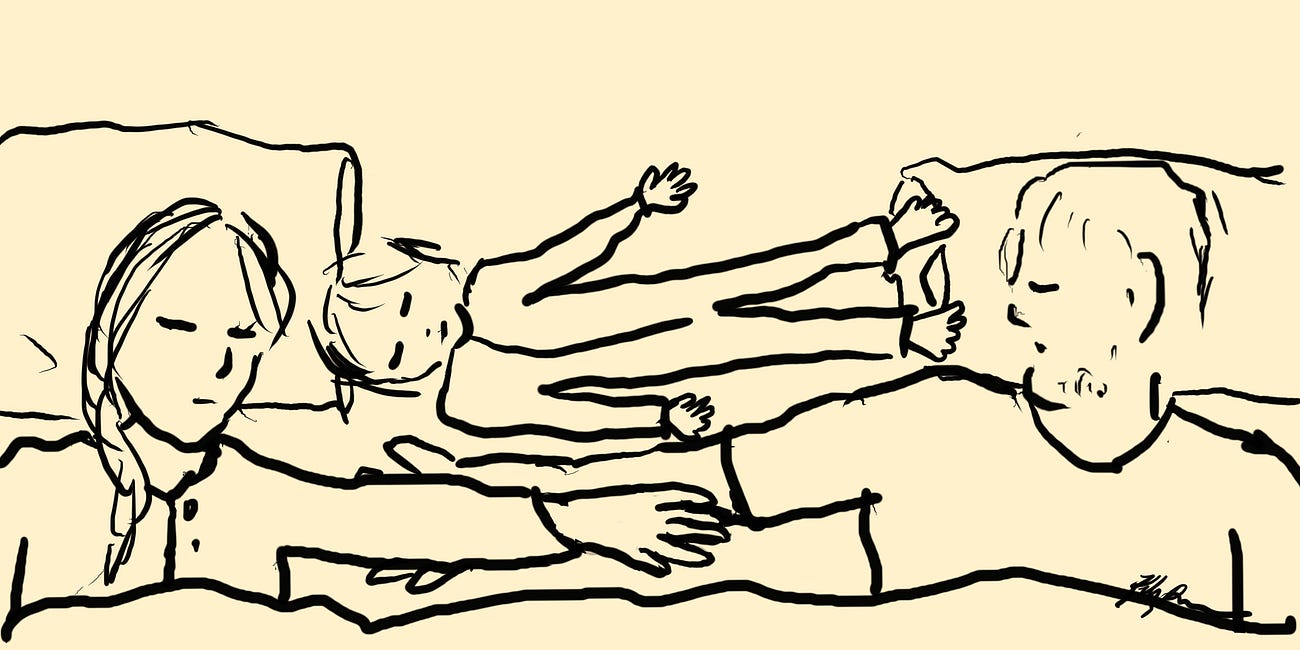
Half-awake, the boy says “mama” from inside the circle of my arms. His hand reaches back and traces my face, and he goes back to sleep.
“Do you think he dreams?” I ask Robert.
What I really mean is, to what extent is language an insight into his understanding of the world?
Clearly, his early words are motivated by his interests. The fruit vocabulary is outsized and concrete: nouns he can use to name desired objects.
Other words seem to simply charm him. ‘Freckle’ (“grackle”) gives him an excuse to poke across my skin. “Peebow,” I realize slowly, is “peekaboo.” He repeats it to himself as he stomps around in solo play.
I watch his language grow in its level of abstraction. He begins to meow, for example, not just when he sees a cat but when he hopes to, or when we’re somewhere he has seen one before.
Though pronunciation limits his word growth to some extent (I struggle to distinguish “poop” from “book”), we add in more signed gestures for “please” and “help” to distinguish an observation from a request.
It’s still not clear what my toddler understands, and what’s just repetition.
“Baby,” he says, pointing out a baby at the library. He knows what they are. But surely he does not understand the concept of pregnancy, a baby inside his mother. Nevertheless, he’s consistent when I show him my swelling belly.
“Baby,” he says, reaching his arms around it. He kisses it, cuddles, seeks it out.
He uses the word for himself, too. It’s a shorthand for “cuddle me, and forgive the violence I’ve just done to your face.” He presses his own face flat against my cheek.
“Baby” he insists, and becomes one.
In April, his signs are accompanied by verbal words. “Water,” “please,” and “more” are said aloud with the gesture. “Help,” he says often.
The specificity of his desires outpaces the language explosion. It’s not “fruit” anymore, but a particular one, delivered in a particular way. He points, makes a concerned face, grunts eloquently.
“Orange?” I offer, hand hovering over the fruit bowl. “Pear?”
He grows whiny with frustration. I lift him so he can show me himself.
“Oh, avocado.”
But he doesn’t want to wait for me to open it, or set him down during knife handling.
“Cado,” he whines in impatience — a word he’s saying for the first time.
I pass him the half without the pit, but he wants the other one. He wants a spoon, but only to hold in his hand as he bites the flesh out.
No, he doesn’t want help. But now he does: he needs to sit on my lap, holding the fruit limply while I attempt to scrape it out and bring it to his lips.
Language makes life easier. He wakes from his nap in the living room, looks at me, and requests an orange.
“Ohhrj,” he says. “Pees.” His hand swipes “please” across his chest.
“I left one in the kitchen for you,” I tell him.
He rises and toddles there. But then he pauses, doubles back. First, a cuddle. “Mama.”
It’s May now, and nouns are easy. I can say a word once. If he says it back, he knows it.
Intonation is key. I realize I always say “all done” with the same definitive falling tone, because so does he.
He nods his head to music: a passing bicyclist with a speaker, the playlist in the shop. One afternoon, he astonishes me as we hang the laundry. I’ve put on EMF’s “Unbelievable” and he pronounces the eponymous chorus as it comes around. Five syllables, and I wonder if I imagined it.
“I love you,” I tell him one evening, and my myna bird son says “I lubboo” in the exact same cadence back.
Previous: What They Should Tell You: Reprise | Next: To Love a Child
What They Should Tell You: Reprise
·
Apr 24

I’ve made it to the third trimester of my second pregnancy, and I’m still astonished by this process of human-making. This seemed a good time to reread my writing from last pregnancy — most of which still lands.
To Love a Child
·
May 24
The only time in my life I’ve been a bad student was when I was falling in love with my husband. I’m type A, problematically diligent. But in the autumn of our whirlwind romance, I let it all slip.
Comments
Nothing yet. Say the first thing.
Sign in to join the conversation.