
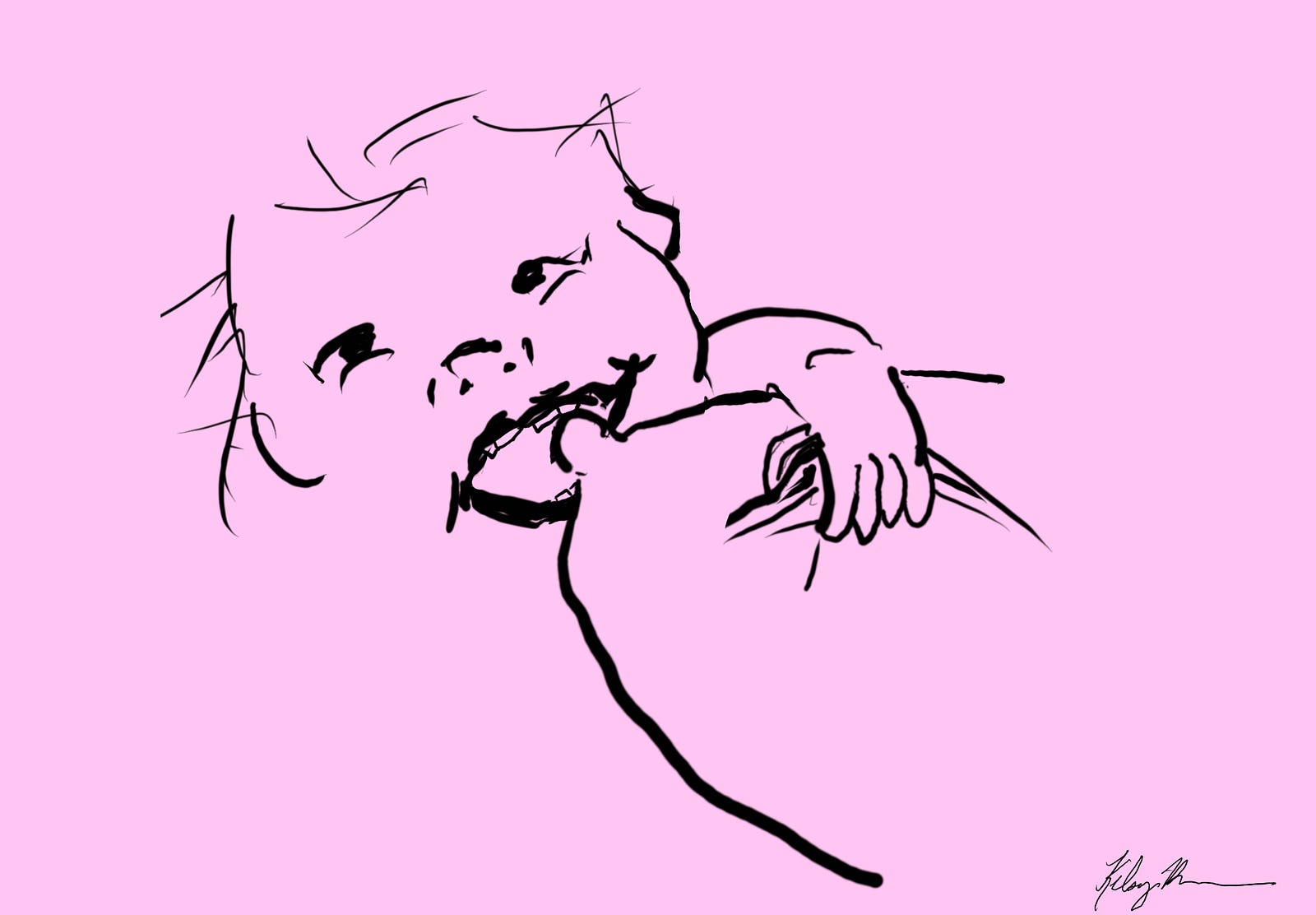
When I first heard “weaning” as a term for the introduction of solid foods, I was confused. Doesn’t “weaning” mean the process of detaching a baby from its mother’s milk?
I’ve watched mother pigs roll their teats out of reach of their sharp-hooved progeny, the piglets squealing in frustration even as they nosed at feed on the floor. That’s weaning. My own six-month baby would take eager little tastes of fish, then cuddle in for a happy suckle. I wasn’t taking anything away; I was inviting him to the joys of flavor. The same term shouldn’t apply.
Adding solids doesn’t dull a baby’s hunger for milk. But as time went on, my son’s behavior reminded me more and more of the piglets. His sharp little nails, his groping hands gave me new empathy for the tired sow.
When does weaning happen? Humans can continue to breastfeed well past three years of age — tandem feeding with younger siblings, re-tasting sticky colostrum when their mothers birth new babies.
Modern mothers breastfeed for a considerably shorter period, especially in my home countries. In the U.S., only about half of infants (and closer to a third of U.K. infants) receive any breastmilk at all by six months, when solids are typically introduced. The World Health Organization suggests breastfeeding for two years.
Ultimately, it’s a fraught personal decision. Breastfeeding mothers juggle preferences and practicalities, try to gauge their own and their kids’ needs and desires. We compare notes: when to stop, what it’s like, and how.
As hard as it is to know when to wean, it’s even harder to do it. If you breastfeed, stopping is a cliff, a black hole, weirdly a breakup. Is it cruel to stop all at once, or more so to confusingly taper? Can you waver, renege? How now, 2am, and he’s sick, and he needs you? When the baby is crying for milk, what do you do?
It’s hard to explain why breastfeeding is a phase to treasure. Certainly, it isn’t all loving cuddles. But it can be such a saccharine feeling that mothers blush as we relate over the joy of it. The “my baby, my dear baby” feeling is ridiculously strong.
Though oxytocin release is certainly a factor, there’s also specialness to the act that’s more akin to empathy. The baby is sad/injured/sleepy? You can fix it, instantly. The creature you love wholly wants succor? You’re not just the sole provider of relief, but compersively joyful as the infant grunts his pleasure.
It’s not just pleasure, but power. Power in a very specific domain — but in the moment of its use, the only one that matters to you. It’s a massive pain, a caloric drain, a lifestyle that limits what you can eat, drink, and wear. But it’s hard to give it up.
The baby wants milk, and you have it, and you love to give the baby what he wants. His happiness is everything, and your milk is his heroin. It’s been a staple of our relationship since his birth.
My baby is four months old when he has his first taste of banana. He gnaws at its end. His little tongue pushes the mash back out.
Over the next months, he learns the workings of his mouth. Food moves further back as he learns how not to choke. He gums strawberries from the garden, pulping them toothlessly. Around the table, we all offer tastings from our plates.
To a crawling baby, the world is a buffet. At six months, my little guy isn’t picky — but he also can’t distinguish “food” from “not food.” The newborn phase of “why are you wet?” transitions seamlessly to “what is that in your mouth?”
A baby’s sense of touch is concentrated in the mouth. They don’t develop full sensation in their fingers until about a year — so “tasting” and “exploring” look the same. I don’t know if the baby knows the difference, either.
“What if,” I posit to my dad, “we increased the proportion of little things on the floor that he can eat?”
My dad, naturally, agrees — and this begins our Cheerios era. Our respective spouses keep their eyes admirably unrolled. My mother builds cardboard blockades around the cat food; I send her videos of the baby surmounting them. I scatter cereal on her dining room floor.
I love the idea of a high chair: the baby joins the table, and I get a few minutes of space. But in practice, it’s a struggle. Feet jam; the back arches. After a minute or two, he starts to climb out.
We return to the floor — a situation he greatly prefers anyway. Raspberries smash beneath his knees, oatcakes crumble. This is what the robot vacuum is for. I’m happy he likes to eat.
Through it all, we breastfeed. If my boy is sad, cuddly, hungry, if he bumps his head or he’s squirmy on transit, I have a ready fix.
I love breastfeeding my baby. Like me, he feels hunger acutely. His relief at succor is unrestrained: rolled-back eyes and grunts of pleasure. I look down at his sweet little face, and sometimes he meets my eyes.
But it’s not exactly the scene my mother lovingly described: “and when they reach for your face…”
If he’s reaching for your face, watch out. His sharp little fingers will seek out any orifice — or if none are permitted, he’s prepared to make new ones. If the second nipple is in reach, he pinches like it’s a registration point.
I remember celebrating when my newborn developed the core strength to keep himself latched without an arm or pillow to prop him up. Now, I don’t have to hold him at all. If I show him a nipple, he’ll cross the room.
His eyes lock on and he approaches with grabbing hands. He tries to stretch the nipple to his mouth with his fingers first, to no avail. Then his many-toothed mouth slams in, wide open.
I felt his first teeth, detaching at each tooth-clamp — a Pavlovian attempt to curb biting behavior. Now that he’s stronger, it’s an exercise in trust. Some mothers lose chunks. I treasure the rapport we’ve built.
But he’s grabby. Increased mobility meets object permanence, and — voila! By ten months, we have a baby who gropes. His questing hand sneaks constantly down my shirt. I hold my neckline closed against his scrabbling.
At home, I lay down exhausted, lifting my shirt. I can read a book; he can feed. If he’s wiggly, he’ll helicopter his body in a full circle while maintaining the latch. His toes tangle in my hair as he scrambles sideways over my face.
But then, he’ll detach. Knees against my side in child’s pose, he’ll lay his cheek on my belly and fall asleep: the perfect penitent.
I go away for a few days when the baby is almost one. When I get back, he’s night weaned: my husband’s patience, and no milk-mother smell. That lasts a week, and then I cave. The baby gets sick, and I’d do anything to make him feel better.
Breast milk is both comfort and immune support, and he’s sobbing through his snot. He’s not old enough for nuance — I can’t tell him this is an exception. It’s two in the morning and I know that if I give him the nipple, he’ll ask again and again. I do it knowing it undoes the process.
And yet, it’s a lesson none of us unlearns: he doesn’t really need it. From then on, though I usually feed him when he fusses, I can roll away instead. We all know he’s capable of cuddling back to sleep.
I become pregnant ten months into breastfeeding my first baby. I consider feeding my older one through it, but I also wonder if it will bring jealousy between my two under two. The milk letdown hurts, but it’s manageable — until the biting phase resumes.
I take the baby to bed, exhausted and ready to give my sweet boy succor. He chomps. I howl. Instantly, we’re both screaming, in tears.
It’s his molars, I think. He only bites when he’s tired. He’s teething. Whatever it is, it’s too much. What was sweet and good simply isn’t anymore.
I want to keep feeding my child: keep holding him tight as my body supplies all his needs. He is a toddler, but in these moments he has not yet ceased to be a baby.
But when his grabby hands creep endlessly into my clothes and his sharp toenails dig against the soft place where his sibling is growing, it isn’t love I feel. I’m exhausted, scratched and bitten, and he won’t leave me alone.
He knows signs, now: “milk”, “more”, “water”, “hungry”. It was so sweet when he learned them: in the night, eyes still closed, frantically signing: “more!” until I fed him.
This was much gentler than his wailing and grabbing. But communication is too little, too late. Now I gaslight through the day:
“Milk,” he signs clearly, little fingers flicking open and closed — every half hour or so.
“Hungry?” I ask, fingers to my lips. “Water?”
“Hungry,” he pivots, tapping his own lips. His signs are still a little confused, and I’m abusing it.
I give him a piece of fruit. He eats it, then signs: “milk,” clambering onto my body and trying to help himself.
His entitlement is profound. Defense bubbles into rage: he doesn’t even need this, but he grabs, and he bites, and he takes.
Any practice that makes me feel not-loving towards my child is one to drop. It’s not a triumphant graduation, but the sad fizzle of patience lost. Not all endings are beautiful.
When I stop daytime breastfeeding, I can finally wear clothes that pull neither up from the waist nor down from the neck. It’s a small freedom, but one I hadn’t realized was so limiting.
Each night, I quick-change like I’m in a locker room. If I slip and the little one sees my breasts, he reaches and fusses: how can he see the milk source but not have it? But otherwise, he’s calm — and by only feeding in the night, I’m saved the worst risk of teeth.
“It’s been more than a month since he fed to sleep,” I observe to my husband.
The tired toddler resists bedtime as long as he can, crawling across our faces and necks for one more handful of Cheerios, one more reading of Spot. Eventually, he cuddles into my armpit. Head on my shoulder, he drifts to sleep. He doesn’t need the suck; he needs the contact. Finally, when his breaths grow deep, I can slip my arm away.
When he stirs in the night, I wait: sometimes he settles on his own, sometimes cuddles down. Sometimes he pivots to sitting, eyes still closed, and squeezes his hand for milk. I acquiesce.
He’s only little, still. Fetal, he curls against me, and I love it like I once did. My little belly-swimmer flutters feet against the confines of its world; my toddler’s toes indent it from the outside as he cuddles close.
It’s fleeting, this phase. My boy will nurse only for this first sliver of his life. Though I feed both child and fetus from my body nearly half my second pregnancy, there are only three weeks where I can feel them both. Then, I cut him off.
At four months pregnant, I have a week away from my family — and I use it.
I’m surprised by my sentimentality as we approach the last feed. I’ve found his grabby entitlement frustrating for months now, but we’re losing a precious bond—and he doesn’t even know. The morning of his final feed, he rolls away. He’s content; it’s me blinking back tears. I’m on a plane later that day.
When I get back, the boy asks for milk, but only a couple of times. Only at night. I roll away. Within a week, he’s sleeping through the night.
The end is final, but it should be. He’s growing. Growing up means needing me less — and choosing his closeness more.
My little boy cuddles as often as he ever fed. He climbs atop my lap, leans his body back. His future sibling prods him through my skin. My arms around the boy, I hold them both.
Previous: A Better First Trimester | Next: What They Should Tell You: Reprise
A Better First Trimester
·
Feb 16
After my harrowing 58-hour labor, one of my first thoughts was, “I could do that better.” I could do the whole thing better, I think: pregnancy, childbirth, all more competent next time around.
What They Should Tell You: Reprise
·
Apr 24

I’ve made it to the third trimester of my second pregnancy, and I’m still astonished by this process of human-making. This seemed a good time to reread my writing from last pregnancy — most of which still lands.
Comments
Nothing yet. Say the first thing.
Sign in to join the conversation.