
The text of a keynote address given by IEET ED James Hughes at the “Existential Threats and Other Disasters: Novel (Bio)Ethical Solutions for Novel Challenges” conference in Paris June 11-12, 2026.
As Jonathan Moreno has recently argued, the project of bioethics is morally universalist and inextricably linked to liberal internationalism. The post-WWII liberal world order is now in a state of terminal decline, a collapse accelerated by Trump and the resurgence of reactionary nationalism based on ethno-state illusions. Nation-states, individually or as members of transnational bodies, are incapable of resolving the existential threats we have convened to address. This New World disorder is an historical opportunity to advance a more politically legitimate, ethically grounded, indeed revolutionary, democratic world federalism. This renewed globalist agenda, in turn, requires the rejection of national identities and the embrace of global citizenship. Drawing on the Buddhist ontology of no-self and Enlightenment cosmopolitan universalism, I argue that our moral subjectivity as persons presupposes the world-state. If the bounded self is illusory, so is the bounded nation that we arbitrarily find ourselves part of as the terminal unit of moral concern.
I explore how our technological augmentation dissolves local identity, augmenting our capacity for global empathy and “cyborg citizenship.” I present sociological evidence that the apparent rise of nationalism is an extinction burst of localized identity being eroded by Internet-mediated cosmopolitanism. Nearly half of the world’s population consistently feels more like global than national citizens, and a majority support empowering international bodies. While social media algorithms can reinforce moral insularity with echo chambers, and authoritarian regimes build Great Firewalls, digital life also forges new, boundary-defying communities of empathy and social action. Ultimately, this presentation argues that replacing the obsolescent nation-state model with democratic world federalism and post-national identity is the path forward for human survival. Bioethicists, as moral cosmopolitans, have a special responsibility to own the politics that follow from being global citizens.
One of the attractions of Buddhism for me, as a teenage existentialist, was its simultaneous rejection of moral realism and its assertion that normative judgment flows organically from fellow feeling among sentient beings. Following both Buddhist and Western Enlightenment logic, this co-emergence of mind and morality — consciousness as both the origin and object of ethics — is universalist by definition. Enlightenment cosmopolitanism asserts that every individual is a citizen of the world, the term itself combining kosmos (world) and polites (citizen). We have moral obligations to all sentient beings regardless of race, religion, nation, gender, class, or species.
From these predicates, as a teenage Buddhist leftist, I saw world federalism as the natural corollary: our obligation to defend universal rights and secure global collective goods supersedes the pursuit of particular goods by specific polities. If all sentient beings are moral ends, democratic legitimacy requires that all those affected have a voice in the decisions that affect them. Global institutions are a logical moral requirement.
In Buddhist mythology, the righteous ruler who unites the world is called the wheel-turner. Righteous rule — specifically the prevention of poverty and inequality — calls forth an enormous wheel from the sea that peacefully unifies all nations, respecting their particularities while subordinating them all to shared moral values.
As a child collecting coins for UNICEF, I saw that project manifest in the post-WWII architecture of the United Nations and in liberal internationalism. World federalism was the background assumption in the science fiction I grew up with, from H.G. Wells to Star Trek. As a socialist adult, it crystallized in the project of socialist internationalism and the European project.
When I engaged with bioethics, my moral universalism found kinship in the work of Peter Singer — from his non-anthropocentric consequentialism to his advocacy for globalism in the book One World. My book Citizen Cyborg extended this logic, arguing for non-anthropocentric personhood as the basis for a transnational citizenship.
Jonathan Moreno has recently argued that bioethics, in particular, is morally universalist and inextricable from the liberal internationalism now in crisis. Our predecessors were key architects of global human rights, from the Nuremberg Code to UNESCO’s bioethics declarations. Bioethical values inform not only the global regulation of healthcare but also economic development and security, as reflected in the laws of armed conflict and the treatment of prisoners of war. I do not claim that bioethicists bear special moral obligations. But the bioethics tradition has largely reflected universalist values, even when it has stopped short of spelling out their attendant political commitments.
Today, nationalism has gotten louder precisely because it has become anachronistic. The Peace of Westphalia gave us state sovereignty as the organizing principle of international order. It also gave us centuries of warfare, colonial extraction, and the systematic subordination of human welfare to national interest. The post-WWII liberal order tried to patch this architecture with human rights law, international institutions, and nuclear deterrence. That patch is failing, accelerated by Donald Trump’s protectionist foreign policies and the global resurgence of far-right, reactionary nationalism. Trump has broken decisively with core tenets of the liberal international order — NATO, democracy promotion, and human rights as goals of U.S. foreign policy, embracing protectionism against traditional allies. We have returned to nineteenth-century imperialism and spheres of influence. Europe alone lacks the clout, and China the will, to advance a new rules-based order.
Yet this New World Disorder presents a unique historical opportunity. As Canadian Prime Minister Mark Carney has framed it, the liberal world order — admirable in ambition if never consistently applied — is dead and won't come back, and should be replaced by a new order that empowers the world beyond the G7. We must seize this moment to advance a more legitimate, democratic world federalist agenda.
Fragmented nation-states are structurally incapable of resolving transnational crises such as climate change, global security, and fair trade. To address these collective action problems, we need transnational governance with genuine enforcement power, and we need to clearly delimit the scope of national sovereignty and subsidiarity — local decisions made locally, global decisions made globally. We are not merely obligated to help distant others; we are obligated to build the structures that make helping possible.
The ethno-state basis of most polities stands in direct opposition to Enlightenment universalism, and national identity is a morally arbitrary construct, an empty signifier. Like the self and the other baggage it accumulates, ethnic, religious, and national identity causes suffering. Yes, we all come from some place, and we all feel particularist obligations that compromise perfect universalist impartiality. But just because we all fall short of the moral ideal does not mean we do not recognize it and strive for it. Empirically, people who identify with humanity as a whole tend to be more prosocial across a range of domains, from giving to international charities to volunteering for humanitarian causes. Global social identity is thus superior, both functionally and philosophically, to parochialism.
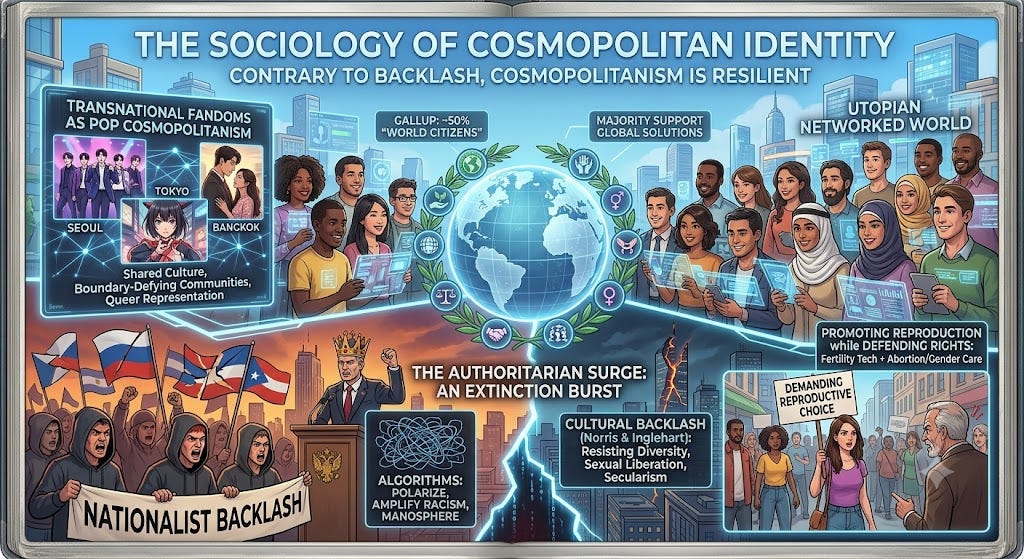
Contrary to the dominant narrative that globalization inevitably breeds nationalist backlash, recent global surveys reveal a surprising resilience in cosmopolitan identity. Gallup polls consistently find that nearly half of the world’s population feel more like citizens of the world than of their own country, and a majority support granting international bodies the power to enforce global solutions to problems like environmental pollution. Transnational and national identity can and do coexist, but a recent study of 65,000 participants across 49 countries found a generally negative correlation between the two.
This emerging transnational solidarity is inextricably linked to digital connectivity. Mark Zuckerberg’s promise that global networking platforms would deliver peace and understanding crashed long ago. Social media algorithms polarize, empower division, and amplify racism and nationalism.
But I have found unexpected inspiration in transnational fandom networks generating what might be called a pop cosmopolitanism on digital platforms — local political action rooted in shared global culture. Millions of young people around the world find community across ethnic and national lines through shared devotion to Korean idols, Japanese anime, and Thai drama. Queer television produced in Bangkok and Vancouver reaches a global audience demanding LGBTQ representation and marriage equality. Digital platforms, despite their destructive potential, are also forging new, boundary-defying identities that inspire social action.
One cause of the global far-right, traditionalist, patriarchal, nationalist backlash is precisely this creeping cosmopolitanism introduced by global connectivity. As social scientists Norris and Inglehart argue in Cultural Backlash: Trump, Brexit, and Authoritarian Populism, the far-right surge is an extinction burst responding to growing openness to diversity, sexual liberation, minority rights, gender and racial equality, and secularism. The World Values Survey shows that across post-industrial societies, Gen Z and Millennials hold markedly more liberal views on gender, sexuality, immigration, and internationalism than their predecessors. It is precisely these rapid transformations that have triggered nationalist reaction among traditionalists who feel they are losing their cultural moorings.
Unfortunately, the victory of cosmopolitanism is not guaranteed by generational succession. The surge of far-right support among young men is quite real. The authoritarians and nationalists are promising to restore an idealized patriarchy. The manosphere project is a response to radicalized young women’s withdrawal from dating, marriage, and childbirth, and women’s growing success in education and the labor force. As fertility drops and life expectancy lengthens, bioethicists will be drawn into debates about how we can promote reproduction while defending LGBTQ rights and reproductive choice — through subsidizing fertility technology alongside abortion and gender-affirming care, for instance. These are not peripheral to re-establishing global order and addressing existential threats. Women’s education and empowerment are inextricably tied to the spread of cosmopolitanism and to support for the solidaristic policies we need.
Moreno’s challenge to bioethicists is to understand where we came from and to connect our cosmopolitan ethics to the global moment, threatened by resurgent authoritarianism. The effective altruism and existential-risk communities have been brilliant at predicting catastrophe, and poor at building the institutions necessary to prevent it — partly because they were funded by people profiting from creating those risks. Or at least, the same billionaires giving millions to study the risks of the Terminator scenario are also profiting from building drone armies, and giving hundreds of millions to maintain authoritarian war mongers in power. We bioethicists don’t have billionaires, but we have a global community built over seventy years. Bioethics has the institutional networks, the normative vocabulary, and the international legitimacy to make a substantive contribution to building a new New World Order.
The obligations of transnational universalism begin with epistemic virtue, directing our attention to the world, and refusing the tendency to parochialism. It is also a commitment to a globalized moral calculus, a cosmopolitan consequentialism that rejects special accounting for co-nationals. For instance, Singer argued in One World that a cap-and-trade carbon system should be built on an equal per-capita allocation of carbon credits to every human being, not different caps for different nations.
Bioethics-specific efforts at transnational regulation relevant to existential risks include:
Strengthening the World Health Organization and the International Bioethics Committee at UNESCO
Pushing for enforceable global biosecurity protocols for synthetic biology, and condemning vaccine nationalism
Further empowering the International Criminal Court
Strengthening the International Association of Bioethics as a voice for global health policy and transnational regulatory efforts
Solidarity with democratic activists in every country, since the legitimacy of transnational institutions is diminished by authoritarianism and inequality
But in this apocalyptic conjuncture, we should also promote genuinely utopian demands for new and stronger transnational institutions. The aging and beleaguered world federalist movement is still pushing UN reforms, calling for a UN Charter review conference, and transnational policies to address climate protection, nuclear disarmament, AI regulation, anti-corruption, and global democracy. Perhaps we need even bolder utopian proposals and projects that will capture the imagination, such as those from Thomas Piketty and the Global Justice Project, which recently proposed a global sovereign wealth fund to hold 10% of the world capital stock, a global wealth tax rising to 20% annually on billionaires, and a global income tax rising to 90% at the very top.
The United States was impossible until it wasn’t. The European Union was utopian until it wasn’t. The question is not whether world federalism is achievable this decade. The question is whether it is the correct direction of travel — and whether every incremental global institution we build should be designed for universal, egalitarian accountability to all sentient beings, rather than for the perpetuation of Great Power privilege and resignation to the intractability of escalating existential risks.
No posts
Comments
Nothing yet. Say the first thing.
Sign in to join the conversation.