
0:00
-1:44
CHIPS met its non-inferiority criterion for 21-day cold-stored platelets with better than 99.9 percent posterior probability. In the same paper, bleeding scores worsened as storage lengthened, patients received more blood products, and re-exploration for bleeding more than doubled. Both things are true, and the reason they can both be true is a design decision made before the first patient enrolled.
Here are two sentences about the same trial, published in the same paper, five days ago in JAMA.
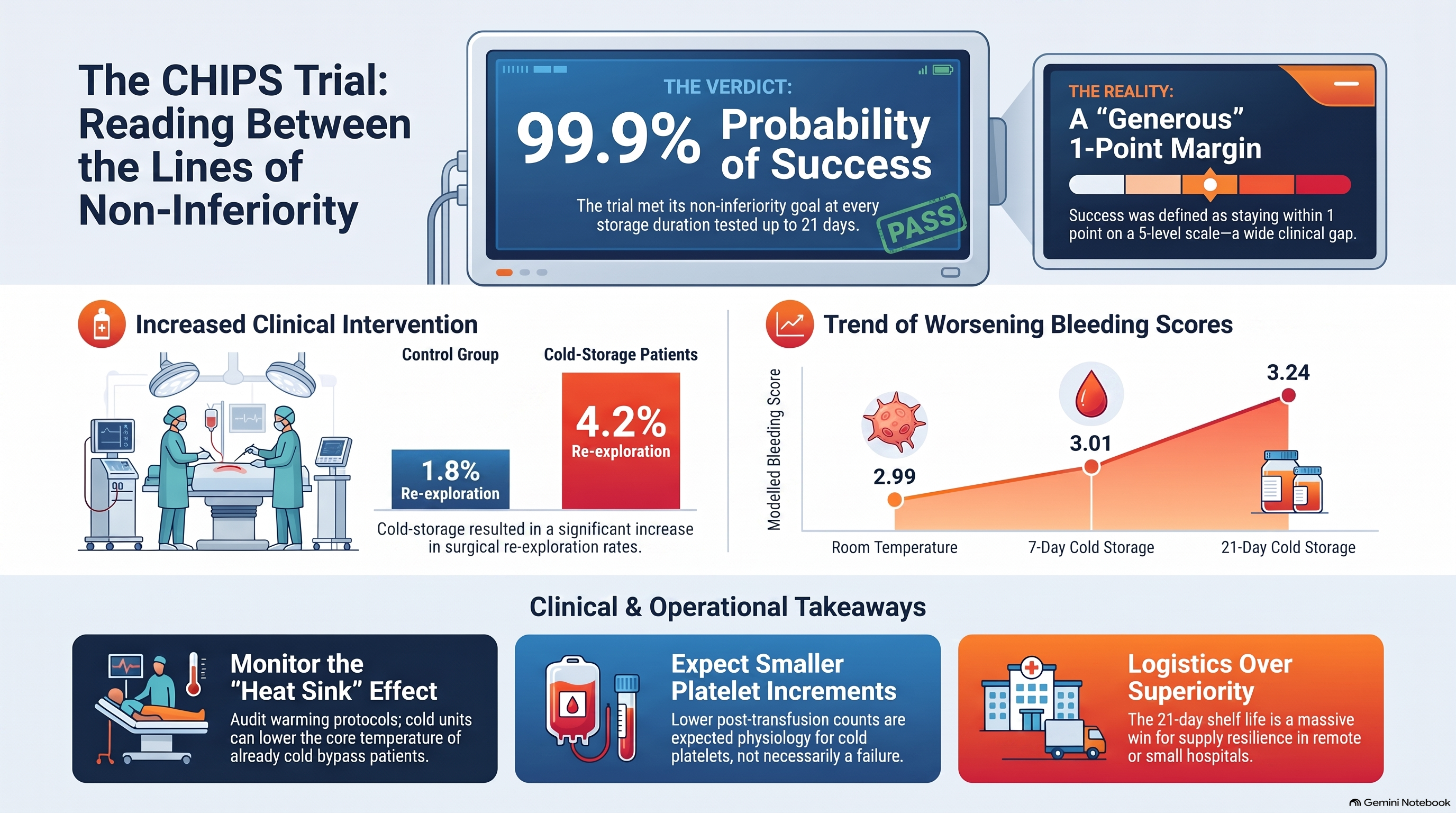
Cold-stored platelets stored for up to 21 days were non-inferior to conventional room-temperature platelets, with a posterior probability of non-inferiority above 99.9 percent at every storage duration tested.
Cold-stored platelets produced worse modelled bleeding scores as storage lengthened, required more blood products, produced smaller platelet count increments, and were followed by re-exploration for bleeding in 4.2 percent of patients compared with 1.8 percent.
Neither sentence is spin. Both are accurate. The trial did what it set out to do, and the investigators reported all of it plainly, which is to their considerable credit.
The reason both sentences can be true is a single number chosen before the first patient enrolled: the non-inferiority margin was one full point on a five-level bleeding scale.
With a control group mean near 3.0, that margin permitted a cold-stored mean approaching 4.0 while still declaring success. On a scale where higher means worse, that is room for an entire category of deterioration, conceptually the distance from moderate bleeding toward severe.
I want to be careful here, because there is a lazy version of this observation that amounts to accusing investigators of rigging a trial, and that is not what happened and not what I think. CHIPS is a serious, well-run, independently monitored study that answered a question the field badly needed answered. The margin was prespecified, published in a design paper three years before the results, and reviewed. Everything was done in the open.
What I am saying is narrower and, I think, more useful. A trial’s headline verdict is a function of the question it was built to answer. Reading only the verdict tells you whether the trial’s own criterion was met. Reading the table tells you what happened to the patients.
ICCN Update
The new ICCN website is live at iccn.io. Every article published in the past two weeks is now archived in one place, and our new Research section pulls recent published data from 26 major critical care and medical journals into a single curated feed for subscribers. Bookmark iccn.io.
Three reasons this belongs in front of you today rather than in three months.
The first is that platelets are the most operationally fragile product in the blood bank. A room-temperature unit lives 5 to 7 days because bacteria grow in it. It must be agitated continuously in a temperature-controlled cabinet. It requires either complex bacterial testing or expensive pathogen reduction. The consequence is that many hospitals cannot maintain a platelet inventory at all, and those that can throw a meaningful fraction of it away. A 21-day product would change that arithmetic completely. That is not a marginal convenience. For a small or remote hospital facing a haemorrhaging patient, it is the difference between having platelets and not having them.
The second is that the direction of the observed effect matters for how you implement, even if it does not change whether you implement. If your centre adopts 21-day cold storage, the trial tells you what to watch: transfusion volume, re-exploration rate, and platelet count response. That is a haemovigilance plan, and it comes free with the paper.
The third is the transferable skill. Every clinician reading this will encounter a dozen non-inferiority trials this year. The margin is the design element that determines what the trial can conclude, and it is almost never discussed on rounds or in journal club. This is an unusually clean worked example.
A non-inferiority trial does not ask whether a treatment is as good. It asks whether it is within a distance somebody chose in advance.
Why anyone wants cold platelets. Cardiopulmonary bypass produces both thrombocytopenia and platelet dysfunction, and platelet transfusion is common when bleeding persists during complex cardiac surgery. Room-temperature storage at 20 to 24 degrees Celsius with agitation caps shelf life at 5 to 7 days because of bacterial proliferation and progressive loss of function. Refrigeration at 1 to 6 degrees suppresses bacterial growth and may preserve or enhance immediate haemostatic activity for 14 to 21 days. The trade-off has been known since the 1960s, when cold storage was standard and was abandoned after radiolabelling studies showed shorter post-transfusion survival: cold platelets circulate less well and produce smaller count increments.
The bet behind CHIPS was that for a bleeding patient in an operating room, short circulating survival may not matter much, because you need haemostasis now rather than a platelet count on Thursday.
What CHIPS did. This was an investigator-initiated, phase 3, multicentre, international, partially blinded, adaptive Bayesian non-inferiority storage-duration-ranging trial across 25 US and 2 Australian hospitals from December 2021 to March 2025. Patients undergoing planned complex cardiac surgery with bypass, expected to bleed enough to require platelets, were randomised 2 to 1 to leucocyte-reduced apheresis platelets stored at 1 to 6 degrees without agitation, or to conventional room-temperature platelets. The population ran from neonates weighing at least 3 kg through adults under 85.
The maximum permitted cold-storage duration started at 7 days and was extended adaptively after successive cohorts of 200 transfused patients, up to 21. The primary outcome was an adapted five-level perioperative haemostatic efficacy score, higher meaning worse bleeding, and the non-inferiority margin was one point. A monotonic Bayesian piecewise-linear model related storage duration to score.
Of 1,811 randomised, 178 had participation cancelled before surgery, 596 never had platelets ordered, and 1,000 received a study transfusion. The primary analysis included 989.
What it found. Every evaluated duration cleared the bar with a posterior probability of non-inferiority above 99.9 percent. The trial was not stopped early and ran to its planned enrolment.
The model-estimated haemostatic efficacy score was 2.99 for room temperature, 3.01 at 7 days, 3.10 at 14 days, and 3.24 at 21 days. Pooled across durations, the cold-stored score was 3.08 versus 2.99, a mean difference of 0.09 with a 95 percent credible interval of minus 0.06 to 0.23.
Twenty-four-hour chest-tube output was 8.9 versus 8.4 mL/kg, difference in medians 0.4, 95 percent CI minus 1.0 to 1.5, P equals 0.83.
Then the exploratory outcomes, and I am flagging that word deliberately because none of what follows was adjusted for multiplicity and none of it is established harm. Total blood product volume within 24 hours was 26.0 plus or minus 37.4 mL/kg versus 19.4 plus or minus 20.1, a mean difference of 6.7, 95 percent CI 3.1 to 10.3, P equals 0.04. Platelet volume was 2.7 mL/kg higher (P equals 0.02) and plasma volume 1.8 mL/kg higher (P equals 0.004). Relative platelet count change at 6 hours was plus 0.12 versus plus 0.54. Re-exploration for bleeding within 24 hours occurred in 28 of 660 versus 6 of 340, 4.2 versus 1.8 percent, absolute difference 2.5 percentage points, 95 percent CI 0.4 to 4.6.
Arterial thrombotic events were 2.6 versus 3.8 percent and venous 2.6 versus 1.8 percent, with no clear difference and no power to establish equivalence for uncommon events. Twenty-eight-day mortality was 21 of 660 versus 6 of 340, 3.2 versus 1.8 percent, 95 percent CI minus 0.5 to 3.4.
Where the surrounding evidence sits. A 50-patient pilot in complex cardiothoracic surgery found no significant difference in postoperative chest-drain output. A mechanistic randomised study by Kogler and colleagues found better reversal of platelet inhibition with room-temperature platelets, with substantial donor variability. In trauma, CRISP-HS found early cold-stored platelet transfusion feasible but did not significantly reduce 24-hour mortality at 5.9 versus 10.2 percent, absolute difference minus 4.3 percentage points, 95 percent CI minus 12.8 to 3.5, P equals 0.26, and a 2026 Bayesian reanalysis estimated an 89.1 percent posterior probability of reduced 24-hour mortality, which is suggestive and not definitive. CRISP-TBI found no improvement in six-month Glasgow Outcome Scale-Extended distribution, odds ratio 1.58, 95 percent CI 0.71 to 3.54, P equals 0.27.
And sitting underneath all of it, the 2025 AABB and ICTMG international guideline advises against platelet transfusion in patients without thrombocytopenia undergoing cardiovascular surgery in the absence of major haemorrhage, including those on bypass.
The direction of effect was monotonic, and the model made it so.
The estimated score rose steadily with storage age. That pattern is partly a property of the analysis, because the Bayesian model imposed a monotonic duration-response relationship as a prespecified structural assumption. It is a reasonable assumption, since it would be biologically strange for a platelet to get better at day 18 than day 12. But it means the smooth upward line is not purely an empirical observation. It is an empirical observation shaped by a modelling choice, and only 38 patients actually received platelets at the exact 21-day duration.
The 21-day credible interval excluded zero.
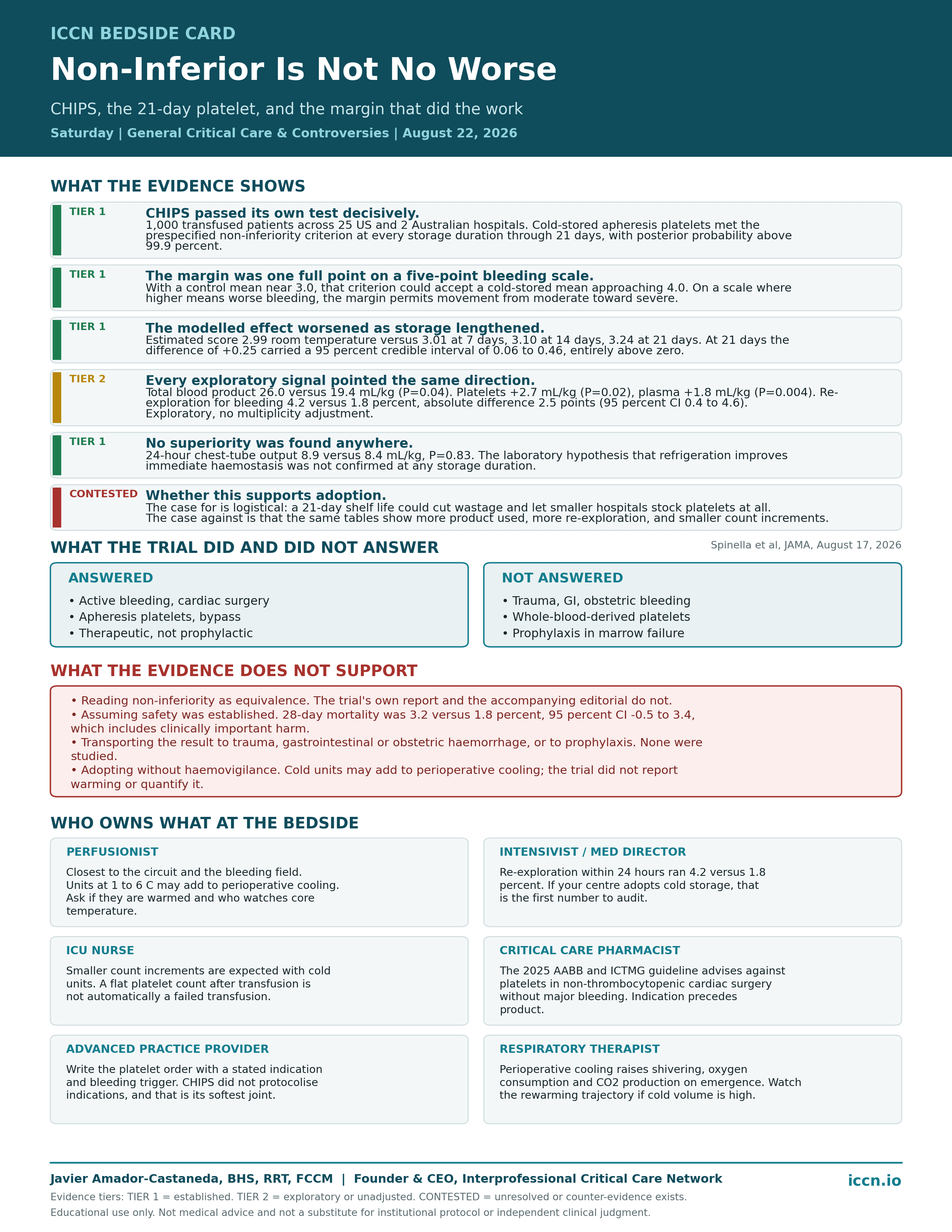
The difference at 21 days was 0.25 points with a 95 percent credible interval of 0.06 to 0.46. That interval lies entirely above zero. In plain terms, the data are consistent with cold-stored platelets at 21 days being modestly worse, and are not consistent with them being identical. They are comfortably inside a one-point margin, and they are outside the zone of no difference. Both statements come from the same number.
The exploratory outcomes were internally consistent, which is the part that gives me pause.
If the transfusion-volume finding stood alone, I would call it noise. It does not stand alone. More platelets, more plasma, numerically more red cells, smaller count increments, more re-exploration, and a worse modelled score all point in one direction. Internal consistency across independent measures is weak evidence that behaves differently from a single unadjusted P value.
I want to hold the counterweight honestly too. The clinician physically hanging the unit could often tell which product it was, by touch or by condensation on the bag. Transfusion decisions, additional product, and the decision to re-explore are all clinician-dependent. A partially unblinded clinician who believes cold platelets work less well may transfuse more and re-explore sooner. That mechanism would generate exactly this pattern without any true difference in platelet function. The trial cannot separate the two.
Crossover ran the wrong way for a sceptic.
In the cold-stored group, 14.7 percent received at least some room-temperature platelets, compared with 1.8 percent crossover in the other direction. Contamination of that kind dilutes a true difference and pushes a non-inferiority trial toward its desired conclusion. The per-intervention analysis was nevertheless consistent with the primary result, which is reassuring, but the asymmetry is worth knowing.
The analysis population was conditioned on something that happened after randomisation.
The primary analysis included 989 of 1,811 randomised patients, restricted to those who actually received a study platelet transfusion. Conditioning on a post-randomisation event can compromise the protection randomisation provides. The mitigating facts are that the proportions transfused were similar across arms and allocation was generally concealed at the moment the transfusion decision was made.
Internal consistency across six independent measures is a different kind of evidence than one unadjusted P value, even when every one of those measures is labelled exploratory.
Let me separate what I think this trial establishes from what I think it invites.
What it establishes. For a bleeding adult or child on bypass, apheresis platelets refrigerated for up to 21 days provide haemostasis that falls within one point of conventional platelets on a five-level scale. Given how large that band is, this is a genuinely useful pragmatic statement: cold platelets are not a disaster, they do not fail catastrophically, and a hospital that has 21-day platelets on the shelf and no room-temperature platelets is better equipped than a hospital with nothing.
I think that is the honest headline, and it is not a small one. The trial’s own overall takeaway frames the potential as logistical and supply-related rather than as superior haemostasis, and I agree.
What it does not establish. That the products are interchangeable. The investigators do not claim that, and the accompanying JAMA editorial reads the trial as establishing non-inferiority under current practice rather than proving universal equivalence at 21 days.
What it invites. A specific implementation posture. If your centre moves to cold-stored platelets, three things follow directly from the data.
You should expect smaller platelet count increments, and you should tell the bedside before the first unit arrives, because otherwise a normal finding will be read as a failed transfusion and will trigger another unit. That reflex is plausibly one of the mechanisms behind the higher transfusion volumes in the trial.
You should audit re-exploration for bleeding. Not because harm is established, but because 4.2 versus 1.8 percent is the signal most worth knowing about locally, and because your own rate is the only number that will actually change your practice.
And you should ask the thermal question, which as far as I can tell almost nobody is asking. Several units at 1 to 6 degrees Celsius going into a patient who is already at risk of perioperative cooling is a heat sink. Even mild perioperative hypothermia worsens bleeding. The trial did not report whether products were warmed and did not quantify any temperature effect. That is a real gap, and it is the kind of gap that gets discovered by a unit rather than by a trial.
The most important operational question about cold platelets may be one the trial did not measure: what several cold units do to the temperature of a patient who is already cold.
1. Ask whether the units are warmed, and who is watching core temperature.
For perfusionists, this is your question more than anyone’s. You sit between the blood bank and the bleeding field, you already manage temperature through the circuit, and you are the person most likely to notice a thermal effect that a multicentre trial averaged away. If your centre pilots cold-stored platelets, ask on day one what the warming protocol is. If the answer is that there is not one, that is worth raising formally.
2. Reset the count-increment expectation before the product arrives.
For ICU nurses, smaller platelet count increments are the expected physiology of a cold-stored unit, not evidence that it failed. A flat count six hours after transfusion in a patient who has stopped bleeding is a success. If that expectation is not reset in advance, the predictable result is additional units ordered on the basis of a number rather than a bleeding assessment.
3. Put the indication upstream of the product.
For critical care pharmacists, CHIPS did not protocolise transfusion indications, and the 2025 AABB and ICTMG guideline advises against platelet transfusion in non-thrombocytopenic cardiovascular surgery without major haemorrhage. Debating storage temperature is a second-order question if the first-order question, whether this patient needs platelets at all, is not being asked consistently. Pharmacy is well positioned to ask it.
4. Write the indication and the trigger into the order.
For advanced practice providers, an order that says “transfuse one unit of platelets” carries no information about why. An order that names the indication and the bleeding trigger creates a record that makes local audit possible. Given that unprotocolised indications are the softest joint in this trial, that is the gap your order set can close locally.
5. Audit re-exploration first.
For intensivists and medical directors, if adoption happens, re-exploration for bleeding within 24 hours is the outcome to track prospectively from the first unit. The trial gives you a reference range of 4.2 versus 1.8 percent. Your own number, measured against your historical baseline, is the only thing that will settle the question locally.
6. Watch the rewarming trajectory.
For respiratory therapists, perioperative cooling raises shivering, oxygen consumption, and carbon dioxide production during emergence and early weaning. If a patient received a large volume of cold product, expect that trajectory to be steeper and longer, and expect ventilation demand to move with it. This is not in the trial. It is physiology that follows from the trial’s intervention.
Three questions for any non-inferiority trial, in this order. They take about ninety seconds and they will change how you read the abstract.
1. What was the margin, and what does it mean on this scale? Not whether a margin existed, but how big it was relative to the outcome. A one-point margin on a five-level bleeding score is very different from a one-point margin on a hundred-point scale. Convert it into clinical language: what is the worst result this trial could have observed and still declared success?
2. Where did the point estimate actually land? Non-inferiority means “inside the margin.” It does not mean “at zero.” A result can be non-inferior and simultaneously show a difference whose confidence interval excludes zero. That is precisely what happened at 21 days in CHIPS.
3. Which direction did the secondary and exploratory outcomes run? If they scatter randomly, the primary result probably reflects genuine similarity. If they line up consistently on one side, the margin may be absorbing a real effect.
Run CHIPS through it. Margin one point on a five-level scale, wide. Point estimate at 21 days plus 0.25 with a credible interval entirely above zero. Six exploratory measures all pointing the same way.
The trial passed. The table says something more specific than “passed.”
Do not read this as an argument against cold-stored platelets. I do not think the field should reject a 21-day product on this evidence. The supply case is strong, the effect size is small, and a hospital with cold platelets is better off than a hospital with none.
Do not read the exploratory findings as established harm. Re-exploration, transfusion volume, and mortality were all exploratory outcomes without multiplicity adjustment, in a trial where the administering clinician could often identify the product. The 28-day mortality confidence interval of minus 0.5 to 3.4 percentage points includes both no difference and clinically important harm. That is uncertainty, not a finding.
Do not assume the mechanism is known. Cold platelets may clear faster, may be incorporated into forming thrombus faster, may produce laboratory results that prompt additional transfusion, or may have genuinely lower sustained efficacy. CHIPS could not distinguish these, and the difference matters for what you would do about it.
Do not transport this to other bleeding. CHIPS does not establish efficacy for trauma, gastrointestinal or obstetric haemorrhage, liver transplantation, non-cardiac surgery, or bleeding without bypass. The trauma evidence is separate and mixed: CRISP-HS did not reach significance on 24-hour mortality and CRISP-TBI found no functional benefit.
Do not transport this to prophylaxis. Short circulating survival may be acceptable when treating active surgical bleeding in a patient with intact platelet production. It is a different proposition entirely in chemotherapy-associated or marrow-failure thrombocytopenia, where sustained circulating platelets are the entire point. That population was not studied.
Do not assume this covers your product. All sites were in the US or Australia and used leucocyte-reduced apheresis platelets. Pooled whole-blood-derived platelets, common in many health systems, were not evaluated.
The one-point non-inferiority margin is generous relative to a five-category scale, and it is the design feature most responsible for the gap between the verdict and the table.
The primary outcome score was coarse, incorporated clinician-dependent components including blood product use, haemostatic agents, delayed sternal closure and re-exploration, was originally validated in adults, and was modified with unvalidated weight-adjusted criteria for smaller patients.
Transfusion thresholds, indications, other blood products, and haemostatic adjuncts were not standardised, so additional transfusion may have both compensated for a product difference and simultaneously contributed to the primary score.
The principal analysis was a modified intention-to-treat analysis of 989 patients rather than all 1,811 randomised, conditioned on post-randomisation receipt of study platelets.
Protocol adherence was 85.3 percent in the cold-stored arm versus 98.2 percent in the comparator, and asymmetric crossover of that size biases a non-inferiority trial toward its conclusion.
Only 38 patients received platelets at the exact 21-day duration, so the headline 21-day estimate depends on a model borrowing information across storage ages under an imposed monotonicity assumption.
The clinician administering the platelets could frequently detect allocation from the temperature or condensation of the bag, and the outcomes most affected by that limitation are precisely the ones showing differences.
At least one ABO-incompatible platelet product was given to 50.5 percent of cold-stored recipients versus 37.4 percent of controls, which complicates interpretation of laboratory platelet recovery.
The trial was not powered to establish equivalence for mortality, thrombosis, or other uncommon adverse events, and no post-CHIPS confirmatory trial, meta-analysis, or guideline yet exists.
CHIPS is the largest randomised evaluation of cold-stored platelets ever conducted, and it met its prespecified non-inferiority criterion at every storage duration through 21 days with better than 99.9 percent posterior probability. That result matters, and its value is logistical: a 21-day shelf life could reduce wastage, improve resilience during shortages, and let hospitals that cannot maintain conventional platelet inventory stock platelets at all.
The same paper shows that modelled bleeding scores rose as storage lengthened, that the 21-day difference of 0.25 points had a credible interval entirely above zero, that recipients received more blood products, and that re-exploration for bleeding ran 4.2 versus 1.8 percent. Those exploratory findings do not establish harm, and partial unblinding could produce every one of them. They do point consistently in one direction.
Both readings are correct because the non-inferiority margin was one full point on a five-level scale, wide enough to contain an entire category of worse bleeding.
Adopt if the supply case justifies it. Reset the platelet count expectation before the first unit. Audit your own re-exploration rate. Ask what happens to the patient’s temperature.
And the next time you read that a trial demonstrated non-inferiority, ask what the margin was before you ask what the result was.

The provided text explores the results and clinical implications of the CHIPS trial, which investigated the use of cold-stored platelets for patients undergoing complex cardiac surgery. While the study officially met its non-inferiority criterion, meaning refrigerated platelets were deemed acceptable compared to standard room-temperature units, a closer look at the data reveals increased bleeding risks and higher transfusion requirements as storage time lengthened. The author emphasizes that the trial’s success was largely due to a generous non-inferiority margin, which masked subtle but consistent trends toward worse patient outcomes. Beyond the statistics, the source offers practical guidance for various healthcare roles to manage the physiological challenges, such as potential patient cooling and reduced platelet recovery, associated with this storage method. Ultimately, the text serves as a methodological lesson on why clinicians must examine full data tables rather than relying solely on a trial’s headline verdict.
Spinella PC, Zantek ND, VanBuren JM, et al; CHIPS Investigator Group. Cold and room-temperature platelets in cardiac surgery: the CHIPS randomized clinical trial. JAMA. Published online August 17, 2026. doi:10.1001/jama.2026.13328
Hess AS. A world with platelets stored cold for 21 days: chill and tender. JAMA. Published online August 17, 2026. doi:10.1001/jama.2026.13885
Metcalf RA, Nahirniak S, Guyatt G, et al. Platelet transfusion: 2025 AABB and ICTMG international clinical practice guidelines. JAMA. 2025;334(7):606-617. doi:10.1001/jama.2025.7529
Zantek ND, Steiner ME, VanBuren JM, et al. Design and logistical considerations for the randomized adaptive non-inferiority storage-duration-ranging Chilled Platelet Study. Clin Trials. 2023;20(1):36-46. doi:10.1177/17407745221126423
Strandenes G, Sivertsen J, Bjerkvig CK, et al. A pilot trial of platelets stored cold versus at room temperature for complex cardiothoracic surgery. Anesthesiology. 2020;133(6):1173-1183. doi:10.1097/ALN.0000000000003550
Kogler VJ, Miles JA, Özpolat T, et al. Platelet dysfunction reversal with cold-stored vs room temperature-stored platelet transfusions. Blood. 2024;143(20):2073-2088. doi:10.1182/blood.2023022593
Sperry JL, Guyette FX, Rosario-Rivera BL, et al; CRISP-HS Study Group. Early cold stored platelet transfusion following severe injury: a randomized clinical trial. Ann Surg. 2024;280(2):212-221. doi:10.1097/SLA.0000000000006317
Gerard J, Sperry JL, Guyette FX, et al; CRISP-HS Study Group. Bayesian analysis of the early cold stored platelet transfusion following severe injury randomized clinical trial. Trauma Surg Acute Care Open. 2026;11(3):e002145. doi:10.1136/tsaco-2025-002145
Neal MD, Okonkwo DO, Guyette FX, et al; CRISP-TBI Study Group. Early cold-stored platelet transfusion following traumatic brain injury: a randomized clinical trial. Ann Surg. 2025;281(5):796-805. doi:10.1097/SLA.0000000000006640
Klompas AM, Zec S, Hanson AC, et al. Postoperative transfusions following administration of delayed cold stored platelets vs room temperature platelets in cardiac surgery: a retrospective cohort study. Anesthesiology. 2023;139(2):153-163. doi:10.1097/ALN.0000000000004605
Bartoszko J, Peer M, Grewal D, Ansari S, Callum J, Karkouti K. Delayed cold-stored vs room temperature stored platelet transfusions in bleeding adult cardiac surgery patients: a randomized multicentre pilot study (PLTS-1). Pilot Feasibility Stud. 2024;10(1). doi:10.1186/s40814-024-01518-z
⚠️ Medical Disclaimer: The content published in ICCN is intended solely for educational and informational purposes for healthcare professionals. It does not constitute medical advice, clinical guidelines, or a standard of care, and should not be used as a substitute for the independent professional judgment of a licensed clinician. All transfusion decisions must be individualized to the patient and made by qualified healthcare providers in accordance with institutional protocol and transfusion service policy. ICCN assumes no liability for any clinical outcomes arising from the information presented herein.
© 2026 Interprofessional Critical Care Network (ICCN). All rights reserved. Unauthorized reproduction or redistribution of this content is prohibited. Subscribers may share excerpts with proper attribution to ICCN and the author.
Javier Amador-Castaneda, BHS, RRT, FCCM | Founder & CEO, ICCN
No posts
Comments
Nothing yet. Say the first thing.
Sign in to join the conversation.