
0:00
-1:37
I have spent a fair amount of my career standing at the bedside of patients with a tracheostomy tube, and I want to tell you what the literature has to say about the part of their care I actually participate in.
Almost nothing.
We have randomized trials on when to place the tube. We have a Cochrane review, several meta-analyses, and a 909-patient multicenter trial on that question. We have another Cochrane review on percutaneous versus surgical technique.
Then the tube is in, and the published evidence essentially stops.
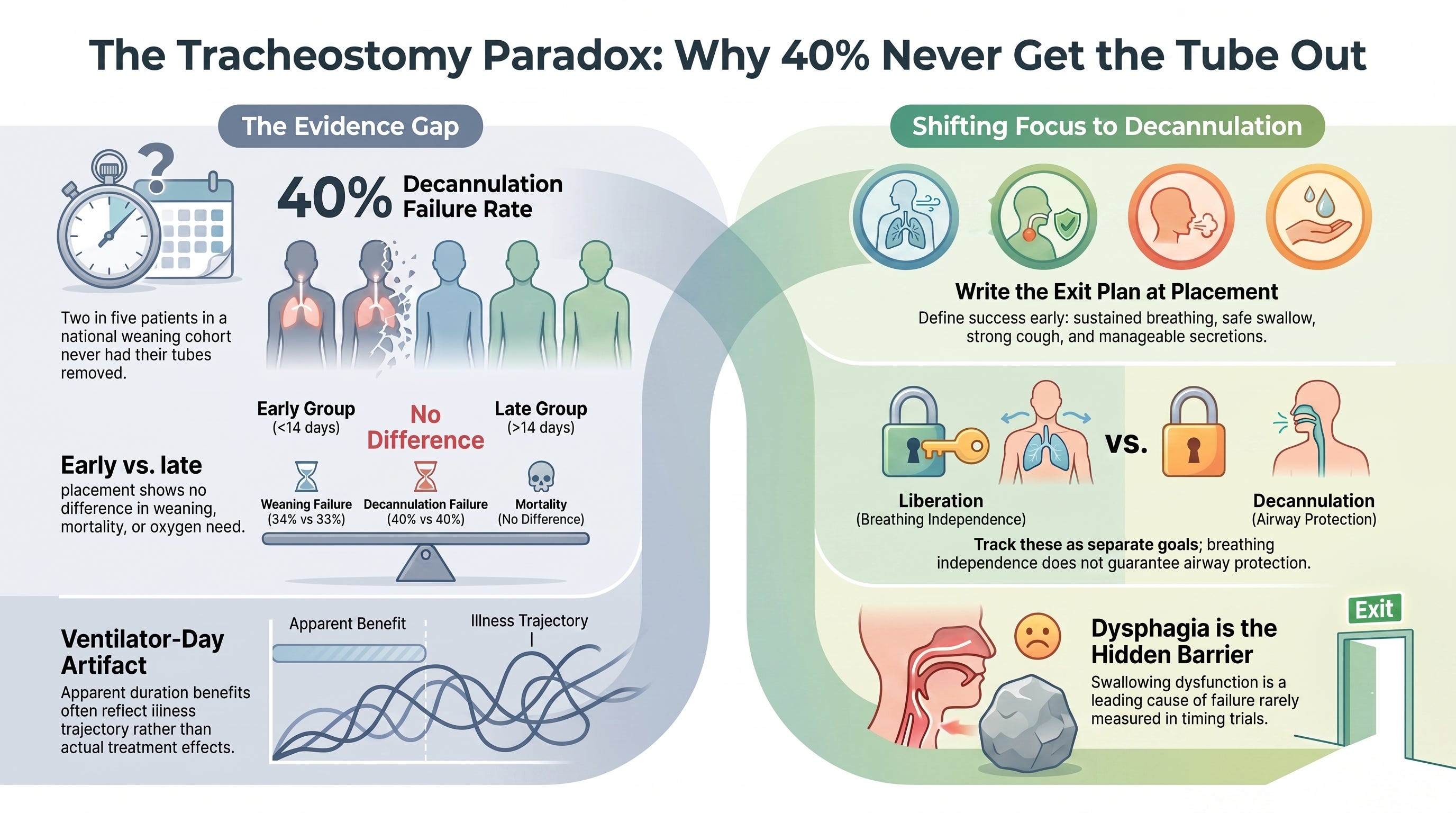
In March, a group in Stuttgart published twelve years of data on 738 patients who were transferred to a German national weaning center after prolonged ventilation. They asked whether early tracheostomy produced better weaning outcomes. It did not. No difference in weaning failure, decannulation failure, long-term oxygen need, or mortality.
But buried in their results is a number I have not been able to stop thinking about.
Roughly forty percent of these patients were never decannulated.
Four in ten. And when the authors explain why, they name two causes, persistent ICU-acquired dysphagia and long-term ventilator dependence, and then state that neither was evaluated in their study.
That is the honest state of this field. We know precisely how many days to wait before cutting a hole in someone’s neck, and we do not know what happens to nearly half of them afterward.
ICCN Update
The new ICCN website is live at iccn.io. Every article published in the past two weeks is now archived in one place, and our new Research section pulls recent published data from 26 major critical care and medical journals into a single curated feed for subscribers. Bookmark iccn.io.
Last week closed a three-week arc on the artificial airway. We looked at the cuff, at airway clearance, and at the moment the tube comes out. The pattern that emerged was consistent: we have built careful practice around process measures and categories that the evidence does not fully support.
This week opens a new arc, and it starts with the patients who never reach that moment.
Tracheostomy is presented to families and to trainees as a step forward. It reduces sedation requirements, it improves comfort, it may allow speech and oral intake, and it makes weaning attempts more tolerable. Those are real advantages and I am not disputing them.
What I am disputing is the framing that places the decision at the center of the story. The decision has been studied to exhaustion. The eighteen months of a patient’s life that follow it have not.
Ghiani and colleagues conducted a retrospective analysis of patients consecutively admitted to a specialized national weaning facility in Germany between December 2011 and January 2024.¹ Every patient had been referred from an ICU elsewhere in the country for prolonged weaning, meeting either the International Consensus Conference or WIND criteria: failure of at least three weaning attempts, or more than seven days of ventilation after the first separation attempt.
To be admitted, patients had to be ventilated through a tracheostomy tube with PEEP below 10 cmH2O and FiO2 below 0.6, hemodynamically stable without vasopressors, and not deeply sedated. These are, in other words, patients who have survived the acute phase and are now stuck.
Of 950 screened, 738 were included. Early tracheostomy was defined as placement within 14 days of intubation, with a 10-day threshold used for sensitivity analysis. Five hundred and seven procedures, 69 percent, were early. Propensity score matching yielded 220 patients per group.
Here is the full result set.
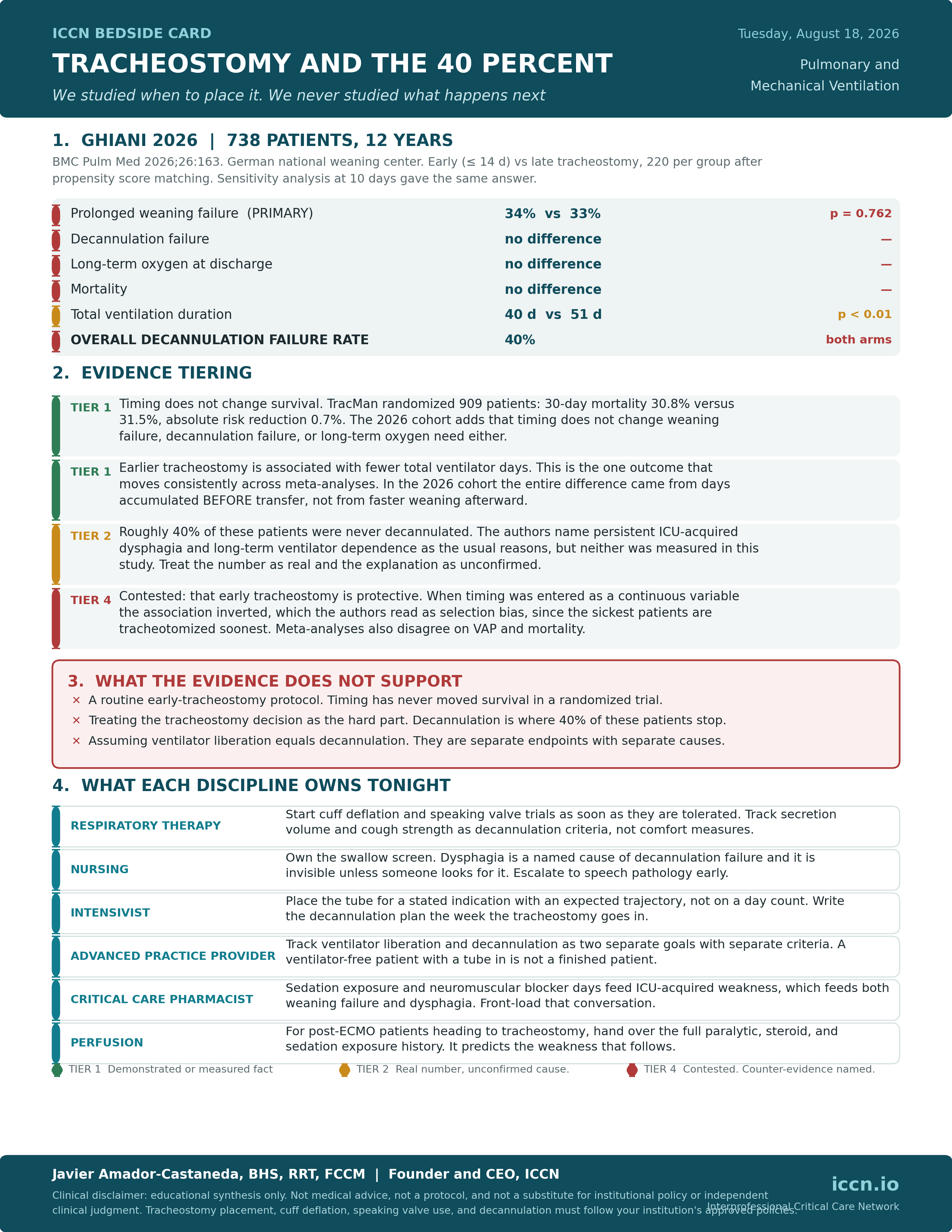
Prolonged weaning failure, defined as transition to domiciliary noninvasive or invasive ventilation: 34 percent in the early group, 33 percent in the late group, p = 0.762.¹
Decannulation failures: no difference. Long-term oxygen therapy at hospital discharge: no difference. Mortality: no difference.
Total mechanical ventilation duration: 40 days (IQR 32 to 56) in the early group versus 51 days (IQR 52 to 70) in the late group, p < 0.01.¹
Ventilator-free days at 90 days favored the early group, and the authors attribute both of these differences to a single cause. Patients with late tracheostomy had accumulated significantly more ventilator days at the referring ICU before they ever arrived. Once at the weaning center, weaning duration did not differ.
The physiology at the first spontaneous breathing trial after admission was also indistinguishable. No significant differences in predicted-body-weight-normalized tidal volume, dynamic respiratory system compliance, ventilatory ratio, mechanical power, or power density.¹ P/F ratios differed slightly. That is all.
In multivariable logistic regression adjusting for baseline characteristics, reason for intubation, and comorbidities, early tracheostomy was not independently associated with weaning failure. Kaplan-Meier analysis showed no difference in the probability of prolonged weaning failure between groups.
And the overall decannulation failure rate reached 40 percent, which the authors note is consistent with previous work.¹
Set that against the landmark trial. TracMan randomized 909 patients across UK ICUs to tracheostomy within four days or after ten days.² Thirty-day all-cause mortality was 30.8 percent in the early group and 31.5 percent in the late group, an absolute risk reduction of 0.7 percent. ICU and hospital stay were similar.
Across the meta-analytic literature, the picture is consistent in one respect and inconsistent in every other. Chorath and colleagues found early placement associated with shorter ventilation and lower pneumonia risk but not lower mortality.³ Other syntheses restricted to randomized trials disagree, particularly on pneumonia and mortality.⁴ ⁵ ⁶ The one outcome that improves consistently across trials is total ventilation duration.
The anchor authors make an observation about this literature that I think is the most important sentence in their paper. None of these meta-analyses and systematic reviews presented data concerning weaning failure rates.¹
Twenty years of trials about tracheostomy timing, and nobody reported whether the patients were weaned.
1. The ventilator-day difference is a bookkeeping artifact, not a treatment effect.
Early patients spent 40 days on the ventilator, late patients 51. That looks like an eleven-day benefit until you see where it came from. The late group simply spent longer at the referring ICU before transfer. After admission to the weaning center, weaning duration was the same.
The authors offer a reasonable explanation. Patients who receive a late tracheostomy may have been sicker for longer, with gas exchange too poor to justify the procedure earlier. Most clinicians do not tracheotomize a patient who still needs high FiO2 and high PEEP.
So the eleven days may reflect illness trajectory, not the benefit of an earlier procedure. Which is a different claim than “early tracheostomy shortens ventilation.”
2. The continuous-variable analysis pointed the opposite way, and the authors said why.
When tracheostomy timing was entered as a categorical variable, no association with weaning failure. When entered as a continuous variable, the analysis showed an inverse relationship between days from intubation to tracheostomy and inability to wean.¹
Read literally, that says later tracheostomy predicted better weaning. The authors do not read it literally. They state that this may reflect selection bias, since patients with evidently worse weaning prognoses may have been tracheotomized very early.
I want to flag this as a model of how to report an inconvenient result. They published the finding, gave the most likely explanation, and did not spin it in either direction.
3. Forty percent, and nobody measured why.
This is the number that made me want to write the piece. Two in five of these patients never had the tube removed.
The authors name the usual causes: persistent, severe ICU-acquired dysphagia producing excessive salivation and aspiration, and long-term ventilator dependence after prolonged weaning. Then, in the same sentence, they state that neither was evaluated in the present study.¹
That is not a criticism of them. It is a description of the field. Dysphagia is a plausible, frequently cited, mechanistically supported reason that patients cannot be decannulated, and the timing literature does not measure it.
We have run randomized trials on the day the tube goes in and have never systematically measured the thing that keeps it from coming out.
4. The respiratory mechanics were identical, which tells you where the problem is not.
At the first spontaneous breathing trial after transfer, compliance, ventilatory ratio, mechanical power, and power density were the same in both groups.¹ Some of these indexes have been shown to predict prolonged weaning outcomes in earlier work from the same team.⁷ ⁸
If the respiratory pump looks the same regardless of timing, then timing is not acting through respiratory mechanics. Whatever separates the patients who get free from those who do not is upstream or downstream of the numbers we watch on the ventilator.
5. The mortality figures are deflated by design, and the authors say so.
Only patients who survived their referring ICU stay were eligible for transfer. Every death before transfer is invisible here.¹ Any comparison of mortality in this cohort is conditioned on survival to a specific point, and the authors state this in their limitations rather than leaving the reader to work it out.
Here is my read.
The tracheostomy timing literature is a case study in what happens when a field finds a question it can randomize.
The date of a procedure is easy to assign, easy to protocolize, and easy to compare. Weaning trajectory, swallowing recovery, communication, and the eventual removal of the tube are hard to define, hard to standardize across centers, and unfold over months rather than days. So we studied the tractable question thoroughly and left the important one alone.
That is not a moral failing. It is the ordinary gravitational pull of research feasibility. But the consequence is a literature that can tell you with confidence that day four is not better than day ten, and cannot tell you what to do on day forty.
The field studied the question it could randomize rather than the question that decides whether the patient goes home talking and eating.
Consider what actually stands between a tracheostomized patient and decannulation.
They need to breathe without ventilatory support for a sustained period. They need to protect their airway, which means an intact cough and a functioning swallow. They need to clear their own secretions at a volume the upper airway can handle. And they need an upper airway that is patent, without granulation tissue or stenosis from the tube itself.
Only the first of those four is a ventilation problem. The other three are neuromuscular and airway problems, and the timing literature addresses none of them.
Dysphagia deserves particular attention here. The mechanisms proposed for ICU-acquired swallowing dysfunction include direct trauma from endotracheal and tracheostomy tubes, neuromyopathy producing muscular weakness, diminished laryngeal sensory function, impaired sensorium, gastroesophageal reflux, and dyssynchrony between breathing and swallowing.⁹ Every one of those is plausible in a patient who has been ventilated for weeks. Post-extubation dysphagia is commonly observed in ICU patients, is mostly persisting, and is independently associated with adverse patient-centered outcomes.⁹
And breathing and swallowing are neurologically and anatomically interdependent, which means a tube crossing the larynx is not a neutral bystander in this process.
So when 40 percent of a prolonged-weaning cohort cannot be decannulated, and dysphagia is named as a leading cause, the obvious inference is that a substantial share of these patients are held by a problem that no tracheostomy trial has ever measured.
I want to be careful about how strongly I put that. The anchor did not measure dysphagia. I am connecting their observed failure rate to a separate literature, and that connection is inference rather than demonstration. But it is the inference the authors themselves invite in their closing sentence, where they call for future research on patient-centered outcomes such as dysphagia, speech, and mobility impairments, which may also depend on the timing of the procedure.
Now let me place the six disciplines properly, because this is a topic where the work is genuinely distributed and the ICU frequently hands the patient off before any of it is finished.
Respiratory therapists carry the practical weaning plan for these patients, often with more continuity than anyone else on the team. The decisions that matter here are cuff deflation trials, speaking valve tolerance, and honest tracking of secretion volume and cough strength. Those are frequently treated as comfort and communication measures. They are decannulation criteria, and documenting them as such changes what the team can act on.
ICU nurses are positioned to catch the dysphagia problem earlier than anyone. Excessive salivation, coughing with oral intake, wet vocal quality, and aspiration events are nursing observations before they are speech pathology findings. If your unit does not have a routine swallow screen for tracheostomized patients, the problem that stops 40 percent of them from being decannulated is being detected by accident.
Intensivists own the framing of the decision itself. The evidence supports placing a tracheostomy for a stated indication in a patient with an anticipated trajectory, and does not support a protocol that places one on a day count.² ³ The more valuable act is writing the decannulation plan the same week the tracheostomy goes in, naming what has to be true for the tube to come out.
Advanced practice providers own the distinction that this entire article rests on. Ventilator liberation and decannulation are two separate goals with two separate criteria sets. A patient off the ventilator with a tube still in is not finished, and the daily note should track both.
Critical care pharmacists own the exposures that feed the weakness. Cumulative sedation, neuromuscular blocker days, and corticosteroid exposure all contribute to ICU-acquired weakness, which plausibly connects to both weaning failure and swallowing dysfunction.⁹ The pharmacist raising that on day three of ventilation is working further upstream than anyone else in this story.
Perfusionists manage patients who arrive at tracheostomy with an unusually heavy exposure history. For post-ECMO patients, the paralytic, steroid, and sedation record is genuinely predictive information for the team who will later try to wean and decannulate, and it is routinely lost in handoff.
1. Respiratory therapists: treat cuff deflation and speaking valve trials as decannulation criteria.
Begin them as soon as they are tolerated, and document secretion volume, cough strength, and tolerance duration in the same place you document weaning progress. These are the measurable properties that determine whether the upper airway can take over, and they are frequently charted as comfort observations rather than as data.
2. ICU nurses: put a swallow screen on every tracheostomized patient, on a schedule.
Do not wait for an aspiration event to trigger a speech pathology consult. Wet voice, coughing with intake, excessive oral secretions, and reluctance to eat are early signals. Persistent dysphagia is one of the two reasons the anchor authors name for decannulation failure, and it is invisible unless somebody is looking for it.⁹
3. Intensivists: place the tube for a stated indication, and write the exit plan the same week.
Replace day-count thinking with a documented indication and expected trajectory. Then write what has to be true for decannulation: sustained unassisted breathing, an adequate cough, a safe swallow, manageable secretions, and a patent upper airway. A plan written at placement is worth more than a plan improvised at week six.
4. Advanced practice providers: track liberation and decannulation as two separate goals.
Add both to the daily assessment with their own criteria. Ask specifically what is currently preventing decannulation in this patient. If the answer is “still on the ventilator,” that is one problem. If the answer is “cannot protect the airway,” that is a different problem needing different people.
5. Critical care pharmacists: work the weakness exposures during the acute phase.
Cumulative sedation, paralytic days, and steroid exposure are modifiable in week one and not in week six. Bring them to rounds early in the ventilation course, before the patient becomes a prolonged weaning patient, because that is where the leverage is.
6. Perfusionists: hand over the full exposure history at transition of care.
For post-ECMO patients heading toward tracheostomy, transfer the complete paralytic, sedation, and corticosteroid record to the receiving team. It is directly relevant to the weakness that will shape their weaning and decannulation course.
[DOWNLOADABLE LEARNING SLIDES PLACEHOLDER: ICCN-original slide deck for unit education and journal club, attach after Bottom Line.]
When you read an intervention literature, check what the trials measured against what the patient actually needs.
The tracheostomy timing literature measured mortality, ventilator days, ICU stay, and pneumonia. Those are legitimate outcomes. But for a patient who will spend three months in a weaning facility, the outcomes that define their life are whether they get the tube out, whether they can swallow, whether they can speak, and whether they go home on a ventilator.
The anchor authors performed the check for us and reported the result: none of the meta-analyses and systematic reviews on tracheostomy timing presented data on weaning failure rates.¹
That is a searchable, repeatable exercise, and you can run it on any literature. Take the outcome set from the major trials in a field and put it beside the outcome set a patient would name. When those two lists diverge sharply, you have found the shape of what the field does not know, and it is usually more useful than any individual effect estimate.
Put the trial’s outcome list beside the patient’s outcome list. The gap between them is the map of what nobody has studied.
Do not assume this study shows late tracheostomy is as good as early. It shows no difference in weaning outcomes among patients who survived to reach a specialized weaning center. Patients who died before transfer are absent from this analysis entirely, and the authors state that mortality rates are likely deflated for exactly this reason.¹
Do not assume the 40 percent decannulation failure rate applies to your ICU. This is a national referral center for prolonged weaning, so the population is selected for difficulty by definition. The authors state directly that their results may not apply to tracheotomized patients in general medical or surgical ICUs.
Do not assume dysphagia caused the decannulation failures in this cohort. It was not measured here. The connection is drawn from a separate literature and remains inference.
Do not assume the inverted continuous-variable association means later is better. The authors attribute it to selection bias, and that is the most plausible reading.
Do not assume tracheostomy timing never matters for anyone. The anchor authors note that specific subgroups, such as patients with traumatic brain injury, may still benefit from early placement.¹ ¹⁰ Population-level nulls do not exclude subgroup effects.
Do not assume this argues against tracheostomy. It argues that the timing question has been answered and the management question has not.
This is a retrospective, single-center, observational study. Propensity score matching and multivariable regression reduce but do not eliminate confounding, and the authors acknowledge they could not control for variability in referring ICU practice, including sedation strategy, ventilation management, and local resources. External validity is limited by the monocentric design and by restriction to a specialized long-term weaning facility.¹
Because only ICU survivors were transferred, mortality is conditioned on survival and is deflated. Ventilator-associated pneumonia could not be assessed because information on management at referring ICUs was limited. Dysphagia, speech, and mobility outcomes were not evaluated, which is the specific gap this article is about. The study reports no funding and the authors declare no competing interests.
TracMan is a 2013 trial reflecting practice of that era.² The meta-analytic literature is limited by substantial heterogeneity in how early and late are defined, which the anchor authors name as a persistent problem across the field.¹ ⁴ ⁵ The dysphagia literature cited here is drawn from mixed ICU populations and includes both post-extubation and post-tracheostomy patients, with prevalence estimates varying widely by population, assessment timing, and evaluation method.⁹
A German national weaning center followed 738 prolonged-ventilation patients over twelve years and found that tracheostomy timing did not change weaning failure, decannulation failure, long-term oxygen need, or mortality.¹ The apparent ventilator-day advantage of early placement came from days accumulated before transfer, not from faster weaning afterward. TracMan reached the same place on survival thirteen years ago.²
Forty percent of the cohort never had the tube removed, and the reasons the authors name for that were not measured, because the tracheostomy literature has never systematically measured them.
So the practical position is this. Stop treating the placement date as the decision that matters. Place the tube for a stated indication in a patient with an anticipated trajectory, and write the decannulation plan the same week. Track ventilator liberation and decannulation as two separate goals. Screen for dysphagia deliberately rather than incidentally. And ask, on every tracheostomized patient, the question the literature cannot answer for you: what specifically is preventing this tube from coming out today.
The field spent twenty years perfecting the answer to a question about a calendar. The patients are waiting on a different question entirely.
Next Tuesday we continue Arc 4 with the artificial airway as a resistive load during weaning.

This source examines a long-standing debate regarding the optimal timing for tracheostomy placement in critically ill patients. Recent data from a German weaning center suggests that whether the procedure is performed early or late has no significant impact on mortality, long-term oxygen needs, or the ability to eventually breathe without a ventilator. A major finding is that forty percent of patients never have their tubes removed, yet the underlying reasons for this failure, such as severe swallowing disorders, are rarely the focus of clinical trials. The author argues that medical research has prioritized procedural scheduling over the complex, long-term recovery factors that actually determine if a patient can return to normal life. Consequently, clinicians are encouraged to shift their focus from the calendar date of the surgery toward proactive, individualized decannulation and rehabilitation plans.
Ghiani A, Tsitouras K, Lutfi A, Barnikel M, Kempa AT, Kneidinger N. Tracheostomy timing and weaning outcomes following prolonged mechanical ventilation. BMC Pulm Med. 2026;26(1):163. doi:10.1186/s12890-026-04252-9
Young D, Harrison DA, Cuthbertson BH, Rowan K; TracMan Collaborators. Effect of early vs late tracheostomy placement on survival in patients receiving mechanical ventilation: the TracMan randomized trial. JAMA. 2013;309(20):2121-2129. doi:10.1001/jama.2013.5154
Chorath K, Hoang A, Rajasekaran K, Moreira A. Association of early vs late tracheostomy placement with pneumonia and ventilator days in critically ill patients: a meta-analysis. JAMA Otolaryngol Head Neck Surg. 2021;147(5):450-459. doi:10.1001/jamaoto.2021.0025
Hosokawa K, Nishimura M, Egi M, Vincent JL. Timing of tracheotomy in ICU patients: a systematic review of randomized controlled trials. Crit Care. 2015;19:424. doi:10.1186/s13054-015-1138-8
Andriolo BNG, Andriolo RB, Saconato H, Atallah AN, Valente O. Early versus late tracheostomy for critically ill patients. Cochrane Database Syst Rev. 2015;1(1):CD007271. doi:10.1002/14651858.CD007271.pub3
Deng H, Fang Q, Chen K, Zhang X. Early versus late tracheotomy in ICU patients: a meta-analysis of randomized controlled trials. Medicine (Baltimore). 2021;100(3):e24329. doi:10.1097/MD.0000000000024329
Ghiani A, Paderewska J, Sainis A, Crispin A, Walcher S, Neurohr C. Variables predicting weaning outcome in prolonged mechanically ventilated tracheotomized patients: a retrospective study. J Intensive Care. 2020;8:19. doi:10.1186/s40560-020-00437-4
Ghiani A, Walcher S, Lutfi A, Paderewska J, Neurohr C. Mechanical power density, spontaneous breathing indexes, and prolonged weaning failure: a prospective cohort study. Sci Rep. 2024;14(1):16297. doi:10.1038/s41598-024-67237-w
Zuercher P, Moret CS, Dziewas R, Schefold JC. Dysphagia in the intensive care unit: epidemiology, mechanisms, and clinical management. Crit Care. 2019;23(1):103. doi:10.1186/s13054-019-2400-2
Holevar M, Dunham JCM, Brautigan R, et al. Practice management guidelines for timing of tracheostomy: the EAST practice management guidelines work group. J Trauma. 2009;67(4):870-874.
Ghiani A, Tsitouras K, Paderewska J, et al. Incidence, causes, and predictors of unsuccessful decannulation following prolonged weaning. Ther Adv Chronic Dis. 2022;13:20406223221109655. doi:10.1177/20406223221109655
Park C, Ko RE, Jung J, Na SJ, Jeon K. Prediction of successful decannulation of tracheostomized patients in medical intensive care units. Respir Res. 2021;22(1):131. doi:10.1186/s12931-021-01732-w
Whitmore KA, Townsend SC, Laupland KB. Management of tracheostomies in the intensive care unit: a scoping review. BMJ Open Respir Res. 2020;7(1):e000651. doi:10.1136/bmjresp-2020-000651
Beduneau G, Pham T, Schortgen F, et al. Epidemiology of weaning outcome according to a new definition. The WIND study. Am J Respir Crit Care Med. 2017;195(6):772-783. doi:10.1164/rccm.201602-0320OC
Boles JM, Bion J, Connors A, et al. Weaning from mechanical ventilation. Eur Respir J. 2007;29(5):1033-1056. doi:10.1183/09031936.00010206
Putensen C, Theuerkauf N, Guenther U, Vargas M, Pelosi P. Percutaneous and surgical tracheostomy in critically ill patients: a meta-analysis. Crit Care. 2014;18(6):544. doi:10.1186/s13054-014-0544-7
Schefold JC, Berger D, Zürcher P, et al. Dysphagia in mechanically ventilated ICU patients (DYnAMICS): a prospective observational trial. Crit Care Med. 2017;45(12):2061-2069. doi:10.1097/CCM.0000000000002765
Macht M, Wimbish T, Bodine C, Moss M. ICU-acquired swallowing disorders. Crit Care Med. 2013;41(10):2396-2405. doi:10.1097/CCM.0b013e31829caf33
This article is educational content for licensed healthcare professionals and does not constitute medical advice, a clinical protocol, or a standard of care. Decisions about tracheostomy placement and timing, cuff deflation, speaking valve use, swallow assessment, and decannulation require direct bedside evaluation of an individual patient and must follow your institution’s approved policies and the manufacturer’s instructions for use. Dysphagia assessment and management fall within the scope of qualified speech and language pathology practice. Nothing here replaces independent clinical judgment or institutional governance. Verify every parameter and protocol locally before applying it at the bedside.
Javier Amador-Castaneda, BHS, RRT, FCCM | Founder and CEO, ICCN
No posts
Comments
Nothing yet. Say the first thing.
Sign in to join the conversation.