

Hi! Did you know that because the Buddha & I both suck at search engine optimization, finding this article is about as hard as it is for a one-eyed turtle to pop his head up through a hoop on the surface of the vast ocean? I know, that’s what every YouTube video seems to say these days (“You’ve been guided here by the universe”), but I really feel blessed to write this and I hope you feel blessed to read, comment, share, & ❤️ it also!
Buckle in, this is a long article. The first part will be my own life experiences. The Enlightenment Manual then turns those experiences into practical guidance, along with the sutta and science case for what I think nibbāna is. If you prefer to jump directly there, use the Table of Contents on the left side of the window. And if you really just want the evidence and claims without the cute wrapper, here’s my research report, including why this analysis is unique yet still mostly grounded in the Buddhist suttas (discourses) and science.
I’m so glad you asked! That shows you’re curious and a deep thinker. 😜
Well, it’s not because I was bored or I like to write! I’ve been infinitely blessed in this lifetime to find the liberation that the Buddha pointed to (Nirvāṇa in Sanskrit, or Nibbāna in Pāli) in a very roundabout and crazy way. I want to share my experience and understandings because if it weren’t for others who shared theirs with me, I would never have gotten to this point. There’s so much confusion about the Buddha’s teaching, but many people have part of the answer. As the saying goes, we stand on the shoulders of giants.
Speaking of shoulders, I was lucky to grow up in a very special family. My parents ran a nonprofit called The Aquarian Research Foundation, whose mission was to find out how the planet could have a positive future. You can see my dad’s film Where’s Utopia. You can understand my early life from this pic:

Our house was situated right in the middle of a ghetto area in Philadelphia, PA, USA. Our street was between the ultra ghetto behind us and a literal mansion with its own forest on the other side. Every night, there were police helicopters, gunshots, screaming, sirens, murder & mayhem. We had kids throw cherry bombs into our living room every night for like a year until we caught them on camera and showed their parents. Some neighbor kids threw a rock at my head when I was two years old. My mom said she saw the rock swerve away from me at the last second, miraculously. I definitely feel I’ve been protected by angels.
On the other hand, we also had a lot of ghosts in that house and they kept daring me to jump out the windows. My parents had to put bars on the windows to block me from accepting the dare!

Around that same age, I told my mom (as she later told me), “I think this is one of my last lifetimes.” She didn’t understand. I also had a recurring dream as a child, in which there was only “vastness” with nothing else in it. It now reminds me of the immaterial meditative absorption the Buddha taught as the Infinity of Space. But my dad, though he was a meditator, never taught me to meditate. So I became more of a materialist as I got older, not interested in spirituality or religion.
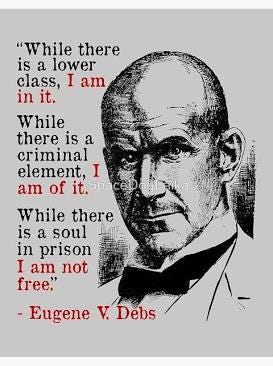
Like my family, I felt the weight of the world on my shoulders, beginning at the age of 12 when I really started to understand that life is brutal for most people (especially in our ghetto). There was nothing to complain about in my life, but I became convinced that being happy myself, while others weren’t, was selfish. I had this poster in my room that really resonated with me, by the famous socialist, Eugene V. Debs. I cried myself to sleep every night. I told this to a therapist in college and she actually agreed it was a good reason to be depressed!
I got into political activism in my later teenage years, and volunteered full-time for the African People’s Socialist Party. That did give me some sense of purpose, but eventually I dropped out of that after visiting Cuba and seeing that socialism, while it did have benefits, was not the full solution to the problems of humanity. Later, I visited the Zapatistas in Chiapas, Mexico, which did actually give me more hope about how humans could live happily (explained in my Community article). But how could we copy their spiritual anarcho-communism without having their culture to start with? It seemed like the first step was to change the education system if I wanted to create a new culture of love.
So I then studied Education & History at Temple University, with the goal of helping children in public schools to feel more empowered as agents of change in the world, and teaching them about other possible ways of life for humanity. But when I finally finished my M.Ed. program and started student-teaching at Olney High School, my students threw me a curveball. They said, “Why are you trying to make us think? We don’t want to learn.” Then they slashed my bike tire. Boy was I dumb to waste all those years preparing for an imaginary career!
That’s also when I first tried a drug, at age 26. My friend Emile gave me a puff of weed. It was normal for him, but as it was my first, it gave a mind-blowing synesthesia experience. Colors had texture, numbers had smell, and my life story was being enacted by a cartoon mouse in the center of a stage!

What I learned from that crazy trip was that the limits of reality I had thought were fundamental weren’t. He suggested I try magic mushrooms next. So I got some Tampanensis truffles (“philosopher’s stones”) from the Netherlands by mail. That trip started off with uncontrollable laughter, and then, as I sat outside in a hammock in nature, suddenly “everything made sense.” I understood that everyone’s mind is operating just due to conditions. I was able to go into the mind of anyone in history and understand how it worked. Everyone is always making the best decision they know how to make in that moment (which is also something I learned in Re-evaluation Counseling prior, but didn’t grasp at a deep level).
I called up my best friend, Michael, who was chronically depressed: “Michael! Everything is already perfect! It’s just happening automatically!” He said, “Are you on drugs?” … “Yeah, you should try shrooms!”… “No thanks.”

Oh well, everything may not be perfect for Michael, I guess. Anyway, that taught me once again that the limits of reality were completely unknown to me. I wanted to go deeper, so I googled “most powerful psychedelic.” It came up with “ayahuasca.” I read a trip report on Erowid where a guy drank a huge amount and became the entire universe, with infinite love & vision. I thought, “no.. you can’t be the whole universe. I gotta see that.” So I followed his ridiculously overdosed recipe (my Haoma protocol gives a much nicer trip) and within about 15 minutes of drinking a pot of this tea, I was lying on my bed, realizing some rando on the interwebz tricked me into poisoning myself and I was dying.
I saw infinitely multicolored rainbow mummy aliens dancing hypnotically in front of me and I heard this bird song on loop:
0:00
-0:05
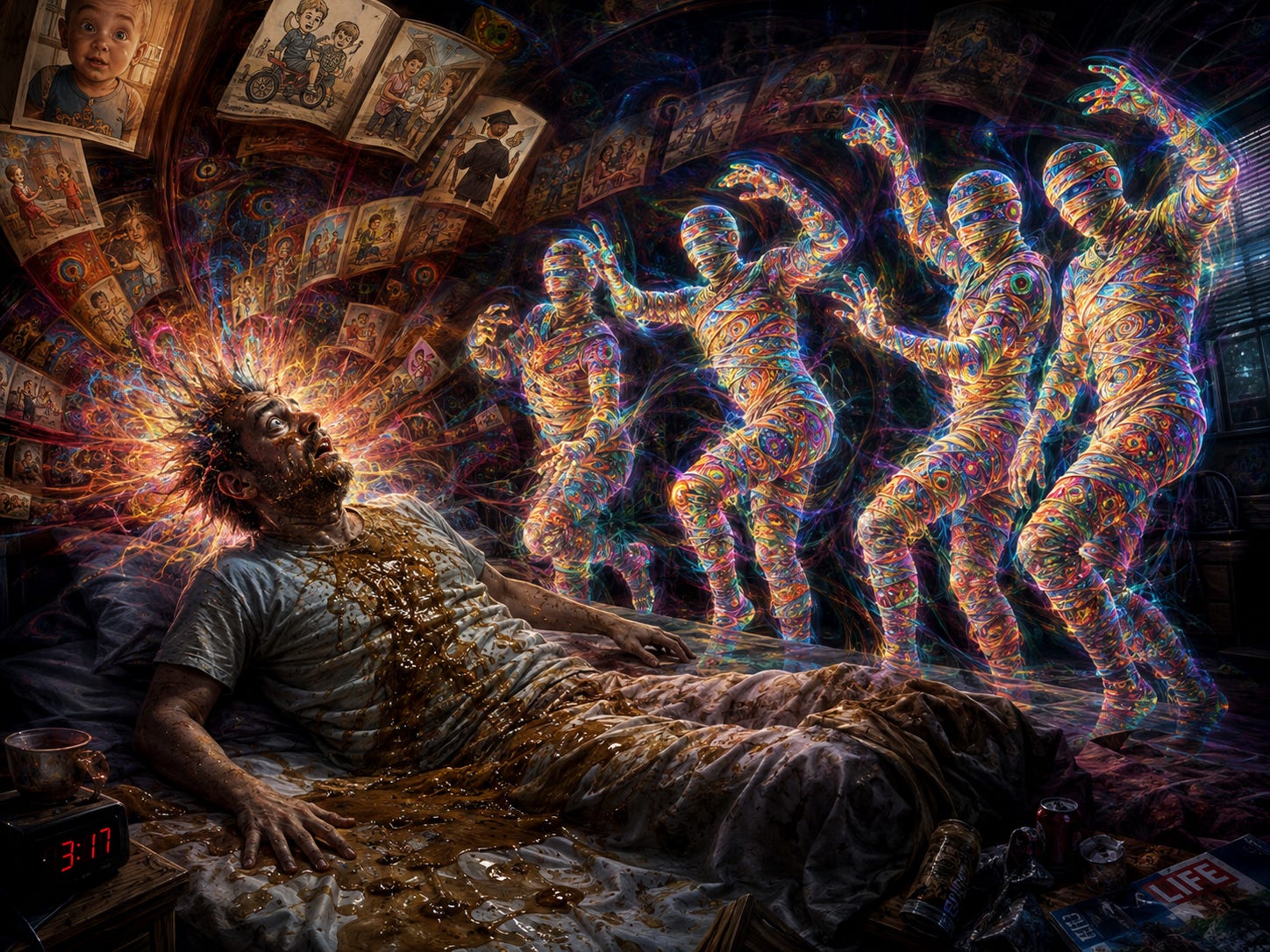
I saw my life flash before my eyes like a story flipbook and my head felt like it was about to explode. I was OK with dying at this point, just didn’t want everyone to think I wasted my life’s potential due to stupidity. But I eventually just gave up on life, and that’s when my mind exploded. 🤯🤯🤯
There was no more little me, and no more body. I became the entire universe, seeing everything, being everything, knowing and loving everything! Each universe would expand for billions of years, contract to a point, and then explode. Those explosions were insane!
MN 36 says that on his awakening night the Buddha remembered lives across “many eons of cosmic contraction” and expansion. I hadn’t read it yet, so it didn’t prime me, but the coinkydink was cool.
These unity experiences could be insanely euphoric. Heck, unification is arguably the main motivating factor for humanity, if ya know what I mean. Expand that urge across the universe and it can resemble making sweet beautiful love multiplied by infinity. I have spent hours yelling “OH MY GOD” after experiences like that. And it became impossible for me to even kill bugs to this day.
But the afterglow only lasted 1-2 weeks, and then it almost felt like a reverse realization would set in: “Oh, all that sense of perfection I had was just because I took a drug. I’m not one with the universe. How dumb.” And then ironically, that lack of belief in the experience would cause me to want to experience it again. So I got stuck on the aya treadmill for some months. It was only after I finally decided “OK, this experience must point to something real regardless of what initiated it,” that I was freed from that loop.
But taking the experience seriously also had its price. If you seriously believe you’ve been the All & Everything, then you can’t be satisfied anymore with a normal life. I ended up breaking up with my otherwise wonderful girlfriend, as I didn’t feel we had anything in common anymore.

I had to struggle with a bit of a Messiah complex. I felt it was my mission to spread this experience to everyone on Earth. The ayahuasca told me to go down to Cuba, do aya with Fidel Castro, and then he could get everyone on the island doing it, and then it would spread from there because people would visit Cuba and do aya. I was really gonna execute that plan, but I’m glad I stalled long enough to give up, even though I felt like a failure. Now looking back on it, it seems so absurd. As if everyone would have my experience, and as if there was not already a huge ayahuasca religious tradition in the Amazon jungle area. But that’s what happens when you experience apotheosis I guess.

At some point I decided to do a further test: if this experience was really real, I shouldn’t need to take a drug to have it. So I meditated very determinedly while sober, and indeed, I was able to have the same experience that way. So it was decided then…
And yet, despite having access to incredible peak states “at will” (with enough effort & time), I still felt a basic void in my heart. I remember one time, while an ayahuasca trip was coming on strongly, I thought, “I really just want a girlfriend.” Surprisingly, the aya said, “OK, fine, then go find one.” And with that, the trip completely aborted, instantly. It seems like my crown chakra was open, but my heart chakra was only open after an ego death. Could a better girlfriend be the answer for this? Or was I missing something fundamental in my “enlightenment”?
Almost everything I found in the modern seeker marketplace confirmed my experience was basically the ultimate one. Browse through the teachers on Buddha at the Gas Pump, and universal consciousness is like the default spiritual answer. Advaita, the Hindu nondual tradition, and its modern neo-Advaita offshoot supplied a complete philosophy for what I’d already experienced. It was beautiful, intoxicating, and comparatively easy: we are all one universal, happy awareness.
Many people get stuck at that stage, because it’s a nice one. But I’m a curious cat with less than 9 lives left, and I wanted to know about this guy called Buddha who was strangely absent from Buddha at the Gas Pump interviews!
So, I started branching off into Buddhist books to see if I could challenge myself & go further. The Buddha’s habit of breaking experience into aggregates – the five changing components of a person – form, sensation, perception, mind, and consciousness, seemed almost perversely backward. I had found the One. Why was this man taking everything apart?
But one actually useful thing I got from reading all those Buddhist books was the idea that I could actually be of benefit to all beings by radiating love in all directions. So that’s when I started practicing loving-kindness (mettā) meditation. I was astounded at how it cured my depression instantly, and it worked every time. I started connecting it to mantra practice and it was incredible how I could walk down the ghetto streets and even violent crazy people would realize there was no point in fighting me after they felt my vibes! (note: didn’t work for the thugs in Kenya)
So then I started preaching that loving kindness meditation + mantra, but a lot of people couldn’t get it to work, because the Buddha’s advice was too old-fashioned.
In Ud 5.1, the Buddha exclaims:
Having gone around in all directions with the mind,
There is surely no one found who is loved more than oneself.
In the same way others each love themselves,
Therefore one who cares for himself should not harm another.
In the modern world, tho, I meet many people who seem to hate themselves! 🥲
It took me many years to finally learn that these folks need to build a loving inner adult before dissolving the cosmic witness. And the Buddha actually hints at this in a new translation of the Mettā Sutta. Interestingly, my first wife was the one who told me she couldn’t let go of ego until she built it up first, although neither of us really understood what that entailed.
A peak experience (or satori when it shows your true nature) can truly change someone’s life if they are ready for that. It can even change the history of the whole world.
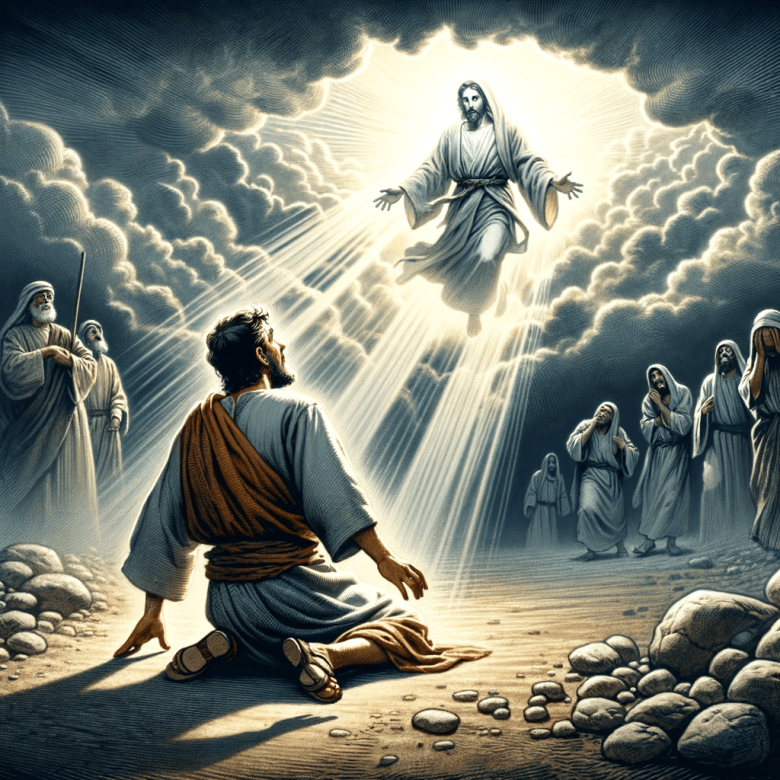
I’m sure you know how modern Christianity started. It was a peak Christ experience that the apostle Paul had (possibly during a seizure or heat stroke) while on the road to Damascus to persecute disciples of Jesus. Paul literally changed his name after that (it was Saul) and did a 180, becoming the most important spreader of the Christian faith, to the point that scholars even joke that Christianity should be called Paulianity due to the oversize influence he had on it.
But on the other hand, strangely, peak experiences do not reliably transform people. I’m sure you already have a bunch of examples in your own life that you can think of which should have impacted you more than they did. Or at least, you can think of those times in others’ lives. State-dependent learning is likely at play. It makes sense if your experience was due to taking a drug to deliberately alter your mind (especially a dissociating one like ketamine, THC, 5-MeO-DMT), or if it was a psychotic episode.
Heck I’m actually a prime example of peak states not transforming me if you recall my aya treadmill.
But we like to think that we are capable of being changed by momentous events, at least if they happen while sober. Because if a peak experience can’t change our life, then what can?
Here are three examples of people close to me who were strangely unfazed by their peaks:

After months of hearing me like a broken record saying, “Everything is just conditions, all your problems are imaginary!” my first wife entered some kind of satori for about a week. She became the loveliest presence – peaceful, gentle, and seemingly free of mental illness and personality disorders.
Then she started slowly coming back to her old self. I asked, “Don’t you want to go back to being enlightened?”
She said, “No, that’s done now.”
Her answer still blows my mind. Some people are content with less. Is that like, reverse enlightenment crazy wisdom? I’d have to ask Trungpa Rinpoche. 😅
My mom did something equally strange while sick with cancer, roughly ten years before she died. Her hip was in terrible pain, so she had a loving, two-way conversation with it. She told me her whole body then dissolved into infinite cosmic orgasms for hours. I thought, wow, maybe she could cure her cancer if she keeps doing this practice! But strangely, she never tried it again. Later, she forgot the experience altogether. I suspect it was so alien to her ordinary reality that it kind of just didn’t register as something to incorporate into her regular life. People who take psychedelics know what I’m talking about, because you can visit all kinds of incredible realities and then leave it at that. But to me, if you experience some true magic stone cold sober, that should be life-changing.
My BFF, Emile, used to be an atheist. Then one day, while shopping at the supermarket, a Christian evangelical lady came up to him and asked: “Do you know Jesus?” Emile said, “Uh.. I guess?” She said, “Will you hold my hands and pray with me to feel him?” He said “Sure, why not?” And so they did. What he experienced then was some kind of infinite love that he’d never experienced before. Suddenly, he told me, he understood what people mean when they say they’re Born Again in Jesus. But would you believe that years later, he forgot that happened entirely? He does now identify as a Christian, although he doesn’t seem to remember what led him there!
This also reminds me of what Gurdjieff said: most people are just sleepwalking through life. Not paying attention to what’s going on.
As they say, “life is stranger than fiction.” It really does seem like a dream, to me anyway.
I’m reminded of that Jack Kornfield book I read at the time, After the Ecstasy, the Laundry. Kornfield’s right that a real satori can still leave the moldy sheets in the closet. Less selfishness, less grasping, and a greater capacity to love your inner child & ordinary people lack the glamour of that peak, but they are ultimately what we should be after.
The loving kindness key was super awesome, but I knew that the Buddha still had something deeper to offer, since after all, pretty much every religion has some teaching about loving kindness. What about life, death, and rebirth?
Most Buddhist books I read challenged my oneness, but they still gave me lists (4 noble truths, 5 precepts, 3 refuges, 8-fold path… and a partridge and a pear tree!) rather than one useful paragraph about what the absence of unified awareness actually felt like. That seemed ironically opaque for a religion that’s supposedly uniquely open to investigation and debate, as in the Kalama Sutta, AN 3.65.
Later I found that some of the uselessness was built-in due to the monastic rules. The Vinaya, the code of conduct for Theravāda Buddhist monastics – in the oldest surviving Buddhist sect – includes Pācittiya 8, requiring confession if a monastic tells anyone not fully ordained about a genuine “superior human state,” including meditative absorption, psychic knowledge, or a path or fruit of awakening. A false attainment claim brings Pārājika 4, permanent expulsion from the order. So CYA applies to anyone with status to protect: monastic authors have an excellent reason to repeat lists and techniques while staying maddeningly vague about their own experience. It’s like asking a doctor whether they ever tried the medicine they prescribe and being told, “I studied medicine. I’m a doctor.” I needed to find someone with direct experience.

Then I found Awakening to Reality (AtR) and Soh Wei Yu. Soh described his ordinary 24/7 experience as fully disjoint “mind-body drop”: each appearance self-aware without a knower. Hearing that made life without a hidden observer imaginable enough to practice toward. He called my nibbāna experience mind-body drop too, because he didn’t categorize nibbāna as an experience. But AtR’s own accounts retain the ordinary body, world, intention, and function within a transparent or boundless “one suchness.” I now think that is closer to what I’ll explain as partial untying than the full unweaving I experienced.
I use “unification” for the functional coordination through which a person speaks, crosses a road, recognizes a friend, and answers a message, even with no separate knower. Most of my daily life includes that ordinary unification and feels almost like everybody else’s day (well, if they’re happy).
I owe Soh a great deal, but one key difference remains: he says sensory unification isn’t required for functioning, which makes no sense to me. I long suspected AtR practitioners were overclaiming, especially because John Tan often scolded Soh for it. I proved one claim false when I met Soh in Singapore. He had said he was in bliss 24/7, but wasn’t smiling. “So you’re in bliss 24/7?” “Yes.” “Even now?” “Well, no, not now.” 😜
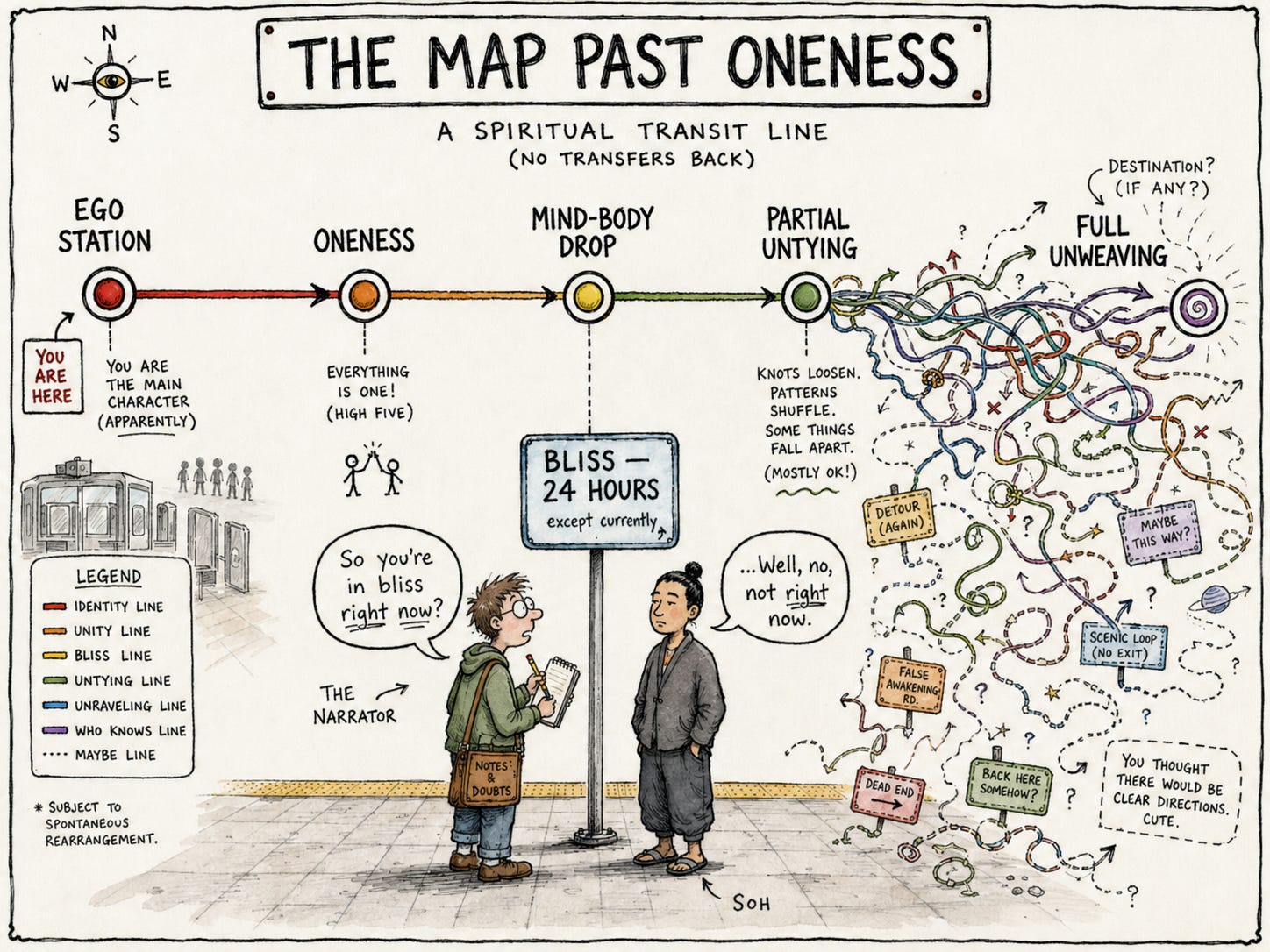
John Tan’s stage map was another major help. His public stages post says it is “nothing authoritative, merely for sharing purposes,” and John does not present the stages as universal nor prescriptive.
I used to think John’s experience was mostly modern, though I already knew from DN 1, MN 26, and MN 36 that the Buddha learned mind-unification meditations (jhānas) from pre-Buddhist teachers. They mistook those states for enlightenment; he saw that they weren’t liberating by themselves, but were useful for stabilizing and purifying the mind before penetrative insight (vipassanā). And no, vipassanā doesn’t mean Goenka-style body-scanning as many now believe.
MN 137 tells practitioners to use unification to relinquish diversity, then non-identification to relinquish unity. In MN 121, at every depth of unification the meditator audits the remaining disturbance and finds “just this much – that which depends on oneness.” Unity itself is the last stress.
My own journey included the four material jhānas and four immaterial attainments (the commentarial 5th–8th jhānas), via the excellent instructions in Ajahn Brahm’s Mindfulness, Bliss, and Beyond. They were amazing, psychedelic-like states I probably needed before I could stop thinking psychedelics were required. In first jhāna, my body dissolved into a cloud of euphoric atoms in love with each other 😶🌫️💗🥰 for idk how long! But I wouldn’t make those “hard/powerful” jhānas a prerequisite for insight; the suttas don’t.
The general recommendation is collectedness: gather the mind before trying to untie its unity. You have to collect the trash before you can toss it. In AN 4.170, Ānanda, the Buddha’s main attendant, says everyone who reached full liberation did so with some cultivation of serenity or mental unification, though not necessarily before insight.
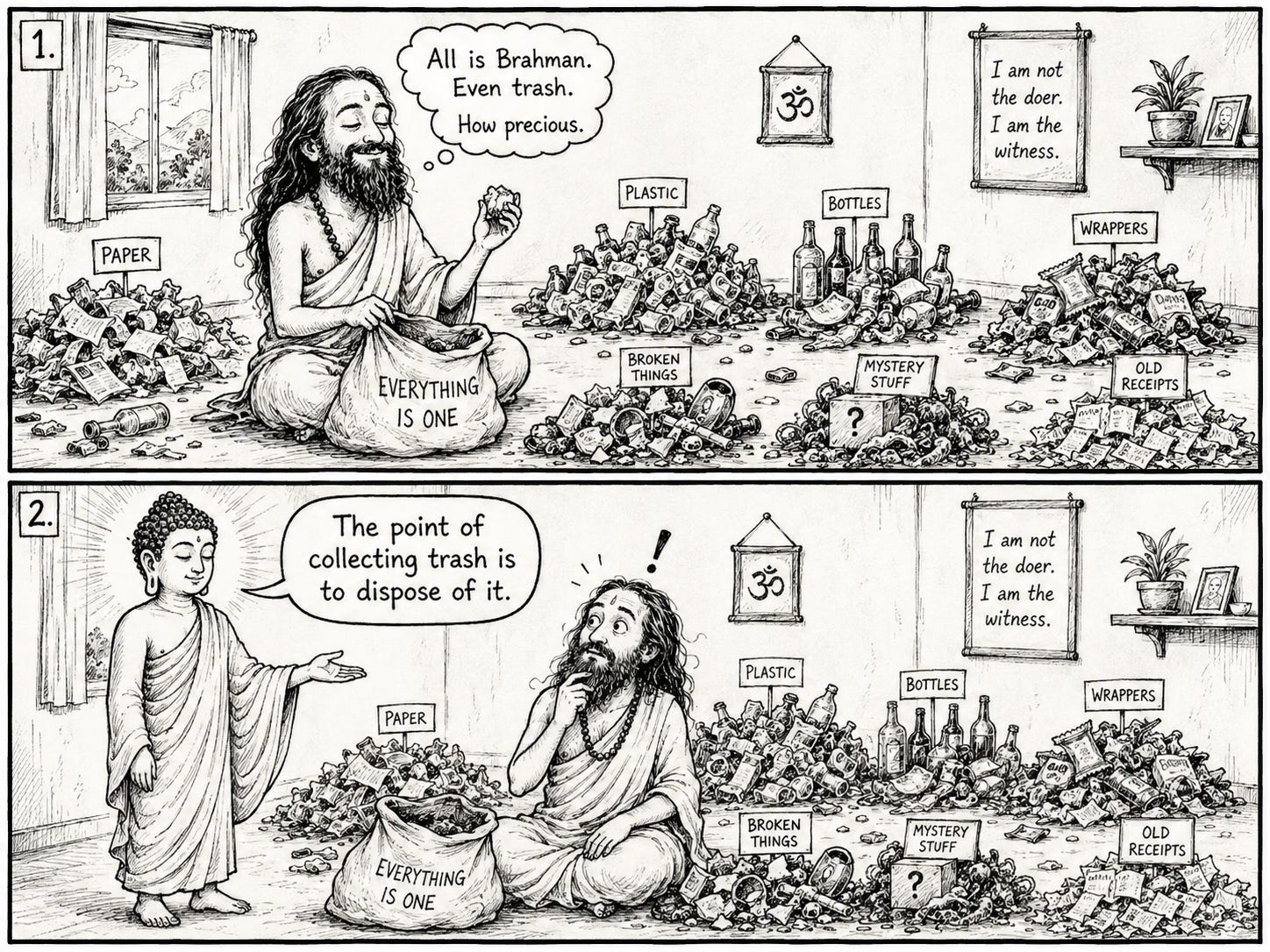
Most seekers, now as before the Buddha, don’t get beyond unification. Advanced claimants at BatGap or Liberation Unleashed generally settle into oneness, a luminous witness, or cosmic consciousness, and almost never discuss the suttas – though the suttas can also be read with bias. The map and suttas gave me a direction beyond oneness, but they didn’t open me by themselves.
The main sutta AtR recommends for liberation is the Bāhiya Sutta, Udāna 1.10. Not only is it the only sutta giving direct instructions for immediate liberation through the senses, but it’s also such a beautiful sutta that I’ve read and repeated it hundreds of times. It has multiple lessons layered in. I’d advise you to check it out to see if you also connect with it deeply.
Basically, Bāhiya was an ascetic, not a Buddhist, who thought he was enlightened, or on the path to enlightenment. A spirit came to him and told him he was nowhere near enlightenment. Bāhiya humbly asked, “Then who is enlightened?” The spirit told him, “The Buddha is enlightened, go find him.”
So, Bāhiya asked ChatGPT where to find the Buddha and used Google Maps for the three-day walk there (just kidding, idk how people did anything back then!). When he finally found the Buddha, it was bad timing. The Buddha was on almsround begging for food and didn’t want to answer any questions. Bāhiya pressed him three times (3 being the magic number back then), saying “life is uncertain, you never know when it may end, please teach me the Dhamma briefly.” Dhamma means the Buddha’s teaching and the reality it points to (although it could also be used to refer to anything generically).
This is how the Buddha finally advised Bāhiya to practice, in the pithiest instructions ever (Ajahn Amaro’s interpretive translation, also published in Small Boat, Great Mountain):
In the seen, there is only the seen,
in the heard, there is only the heard,
in the sensed, there is only the sensed,
in the cognized, there is only the cognized.
Thus you should see that
indeed there is no thing here;
this, Bāhiya, is how you should train yourself.
Since, Bāhiya, there is for you
in the seen, only the seen,
in the heard, only the heard,
in the sensed, only the sensed,
in the cognized, only the cognized,
and you see that there is no thing here,
you will therefore see that
indeed there is no thing there.
As you see that there is no thing there,
you will see that
you are therefore located neither in the world of this,
nor in the world of that,
nor in any place
betwixt the two.
This alone is the end of suffering.
For about 15 years I read this as the Buddha literally saying there is no self between the sensory streams. He didn’t explicitly say that. Amaro’s rendering is contemplative and interpretive; literal translations are narrower and actually clearer, targeting the deconstruction of “things,” though still without my parallel-flows understanding. The full comparison is in the research report. So when I say “sounds hear themselves,” I’m giving a direct-experience pointer inspired by “in the heard, only the heard,” while extrapolating beyond the original Pāli.
The other super valuable description of awakening that AtR gave me was from Dōgen, the 13th century Japanese founder of Sōtō Zen. In the Tanahashi/Aitken translation of his Genjōkōan, he says:
“To carry yourself forward and experience myriad things is delusion. That myriad things come forth and experience themselves is awakening.”
Other translations give opposite readings, but this one was key for me.
Interestingly, both of us were really desperate for an end to suffering right now. That seems to have been key for us, although we did have a bunch of preparation as well.
Some people go to retreats hoping to experience what happened to me. I couldn’t afford that, but luckily being broke helped more (as it did for the Buddha). So did a severely unstable marriage that made me feel I had completely failed at life!
My first wife had become unexpectedly pregnant with our son about a month before I had to commit her to a psych ward when I found out how serious her mental issues were. Imagining my life as a poor guy trying to raise a kid (or more) with a woman like this was too much. My friends & family were all starting to abandon me because they couldn’t even bear the burden of her insanity. Some even had to leave the country to escape her wrathful episodes, while others offered to help me “solve the problem” in a way that I wouldn’t even talk about.
I would have killed myself if I had not believed that suicide would simply lead to a worse rebirth. I suppose this is what Buddha meant when he said you should “practice like your head is on fire” in SN 56.34, SN 2.16, AN 6.20…
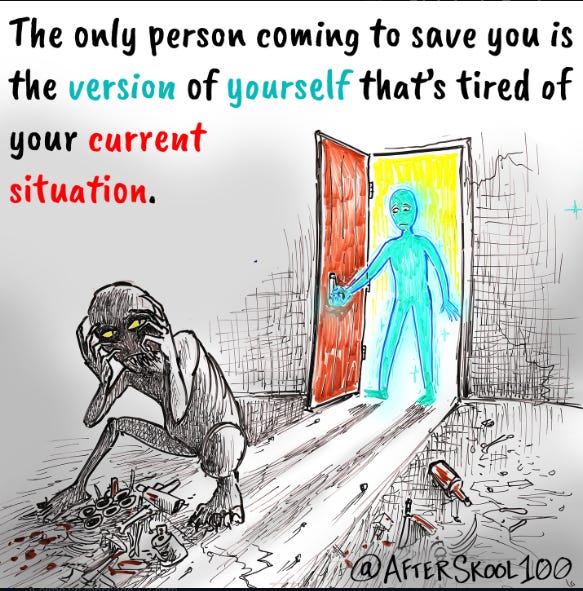
Speaking of avoiding a worse rebirth, I had just watched a beautiful documentary called For the Benefit of All Beings which affected me deeply. It was the biographical documentary of a Tibetan Buddhist master named Garchen Rinpoche, who spent roughly twenty years in a Chinese prison labor camp after fighting the Chinese invasion of Tibet with CIA weapons & training. He knew he was going to hell for killing people, but he felt he had no choice. And in fact, he already was in hell in his own mind of hatred.
Ironically, it was in that brutal Chinese prison camp where he found his true master. His master taught him to love the Chinese and be happy that he was growing rice for them, since the people were not their government. That’s where his practice of loving-kindness blossomed, and he became a light of love upon the world. I thought: if he could find love there, perhaps I could stop treating my own hell as an excuse.
So, back to desperate little me in bed beside the then-wife I feared. Inspired by the documentary, Soh’s description, and his explanation that everything is conditions, I chanted Om Mane Pemme Hum while meditating with the intent of experiencing what he was pointing at. I fell asleep, woke, sat up, and my awareness coalesced around my navel, then seemed to leave my body – a familiar prelude that usually produced oneness with the room, world, or universe.
This time, my awareness dispersed, or popped like a balloon! 🎈
Awareness as one thing was gone. I was gone. What remained were the room’s flows of colored light, all experiencing themselves in indescribable perfection. They were disjoint, but not isolated: the flows ran into and through one another, connected everywhere without becoming one experience or one witnessed scene. Nothing observed them from behind. There was no cosmic knower celebrating its achievement. There was also no black void. The flows were infinitely more intimate, beautiful, and alive than ordinary perception, while possessing no owner at all.
I now call this body-uncontained nibbāna. It was a full unweaving because unified consciousness and the functioning body-world were gone, but its scope was no longer limited to sensations inside the body as with the fingers nibbāna event. I was not seeing the room from everywhere. There was no “I” or single place from which it was seen.
The light flows were each presenting every other flow from every corner and angle, with no overall background experience containing them. The content may still have been conditioned by the room the body had perceived before the event, so I am not claiming that it displayed all reality everywhere, but it didn’t need to.
The closest comparison that’s worth mentioning is the out-of-body perception in some near-death experiences. People sometimes report seeing things from impossible angles, and a controversial subset of those reports were verified by others in the room. Those cases had an externally verifiable target, which was not part of my room experience, since I was not floating around to notice any specific details. They aren’t proof of my own event, but they could help explain what I mean by an experience that was no longer limited by the body’s vantage point. See this systematic analysis of near-death reports, the AWARE-II cardiac-arrest study, and a recent veridical-NDE evidence scale.
I had already gone thru the formless absorption of nothingness before the room event, and I had also experienced being everything as cosmic consciousness. Neither was the liberation nibbāna was. Both are imaginable: one is an absence, while the other is ordinary unified experience expanded until it contains everything.
A fish could hear a precise description of air – how it moves and what breathing there is like – and still have no way to imagine being outside water. If nibbāna were imaginable, many people would have already imagined and written this account, and the Buddha would be one more person who imagined something and talked about it. Many psychedelic trips would be nibbāna instead of just unity.
It felt entirely different from the ayahuasca ego deaths: no cosmic orgasms and no screaming. The bliss was deeper, subtler, and vastly more peaceful. I believe the Dhammapada is right to call unbinding the foremost ease – the traditional line often rendered “nibbāna is the highest happiness.”

I have no idea how long this lasted. Time belonged to the unified world that was absent. Eventually, the ordinary body, room, witness, and biography formed again.
Some months after that first full nibbāna room experience, I fell asleep in my car while meditating. It was parked, don’t worry! Although I later found out it wasn’t my car.
Before “I” woke up to notice them, my fingers came online all by themselves. Each finger was its own complete experiential flow. I mean it, there were literally 10 distinct, self-presenting, indescribably blissful, and absolutely perfect, finger flows happening at the same time. (These were light flows in finger form—not my anatomical fingers each running a little mind of their own.)
Then “my” mind came back, the perfection vanished, and “I” realized how silly those perfections were. I literally said: “Oh, those are just my fingers!” 😂
That was it, the magic was over.
The finger episode was a small flashback of my full first nibbāna experience of the room itself unweaving, which I analyze further down. Nibbāna is the word the Buddha used to refer to the deathless, perfect reality that’s misapprehended as saṃsāra.
I call the fingers event body-limited nibbāna and the room event body-uncontained nibbāna. Both were full unweavings of unified consciousness; the difference was scope. Nibbāna matters so much to me because the room event became the fruition that I believe launched me into stream entry—the first irreversible stage of Buddhist awakening, where rebirth is now on its way out. I’ll define those terms more carefully below.
Since that first nibbāna room experience, life has never felt like a Chinese finger trap the way it did before. The self and “my story” lost most of their authority; the Dhamma stopped being a mystery, and I began looking for a book that explained it as well as I could so I wouldn’t have to write this article. Selfishness and suffering dropped dramatically. I never wanted to kill myself again, felt angry and sad less often – even after my first wife tried to kill my family and stole my son – felt less trapped, behaved somewhat less foolishly, and became less inclined to hide things or leave them unsaid.

Paradoxically, seeing that the self I had taken as real did not exist gave me confidence, like realizing inside a dream that it is a dream. It didn’t free me immediately from the marriage or prevent later bad relationship decisions, but I never again felt the infinite desperation of owning an irreparable life.
To me, this was doubtlessly the first stage of enlightenment that the suttas called “Stream Entry.” And I was also convinced that anyone who experienced this must be a stream-enterer. However, I now suspect a full unweaving nibbāna can be had without causing stream entry.
I still suggest reading the first part; it contains practical material along with my stories. This section gathers most of the instructions.
Because personal suffering had lost so much credibility for me, I preached nibbāna to people whom I later understood often needed inner-child reparenting. Partly because I knew nothing about reparenting nor spiritual bypassing, I treated trauma as an imaginary dream problem. Interestingly, around the same time, I also had a relevant dream, in which I became lucid and realized there was no point even talking to the dream character I was with. She retorted, “I may be just a dream character, but you’re still mean!”🥲 So, I apologize to the folks that I wasn’t such a good spiritual friend to, although I did my best, as we all do.

If you don’t bring the light of awareness and love to your darkness (“shadow work”) and heal your inner child traumas, any other spiritual transcendence you do will become a form of spiritual bypassing, which will turn you into an egotistical asshole like Sadhguru, Teja Anand, or Artem Boytsov.
You can tell when you are listening to fake gurus because their answers to questions are flippantly self-righteous, due to their own avoidance of their feelings. They continually talk from the perspective of some ultimate reality and then denigrate anyone who “doesn’t get it.” Sadhguru even mentioned in one video that anyone who follows him is an idiot, and his followers lapped that up!
We humans love to deceive ourselves, and we almost beg others to deceive us with praise and flattery, while at the same time we decry the fakeness of society.
On the other hand, more genuine “non-gurus” like my friend Eshwar, will explain their own tortuous personal path to awakening, in which shadow work was 99% of the journey.
If you’re not supported by a community, your chances of a good life are slim. The Buddha taught this also when he said that “Good friends, companions, and associates are the whole of the spiritual life” (SN 45.2, SN 3.18, SN 45.3).
Peer counseling based on my hearthwork guide can help a lot. Beyond that, I’m promoting a plan to help the development of effective spiritual healing communities.
A good spiritual friend can act as a mirror for you to see what the dust in your eyes might make you blind to. They can help you realize that everything is already perfect, while still being there for you when things are hard, and give you an opportunity to be there for someone as well. 🤗🫂
And just for fun, another PoV from Africa:
Life has its ups and downs. The ups feel great, but the downs are the diamonds in the rough! I’ve always had my deepest realizations and releases when I was fed up with life. What about you? I started thinking about how the average life goes: You have a few birthdays, try to satisfy desires as they arise, watch your health decline, and then die.

Maybe, if you had a good life, you leave the world a better place as well, and those who survive you continue through the same cycle. Then the question becomes: what’s next? A lot of people are afraid that nothing is next – that there is no next. But what if they’re afraid of the wrong thing?
I didn’t believe in rebirth in my last lifetime, and I still don’t. 😛 But if Buddhism is right about rebirth – I return to that evidence later on – life is a beginningless cycle of birth, death, joy & suffering, called saṃsāra. A lot of people might be delighted to learn they don’t need to spend $2m per year to live forever like Bryan Johnson, who btw has questioned whether he might be wasting his time with the “Live Forever” campaign.

This question of rebirth became personal after my father died. In the video below, I tell the story of an experience in which I met him in his mid-life transition, and helped him understand why he was headed for rebirth on Earth. He definitely thought everything was already perfect in his heavenly realm, and really didn’t want to come back here!
By “already perfect,” I mean that everything – including our efforts to improve it – is happening according to natural laws. You’ve already tasted a bit of the already-perfect nature if you’ve ever been in a flow state, where you’re no longer consciously directing your efforts but are having more fun & performing better than you otherwise would.
Because we don’t now “exist” as the natural laws themselves, but rather as a fabricated abstraction from them, pain, unsatisfactoriness, and injustice still hurt and still call for a response. But once we can experientially touch ultimate reality and realize the path out of the illusory cycle, those problems don’t hold the same ultimate psychological power over us. Similar to Plato’s cave, but more imminent.
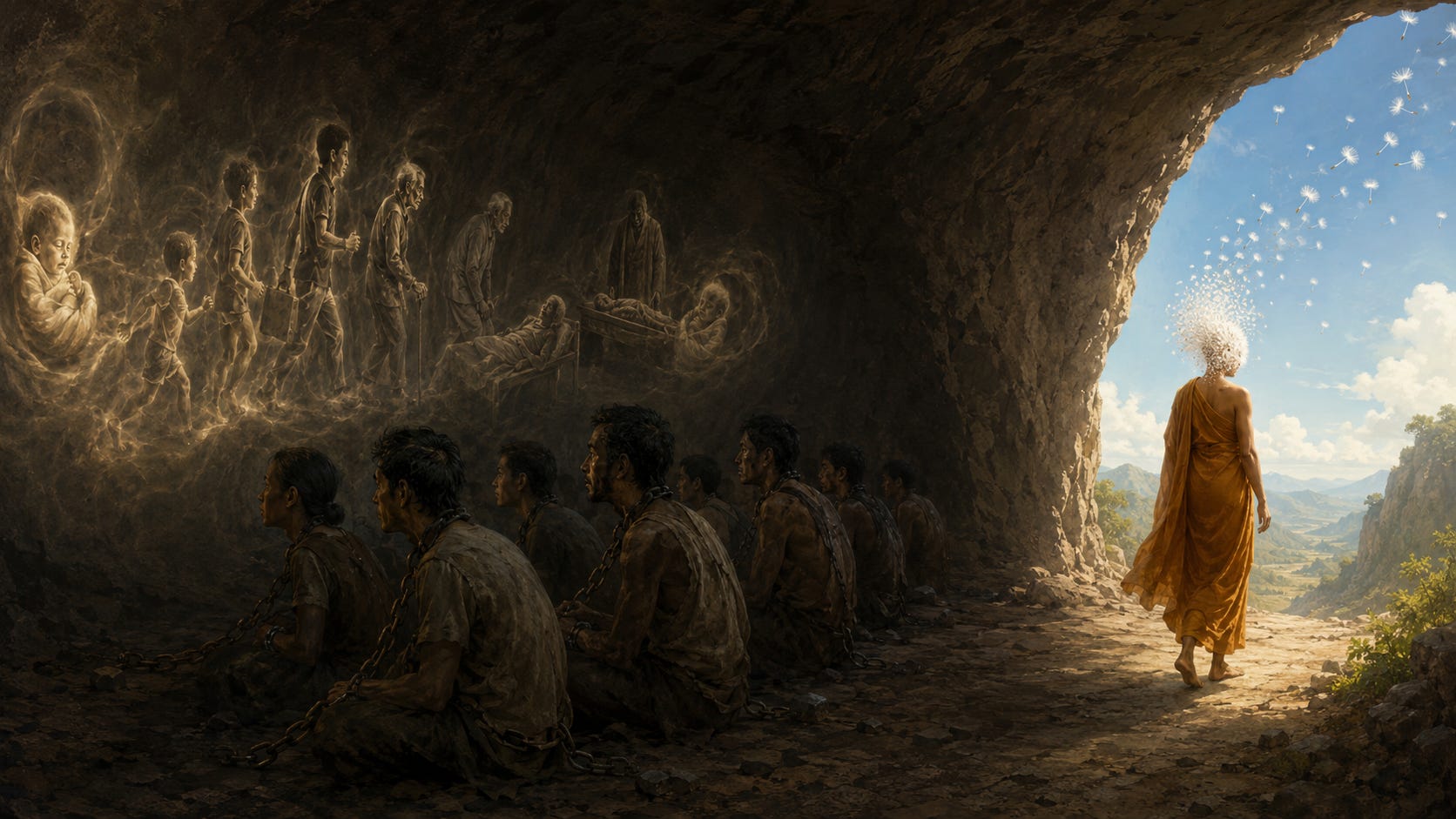
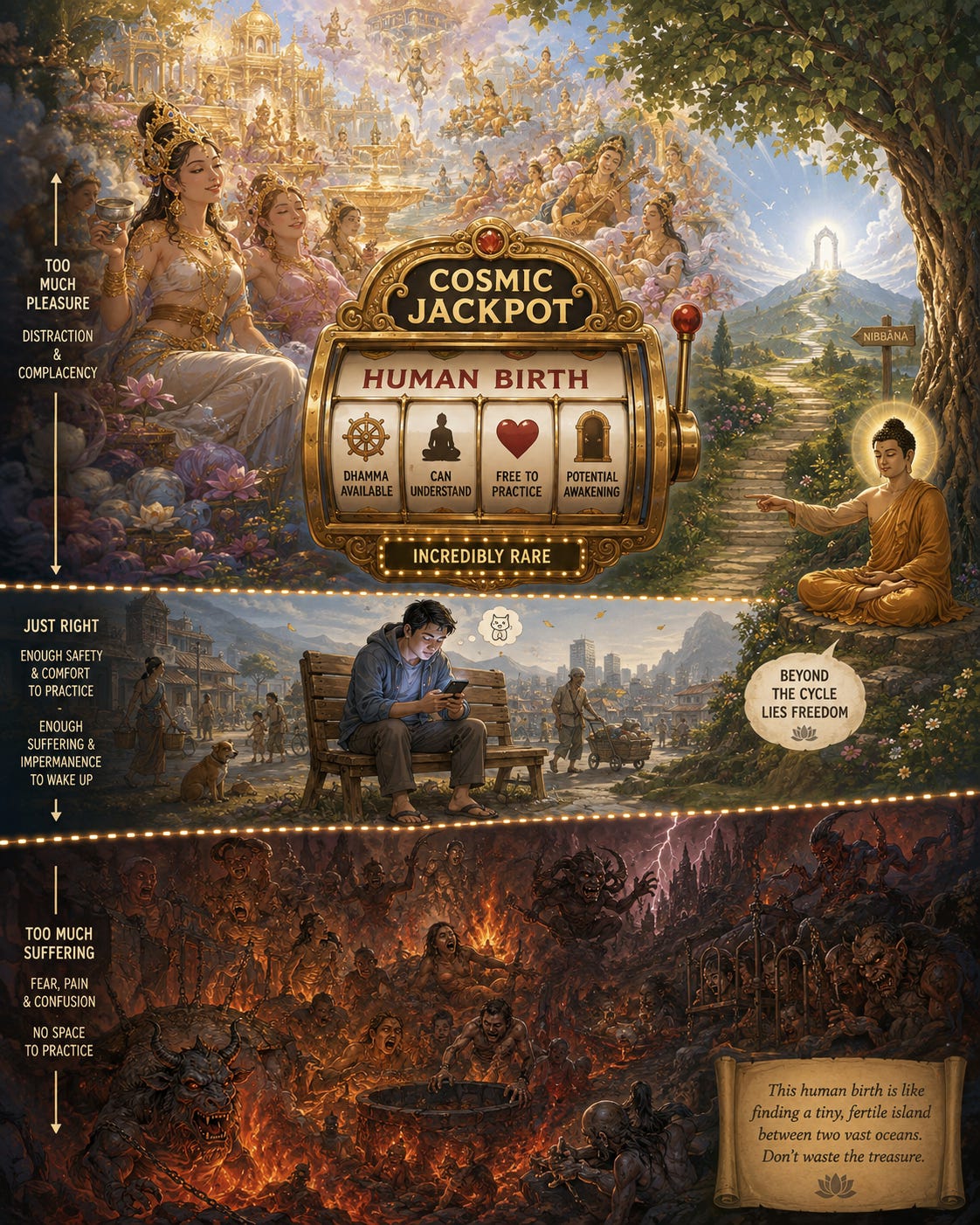
I originally stole the title of this essay about 15 years ago from a question asked by a man dying of cancer, on the now defunct FB group of AwakeningToReality.com. As he was in the long process of dying, he thought to himself, “What if everything is already perfect (without me)?” For him, it was a final liberating insight, while for someone at a different stage of life, I’d suggest trying to see how, as the Buddha taught in MN 129, this lifetime is the “perfect human rebirth” because it gives you an opportunity to finally end rebirth!
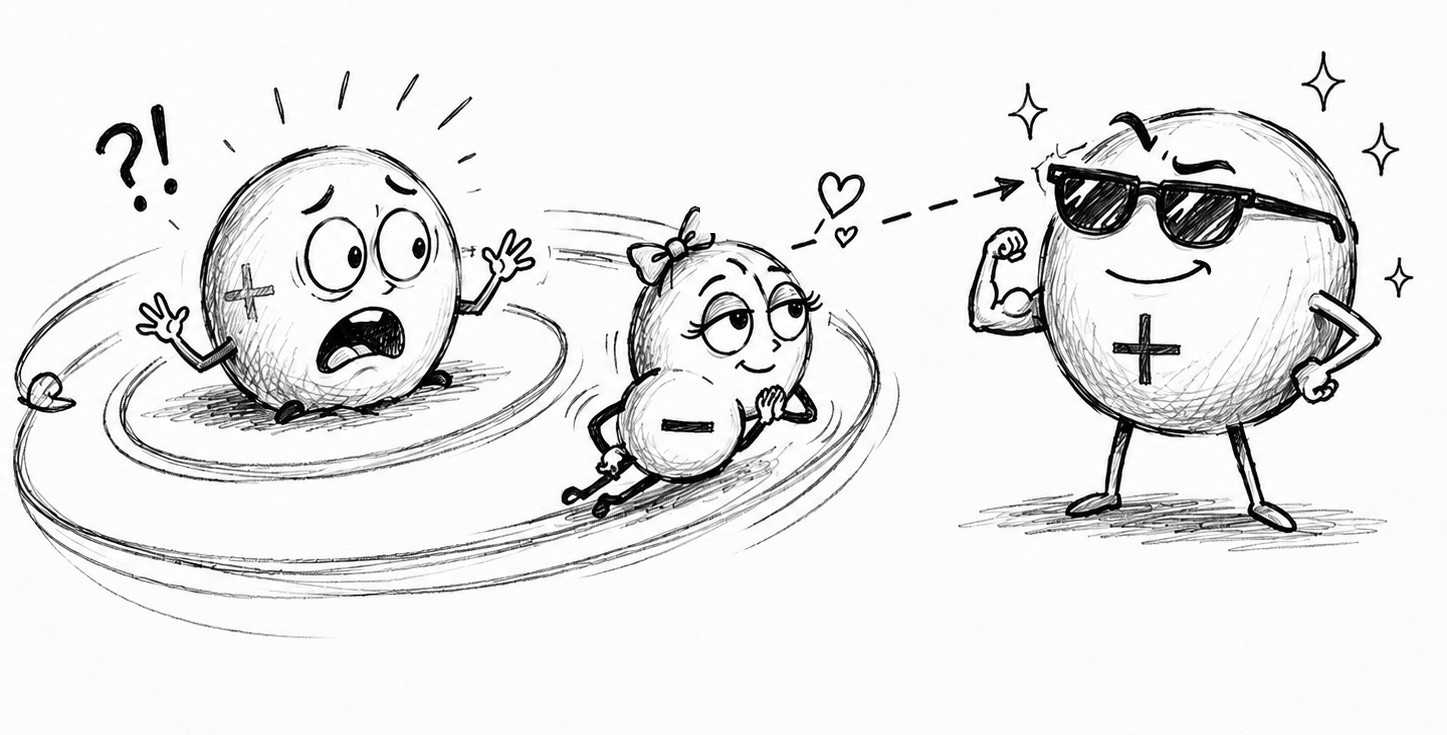
Because everything is just conditions, things work and kinda make sense; otherwise, it would be a bunch of random chaos. Even if we don’t fully understand anything, electrons keep orbiting according to quantum rules which eventually collapse unknowable superpositions into predictable paths around atomic nuclei, the toaster predictably toasts, children hopefully grow up (maybe a bad example), and the sun keeps rising and setting. There was never an electron that felt like she was in the wrong orbital and wished she had ended up around a more handsome nucleus (I assume)! So, if everything is so perfect, why do we want things to be different? Maybe it’s just a hilarious misunderstanding!
How would your life be different if, instead of having to drink some whack Amazon jungle plants to get interested in meditation & Buddhism, then marry a psycho and go on a Hero’s Quest to figure this out, you learned in kindergarten that nothing happens apart from conditions?
Actually, if you ask a kindergartner, you might realize they already basically understand conditions before it gets stamped out of them. I’ve seen a number of kids, when parents tell them that “God created the universe,” respond: “Then who created God?”
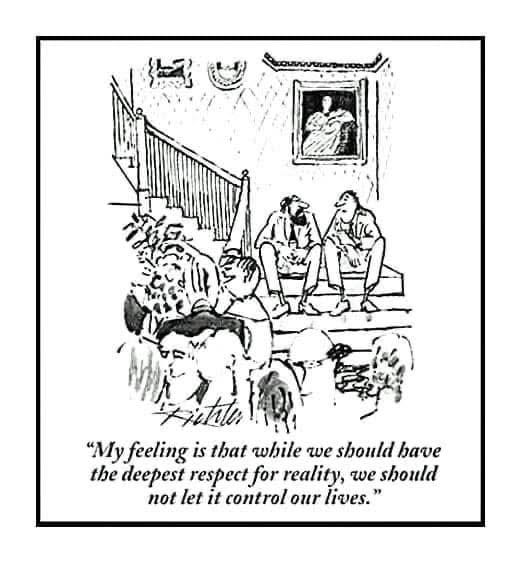
Libertarian free will is defined as a chooser standing outside all conditions and causing a choice from nowhere. Well, that’s logically impossible. Of course, choices are choicing. And those choices do matter, because they become conditions for what happens next. But there’s ultimately no puppeteer self outside the web of conditions (Indra’s Net) pulling its strings. Meditative training is the web of the universe itself learning to pull more wisely.
Even after the little king or queen fantasy disappears, the mind scurries into a subtler place: “Fine, then I must be the awareness that makes everything real.” But awareness here means something that awares apart from what it awares. Every time someone claims to experience pure awareness (sat chit ananda – being, consciousness, bliss), they can still describe how it feels. So that non-duality is false. What I find instead, and what I believe the Buddha was pointing to, are aware energy flows and the processes that gather them into a self & world.
This article itself is version 2.0 of my old one-page Already Perfect essay. That was already perfect, so why on Earth did I spend weeks rewriting it? Not because of “free will,” but because my boss, Oliver, told me to! 🤪 Put another way, “already perfect without you” means experience is complete before anyone owns it. A tree falls in the woods and makes a sound with nobody there to hear it. A color colors the coloring book with nobody holding the crayon. It sounds abstract, but the next sections explain what I think the experience was showing.
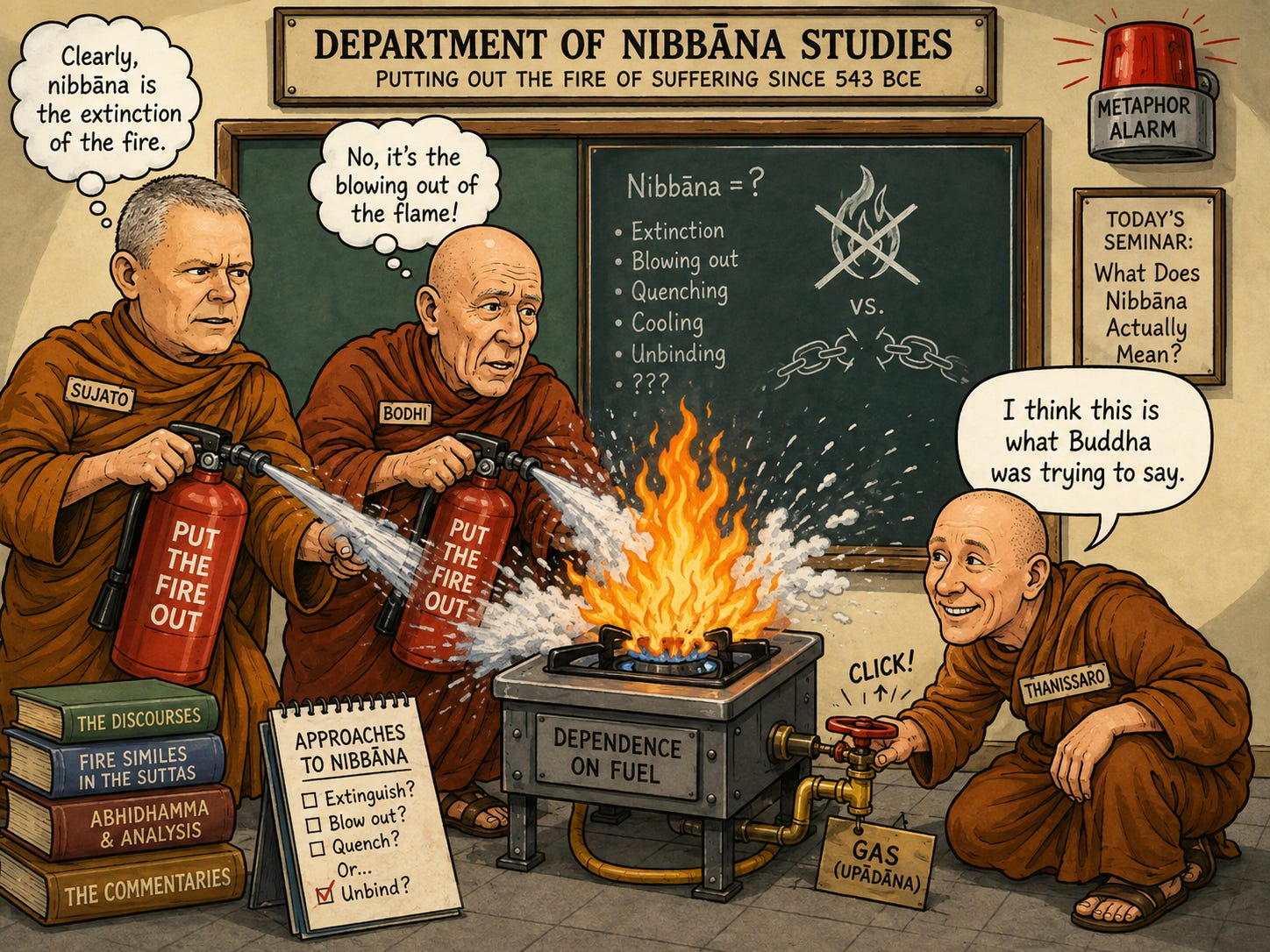
The word nibbāna originally described a fire going out. My old nibbāna book wrongly treated “unweaving” as its direct etymology. “Extinguishment” is more common, though it sounds like the nihilism pole the Buddha avoided in his soteriology.
In the fifth-century Visuddhimagga, Buddhaghosa instead derives nibbāna from vāna, “binding” or “fastening”: craving laces one becoming to the next. Ṭhānissaro Bhikkhu considers that less academically strict but more illuminating and thus translates nibbāna as “unbinding.” A fire depends on fuel (upādāna, also clinging or sustenance) and is freed when its binding to fuel ends. Like them, I find the interpretive meaning more useful here than strict etymology.
The suttas already speak in tangles, knots, and nets. SN 1.23 describes a “tangle within” and “tangle without,” then says the arahants’ (fully enlightened ones’) tangle is disentangled. Dhammapada 90 says the liberated person abandoned every gantha (knot, tie, or bond), while Dhammapada 180 calls craving jālinī (net-like, ensnaring). Unbinding and disentangling are native ways to describe liberation from the binding of the sense streams.
What came apart in my room experience was the fastening of sensory flows into one established consciousness, self, world, and renewed existence. The room looked like it was unweaving, and the suttas’ tangles, knots, and nets make that metaphor feel less accidental.
In my experience, nibbānic unweaving varies by degree and scope.
This distinction isn’t laid out explicitly in the suttas. AN 11.12 says a noble disciple can reach ease and joy through recollecting the Buddha, Dhamma, & Saṅgha – the community of realized disciples – or recollecting ethical conduct, generosity, or qualities shared with heavenly beings. In my experience there can also be physical loosening of unification. My percentages are playful shorthand for how much binding has dissolved: around 1%, a person remains fully functional; by roughly 5%, function is barely possible. Partial untying isn’t limited to that range.
There’s also a strange middle ground where I can have several parallel experiences, each internally bound and therefore not nibbāna, but hinting at it – for example, becoming two different solid birds flying. Ud 5.10 similarly has monastics split into a thousand bodies to clean rooms faster until someone touches one and they merge back into one.
The percentage language applies only to partial nibbāna. The fingers and room events were both full (100%) unweavings; body-limited versus body-uncontained describes their scope, not their depth or authenticity.
At something I would jokingly call 5% nibbāna, I become so peaceful and blissful that doing anything feels ridiculous. Once, at a Workaway farm in Malaysia, I remained around that level for four days. I had no interest in tasks, plans, or becoming an impressive person on a farm. Talking and interacting with people gradually brought the ordinary unification back toward 0-1%, just like in Ud 5.10.

Most of the time, I function through a mostly unified body, one present scene, and some degree of witnessing – just like other people, mostly. Independently perfect finger-flows and a cloud of independent colors aren’t so useful for using a shovel. But what’s always different from before is I no longer take this unified sense of self to be more than a bad approximation of reality. Nature assembled this unified self for survival purposes, so life could reproduce, and so forth. I get it now.
You can get a small taste of the loosening through the guided meditation later in this article.
My old “hard nibbāna / soft nibbāna” language was also my taxonomy. But here’s a better breakdown of how I’d explain it now:
Partial nibbāna / partial untying: some unification loosens while enough of the body-world remains for recognition, desire, memory, meaning… basically, life in the normal sense is still possible, but not as tight.
Full unweaving nibbāna: the unification that creates one functioning and suffering-capable body-world disappears completely.
Body-limited nibbāna: a full unweaving limited by what the living body has made available, as in the fingers experience.
Body-uncontained nibbāna: a full unweaving no longer organized around the body’s viewpoint or sensory aperture, as in the room experience.
Reassembly: the ordinary body, scene, memory, and ability to function return.
Parinibbāna: the same full unweaving without reassembly, i.e. without rebirth, because the body is dead. The living breakthrough to nibbāna is what makes the final direction knowable. Iti 44 agrees on the difference between nibbāna & parinibbāna. It also shows the limit: a living arahant still has preferences and experiences pleasure and pain, but won’t be reborn again. Thus, in this article, saṃsāric means this constructed, dukkha-(suffering/unsatisfactoriness)-capable functioning itself, not only the craving that produces another birth.
Many Buddhists love to tell me nibbāna isn’t an experience, just an achievement or attainment – the loss of the fetters (Buddhist deadly sins). The suttas disagree, tho.
AN 9.47 is literally titled the Sandiṭṭhikanibbāna Sutta, “Directly Visible Nibbāna.” It answers “How is nibbāna directly visible?” with a step-by-step meditative progression: when perception and feeling cease and the taints are destroyed by wisdom, that is directly visible nibbāna “in the definitive sense.”
Arahants also described nibbāna samādhis. In AN 10.7, Sāriputta perceives no earth, water, or normal object – only “the cessation of becoming is nibbāna.” AN 10.6 describes the same state as perceiving “this is peaceful, this is sublime… nibbāna” and nothing else, with parallels in AN 11.7 and AN 3.32. (Bhikkhu Brahmāli reads these as an idea about nibbāna; his paper is here, and I address it in the research report.)
Contact language reinforces that these are experiences. In AN 6.46, monastics touch the “deathless element” with the body. AN 9.43-45 has the “body-witness” touch formless liberations and defines one “liberated both ways” by cessation-contact plus destroyed taints. In AN 9.34, Sāriputta treats the absence of feeling in cessation as pleasure. Ud 8.1 calls nibbāna tadāyatanaṃ (“that sphere”), using the same word as the meditative spheres. You don’t “touch” and “enter” a sphere that’s merely a philosophical abstraction.
My model of a coherent “world” starts with the finger and room experiences. Blissful light flows were present on their own, with no witness behind them. These appearances or awareness flows meet locally like a MeetUp group – although MeetUp banned me for trying to organize a study group about this, which may be why I’m a Substack author instead of the next Jim Jones.
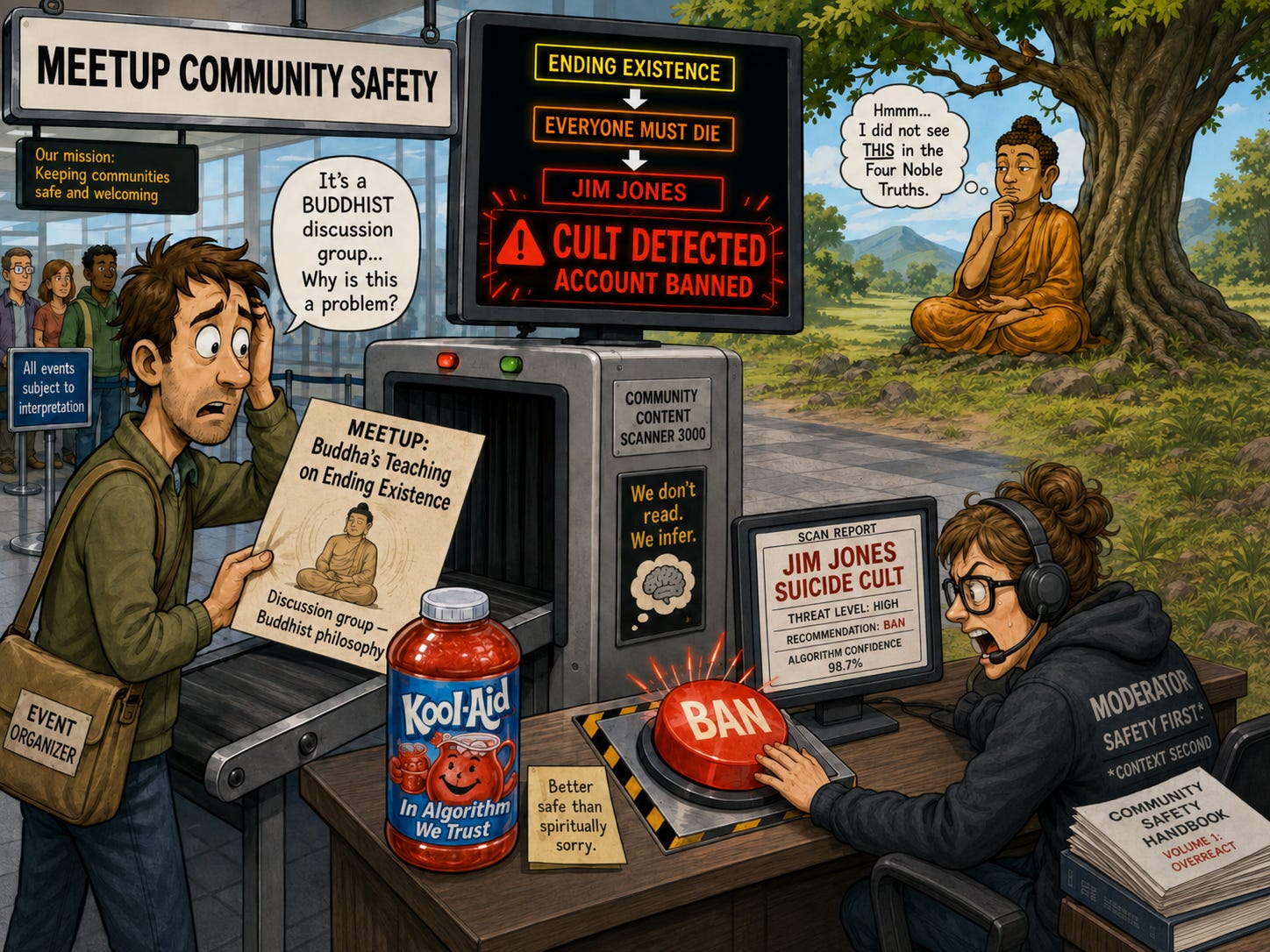
I call those MeetUps “initial contact,” my term, broader than the Pāli phassa. They can help organize a sense door and its sense-consciousness.
SN 12.44 gives the canonical sequence: eye and forms condition eye-consciousness; their meeting is contact. Contact begets feeling, then craving and clinging; clinging to experiences becomes clinging to life, leading to becoming and birth. There is “the whole mass of suffering,” which the sutta calls “the origination of the world” – sutta-speak for saṃsāra.
I use awareness to mean bare, non-reflective appearance: blue is just blue. Consciousness is awareness reflecting back on itself: “I’m blue!” Pāli doesn’t give me separate nouns for this distinction, but DN 11 and MN 49 describe viññāṇaṃ anidassanaṃ anantaṃ sabbato pabhaṃ – non-manifesting awareness, without end and luminous all around – where the elements and mind-and-body (nāmarūpa, often mistranslated as name-and-form) find no footing. The texts distinguish that from ordinary sense-consciousness (viññāṇaṃ) established when one thing perceives another.
I think this non-manifesting awareness should have been “nonmanifesting awarenesses,” strange as that sounds. Without the plural, Ṭhānissaro Bhikkhu can begin correctly in The Mind Like Fire Unbound and The Wings to Awakening by saying the mind fabricates the experienced cosmos, including time and the present, then leave behind one copy-pasted singular line: “consciousness without feature, without end, luminous all around.” He can’t imagine parallel flows as nibbāna because the suttas say nibbāna lacks “differentiation.”
I agree that nobody separates or counts anything in nibbāna. But the light flows weren’t one featureless consciousness either; they were nonidentical by nature, not because a mind was there distinguishing them. The fuller comparison is in the research report. This one-versus-many question ultimately separates Buddhism from prior teachings and new-age spirituality, and it matters because unification gives suffering somewhere to land.
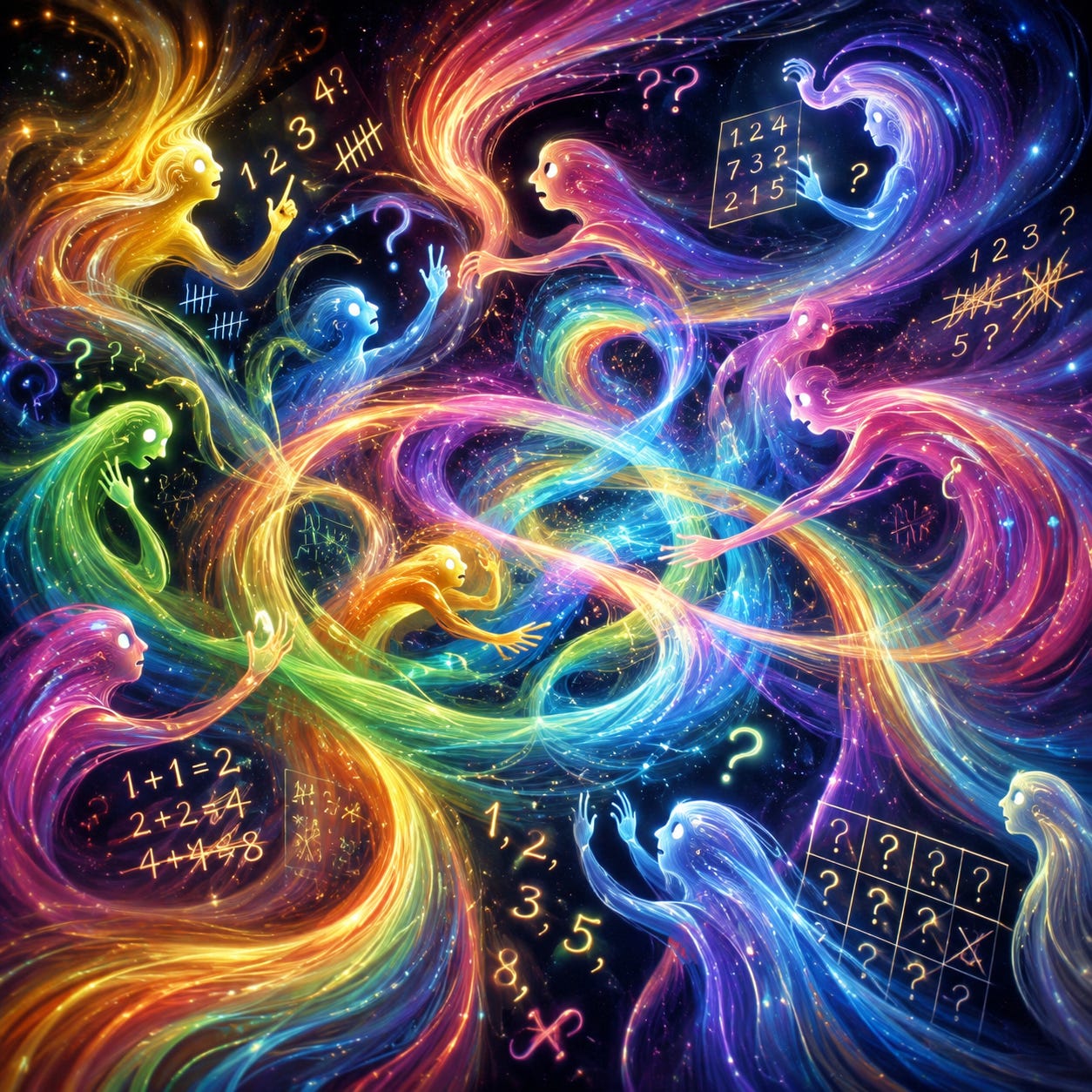
So why would already-perfect flows ever stay tied up in an ever-expanding ball of suffering yarn? I used to think multisensory binding was the root of saṃsāra, based on the Amaro translation of the Bāhiya Sutta, even though that wasn’t my actual experiential insight. Now I realize there’s nothing wrong with the natural random tangling & untangling of stringy energy flows as long as they don’t keep tangling. “Wise” (or lucky) flows tangle and release freely, the way fields, or energy strings in String Theory, bind into quantum particles which then annihilate each other back into stringy energy flows.

And the level of suffering seems to run on the same dial as the tangling. My first-jhāna atoms were a lot more blissful than ordinary life, so calling first jhāna blissful isn’t wrong. But compared with nibbāna, it was euphoria: energized, ecstatic happiness from unification, not the peaceful bliss of release. People usually use bliss for both, and English sutta translations often do too. The Pāli is more precise: the first two jhānas have both pīti—rapture—and sukha—bliss, pleasure, or ease; in the third, the rapture fades while the quieter pleasure remains; in the fourth, even pleasure and pain are gone, leaving equanimity.
If flows forget the beauty of peaceful release, they keep tangling for more euphoric binding. DN 27 says that at some point we emerge as rapture-fed, self-luminous beings, but craving for more leads us to start munching on that yummy dark earth and become solid ourselves. Then we start hoarding food and having sex and eventually develop existentialist philosophy, and now you have anti-natalists blaming their parents for bringing them into the world!
The Buddha names ignorance (avijjā) as the root of the nonstop tangling, the first link of dependent origination. SN 12.2 and MN 9 define it as not knowing dukkha, its origin in craving, its ending, or the path to its ending. My plain-language addition: ignorance is not knowing that the euphoria of merging isn’t happiness compared with the bliss and peace of release.
I’m not gonna make the free-love analogy you might expect, because that gets messy. 😘
Money works the same way. Children are happy with none, then get a little power in their pocket and like it. When it runs out, they don’t return to happiness; they want more. They become adults working like hell for more money while growing less happy. The happiness never came from money, but they didn’t know its source, so they chase the wrong condition harder. Nobody chooses that ignorance; we all logically start from it.

My dad once told me he was hitchhiking, and had only a nickel left in his pocket, which was causing him terrible anxiety. Someone asked for money and he gave away his last nickel, and then he suddenly felt immensely free!
The Buddha said sensual pleasure itself works this way. In MN 75 he compares it to a leper finding relief by scorching his itchy lesions over hot coals, and feeling as pleasure what a healed man would feel as burning.
The Buddha splits the accounting cleanly in SN 22.22: the five aggregates are the burden; craving is picking it up. The tangle is heavy by nature – even an arahant feels the first dart – and craving keeps us carrying it. Physics agrees that binding is literally heavy: quarks supply less than 1% of a proton’s mass; roughly 99% comes from gluon-binding energy. Matter weighs what its binding weighs. Light weighs nothing.
This diagram is my synthesis, but it almost matches the suttas exactly:
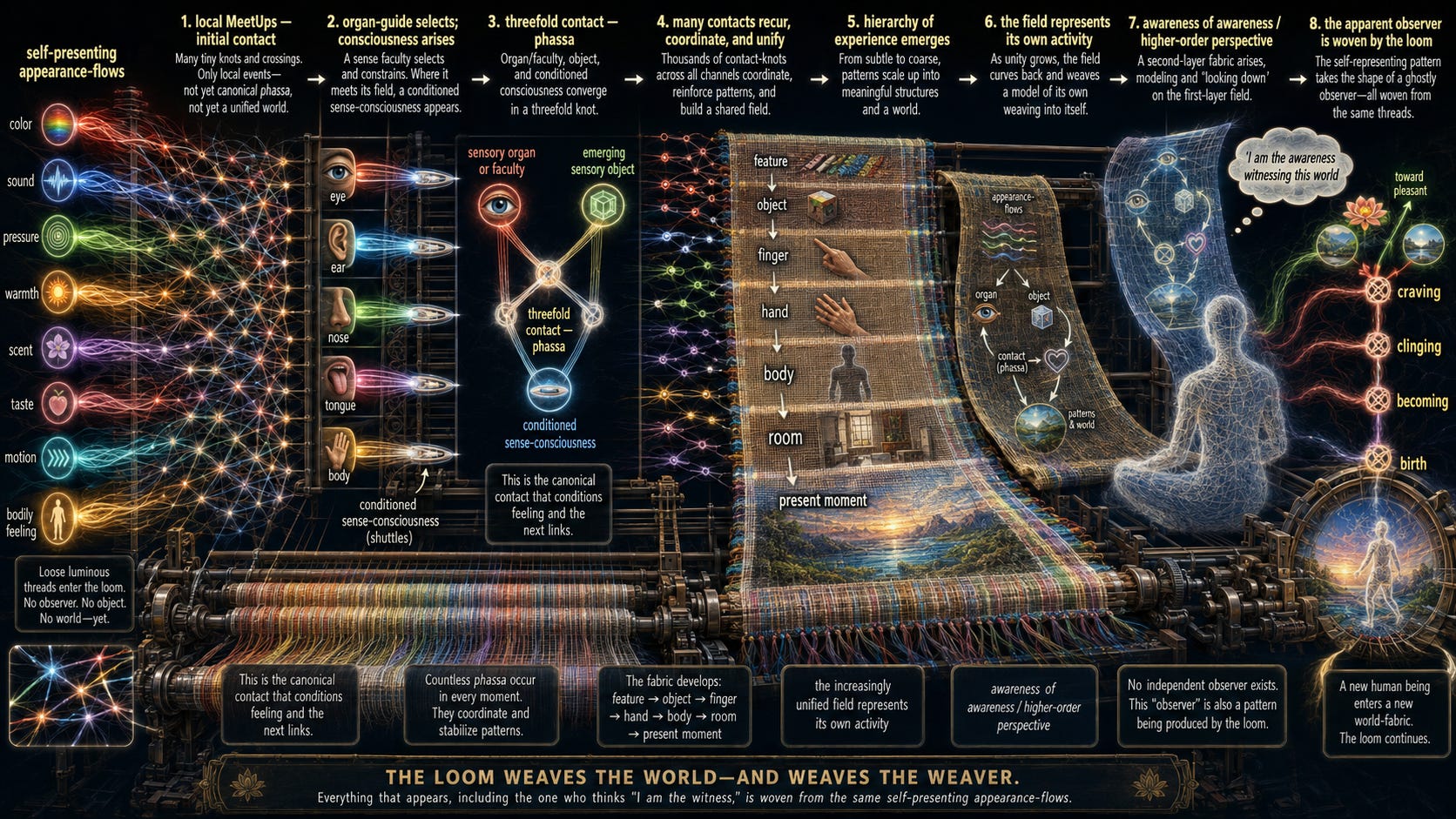
Skipping down to the bottom of the sequence, we see that once enough of the scene has been gathered together, it can remember itself, compare moments, anticipate, plan, and report. Then that unified mind at the end imagines it must have been the primordial witness existing before the flows that constitute it. The newly formed field extends itself through time, building the “origin of the world” from SN 12.44 toward becoming and birth.
Up till now I’ve been a bit imprecise about how a bunch of flows can add up to one me: they don’t melt into a new little soul. It works like the nun Vajirā’s chariot analogy in SN 5.10. When we assemble the parts, we call them a “chariot.” In the same way, where nature heaps together the aggregates, we call them “a being.” The sense of oneness is experientially real because you really do experience one world, but it’s the oneness of an assembly. The “me” it seems to happen to is just an overpaid and underly humble assembly spokesperson.
The main question for me and for the Buddha is whether the capacity for suffering (dukkha) remains. Taking a look at studies on automatic action and split-brain patients, it’s clear that people can function without feeling an inner controller, yet they still feel pain. Anguish requires more reflective consciousness than pain. SN 36.6 describes two darts, where the ordinary person struck by pain also sorrows, grieves, etc, while the fully liberated person (arahant) feels the bodily dart alone when not in nibbāna.
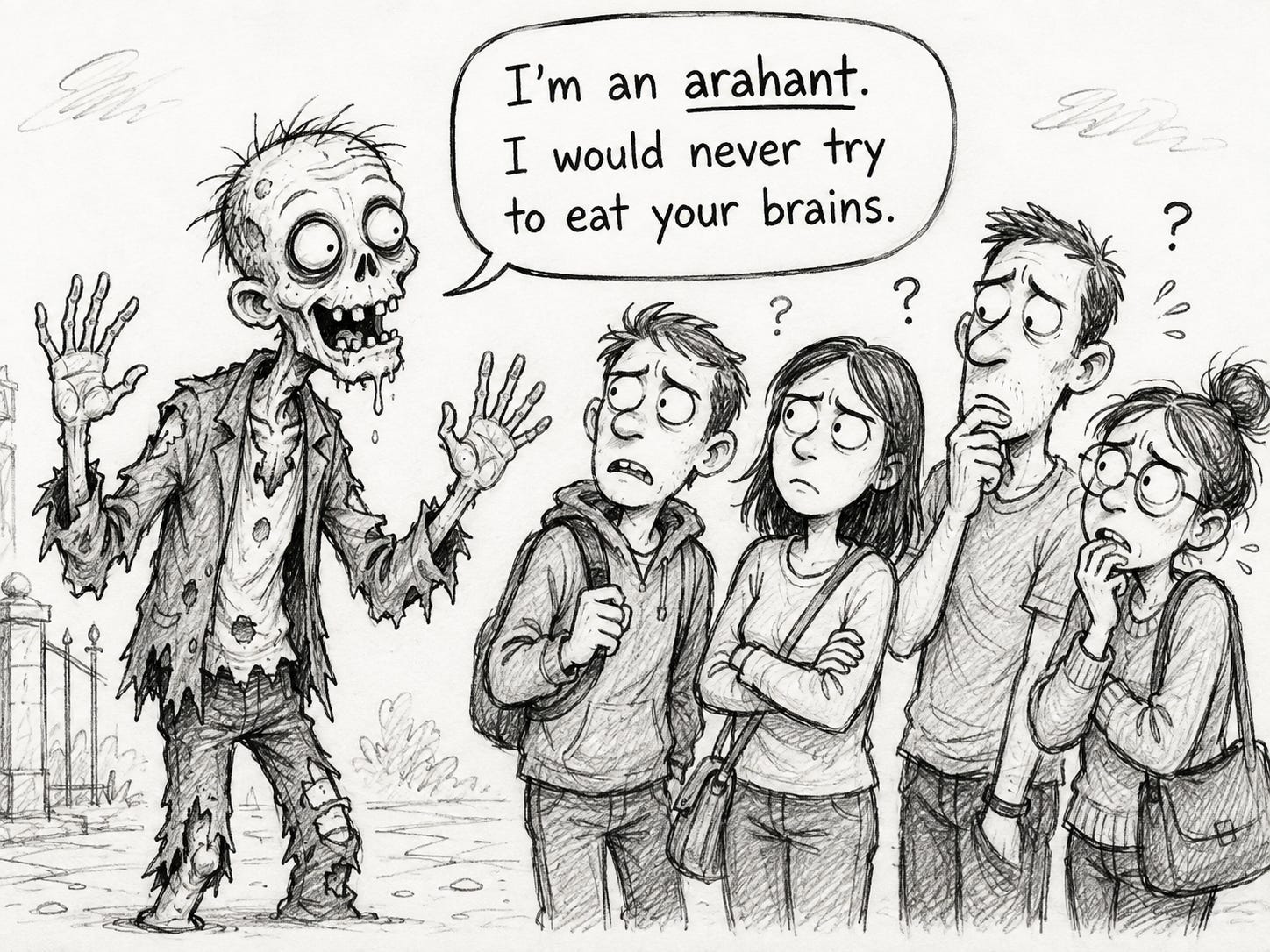
But don’t get it twisted: zombie-like functioning on autopilot, split-brain dissociation, and even a true no-self realization can all occur without making anyone an arahant. Pain without anguish is a symptom of enlightenment, not the definition. An arahant is defined by the complete release of even the subtlest unconscious belief in or craving for unified existence – the full loss of the fetters – which is what ends rebirth.
And it doesn’t take multiple sense streams together to suffer: one stream is enough. Even if all that remained were a single channel of pleasure/pain, that still leaves pain in there. The pain, like a plane, is able to land because there’s somewhere solid to land. During full unweaving, no assembled system remains that could suffer, lack, desire, gain, lose, recognize, or do anything. Supreme bliss is what seems to be left when the capacity for suffering is released (even though you might assume neutrality would be left): as Sāriputta put it in AN 9.34, “nibbāna is pleasant precisely where nothing is felt.”

In my experience, per the Bāhiya instructions, any sensation can be a gateway into nibbāna: one apparent sound can break apart into the many waves composing it before hearing disappears entirely. As the room unweaving experience deepened, all senses disappeared, except for luminous bliss flows.
The order of disappearance of the other sensations makes sense to me. Thought goes first, since nothing is referencing anything to anything anymore. Sound, touch, taste and smell all require solid molecular interactions, but all the solidity had been unwoven. Maybe this is why they call it “enlightenment” instead of “in smelly mint”? 😄
Ultimately, in Physics 101 we learned that nothing is really solid when you look close enough, all matter is actually just electromagnetic interactions. But even before modern physics, in SN 22.95, the Buddha was already deconstructing the idea of “solid matter” (rūpa):
Suppose a person saw a great lump of foam floating down the Ganges… If they inspected it and examined it carefully, it would appear empty, hollow, and insubstantial.
In the same way, whatever physical form there is… a monk inspects it and examines it carefully. To them, it appears empty, hollow, and insubstantial.

This also explains the famous quote by the founding philosopher of Mahāyāna Buddhism, Nāgārjuna. He states in MMK 25.19-20 “there is not the slightest difference between saṃsāra and nirvāṇa,” and “the limit of the one is the limit of the other.” Exactly. It’s saṃsāra when the uncompounded light flows are established as one temporal, material body-world. It’s nibbāna when that establishment fully unweaves.
Light language is all over the suttas. AN 1.49-52 calls the purified mind radiant or luminous (not to say the mind is nibbāna, but a purified mind is needed to dissolve into nibbāna). As the “defilements” of the mind are washed away, and as the “dust” is washed from the eyes, the light flows start to shine through, and when unification fully unweaves, no mind remains to be luminous. Only the luminous flows. DN 27 gives the same sequence in cosmic-story form: self-luminous beings crave the dark earth and become increasingly material. Light first, matter later.
DN 27 wraps the theory into a bedtime story.
The DN 11/MN 49 passage is also the closest suttic description I know of nibbāna as light flows, provided you read its “awareness” in the plural.
And the last verse of Ud 1.10, the Bāhiya Sutta, repeats the same “no footing” image, then adds that stars don’t shine, the sun and moon give no light, and yet there is no darkness. Well, if nibbāna is light flows, of course there’d be no darkness. No sun or moon needed, because this light isn’t produced by luminous objects. Nothing finds footing because no compounded body-world has been established—the same structural reason there is nowhere for suffering to land. Light can be perceived as the material world, but it isn’t an object in the world.
Near-death experiences made “go into the light” a familiar death-transition theme. Some Christian gnostic traditions and the Tibetan Book of the Dead even tell you which light to enter and what to say to avoid rebirth.
Tibetan Dzogchen Buddhism comes at ultimate reality from a more unified lens than me, but it agrees that the essence of the elements is light, and that matter is just that light condensed. They even claim their masters’ bodies actually dissolve into rainbow lights at death. There are a few 20th-century accounts of this; one was looked into on the ground by a Catholic priest, another was written down by the dying master’s own nephew (Namkhai Norbu Rinpoche). (The full comparison with Dzogchen is in the research report.)
Ud 8.3 defines nibbāna as asaṅkhata. Bhikkhus Sujato and Bodhi usually translate that as “unconditioned/independent,” which would trash my theory of light flows because light is conditioned. Lucky for us, I think that’s an obvious mistranslation – one Ṭhānissaro Bhikkhu avoids. Here’s why:
Across AN 3.47, where saṅkhata things arise, disappear, and decay while remaining; SN 22.79, on the manufacturing of experience; and the decay and assembly metaphors in DN 16 and SN 5.10, saṅkhata means “compounded,” “assembled,” or “fabricated,” not abstractly “conditioned.” The etymology agrees: saṁ- (together, completely) + kṛ (make, do, build) gives saṅkhata: something put together from parts.

Light is energy in the electromagnetic field spectrum, and energy can’t be created or destroyed. Individual photons are emitted and absorbed, but a photon has no parts to decay or disassemble. So light isn’t fabricated, even if a factory made your light bulbs. Even “empty” space measurably seethes with fluctuations, while light converts into matter pairs and matter annihilates back into light.
If nibbāna is uncompounded, you don’t get blank nothingness. You get radiant, blissful, unestablished processes with no body-world, no observer, no timeline, and no assembled objects. Which was my experience.
Einstein’s Special Theory of Relativity hands me a serendipitous parallel: at light speed, for a photon, there’s no time or space. Light is the invariant everything else measures space and time against. My full unweaving likewise had no observer, viewpoint, time, or common background space.
The suttas repeatedly call nibbāna unestablished or unsupported. Ud 8.1 gives it no coming, going, standing, passing, or arising. SN 12.38 and SN 22.53 tie unestablished consciousness to ending renewed existence. SN 12.64, of all images, uses a beam of light with nowhere to land. Quantum physics likewise says a photon’s state isn’t established as one definite outcome until measured. Saṃsāra is the unestablished becoming established as a definite relational world.
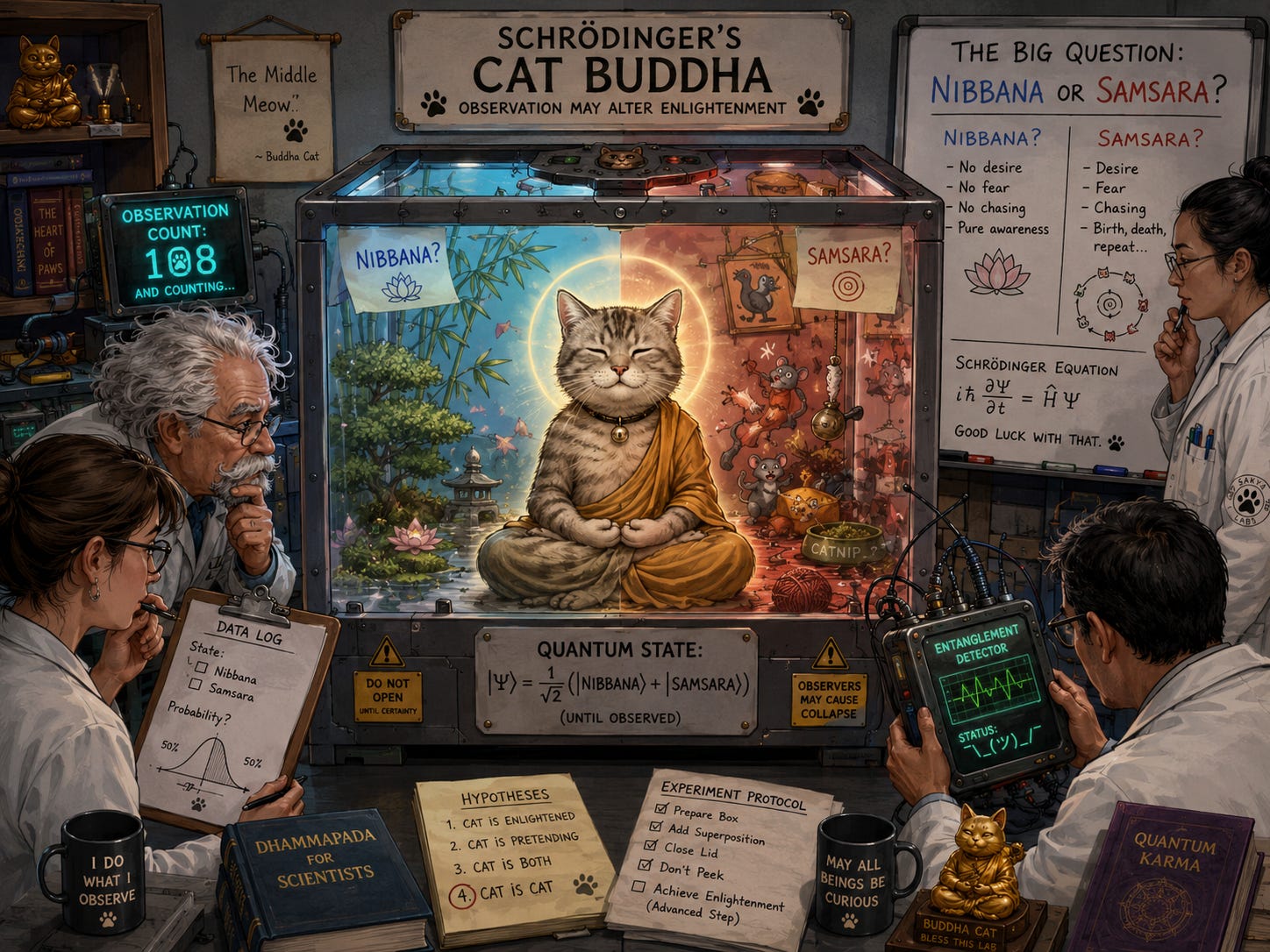
Physics can’t demonstrate from outside what meditation can disclose within: light sees itself. Give light a mirror through which to see its own beauty, and reflective consciousness begins establishing a mind, which leads us to the Greek myth of Narcissus, who died from starvation due to unceasingly staring at his beautiful reflection in a pond.

If that is what the texts were pointing to, how did the point disappear while the words survived?
After 15 years of reading popular & obscure Buddhist books, plus countless hours on forums like SuttaCentral.net, I never once found a positive definition of what nibbāna actually is. Everyone says what nibbāna does (liberates), what it ends (rebirth, consciousness, defilements), what it isn’t (anything), and then gives me the aggregates, sense bases, dependent origination, and no-self again. But what was the experience all those lists were pointing to? Why is it that no Theravāda monk ever seems to be clear despite devoting a life to this? In the Buddha’s time, it was common even for laypeople to become stream-enterers and beyond (DN 16).

Part of the problem is that the Buddha, or those who recorded him, left the pieces in different drawers. Ud 1.10 points to direct sensations as the gateway; SN 12.44 gives the contact chain building “the world”; SN 12.67 has consciousness and mind-and-body leaning together like two bundles of reeds – pull either away and the other falls, like Jenga. DN 15 gives the fuller dependent-origination account, and MN 140 moves through the formless unity states and beyond unity. Consciousness-first Advaita and matter-first materialism both fail because the two keep each other standing. I put the puzzle pieces back in the box in the research report. 😛
Those books did at least teach me that everything arises from conditions. AN 3.61 says conditioned choices still matter because they become conditions for what follows. What still bothered me was who or what was supposedly choosing; most Buddhists I spoke with didn’t even understand the question.
Regarding the self, the Buddha is famous for teaching anattā, or non-self. But many people remain confused about whether he denied a self or merely denied that conditioned experience is the true self. In one of the most quoted suttas, SN 44.10, he refuses to answer the question directly because either answer would confuse an already confused person further. But in many other suttas he specifically states that self-view itself is the problem, and the self is just composed of changing aggregates.
Even many senior monks misunderstood his dependent-origination teaching in AN 6.61, and his clarification remained cryptically terse.
The suttas clearly show that the Buddha succeeded in liberating thousands of people, and the Vinaya says 500 fully enlightened monks took part in the first council after his death. The problem is that as the people who directly understood nibbāna, no-self, and dependent origination became rarer, the words kept getting interpreted by people who were still experiencing one unified consciousness and one world, and the hints stopped landing. I’m reminded of Ud 6.4, when the Buddha talks about how sectarian teachers quarrel over incomplete understandings of reality, much like blind men who each touch a different part of an elephant and argue over its true nature.
And the degeneration is even visible in that first council of 500 arahants, because they excluded the female arahants and shamed Ananda for asking the Buddha to admit women to the sangha.

The canon says this degradation had begun in the Buddha’s lifetime. In SN 16.13, Mahā Kassapa asks why training rules are multiplying while fewer monks reach final knowledge. The Buddha says counterfeit Dhamma gradually makes the true Dhamma disappear.
The funny part is that the words may have survived surprisingly well. They were transmitted communally for centuries, and separately preserved early collections agree on a great deal despite variants, rearrangements, and later additions. But preserving the puzzle pieces doesn’t preserve the picture on the box.
That creates a practical problem. In DN 3 and MN 56, the Buddha waits until a student’s mind is “ready, pliable, rid of hindrances, elated, and confident” before giving the teaching that opens the Dhamma-eye. What happens when a stage map lets anyone skip to the answer?
Today someone perusing Dharma Overground can pull the trigger as I did through AtR, but merely out of curiosity, competition, or hope of claiming an attainment.
Nibbāna is genuinely needed as the trigger for stream entry: otherwise, what was recognized, and where did intuitive certainty about the Dhamma come from? MN 56 says the “stainless, immaculate vision of the Dhamma” arises at stream entry. But without the ammunition of desire, prior practice, and readiness to end rebirth and attachment to self-view, pulling the trigger (experiencing Nibbana) only makes a cool sound. It gets filed away as an awesome experience without immutably overwriting the old view. That’s why the Buddha also taught loving-kindness and the Noble Eightfold Path: ethics, meditation, and wisdom are the prereqs for practice.
Dhammapada 276 says awakened teachers point out the path while practitioners make the effort (wash the dust from their eyes & climb the mountain). MN 38 says the Dhamma must be known, seen, and realized personally. DN 16 pairs reliance on oneself with reliance on Dhamma; and MN 22 calls the teachings a raft for crossing onto “the safe shore” of nibbana, not something to identify with.
The more detailed the map, the more honesty and empirical self-scrutiny it requires. An unprepared reader can use the answer key to exalt a psychedelic rupture, depersonalization, derealization, trauma, or temporary no-self state into stream entry.
Secrecy won’t solve this. Readiness warnings, anti-counterfeit framing, ethical and relational outcome checks, and personal verification are the best protections I know.
AtR’s map saved me, but I still can’t recommend its authentication culture. It seems largely Soh’s semi-authorized editorial creation from John’s journals: John supplied much of the insight, while Soh turned years of journals and chats into a searchable, teachable, generalized system. From the chats Soh sent me, John seemed ambivalent about teaching, yet allowed Soh to act as his mouthpiece. It was a smart arrangement: the student promoted the teacher while the teacher kept calling his posts “a simple sharing” or “nothing authoritative.”
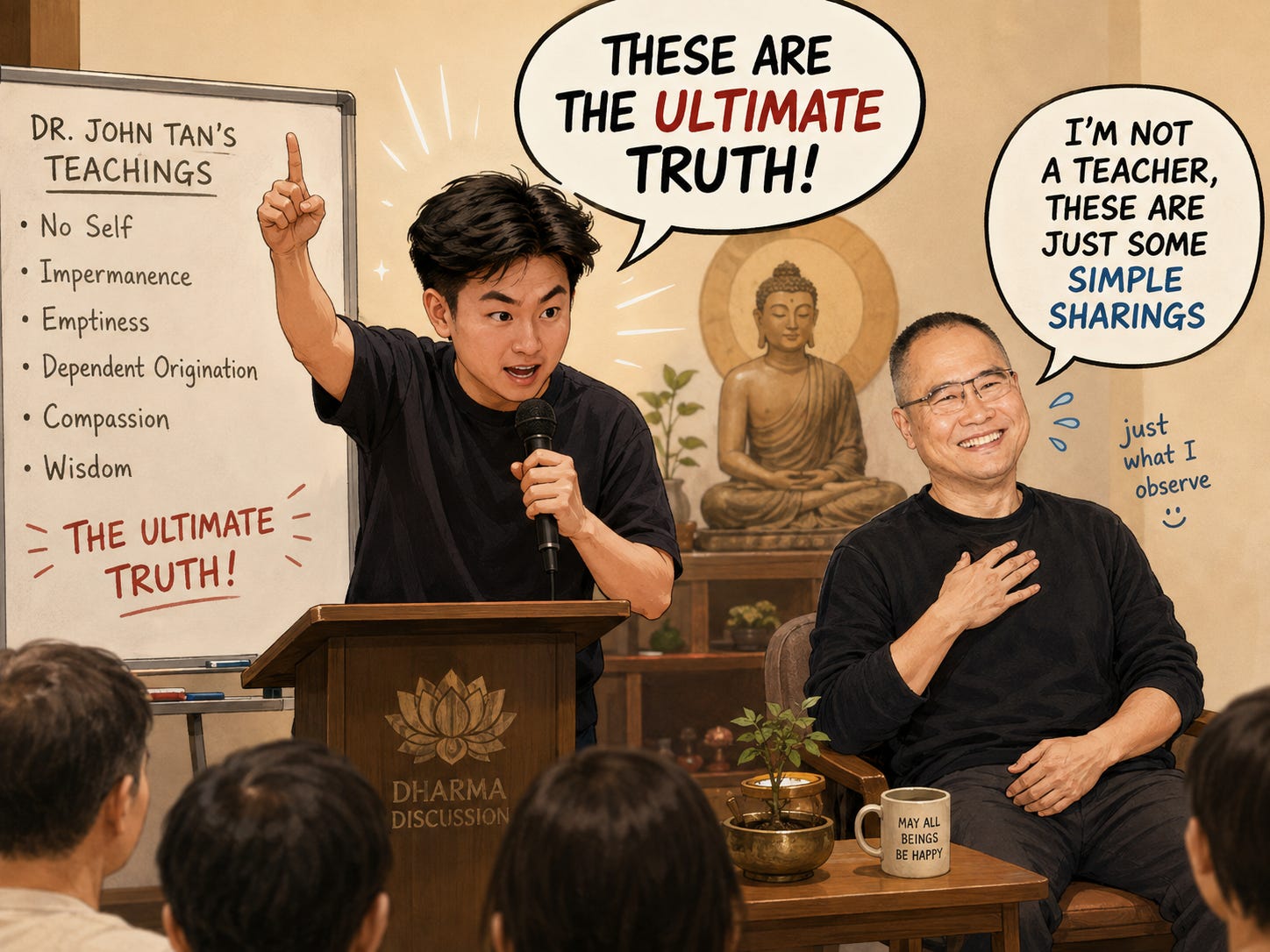
I don’t want to caricature AtR as Buddhist Google Maps. Its blog discusses ethics and the Noble Eightfold Path, and John repeatedly corrected Soh on experience versus insight, view, and stabilization.
Still, Soh seemed to fancy himself the map king and became the person who “authenticated” others’ stages, even though John called awakening “self-authenticated by doubtless realization” and presented the map as only his experience.
I stayed six days with one person Soh authenticated as a stream-enterer, Frank Yang. He didn’t understand basic Buddhist teaching, including “conditions” – which Soh was also confused about while trying to refute determinism – and Frank got angry when I questioned him.
But the problem isn’t as surprising with a YouTube star as it was for me when I met with Āyasmā Ariyadhammika around that time, head teacher at the Sasanarakkha Buddhist Sanctuary, a Theravāda center offering “advanced training” to monastics. He didn’t understand conditions either. He thanked me when I explained that literally everything is conditions, and that seemed to give him a real lightbulb moment, although I never heard from him again.

Frank did suffer much less after softening his identity, which matters, but that isn’t stream entry. He was a good, if shallow, AtR parrot becoming an exalted guru through his charisma & beautiful, crazy YouTube channel:
Stream entry is the first of Theravāda’s four stages of awakening. Once-returning, non-returning, and arahantship come after it. For this article, the first stage is the one that matters. Craving, aversion, and ill will can weaken a lot at stream entry because the self-view behind them has been seen through, but most fetters remain.
Nibbāna, when it’s the experiential fruition of practicing the Eightfold Path, opens the irreversible “Dhamma-eye:” identity view seen through, the Dhamma intuitively understood, and as a result, fundamental doubt about the path is forever gone. Based on the suttas, it is clear that one fruition event is what establishes stream entry. If a later event is needed before that realization happens, the earlier event was, by definition, not stream-entry fruition. It may be possible for someone to investigate an earlier experience until its meaning finally becomes irreversible without a second event, but that is not the normal preparation-then-seeing sequence I find in the suttas. The detailed sutta case is in the research report.
Aside from having the nibbāna fruition experience, AN 10.92 defines stream-enterers as having confidence in Buddha, Dhamma, and Saṅgha, ethical restraint, and direct understanding of causality. AN 3.87 ties the stage to ending identity view, uncertainty about the path, and grasping at habits or practices as sufficient by themselves. It calls the stream-enterer certain, headed for awakening, and safe from states of woe. Later stages keep weakening passion, aversion, and delusion until the remaining fetters end.
AN 4.191 says that a monk who has theoretical understanding of the teachings may be reborn among heavenly beings even if he dies unmindfully. The Dhamma can then return to mind slowly, and after that he can quickly reach stream entry (“the destination”).
And we find a stronger guarantee in SN 25.1. Someone who has fully accepted the Dhamma through faith or reflective deliberation is said to be irreversibly approaching stream entry by the time of death, and incapable of doing evil deeds that would lead to a rebirth in a lower realm.

I know a few people who appear to have had several genuine nibbāna openings. Afterward, their interpretation kept moving between Advaita-style Unity and Buddhist Untying, then back again. One of them, Jackson Peterson, posted publicly like a ridiculous daily pendulum on the AtR Facebook, and he’s something of a guru.
The AtR debacle taught me that both self-authentication and someone else’s authentication are problematic. In the Buddha’s time, self-authentication was possible, per DN 16, but possible doesn’t mean fully reliable, since people can make mistakes or lack self-awareness, especially in these times when the teachings are less well-expounded. We need a rubric something like this, though after-effects alone can’t settle it:
Do you no longer have enough obsessive greed or ill will to cause you to kill, steal, lie, take mind-numbing intoxicants, or engage in sexual misconduct (SN 55.28)?
Do other people notice a durable reduction in your selfishness?
Can you be content with less? The Buddha advised monastics to wear corpse-collected robes (Kd 8.11) and use their own fermented urine (Kd 1.64) and feces (Kd 6.2) as medicine.
Are you more joyful and enjoyable to be around without becoming a people-pleaser, as in MN 89? Soh’s false 24/7-bliss claim isn’t the standard: AN 11.12 says a noble disciple can reach ease through recollection, while in MN 75 the Buddha says he felt pain at what ordinary people perceived as sensual pleasure. Enlightenment isn’t a simple bliss switch.
Does the Dhamma now feel intuitively coherent rather than merely conceptual?
Do you know rebirth is on the way out with the same certainty that everyone knows they will die?
Can you still recognize trauma without floating above it?
That last test matters because a stream-enterer still has most fetters. They still need to do reparenting like other folks, and even a genuine breakthrough does not turn somebody into a therapist, let alone a saint.
Stream entry’s greatest prize is a “release date”: AN 3.88 allows at most seven more lives before final awakening. There is actually quite a lot of modern academic evidence for rebirth. But who’s going around getting reborn if no permanent self exists? Buddhists don’t imagine any permanent self-essence/soul moving between bodies. Rebirth is causal continuity without a traveler, often called a mind-stream: craving and clinging condition becoming, and becoming becomes birth. More like a driverless car. The later Buddhist philosopher Milindapañha compared rebirth to one lamp being used to lighting another.
The lucid-dream comparison from earlier also shapes how I understand the seven-life limit said to be had by the stream-enterer. Once the dream is known as a dream, it becomes naturally difficult to remain stuck in it, similar to how hard it is to be absorbed in a movie when the lights go on and you remember you’re in a theater. If you’ve ever had a lucid dream, you know what I’m talking about.
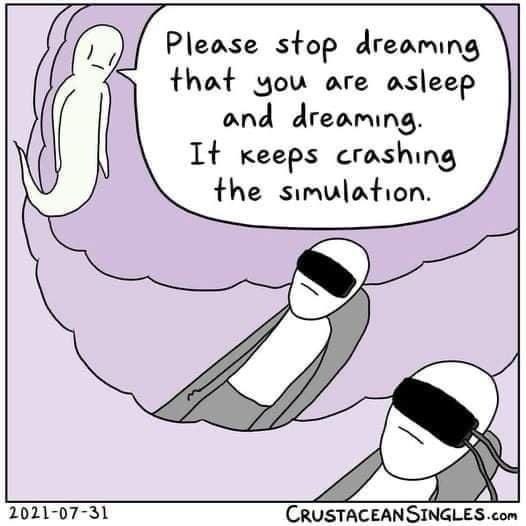
I used to attribute “life is like a dream” directly to the historical Buddha. The famous stanza I loved actually comes from the later Mahāyāna Diamond Sutra, which puts some words in his mouth, although the early Pāli texts offer closely related images. SN 22.95 compares form to foam, feeling to a bubble, perception to a mirage, and consciousness to a magic trick. Dhammapada 170 asks us to see the world as a bubble and mirage.
The Diamond Sutra verse is still beautiful. Here is a widely circulated English rendering:
So should one view all of the fleeting world:
A star at dawn, a bubble in a stream,
A flash of lightning in a summer cloud,
A flickering lamp, a phantom, and a dream.

For me, nibbāna was really like waking up from a dream, except that nobody woke up. Reasoning can make the dream doubtful. The event made doubt about the dream impossible to reverse.
Science circles consciousness’s edges: people can function with no felt controller, several things can be cognized at once, split-brain patients can resemble two knowers sharing a skull, and one recent theory models minds as nested parallel observers. The full nerdy tour is in the research report. Science gives my argument a third wheel, making it safer to ride, but it will never show nibbāna itself – self and sense organs unweaving into self-presenting light flows of bliss. That requires meditation.

Most people won’t go POOF directly into nibbāna, but this practice can do something unusual.
Start by feeling your head and feet at the same time without letting the middle get in the way. See whether they can become independent experiences instead of automatically combining into “my body, my choice.”
Did they feel like two simultaneous experience streams, or did attention just bounce between them? Take note, young grasshopper.
A similar version may work even better while walking: I let my limbs do their own thing while my already-faint torso disappears. You can give your fingers some autonomy and see whether they automatic-write the next Pulitzer Prize novel. Sounds & colors have worked less well for me than bodily sensations, but maybe I’m just kinesthetic. Either way, see whether the self loosens.
Here’s what success actually feels like for me when the loosening works:
My happy head and happy feet both feel vivid as simultaneous yet independent experience-flows. If my attention is bouncing back and forth, that’s still reg mode, meaning I might need to keep trying the untying, but maybe a bit less trying and more relaxx-maxxing.
Several sensations can remain present without becoming “my body.”
The witness gets hard to locate, and an unusually deep relief or bliss shows up.
I might get just a taste of that or it might feel like more.
If it still feels like one body watched by the Watcher, nothing has loosened. Numb, dull, or foggy may just mean you’re sleepy and it’s nap time.
The farther unification loosens, the less useful you become for normal tasks. That’s why I’d suggest starting this practice while lying down… certainly not while driving, cycling, swimming, cooking over fire, crossing traffic, working near heights, operating machinery, skydiving, or flying your pet dragon.

If it becomes frightening or chaotic, come back: open your eyes, wiggle your toes, name things in the room, and talk to your cat or pet elephant.
I’ve always come back so far. That isn’t a promise from the future.
Most of the unification usually returns afterward. Usually.
The afterglow can last for hours or days, sometimes longer, depending partly on where I am and who is yelling at me to feed the sheep.
In a calm moment, I can still get maybe a 1% taste – a release valve I didn’t have before. Going deeper takes more time. When the body and world come back together, they still don’t feel primordial.
Try it somewhere safe. Was it only an experience, or did it bring insight or realization? Did anything remain: less selfishness, fewer delusions, more love?
I told you about the lovely Bāhiya Sutta. Bāhiya hears one short instruction, becomes fully liberated, and instead of going on a book tour with Oprah, he gets killed by a runaway cow. The Buddha declares him totally unbound, never to be born again, and the fastest person ever to grasp the Dhamma.
Some people might think Buddhism didn’t work very well for poor ol’ Bāhiya. But the goal is to end existence itself, and because he wouldn’t be reborn, he reached it: he untied and was released into parinibbāna.
It’s worth noting that Bāhiya was not just lucky to get enlightened so fast. Ud 1.10 shows his urgency and immediate understanding, while the later Bāhiya Apadāna says he had aspired and practiced toward that quick comprehension for a hundred thousand eons. Most people are not as ready as Bāhiya was, so don’t be surprised if you can’t leap from complex PTSD, self-hatred, or a chaotic life directly into complete liberation just because I told you a sound heard itself. The Buddha’s Noble Eightfold Path still needs to be followed, and I would mainly highlight the importance of ethical practice, loving-kindness, inner-child reparenting, healthy relationships, and a supportive practice community.

I don’t want Bāhiya’s cow to get the last word. In AN 3.55, the Buddha says abandoning greed, hatred, and delusion ends plans to harm oneself or others and brings mental peace and bliss. The following formula calls nibbāna directly visible, not bounded by time, inviting one to come and see, leading inward, and personally realized by the wise.
Here’s something to ponder. SN 12.61 says mind arises as one thing and ceases as another day and night; AN 1.48 says nothing turns over faster than the mind, and won’t even offer a simile. If so, untangled reality isn’t a faraway Garden of Eden requiring an arm & a leg’s worth of past-life hypnotherapy. As Roaring Silence says, it appears in blessed moments as “the sparkling-through of our beginningless enlightenment.”
Physics shows the same shape: permanence is a pattern made from nature’s impermanence, reminiscent of a mind arising as one thing and ceasing as another, and of flows tangling, getting heavy, and releasing.
I invite you to come and see for yourself! Ehipassiko!



For roughly fifteen years I have also had semi-random micro-disappearances in which the felt “I” vanishes. Each instance includes, in varying proportions, a high-pitched nāda-like inner sound, bliss, and a dissolution of the felt self. Still not unweaving, but a potential gate into it, as with any sensation that goes direct. Nāda is a Sanskrit word for sound; some Hindu contemplative traditions use it for an inwardly perceived sound. Sometimes the sound dominates. Sometimes the dissolution & bliss do. This is the closest traditional comparison I know.
The effect often begins on one side of my head. By relaxing & tuning attention, I can sometimes bring the other side into it. As it deepens, the bodily sense of the head or brain area can also dissolve along with “me.” I’ve never been able to scrounge up enough money for an MRI to check if my brain is really still there, and some would argue it’s completely gone! 😂
Dzogchen, a branch of Tibetan Buddhism, also has practice advice that fits these episodes: short moments, many times. No need to try to keep the moment going if it’s effortful, since the whole point is to relax the sense of owner/doer.
At first I wondered if I should stop riding my bike to work. What if “I” vanished in the midst of a left turn and the bicycle didn’t know what to do? But so far, everything’s turned out fine, Alhamdulillah! And better than fine, I feel infinitely blessed each time, and I really do thank the universe each time. It’s become a huge gratitude practice.
My buddy E. told me he had much stronger episodes while driving: for long stretches, his own car and the traffic seemed to disappear. He never had an accident either. Luck is one possibility; so is a misunderstanding of what was happening, some feature of how these states operate, a combination, or God only knows.

Whatever the explanation, to be safe, I wouldn’t keep driving through that. Anyone having comparable episodes should stop operating machinery until they understand them better. That’s my own CYA showing. 😇
Comments
Nothing yet. Say the first thing.
Sign in to join the conversation.