
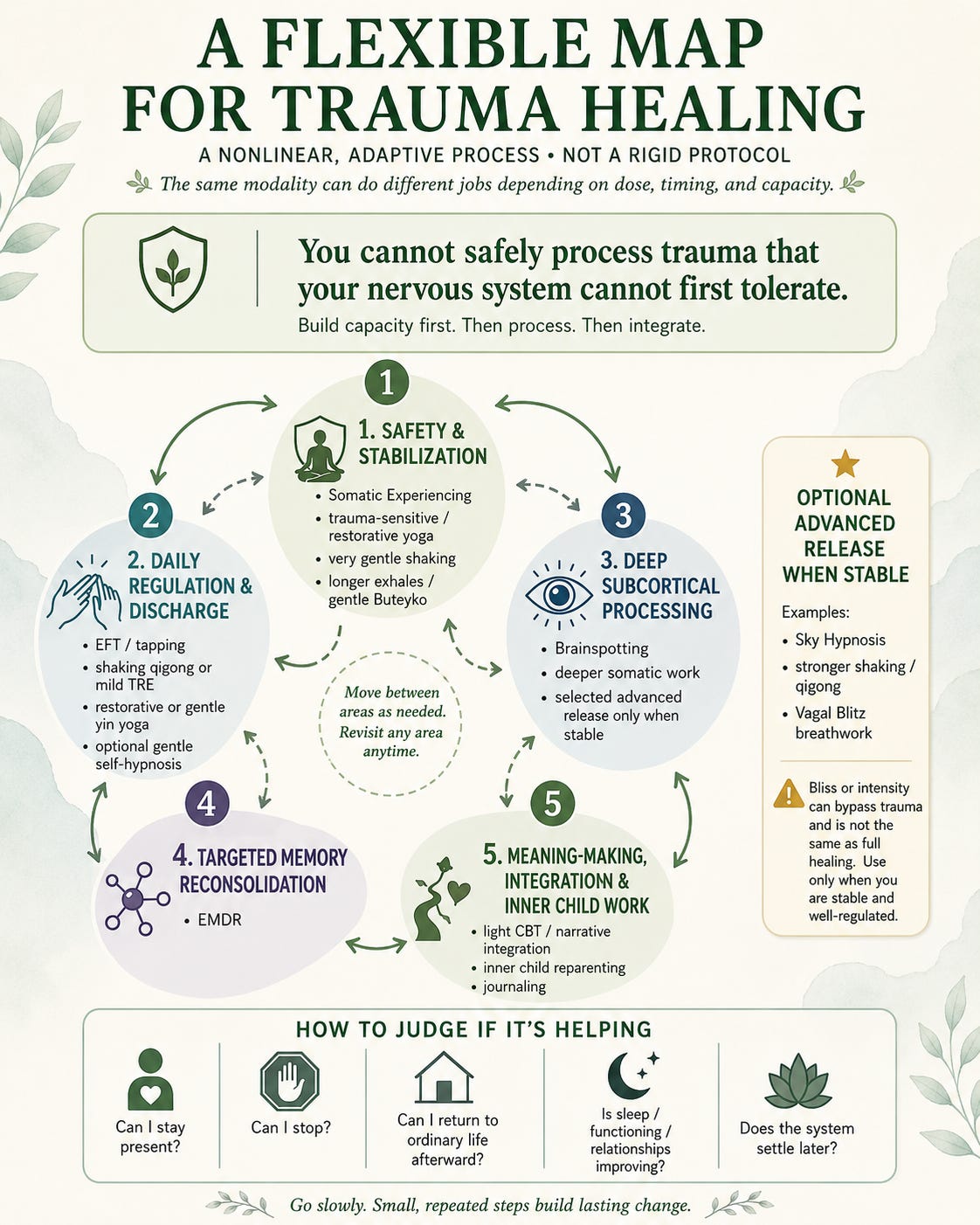
Trauma healing is rarely just a matter of revisiting painful memories. The body was involved in surviving what happened, and it may still brace, collapse, freeze, disconnect, scan for danger, or flood long after the danger is gone.
For many people, especially people with complex or developmental trauma, lasting recovery follows a sequence: establish safety and nervous-system regulation, release accumulated stress and survival responses, and only then move into deeper trauma processing.
The core principle is simple:
You cannot safely process trauma that your nervous system cannot first tolerate.
I am going to place Somatic Experiencing, trauma-sensitive yoga, EFT, shaking practices, Brainspotting, EMDR, and cognitive integration on one flexible map. They do different jobs. Some are therapies. Some are useful adjuncts. Some are mainly experiential practices that may help particular people but should not be dressed up as settled science.
All of them can also prepare the ground for deeper inner-child therapy by making the body a little safer to inhabit before old material is approached directly.
Remember, therapy is not just work. It’s also play! We often make the most incredible discoveries when we approach things with playful curiosity. For example, here’s a bridge between somatic therapy and inner-child therapy which I recently learned from Professor Baby Sheep:
And in my personal experience, what actually works better for me than all of these therapies is shaving my head and massaging it, especially while on loveyhuasca!
Putting these jobs in a rough order makes intuitive and clinical sense for people who are repeatedly overwhelmed, severely dissociative, actively unsafe, unable to settle after activation, or missing the practical support needed to tolerate trauma work.
This five-job map is built from first-principles reasoning and community signal, rather than a scientifically validated protocol.
But the evidence does not establish one universal sequence in which everyone must complete Somatic Experiencing, yoga, EFT, and shaking before beginning EMDR or another trauma-focused therapy.
Even if a trial eventually validated an average sequence, it still would not tell you what is right for your nervous system. So use the jobs below as questions:
Can I stay present enough to do this?
Can I stop?
Can I return to ordinary life afterward?
Is this practice reducing symptoms and increasing freedom, or am I becoming more activated and more obsessed with processing?
Capacity matters. But capacity-building should not become an endless waiting room where the actual trauma is never treated.
Judge progress by sleep (see my sleep guide), relationships, functioning, freedom, and symptom change—not by how dramatic the session felt.
A modality does not belong permanently to one job. The route depends on what you are doing with it, how intense the dose is, what target you are approaching, and what capacity the person already has. Present-focused self-hypnosis differs from immersive memory work; resource-oriented Brainspotting differs from entering highly charged developmental material; gentle shaking differs from cathartic release.
You may have one primary job, several secondary jobs, and some targets that should wait. One person can need daily discharge, help with a discrete memory, and basic inner-child reparenting at the same time. Don’t force the whole case into one modality or one point on the map.
I distinguish published research, common clinical practice, my experience, community signal, traditional or energetic explanation, and provisional mechanism. A useful practice does not prove every explanation offered for why it helps.
Job 1: Stay Present and Keep Choice — build enough safety, orientation, stopping ability, and return capacity for the next step.
Job 2: Regulate or Discharge Accumulated Activation — keep pressure from building between deeper sessions.
Job 3: Work With Diffuse, Bodily, or Hard-to-Narrate Material — approach sensations, impulses, emotions, images, or fragments that do not yet form a clear story.
Job 4: Work With a Discrete Memory or Trigger Network — address specific traumatic events, flashbacks, and residual triggers.
Job 5: Integrate, Differentiate, and Build a Life — update beliefs, identity, relationships, values, and direction after the body is less trapped in survival mode.
Inner-child reparenting is not only a Job 5 practice. Lighter forms can begin early and run alongside somatic work.
When somebody is flooded, almost completely identified with the child-state, or unable to access a Nurturer or Protector, the first task may be orientation, outside safety, a neutral witness, borrowed adulthood, or one ordinary Protector action. Gentle self-hypnosis can also help at this stage when it remains present-focused and does not go deeply into memories or child dialogue.
In my experience, EFT, Somatic Experiencing, trauma-sensitive yoga, gentle shaking or qigong, non-forced longer exhales, and gentle Buteyko-style breathing can help the body relax and soften tension around the solar plexus or abdomen so heart chakra love becomes easier to access. These can prepare for inner-child work or continue alongside it.
Brainspotting can also prepare for inner-child work or run alongside it, depending on how it is used. A resource-oriented or carefully titrated session is different from using Brainspotting to enter highly charged developmental material.
EMDR may fit better after some basic inner-child reparenting for people with diffuse developmental or relational trauma. Having at least some access to a Nurturer and Protector can make it easier to hold what memory work opens. That is not a universal rule: a stable person working with one discrete traumatic event may be ready for EMDR without completing a long preliminary sequence.
Once the body softens even slightly, you do not have to use the opening to enter painful memories. You can bring to mind a pet, a baby, a friend, a partner, or anyone you naturally love, feel the real love that is already there, and see whether a little of it can move from the heart toward the younger part around the solar plexus and then back up in a loop.
Deep memory work, immersive child dialogue, deep hypnosis, and suggestive exploration should wait until the person can remain present, stop voluntarily, and return to ordinary life afterward.
Ask what job the practice is doing right now—orientation, regulation, discharge, resourcing, processing, or integration—rather than assigning the entire modality to one permanent place on the map.
Goal: Expand the window of tolerance and establish nervous-system safety.
Why it can help here: If the autonomic nervous system cannot return to regulation, deeper trauma work often becomes destabilizing. Somatic Experiencing is useful here because it works with sensation, orientation, impulse, defensive response, and nervous-system pacing rather than forcing the person to narrate the trauma before the body can tolerate it.
Typical duration: Some people spend three to six months building these capacities, and severe developmental trauma can take longer. This is orientation, not a prerequisite or countdown. A stable person with a clear target may move into trauma-focused therapy much sooner.
Best use: Building capacity, tracking sensations gently, learning titration, pendulation, orientation, and the difference between activation and overwhelm.
Goal: Gain body awareness, flexibility, enjoyment, and agency.
Yoga often fits early in the sequence. No power yoga. No hot yoga. Nobody announcing, “Open your hips and release your trauma.” The useful version is slow, choice-based, and non-invasive.
Best forms:
Trauma-sensitive yoga
Restorative yoga
Gentle somatic yoga
Very gentle yin yoga, only when propped, short, and choice-based
Good trauma-sensitive instructions sound like:
“You might try…”
“You can keep your eyes open.”
“You can come out of the shape at any time.”
“Notice whether this feels useful, neutral, or too much.”
“A posture can have several correct versions; choose one that fits your body.”
Warning: Avoid intense stretching, long passive holds, forced breathwork, breath retention, hands-on adjustments without clear consent, aggressive hip openers, or instructions to “push through sensation.” The objective is choice, safety, and embodiment—not dramatic release.
Gentle shaking or basic trauma-release exercises can support Job 1, but the dose should stay low. You should finish feeling more regulated, not blasted open.
Examples:
Basic Trauma Release Exercises, kept very mild
Light neurogenic tremoring
Gentle shaking while standing
Short, playful movement that can stop easily
Warning: For Job 1, the objective is regulation rather than catharsis. If shaking becomes compulsive, frightening, dissociative, or hard to stop, the intensity is too high. If tremoring reaches your neck while you are lying down, do not let your head whip around unsupported. Stop or reduce the movement, support your head—or have an experienced provider help you support it—and get guidance before continuing; forceful, rapid back-and-forth neck movement can injure the neck.
Once the system has some basic safety, another common job is daily regulation. Deep sessions can be undermined when the rest of the week keeps accumulating activation. Job 2 creates a regular pressure-release system.
Goal: Portable self-regulation for real-world triggers.
EFT is useful because it can be done quickly, privately, and repeatedly. It gives you something concrete to do when old activation appears in ordinary life: conflict, shame spirals, social fear, abandonment panic, freeze, anger, or intrusive memory fragments.
Best use:
Before difficult conversations
After being triggered
Before or after therapy sessions
When the mind is looping but the body is also activated
As a bridge between body-based and cognitive processing
Not ideal as: The only treatment for severe trauma, or a way to bypass deeper body-based work.
Goal: Daily autonomic discharge and energetic decompression.
Shaking Qigong is a creative fusion of shaking with qigong. The form I am linking to is a class for $10 per month on Skool which my friend Louka took. I am recommending this specific class because Louka tried many different healing and somatic modalities, including basic TRE, but nothing helped him much until he got into this class.
This is where shaking qigong may serve a different job than gentle early shaking. For Job 1, shaking should be gentle and exploratory. For Job 2, it can become a more regular discharge practice, as long as you remain able to stop, orient, and settle afterward.
Mechanism, mainstream interpretation:
Rhythmic movement
Reduced muscular armoring
Greater awareness of bodily sensation
Possible shift from fight-or-flight toward a calmer state
Tremor-mediated release of chronic tension
Completion of interrupted defensive impulses
Mechanism, qigong interpretation:
In qigong, qi means vital energy. From that perspective, shaking may help with:
Removing energetic stagnation
Increasing qi circulation
Dissolving stored emotional charge
Reconnecting breath, body, and movement
Best use:
10–45 minute regular practice
Non-verbal emotional processing
Chronic freeze patterns
Stress accumulation between therapy sessions
Post-therapy discharge when activation remains in the body
Not ideal as:
Standalone treatment for severe PTSD
The primary trauma-processing modality
A catharsis-chasing practice
A replacement for skilled therapy when you are highly dissociative or unstable
A useful daily sequence is:
Shaking Qigong / TRE — discharge excess activation.
Restorative or gentle yin yoga — let the system soften, settle, and rebalance energy flow.
EFT tapping — re-establish emotional calm and cognitive orientation.
The point of the stack is to avoid opening a lot of activation through shaking and then walking away still raw.
Important yin yoga caveat: Yin yoga can be helpful, but only if it is gentle, propped, and non-coercive. In trauma work, long passive holds can become too evocative. Early on, shorter holds are usually better than ambitious five-minute shapes. You should never be encouraged to endure sensation for the sake of “release.”
This is often called deep subcortical processing. I use the word as shorthand for trauma material that shows up through body sensation, impulse, emotion, image, or fragments before it becomes a clear verbal story—not as a claim that one precise brain region contains it.
Goal: Work with emotionally charged material through gaze position, focused attention, bodily awareness, and therapist attunement.
Helpful foundations may include:
Enough nervous-system safety to remain present
At least one way to regulate ordinary triggers
A way to discharge or settle activation afterward
Enough comfort with bodily sensation to notice when the dose is becoming too much
These are capacities, not a checklist of therapies everyone must complete. With enough of them in place—however you built them—Brainspotting can often go deeper without overwhelming you. It can be especially useful when trauma shows up as body reactions, images, impulses, emotions, or fragments that are hard to organize into a clear story. You do not necessarily need to explain every detail for the session to move.
Best suited for:
Diffuse developmental trauma
Pre-verbal or body-held material
Trauma that does not respond well to purely cognitive approaches
Complex emotional knots where the body knows more than the story
Further reading: D’Antoni et al., 2022 — Comparative study of EMDR, Brainspotting, and related methods
After Brainspotting, do not rush straight into analysis. Your body may need time to process whatever surfaced.
Useful post-session options:
Allow spontaneous shaking or tremoring if it arises naturally.
Use gentle Shaking Qigong if your body wants discharge.
Use walking meditation if you need orientation and grounding.
Use restorative, gentle yin, or somatic yoga if your body wants rest, stretching, toning, or reconnection.
Use EFT tapping if emotional activation remains high.
Goal: Resolve remaining discrete traumatic memories, flashbacks, and highly specific trigger networks.
EMDR often fits after you have enough regulation, body capacity, and post-session integration skills. It can be highly effective, but it is not always the best first move for diffuse developmental trauma if your nervous system is still unstable. A stable person working with one discrete event may be ready for it much earlier.
Best suited for:
Specific traumatic events
Accident trauma
Assault memories
Military trauma
Distinct flashback targets
Residual triggers that remain after deeper somatic work
Less ideal than Brainspotting for: Highly diffuse developmental trauma when you cannot identify clear target memories, or when the material is primarily bodily, pre-verbal, or relational rather than event-specific.
Sleep, substance use, medication effects, pain, nutrition, and general physiological stability can influence how well you tolerate therapy. I have a separate sleep guide here.
This is also one point where neurological de-armoring support may be especially relevant. EMDR directly engages memory reprocessing, so anything that affects fear learning, inflammation, dissociation, glutamate/GABA balance, or autonomic tone may change how reconsolidation feels. See my de-armoring supplement guide here.
After EMDR, keep integration simple instead of piling on more processing:
Walking
Restorative yoga
Healthy food and hydration
Journaling only if it feels grounding
Early bedtime if your nervous system feels tired
Light EFT if activation remains
I would not stack Brainspotting, EMDR, intense shaking, and deep yin on the same day unless you already know your system can handle that much and you have skilled support. More processing is not always better. Often the missing piece is integration.
Goal: Rebuild the life narrative after the body is less trapped in survival mode.
Top-down cognitive work often fails when introduced too early because the body still believes the threat is happening. But after regulation, discharge, and deeper processing, light cognitive work can become much more useful.
Best use:
Reframing old beliefs
Building a coherent life story
Separating past danger from present reality
Clarifying values and boundaries
Reclaiming agency
Deepening inner-child reparenting, identity formation, differentiation, forgiveness when relevant, and life direction after enough regulation and adult capacity exist
Trying to think your way out of a body that still experiences the threat often fails. Cognitive work becomes more useful once the body no longer has to keep proving that the past is still happening.
A common movement is:
Regulation → discharge → processing → integration → meaning.
Yoga moves through the map: early for awareness, flexibility, enjoyment, and agency; after shaking to help the body settle and rebalance; or after deeper processing for stretching and reconnection. You do not need every modality or a fixed schedule.
Assess the dose immediately, the next morning, and over the following two or three days. A calm ending does not prove the dose was right. Watch sleep, irritability, dissociation, pain, compulsive processing, relationships, and ordinary functioning before deciding whether to repeat or intensify it.
Keep the explanation as modest as the evidence. Research support, common clinical use, my experience, community reports, and qigong or energetic explanations may point in the same direction without proving one another.
Some advanced shaking, qigong, breathwork, and somatic communities make very large claims about releasing decades of trauma, awakening kundalini, clearing stored emotion, or rapidly healing the whole nervous system. Treat those claims as hypotheses and community signal, not guarantees.
The amount of published research behind a modality matters, but it is not a personal treatment oracle. A thin literature does not prove a method ineffective; a large literature does not prove it is the right first method for you. Start from first principles, look at what seems to help people with similar patterns, try one change at a time, and judge it by what happens in your actual life.
Go slowly, build capacity, honor your system, and do not confuse intensity with healing.
Sky Hypnosis and Vagal Blitz do not have to wait until the end of the map. Stable people may find them helpful even before doing other therapies. They are optional advanced state-shift and release practices, not ordinary regulation exercises or prerequisites for healing.
Physical safety matters. Sky Hypnosis can produce lightheadedness, and Vagal Blitz is a lying-down-only practice with its own cardiovascular and mental-health cautions. Use the complete guide for the practice, begin with the least intense version that produces a useful shift, and stop when balance, orientation, or recovery becomes unreliable. Do not chase fainting or loss of consciousness.
These practices can also produce enough bliss, relief, or altered-state intensity that somebody feels healed while the same trauma is still running relationships and behavior. Judge the practice by what happens afterward. Does it give you more capacity to meet pain, set boundaries, and participate in life? Or has it become a way to avoid grief, conflict, practical problems, or deeper relational healing?
Advanced release does not establish readiness for deep memory work. Reassess orientation, ability to stop, sleep, physical recovery, and whether you are more willing to approach the actual issue. The benefits described in the linked guides include my experience and community signal; their proposed physiological mechanisms need to be judged separately.
Comments
Nothing yet. Say the first thing.
Sign in to join the conversation.