
I recently put my father’s 1988 film, Where’s Utopia?, online for the first time. He made it in 1988 after spending years visiting communal experiments around the United States and asking a question that never really left him: how could human beings live together without reproducing the same loneliness, domination, and stupidity we were supposedly escaping?
He had already spent 17 years in the Bruderhof, a Christian community that doesn’t use money internally. He had no personal money there: income went into the common purse and the community provided what members needed. So when I talk later about moving beyond internal money, I’m not proposing something nobody has ever lived. My father spent most of two decades doing it. They also accepted him as a Jewish atheist, making him a remarkably long-running doctrinal exception. In meditation there, he came to his own understanding that “God is the Universe, and the Universe is Love.”

He might have stayed, but the U.S. antiwar movement during Vietnam needed somebody who knew how to set up printing presses. He eventually founded the Aquarian Research Foundation—not a commune, but a nonprofit devoted to researching how the planet could have a positive future and publishing what it found. His conclusion was simple and enormous: human beings need small tribal communities again, because Civilization Is A Hoax, as I blogged about at the beginning of the Covid plandemic.
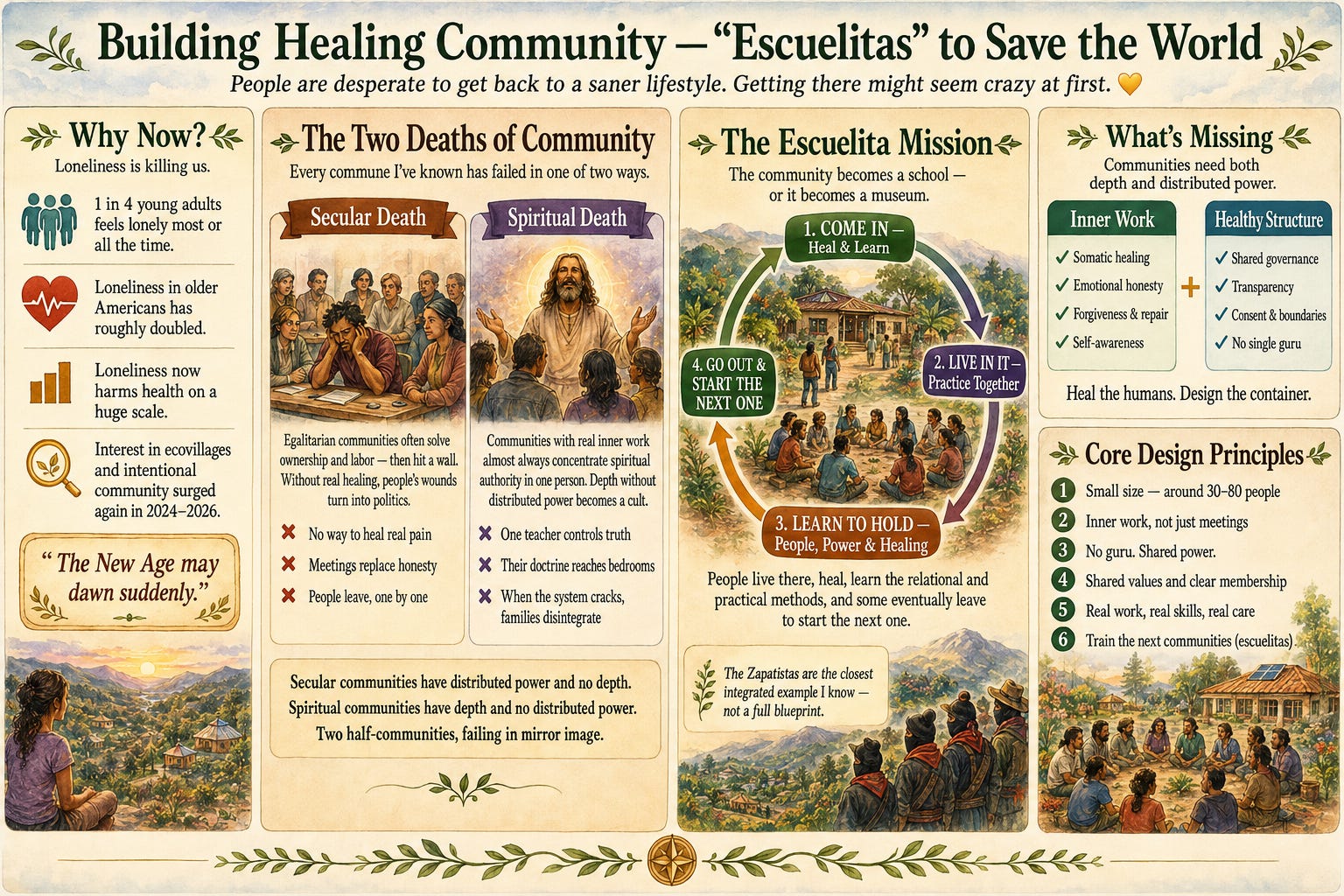
That’s where the escuelita in my title comes in. Escuelita means “little school.” I’m borrowing the word from the Zapatistas, whose Escuelita brought outsiders into their communities to learn autonomy by living it. The healing communities I’m proposing should do the same: people live there, heal, learn the relational and practical methods, and some eventually leave to start the next one. Otherwise, we’ve built a lovely refuge for whoever got there first.
That’s how I spent much of my childhood being carried through Twin Oaks, Acorn, East Wind, Padanaram, Zendik, and many other experiments. I was usually the visitor’s kid, close enough to see how people lived but never quite part of the tribe. At the time this mostly meant boredom. In retrospect, it gave me a strangely useful comparison sample.
From 1999 to 2001, my family actually lived with the Love Israel family in Washington while escaping Y2K, that brief historical period when otherwise reasonable adults prepared for civilization to be defeated by a two-digit date. We lived in a yurt. There were wild berries of every kind, and I loved being in nature. I was also lonely, bored, irritated by the cult programming, and missing my friends in Philadelphia.
I wanted to befriend the children there, but they treated me as an outsider. My mom never liked the place. The leader was also named Love Israel, and to me he seemed like the fakest person I’d ever met, complete with the expected God complex.
We spent a lot of time on our knees in the community garden growing food they could sell in town. The money was opaque and seemed to travel mostly upward toward Love. Meanwhile everybody sang, “Here in the garden, there’s nothing left to do but eat sleep and keep clean.” Again and again. 🌱
My father eventually gave the community his airplane. They sold it instead of using it. He felt tricked, began exposing what was happening, and then we were asked to leave.
East Wind felt almost like the opposite social experience. It had roughly eighty people when I visited: large enough to have real variety, small enough that friendship still felt possible. I was happy there. I also loved the mixed-sex communal showers, and I still wonder whether those survived. These are the questions history books neglect.
East Wind still had a quieter power problem. The woman directing the nut-butter factory brought in much of the community’s income, which seemed to make her unusually difficult to question. The group had a warm social life, distributed labor, and no obvious guru, but the factory’s importance still affected who could be challenged.
Acorn had something like eight people when I visited. There were no children there. I couldn’t tell whether it was a commune I might join or a group of friends who happened to own beautiful land and build lovely things together. Joining an established group of eight friends felt less like applying to a community than asking whether their group chat had an opening.
Twin Oaks was much larger—perhaps two or three hundred people at the time—and felt almost institutional. It was friendly and interesting, but I didn’t feel a tribe. It felt more like a tiny hippie town with an unusually complicated labor-credit system.
Across nearly all of these places, the same absence kept appearing: no communal therapy practice. Human pain still entered the group, of course. It simply got translated into politics.
I remember weekly meetings run under Robert’s Rules of Order, with enormous agendas, little room for what anyone actually needed to discuss, and the persistent thought, “I’d rather be sleeping.” Sometimes people solved that conflict by snoring through the meeting.
Zendik went in the other direction. They held a brutal community meeting that I’m still recovering from 35 years later. 🤣 Five-year-old me was put in the center and told I was bad because I hadn’t volunteered to help adults with whatever jobs they were doing. Apparently kindergarten had already failed to teach me labor consciousness.
The secular communities often buried hurt under procedure. The spiritual communities often put one person in charge of everybody’s inner life. Most of the rest of this article is my attempt to describe the missing third option.
The longing that shaped my father’s film is suddenly everywhere again. The U.S. Surgeon General’s 2023 advisory reported that roughly half of American adults experience loneliness and treated social connection as a public-health issue rather than a sentimental extra.
I’m less interested in declaring an official “epidemic” than in the obvious fact underneath it: a lot of people can’t tolerate isolated modern life anymore. They may disagree about politics, food, God, sex, and whether shoes are oppressive, but they agree that something about the current arrangement is starving them.
Look at Google Trends for “ecovillage” and “intentional community.” Interest had been drifting downward for years, then bent upward sharply in the mid-2020s.
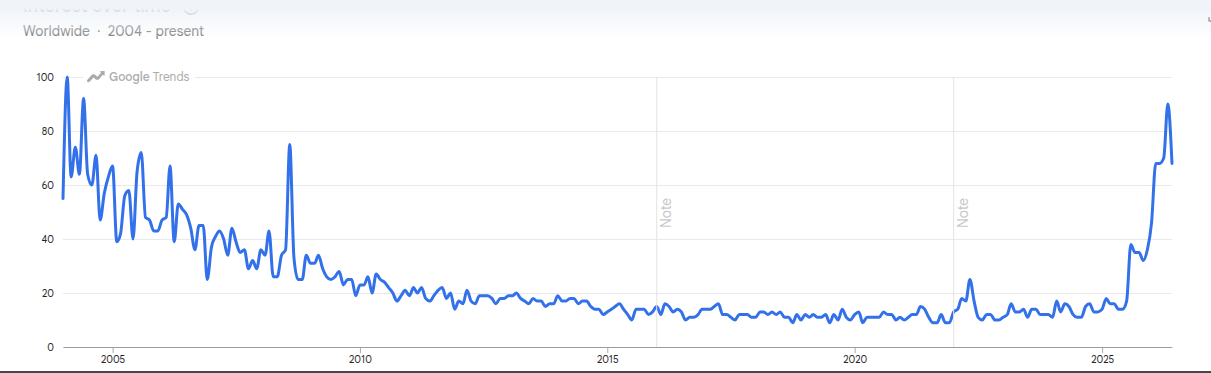
I can’t prove AI caused that turn. The timing is still hard to ignore. Around the same period, AI stopped being a tech-news curiosity and began reorganizing people’s jobs, feeds, relationships, and expectations of the future. Suddenly “maybe we should form a village” sounded less like a 1972 leftover and more like a backup plan.
It’s poppin’ on Instagram too! 🔥 Chantress Seba—my favorite light-language love influencer—posted an application for people interested in starting a commune. I applied, although I don’t think she’s coming to Africa. When I saw the post, many thousands of people appeared to be interested. Imagine opening your inbox after casually inviting a million followers to co-found a village.
Another large influencer later floated the commune idea, and the comments began turning into a recruitment board. People were finding prospective members under a post the way they might normally find a used sofa. It was chaotic, sincere, and revealing.
Not everybody in the comments was trying to join. The oldest objection arrived almost immediately: maybe most people don’t want the responsibility anarchism requires, and communal property becomes “owned by everyone, cared for by nobody.”
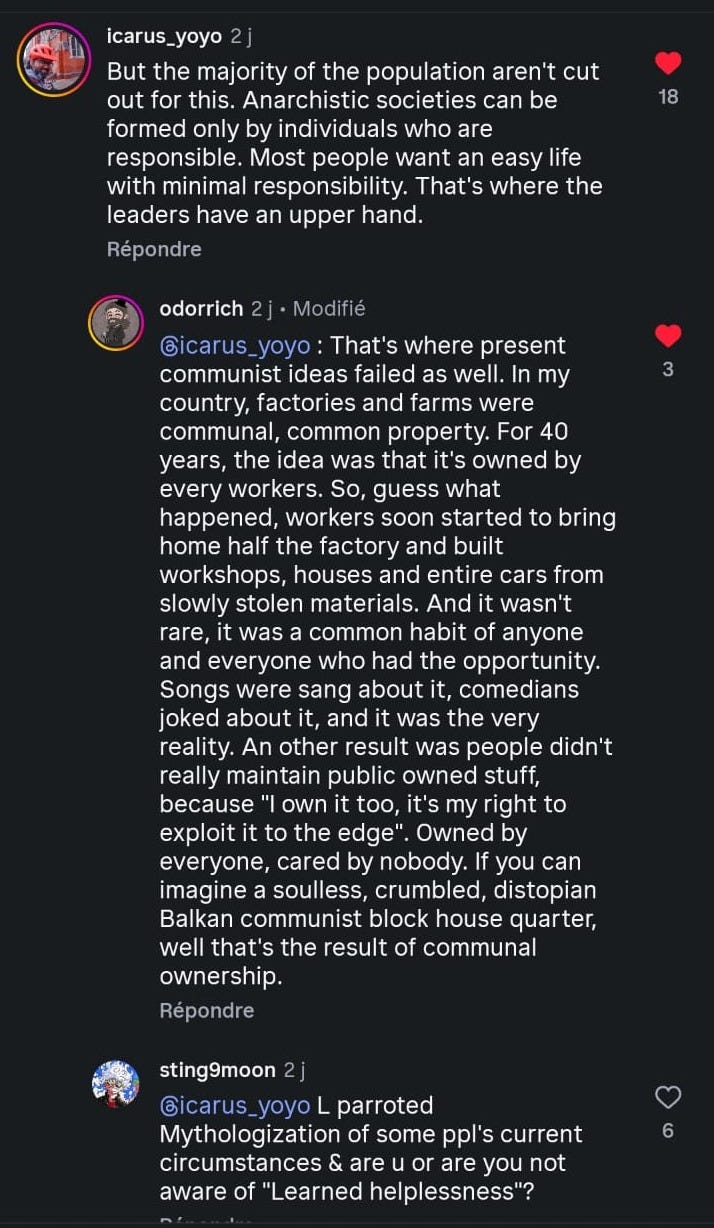
The commune comments became a miniature political-philosophy seminar, as Instagram comments sometimes do.
Although that comment applies more to large socialism experiments than small communes, that objection deserves a serious answer. Some people really would rather let somebody else take responsibility. Shared ownership can blur responsibility until the same three people maintain everything while everybody else discusses freedom. Informal leaders then gain power partly because everyone keeps handing it to them.
Communal ownership therefore needs named stewardship, visible duties, consequences for chronic freeloading, and enough relational capacity to confront the problem before resentment becomes the real government. A community cannot run on the assumption that removing bosses removes passivity, selfishness, theft, or learned helplessness.
The desire to return to a natural way of living together has outrun the knowledge. People know they’re lonely and exhausted. They usually don’t know why so many earlier communities failed, why the same conflicts keep returning, or how quickly beautiful land becomes irrelevant once money, children, jealousy, and ownership enter the picture.
I’m not currently recruiting anyone or founding a community. That makes this easier to write because I’m not trying to get you onto my land. I do plan to buy land, and people may naturally end up living around me. Every warning in this article applies to me too.
The communes I knew tended to fail inwardly in one of two directions.
This failure is caused when the community distributes ownership and labor but has no shared way to address jealousy, childhood wounds, humiliation, attraction, resentment, or grief. Those things don’t disappear. They acquire agenda items.
The Federation of Egalitarian Communities and other income-sharing groups developed sophisticated systems for labor, money, and decision-making. Yet a meeting procedure can’t make two people stop hating each other. It can only determine whose turn it is to speak about the hatred and whether the motion requires a second.
Eventually politics begins carrying emotional material that nobody knows how to name. People argue about schedules, committees, noise, food, or policy while the real subject sits nearby with its arms crossed.
This is caused when the community recognizes that inner transformation matters, then routes it through a founder, teacher, channel, or special interpreter of reality.
The Farm in Tennessee grew to around 1,500 people and held many beautiful values. Its early spiritual and social life was also deeply shaped by Stephen Gaskin. Accounts from former members describe community doctrine reaching into intimate decisions. A group can talk about universal consciousness while one man’s opinions become unusually difficult to escape.
The two failures mirror each other. Secular groups distribute power but leave the inner life largely private. Spiritual groups address the inner life but concentrate power around whoever defines the path.
The deeper failure is that authority earned in one role can be spent in every other role. A founder may be a gifted teacher. A therapist may genuinely help people. A farmer or business manager may carry much of the economy. The danger begins when the same person can define the problem, control the evidence, choose the remedy, and make disagreement or exit costly.
I want depth without a guru owning it, and distributed authority without pretending that people arrive emotionally finished. That requires practice between peers, plus enough play that the community doesn’t become a permanent repair shop.
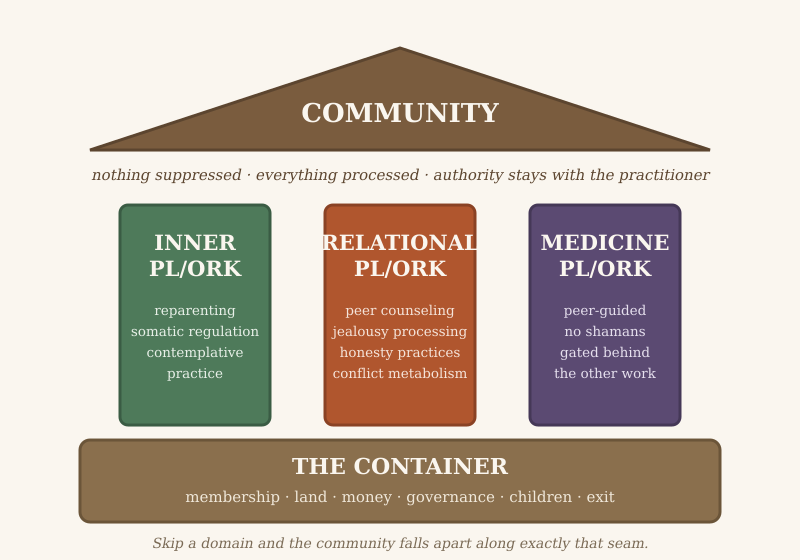
Communities tend to solve whichever part most interests the founders. The political people write bylaws. The spiritual people meditate. The therapists process. The psychedelic people discover that everyone is God and forget to decide whose name goes on the deed.
I divide the model into four parts. Yes, four sounds suspiciously tidy for something involving jealousy, children, land, money, God, and iboga. Bear with me. I’ve published detailed guides for the first three—free, with no funnel and no retreat to buy. Most of this article is about the fourth.
Food, housing, and logistics are not enough reason to bind whole lives together. Shared inner practice gives the difficulty meaning: we are not merely maintaining property together, but helping one another heal and become less governed by fear. An outward escuelita and federation purpose adds another reason to keep going—the community exists not only to protect the people already inside it, but to help other people build.
Nothing suppressed, everything processed; authority stays with the practitioner; the community provides the container; and the answers remain fluid and organic instead of freezing into doctrine.
These categories leak into one another almost immediately. Jealousy can become governance; control of shared resources can become psychology; medicine can create status; child-rearing can expose values the founders never discussed. I use the boxes to notice what a community has neglected, not because communal life stays inside boxes.
A community does need stable agreements. Nobody wants to reconsider the membership process every Tuesday because one person had a revelation during breathwork. But agreements have to remain open to lived experience.
Religious communities may call the frozen version doctrine. Secular communities often call it “the process,” which can become equally sacred—just with longer meetings and fewer robes.
Pl/ork means play + work. Calling therapy “inner work” forgets the inner child, who also wants to play.
Forgive the neologism. I hope pl/ork isn’t too corny. 🌽
Here’s an example: you teach your inner child geography, while s/he teaches you the world is a cat!

Inner-child reparenting means identifying as the inner adult—or the three inner adults: Nurturer, Protector, and Guru/Leader—and caring for the inner child from there. The adult reparents. The child receives love, protection, guidance, and enough freedom to remain alive inside you.
Then there’s somatic regulation, because the mind can make a magnificent decision while the nervous system quietly files an appeal.
My contemplative practice is grounded in the early Buddhist suttas, taken critically. Most are treasure. Some seem like late additions. I consider the Abhidhamma a scholastic wrong turn. A living community should relate to its own teachings the same way: devoted enough to practice them and secure enough to disagree.
Hearthwork distributes counseling among peers: equal time, attention without interpretation or fixing, and then you switch.
The community’s capacity to help people therefore lives throughout the group instead of inside one professional, guru, or emotionally indispensable founder.
But care is not jurisdiction. The person listening to me should not automatically gain power over my membership, work, housing, children, medicine, or the evidence in a dispute about them. Peer care becomes another hierarchy the moment emotional access turns into administrative authority.
Some things also remain outside peer competence. Knowing when to refer to outside or expert assistance is important.
Jealousy and conflict should be addressed while they still belong to the people involved—before they acquire minutes, procedural objections, and a place near the bottom of an agenda nobody will finish.
My Romance Guide covers the dyads that will form whether the founding document acknowledges romance or pretends everybody has transcended it.
Careful, peer-guided use of serious plant medicines, with no special shaman placed above everybody else.
Peer-led doesn’t mean casual. Screening, sober sitters, emergency plans, integration, and clear boundaries all have to exist before the first ceremony. Figuring out the rules while several members are altered would be a very pure form of collective learning, but I don’t recommend it.
Membership, land, shared resources, governance, children, and exit.
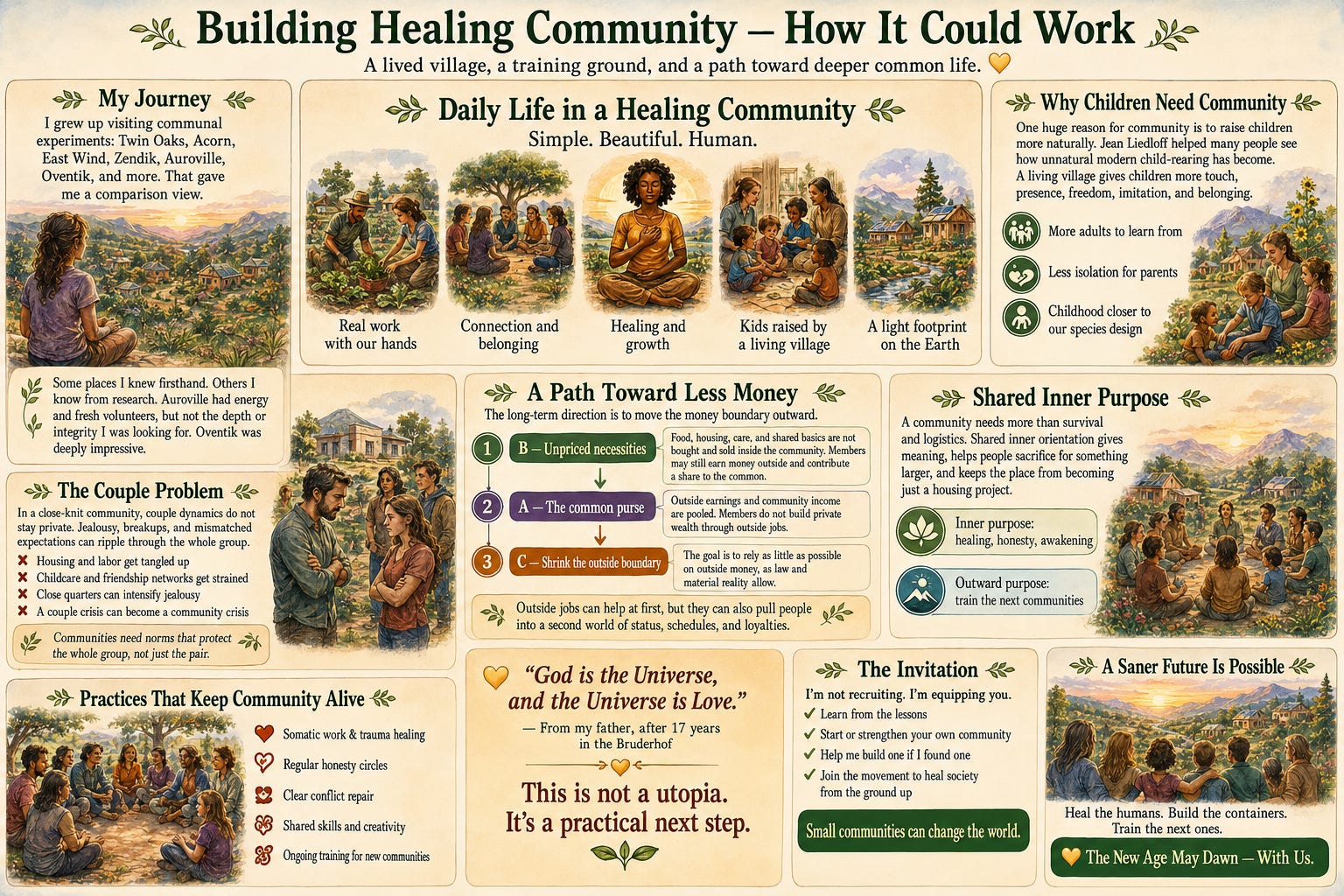
My own long-term direction is toward communities that use less and less money. I think the path has three stages.
First, basic life inside the community—food, housing, care, tools, education, and ordinary transport—is not bought from one another. Members may still keep income from outside work, but anyone earning outside contributes an agreed share to the common. This is probably the realistic starting point.
Later, outside wages and income from community businesses go into a common purse. Members do not accumulate private wealth while they belong. The Bruderhof has lived a version of this for generations; my father spent seventeen years inside it. Twin Oaks and other income-sharing communities have built related versions. A common purse is not an untested theory.
The furthest goal is for the community to stop using money outside too, meeting needs directly and exchanging through goods, gifts, shared work, or reciprocal obligation. I did not find a well-documented modern community that has fully reached that point. Governments may make it literally impossible through land taxes and other required payments. The practical endpoint may therefore be a nearly moneyless community with one small collective cash boundary.
None of this removes scarcity or economic power. Food stores, housing, tools, land, medicine, transport, and access to whatever outside currency the group still needs can all be controlled. A money-free community still has to answer who allocates scarce things, what obligations people have to one another, and what happens when somebody leaves.
These subjects receive less spiritual enthusiasm because nobody has ever returned from an ecstatic vision announcing that the group needs a better provisional-membership policy. Unfortunately, the vision can’t determine a departing member’s share, prevent one founder from controlling the land, or decide what happens when a child reports something serious.
Beautiful land can’t compensate for ownership that gives one person the final say. Peer counseling can’t rescue a membership process that admits people faster than the group can support them. Medicine can’t repair an exit agreement that was never written.
The first three parts shape the community’s inner life. The container gives that work a stable place to happen.
Skip one, and the group eventually has to deal with it under pressure—usually after land, labor, or shared resources are already entangled and everyone has developed opinions.
Psychedelics have moved from taboo toward regulated use much faster than most community literature has acknowledged. Oregon’s licensed psilocybin service centers began opening in 2023. Colorado created a regulated natural-medicine system and began licensing in 2025. New Mexico enacted a Medical Psilocybin Act in 2025. In Australia, authorized psychiatrists have had limited access to psilocybin and MDMA for specified conditions since 2023.
The movement is neither smooth nor inevitable. In 2024, the U.S. Food and Drug Administration issued a Complete Response Letter declining to approve the submitted MDMA-assisted therapy application and asking for further evidence. Portugal is often described lazily as having “legalized everything”; it actually decriminalized possession of small amounts for personal use while trafficking remains criminal.
Communities therefore face real legal differences by country, state, substance, religious status, and activity. Anyone building around medicine needs actual local legal advice, not a friend who once read a thread.
Most intentional communities that use psychedelics still avoid saying so publicly. Even where the law permits some use, parents may worry about children, neighbors may imagine chaos, insurers may disappear, and a local official may understand none of the distinctions.
I’m discussing it because leaving medicine out would falsify my model. Many readers already know my psychedelic writing, including my loveyhuasca/Haoma material. The honest version of this article has to address both the value and the risk.
The case against building medicine into community is serious. The Global Ayahuasca Survey found physical and mental adverse effects were common, although severe outcomes were much less common and context mattered. These medicines can open material faster than a person or group can support it.
They also attract people who love revelation and hate follow-through. A person can collect twelve ceremonies, six origin stories, and a new sacred name while remaining unable to apologize to a housemate. Any community organized mainly around the peak experience will eventually discover that insight does not wash dishes, revise agreements, or calm a frightened child.
The case for communal use is also real in my experience. Psychedelics can loosen defenses that otherwise dominate every serious conversation. They can create powerful bonds when people sit through difficult nights together. They can also produce confusion, grandiosity, dependency, and interpersonal mess. The question is whether the surrounding community has enough maturity to tell those apart.
Insights need somewhere to land. You see your life with startling clarity one night and return to the same environment, where nobody knows what happened and every old cue is waiting. In community, the people who held you through the experience can also notice what happens during the following months.
Depth can increase alienation. After my original ayahuasca ego deaths at 26, I had trouble finding anyone in the physical world who seemed to have experienced anything similar. I couldn’t even find them at Buddhist monasteries despite all the preaching about enlightenment. That helped produce a God complex, a Savior complex, or both—and then attracted exactly the right people to demonstrate my limits. 😂
Trusted support is different from purchased support. The commercial alternative is often paying strangers for one night of care. Sometimes those strangers are excellent. Sometimes the person with the feather has known you for four hours and already has a cosmology for everything you say.
In community, a sober sitter may be somebody who has known you for years. Being watched and being held feel different. This matters especially with long, medically risky experiences such as iboga, where screening and continuous observation are essential.
Peers can also reality-check the downloads. Psychedelics produce genuine insight and convincing nonsense with identical lighting. Friends who know your history may notice which parts resemble a new understanding and which parts resemble your mother.
Community creates rhythm. Many traditional medicine systems place ceremonies inside communal timing rather than individual appetite. A shared calendar can reduce compulsive repetition and give integration time to happen.
The logistics become easier. Trusted childcare can be arranged collectively. People don’t need to drive away from the ceremony. Somebody can bring water, stay nearby, or sit quietly while a person returns to ordinary consciousness.
There are people to play with. Raves often create sudden intimacy among strangers before trust exists. In community, ecstatic music and movement can happen among people who already know one another’s names, histories, and inconvenient habits. 💃🕺
I won’t idealize psychedelics. Some people should avoid them, some communities shouldn’t use them, and enthusiasm will create casualties wherever competence lags behind access. A community choosing this path needs enough humility to say no, pause, refer out, and admit when an experience caused harm.
No special shamans. Traditional lineages usually disagree with me here. Many ayahuasca and Bwiti communities believe medicine should remain under trained lineage authority. I respect what those traditions have preserved and have learned from them.
My objection is to placing one charismatic person above everyone else’s direct experience. A retreat-circuit facilitator may be wise, or may be unvetted, unaccountable, sexually predatory, financially dependent on repeat customers, or simply wrong. Deep openness magnifies the cost of that uncertainty.
I don’t yet know how a peer-led medicine culture prevents an informal shaman from emerging anyway—the person everybody consults, trusts, and gradually stops questioning even though nobody gave them the title. Rotating roles and public accountability may help. I don’t think either solves it completely.
I want people to learn self-guidance and reciprocal care while respecting the limits of their competence. I’ve written more about peer-held ceremonies and about the best psychopath shaman I ever met.
Peer-led never means casual. Screen for medical and psychiatric contraindications. Review medications and combinations. Keep an appropriate sober sitter. Decide what requires professional or emergency care before anybody takes anything. Distributed authority raises the competence requirement; it doesn’t lower it.
I’m especially cautious about medicines and protocols I consider more destabilizing or medically burdensome, including some uses of ketamine and MDMA and bufo. Those judgments are explained in the linked articles rather than smuggled into one sentence here.
The medicine stays behind the other pl/ork. Reparenting, somatic capacity, and peer counseling come first. Medicine can deepen a practice that exists. It cannot create months of honest relationship by pharmacological decree.
This prerequisite also filters out experience collectors. Somebody unwilling to spend six months learning to listen without fixing is unlikely to become more relationally mature because the visions were especially geometric.
Integration is ordinary life. Ceremony opens something. The following weeks reveal whether anything changed—in relationships, daily behavior, sleep, decisions, and the person’s ability to tolerate frustration without declaring a new spiritual emergency.
Supports matter. Preparation, nutrition, interaction screening, dose discipline, and emergency planning matter more than aesthetic ceremony details. I keep my current safety material in Altered States Triage.
Legality needs a written answer. The law varies widely and sometimes ambiguously. A community should document what activities are allowed, prohibited, private, insured, or legally reviewed. “Nobody around here has heard of it” is information, not a legal opinion.

Many people come out of deep psychedelic or mystical experience with the same urge: find the tribe, build the village, and help other people reach whatever just opened.
I know that call. I also know the inflation that can ride beside it. You return believing love can heal anyone. Then you meet people who don’t want to change, people who sincerely want to change but keep choosing the opposite, and people whose crisis exceeds anything your enthusiasm can hold.
The call may be real. Omnipotence is a terrible founding document.
A group formed during collective spiritual euphoria can recruit too quickly, promise too much, and discover arithmetic only after several people are already dependent on it. The capacity and membership sections later in this article exist partly to protect the original generosity from that first rush.
Once the call sobers up, it can become useful. A community can serve as a training ground where people learn the practices, care for one another, and sometimes leave to begin another experiment. That answers the reasonable objection that communes are merely privileged escape pods.
Loneliness is only one reason this feels urgent. I wrote separately about the wider polycrisis:
I don’t know exactly how much of the future fear is accurate. AI may improve life enormously, destroy millions of jobs, become the administrative layer between us and nearly everything, or do all three before Chantress Seba gets through her commune applications.
I’d rather build more human independence than wait for certainty. I’d rather have community and discover I didn’t need an exit than need an exit after spending ten years optimizing my feed.
The useful design question is: which connections to the technosphere do you keep, and which do you limit?
Medical care, banking, phones, vehicles, schools, supply chains, government identification, internet access, and energy are separate decisions. Full rejection can create needless suffering. Full dependence means the outside system can reach directly into every essential function.
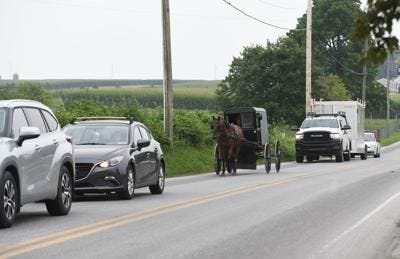
The Amish have spent generations evaluating technologies according to their effects on community life. Different groups reach different answers. A tool may be accepted at work and restricted at home, shared rather than individually owned, or delayed until its social effect becomes clearer. Whatever else you think of the Amish, they at least understand that adoption is a communal decision rather than an automatic software update.
Medicine is one of the hardest couplings. A community may prefer natural care and still need trauma surgery, antibiotics, dentistry, emergency obstetrics, or a specialist. It should decide in advance how members access care, what the community guarantees from common resources, what may require outside money or insurance, and how to treat somebody who chooses a different level of medical involvement.
No member should have to prove ideological loyalty while frightened or sick. A catastrophic-illness agreement should protect choice, access to common resources or outside funds when needed, transportation, privacy, and the possibility that the community’s preferred approach won’t be enough.
At the same time, social connection itself has measurable health value. The Surgeon General’s advisory links isolation with higher risks across several outcomes. Community won’t cure every illness. It can change the daily conditions under which people become ill, recover, age, and die.
Any community that lasts will be reorganized by attraction and pair-bonding. In a city, two exes can move across town. In a thirty-person commune, they may still share a kitchen, work team, meeting, childcare, and friends the next morning. A couple’s jealousy or breakup becomes the community’s problem because it changes loyalties, sleeping arrangements, labor, children, alliances, and sometimes who leaves.
The usual argument—monogamy versus free love—starts one level too late. My Romance Guide gives the longer version. Here I’ll state the community problem plainly: close quarters magnify jealousy, and jealousy can capture either system.
Rigid monogamy can turn fear and possession into moral law. Free love without inner pl/ork can distribute the same fear across a larger spreadsheet. A relationship label doesn’t release childhood panic, comparison, abandonment terror, or the wish to control another person.
I don’t think a community should choose the form for everyone. Couples and other relationship configurations can make different agreements, revise them, and ask for support when those agreements expose old material.
Whatever forms people choose, housing, children’s security, membership, and access to common necessities should not depend on remaining inside one romantic agreement.
ZEGG and Tamera have spent decades experimenting with relationships inside community. Their answers aren’t commandments for everybody, but they demonstrate that a group can acknowledge erotic life rather than pretending twenty adults have become neutral colleagues because the bylaws say so.
The non-negotiable for me is that jealousy cannot become the hidden governor. It has to be speakable, felt in the body, explored without humiliation, and gradually released rather than converted into punishment or policy.
The group can offer support and enforce basic boundaries without choosing everyone’s relationship structure. People will still disagree, which is more realistic than declaring the matter solved.
My own childhood broke many mainstream rules about what children should see and do. I won’t unpack all of it here. I’m grateful that my mother nursed me until I was five, grateful my parents didn’t vaccinate me, and grateful for nearly all of the unusual world they gave me.

The vaccination point belongs here. It is one of the values that would determine whether I could raise children inside a community at all. I’m not trying to design a village for everyone; communities need enough agreement on children’s health that parents can actually trust one another.
The grown child’s review matters more than founders usually want it to. Adults can describe their intentions forever. The person who lived through the system may eventually describe something else.
I actually learned how to parent my son from his future review via his quantum jumping time machine, which he explained in this video:
A friend who reviewed this draft grew up in a Christian commune in Colorado where her father was a pastor. She calls her childhood “a treasure and a burden”: the treasure of belonging and having everybody care for everybody; the burden of a strict religious life she never chose.
That sentence is more useful than another promotional video of smiling children carrying vegetables.
My position is that mothers raise their own children inside a community where care is genuinely shared. The village can carry meals, supervision, teaching, protection, play, and much of fathering. It should never take a child away from the mother in the name of liberating her.
Jean Liedloff’s The Continuum Concept is one of the biggest reasons I think community matters for children. Her Ye’kuana account is one outsider’s interpretation and may idealize what she saw, but the picture remains powerful: babies carried inside ordinary adult life, children surrounded by several ages, learning through participation, and one exhausted parent not expected to become the child’s whole social world. A nuclear household can imitate pieces of this. A real village can make it normal.
Experiments with children sleeping and living separately from parents deserve special caution. Research on Israeli kibbutzim found that communal sleeping eventually ended through a mixture of developmental findings, parental preferences, and social change. High-quality group care and multiple loving adults can benefit children; replacing secure parental attachment is a different proposition.
Tamera’s Children’s Place deserves direct study rather than caricature. My own bias remains with systems that expand a child’s circle without making the parent-child bond ideologically inconvenient.
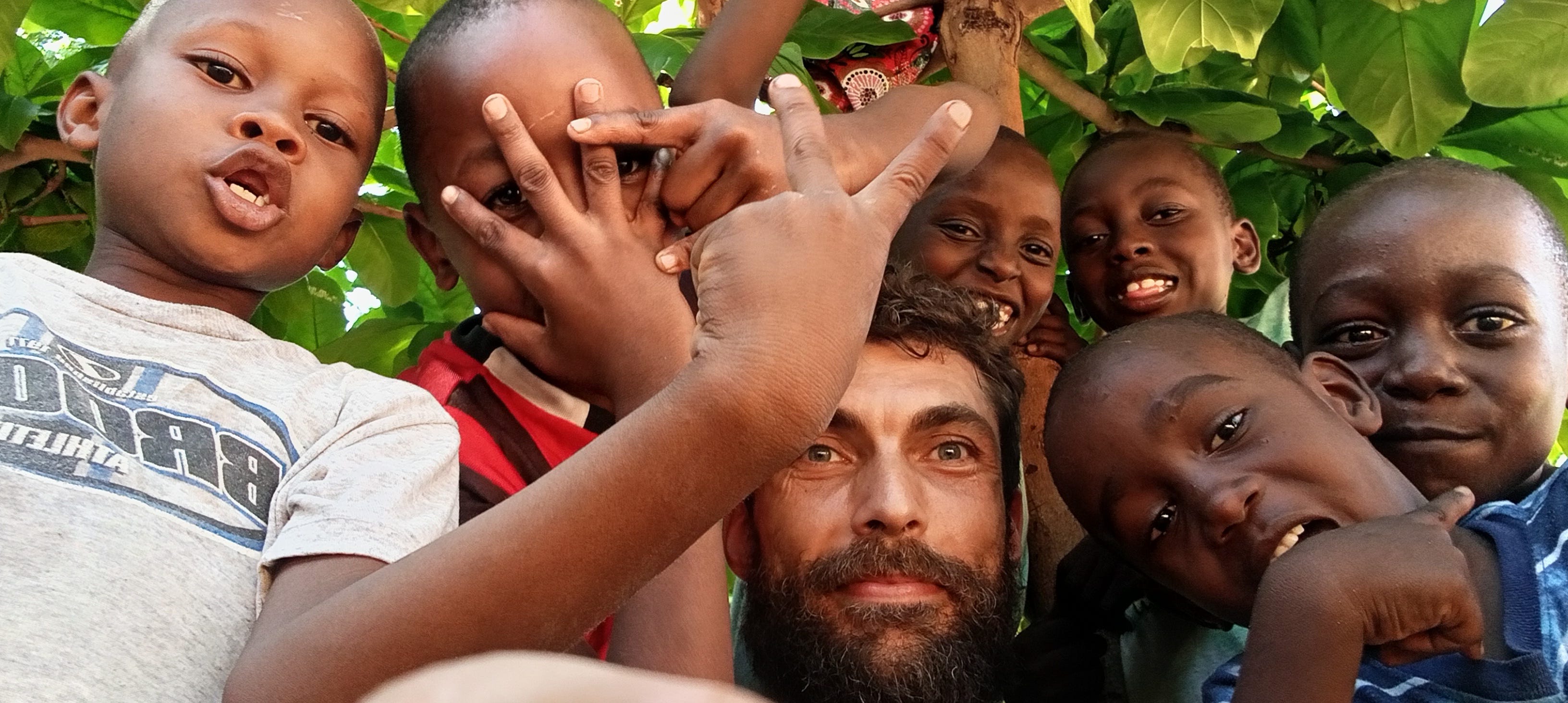
Children also need territory that belongs to them—places where they can develop a society of children, create games, resolve ordinary disputes, and experience some freedom from constant adult management.
I tasted that at a Unitarian youth camp, and it remains one of the freest memories I have. ZEGG’s Kinderhaus works from a similar intuition. Adults hold the outer safety. Children still get a world.
This can be badly misunderstood, so the safeguards need to be explicit. A children’s territory cannot become a place where adults stop paying attention, where older children quietly dominate younger ones, or where secrecy is treated as independence.
I also reject the suburban panic that treats every warm relationship between an unrelated adult and child as suspicious. Children benefit from many adults who know them, enjoy them, notice changes, and will act when something is wrong. Fear can destroy that gift without actually preventing abuse.
The protection has several parts:
Give children real agency. Their “no” matters. Adults aren’t entitled to affection, physical contact, obedience outside legitimate safety needs, or private access.
Create a no-secrets rule. No adult asks a child to hide a gift, game, touch, conversation, or relationship from the child’s mother or another trusted adult. Surprises have an ending date. Secrets designed to isolate the child are forbidden.
Teach truthfulness before a crisis. Children should understand that their words carry power and that adults will listen seriously. This education must never become interrogation, punishment for uncertainty, or a reason to dismiss a report. A frightened or confused child may tell a story imperfectly and still need protection.
Hear the child even when the accused person is beloved. Communities fail here because the adult may be charismatic, useful, wealthy, spiritually important, or everybody’s friend. Decide the response process before anyone’s face is attached to it. Immediate safety comes first; investigation must be competent and fair; nobody’s status buys silence.
Keep relationships and a reporting route outside the community. Grandparents, cousins, local friends, teachers, and other trusted adults give children perspective and somewhere to speak. At least one trusted adult, advocate, or reporting route should be reachable without going through community leadership. In 1984, Vermont authorities seized 112 children during the Island Pond raid, and the court returned them after rejecting the state’s blanket request. State intervention can fail spectacularly. Total community enclosure can also fail. Children need more than one world.
I also searched the research corpus for a well-documented intentional-community case in which a child remained seriously dangerous to other people and the record followed the whole sequence: conduct, assessment, intervention, review, and what happened later. I did not find one. That may be because records are private or cases were routed elsewhere, but it means I cannot claim communities already know how to handle the hardest version internally. The child, the family, and the people at risk all need access to competent help and review that the home community does not control.
Amish youth make an adult choice about whether to join the church, and roughly 85 percent or more eventually do. The popular caricature of Rumspringa as a universal teenage free-for-all is exaggerated, but adult baptism still matters: belonging becomes a commitment rather than a fact imposed at birth.
A community whose children never leave cannot know whether they would freely return. Let them study, travel, make friends, encounter other ways of life, and disagree with the founders without being treated as traitors.
Every childhood narrows the future. Most ordinary families do not hand an eighteen-year-old a pile of money to go explore the world; they try to prepare them for some viable next step. A poor or money-free community may have even less cash to offer, and food, medical care, and basic survival may rightly come first.
The realistic standard is not unlimited freedom. It is that leaving should not be made artificially impossible. If children grow up without using money, they especially need enough knowledge of the outside money world not to be helpless in it: jobs, rent, contracts, banking, scams, identification, transportation, and how to ask for help. They need portable skills and education, relationships beyond the community, access to their records and documents, and at least one plausible next path—school, apprenticeship, work, family, or another community. If the community can offer temporary housing, travel help, tools, or a small transition reserve, great. If it cannot, it can still avoid punishing departure or withholding the knowledge and records a young adult needs to function elsewhere. No upbringing offers perfect freedom. The point is not to erase path dependence; it is not to turn belonging into a trap.
Some may leave permanently; others may start communities with different values rather than waiting decades to inherit the original version. Parents may experience that as loss even when the movement is evolving.
Couples who share a home, culture, and bed still split over screens, vaccines, schooling, religion, food, discipline, and medical care. Multiply that by twenty adults with twenty childhoods.
Goodwill doesn’t answer those questions after a child is already living inside the disagreement. Communities need enough shared child-rearing principles to offer coherence, plus enough room for parents to remain parents.

In 2005, a few college friends and I visited Oventik, one of the Zapatista caracoles in Chiapas. We nearly died several times getting there. The mountain road wrapped around cliffs, and our rental car was barely functioning—a nice combination when you’re trying to visit a revolution.
In San Cristóbal de las Casas, the only white man we met sat us down in a café and questioned us so directly that he appeared to be a CIA agent. Why were we there? Who did we work with? What were our plans? When were we leaving?
It made us feel briefly important. We were college kids in a dying rental car, but apparently the empire had questions. 😂
Oventik itself felt like a real dream. We played basketball with Zapatista youth on an outdoor court. People gave us talks about their history and philosophy, and I translated for my friends because my Spanish was better. Visitors from around the world were coming to learn and to make the communities less easy to attack in silence.
The Zapatistas felt deeply spiritual to me. I also suspect there may be a private relationship with ayahuasca, but nobody told me that, and I present it only as my impression—not as fact.
What impressed me most was their form of authority: mandar obedeciendo, leading by obeying. Representatives carry assembly decisions and remain answerable to the people who gave the mandate.
The Zapatistas are also the closest whole example I found because autonomy there is not merely a voting method. They have built their own education, health, justice, collective production, political formation, and ways of teaching outsiders, while coordinating beyond a single village.
The Fire and the Word describes the movement growing from family to village, village to region, and region to larger structures. It also gives one of the most useful Zapatista principles for community design: build the practice first and develop the theory afterward. The autonomous municipalities came first; an association of them became a rehearsal for the Good Government Boards. When different municipalities encountered different problems and uneven progress, that experience generated another structure rather than being forced to fit the original plan.
In 2023, the Zapatistas announced that they were dissolving the Rebel Zapatista Autonomous Municipalities and Good Government Juntas after a long internal review. Their new arrangement moved authority toward Local Autonomous Governments in each community. Those local bodies can coordinate through regional collectives, but the coordinating levels are explicitly described as dependent on the communities rather than superior to them.
Most institutions accumulate layers and offices as they age. The Zapatistas reviewed theirs and pushed authority downward. They did not issue a leadership book and open a certification program. They changed the system they were actually living in.
This is also where I need to restrain my enthusiasm. Zapatista autonomy grew from Indigenous communities with long histories, shared land struggles, language, kinship, and decades of collective defense. A new ecovillage cannot copy the visible diagram and instantly acquire the trust beneath it.
The Zapatistas themselves have warned people not to import or export Zapatismo as a ready-made model. The useful thing is not their diagram. It is how they learn: build, ask, discover where practice fails, and change the structure.
They are also not proof of my complete economic path from unpriced internal necessities, to a common purse, to eliminating outside money. Zapatista communities use collective work to support schools, clinics, autonomous government, and resistance; they also sell products, trade, and receive outside support. What they demonstrate is that major necessities and public functions can be taken out of ordinary market purchase and governed collectively. Outside help can build capability, but it can also create gatekeepers and uneven dependence when the specialist, donor, or organization remains indispensable.
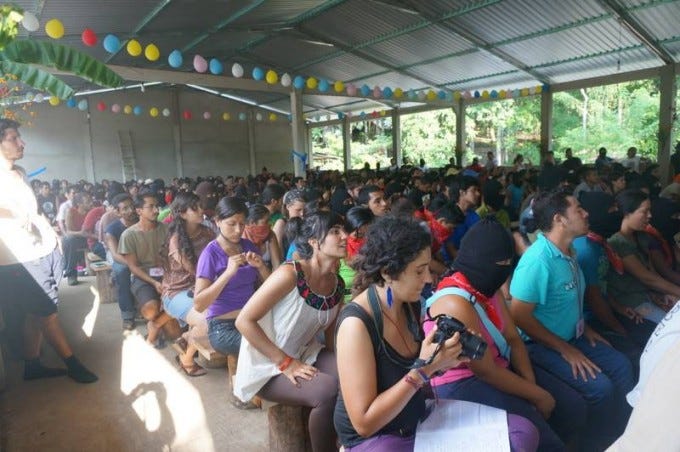
For the tenth anniversary of their autonomous governments, the Zapatistas opened the Escuelita. Outsiders lived with families and learned autonomy by participating in ordinary life. The first sessions brought around 1,500 students, with later sessions bringing thousands more.
An escuelita can fail by becoming a visitor business. Residents spend their lives performing community for paying outsiders, and guest numbers replace daughter communities as the success metric. The point is not to make people feel transformed for a week. It is to teach enough of the social and material system that some can build elsewhere.
In my research, I also tried to trace what happened after the Escuelita. I found alumni networks, people carrying practices home, and later organizing. What I did not find was a clean chain from an Escuelita student to a newly founded communal institution and then evidence about how that institution’s members and children actually did over time. Zapatista influence was already traveling internationally before the Escuelita, so later resemblance alone doesn’t prove descent. I’m borrowing a pedagogy and a replication ambition, not claiming the Zapatistas already proved my whole model.
Sociocracy reaches some similar forms from a very different history: circles, consent, distributed authority, and links between levels. The resemblance doesn’t prove a universal formula. It gives builders another serious system to study instead of inventing governance during their first dispute.
Experimenting with a different rule does not have to mean everybody buys new land immediately. Try the different rule inside the parent group; then as a semi-autonomous project; then, if it needs more independence, as a nearby seed that still shares selected tools, childcare, business, or friendships. Full fission should be one step on a gradient, not the admission price for experimentation.
Some experiments cannot be tested cheaply. A different land system, population scale, or package of mutually supporting rules may look bad when starved of the assets it actually needs. “We tried it in one room for three months” is not always a fair test.
If these communities are supposed to spread, eventually somebody has to solve the boring problem of how they remain connected without building another state. I don’t want one super-commune with a nicer logo. I want communities that can help one another, move people and knowledge around, and still remain different enough to learn from one another.
At federation scale, that outward purpose becomes concrete: spread healing practices, train people, seed new projects, and keep any one comfortable enclave from mistaking itself for the whole movement.
The Federation of Egalitarian Communities says it is currently rebuilding, which is a useful warning. Federation work is work: delegates, records, compliance, resource coordination, meetings, succession, and any dispute function it actually accepts all consume labor and material capacity before local crises have eaten both. Where the surrounding legal or economic system requires money, the federation also needs an external cash budget. But that work does not all need to live in one body. Bilateral friendships, local clusters, and function-specific institutions can coexist with a general federation. The FEC’s PEACH health pool, for example, is currently governed independently from FEC delegates.
Cooperation also shouldn’t quietly become assimilation. The FEC currently distinguishes full members, communities moving toward membership, and Friends that may simply remain friends. People need a similarly practical freedom between communities. If someone can theoretically move but housing, status, health coverage, records, labor accounting, travel costs, taxes, and transition disputes fall into cracks, the freedom is decorative. Often the answer is not harmonizing every internal system; it’s a thin interface that says who is responsible for what while somebody crosses between them.
Exchange and obligations need the same honesty even if nobody uses money internally. A gift of food, pooled medicine, a loan of a vehicle or tool, reciprocal labor, emergency housing, a shared building project, and a visit meant mainly for training or relationship-building are different events. Some create a future obligation; some do not. A federation can keep purpose-specific records without pricing everything or forcing every transfer into parity. If cash is used at the outside interface, grants, loans, guarantees, and shared-enterprise commitments need the same separation. Solidarity is not unlimited joint liability—or an unlimited claim on another community’s labor, stores, land, or tools.
And when two principles collide, don’t preserve only the final rule. Keep the hard case: what happened, which principles actually conflicted, the first judgments, final reasoning, dissent, consequences, and the exact rule version. When the rule changes, rerun the case. Otherwise each generation gets to rediscover the same constitutional fight from scratch.
Every community begins with somebody’s initiative. A person finds the land, writes the first documents, teaches the method, attracts the first members, or keeps the whole thing alive when everybody else loses interest.
That contribution creates real influence. Pretending it doesn’t exist only makes the influence harder to examine.
I know the tension personally because many methods in this article are mine. I wrote the materials. That means I can easily become the person who decides whether everyone else “understood” them correctly. Anti-authoritarian language does not immunize an author against enjoying authorship.
A few things help. Judge the method by outcomes people can observe: are members flourishing and safe; can conflicts be resolved; can people disagree, leave, and later tell a different story; are children doing well when they grow up; does the community remain materially viable; can it correct a bad prediction; can it replace the founder; and, if it is meant to spread, do later projects actually emerge and last? Longevity, occupancy, consensus, and member retention are not enough by themselves. A group can have high retention because people love it—or because leaving costs too much. Do not judge the method by fidelity to the founder’s preferred interpretation.
Allow parallel implementations. Fork the method. A community that changes Hearthwork and gets better results has taught me something. If every adaptation still needs the founder’s approval, the parallel versions aren’t really parallel.
Here are the four questions:
Can the community respectfully override the founder?
Can it replace the founder’s role?
Can it revise the founder’s vision?
Can it survive the founder’s absence?
Then follow the boring power. Whose name is on the deed? Who controls housing, food stores, vehicles, tools, and any outside bank account? Who keeps the records, sets admissions, chooses reviewers, decides access to children or medicine, and can make a complaint disappear? The org chart can say “horizontal” while the keys, passwords, titles, and reputation all point to one person.
An override is real only if it can operate against the person being challenged. If the founder chooses the reviewer, holds the records, owns the land, and can remove the complainant, the community cannot meaningfully override the founder no matter how many circles it holds.
Ask these about any community, teacher, or method. Ask them about me if people end up living on land I buy.
Also watch the daily signs: the founder becomes more central over time; disagreement is treated as failure; every bad result is blamed on poor implementation; insider knowledge grows while public accountability shrinks; outcomes are never measured; former members become morally contaminated the moment they leave.
None of these proves abuse by itself. Several together deserve attention before the founder explains why this situation is spiritually unique.
Every practice in this article can be turned against the people using it.
“Nothing suppressed, everything processed” can become compulsory disclosure. I’ve seen the risk in communities using ZEGG Forum. A group begins by inviting honesty and ends by treating privacy as resistance.
Peer counseling can become surveillance delivered in a warm tone. Medicine prerequisites can create gatekeepers with power over people at their most open. “Willing to be seen” can become a demand that everybody reveal whatever the group wants to know.
The boundary is simple: the principles are commitments I choose for my own practice, never powers the community gains over me.
“Nothing suppressed” describes my relationship with my material. It does not authorize anyone to extract that material. Members can decline to share without producing a therapeutic explanation for the refusal.
Medicine is optional. Abstaining cannot reduce membership rights. No individual or permanent clique controls admission. Disagreement has to be answered as disagreement.
“Your resistance is your wound talking” is one of the most efficient sentences ever invented for avoiding an argument. When a community begins diagnosing dissent instead of responding to it, leave before they schedule a group process about your leaving.
There is also a floor the majority cannot vote away: bodily safety, enough food and sleep, independent medical care, private thought, contact with people outside the community, a way to report harm without asking the accused person’s friends for permission, and a usable way to leave. A majority vote does not make deprivation consensual.
This article asks people to discuss jealousy, God, death, childhood, money, sex, psychedelics, and what happens when somebody wants to leave. Many perfectly intelligent adults would rather discuss solar panels for six hours.
I understand why. Modern life trains us to perform competence while hiding whatever might complicate the performance. Screens let us disappear from discomfort instantly. Institutions reward narrow skills and then act surprised when nobody can sit through a conflict without appointing a subcommittee or blocking somebody.
So the question isn’t whether a person is “good enough” for community. The practical question is how much attention they currently have available for other people, how willing they are to examine their own reactions, and whether the group has enough capacity to support them without being consumed.
Some people have years of contemplative or therapeutic practice. Some got unusually lucky in childhood. Some are actively surviving an emergency and need care more than responsibility. Most of us move between those positions over a lifetime.
In this model, the community shares some functions that modern society assigns to therapists. Peer counseling distributes the capacity to listen, accompany, and help people process ordinary emotional material.
That does not make the community infinitely absorbent.
I borrow the phrase free resource from Re-evaluation Counseling. It means the attention, steadiness, skill, and practical capacity a person has available after dealing with enough of their own immediate material. Need is what currently requires support.
Everyone carries both, and the ratio changes.
My own need has exceeded my free resource at many points. Good Lord. During one stretch, my first wife tried to kill me while psychotic because she believed I was her sociopathic father. Then she took my son. Later she tried to kill my mother, while her pimp stalked my sister’s family until they moved to Canada.
I could continue, but the arithmetic is already visible. I had very little left for anybody else. When I say a person may need to stabilize and do inner pl/ork before helping found a community, I’m not speaking from a mountaintop.
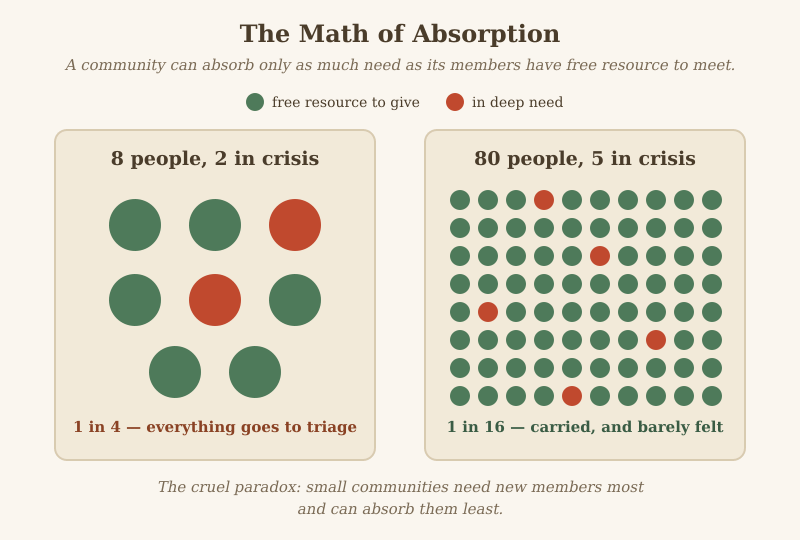
A group can absorb only as much need as its members have free resource to meet. Eight people with two in sustained crisis may spend most of their attention on emergency care. Eighty people can often distribute the same need across many relationships and practical roles.
The ability to welcome somebody is therefore partly a resource question rather than a measure of compassion. Saying yes beyond capacity can injure the existing members and the person who was promised support.
The difficult paradox is that small communities need members most and can absorb disruption least. Eight people still need food grown, equipment repaired, accounts kept, children cared for, and the water system working. The well does not become more understanding because the new member has a beautiful heart.
So early members usually need more available resource than acute need, plus practical skills and a willingness to learn.
I still don’t know how to keep this language of capacity from becoming a respectable way to exclude people who are disabled, poor, less articulate, unfamiliar with therapeutic language, or simply inconvenient. Pretending capacity is unlimited won’t solve that. Any real process would need concrete criteria, outside review, and a way to revisit a “not now” decision. Even then, the power remains dangerous.
This community may not be right for you right now if:
You are fleeing an active crisis and mainly need safety, treatment, housing, or legal help. A founding group should not pretend it can replace those.
You want the feeling of village life without responsibility for governance, maintenance, conflict, and care.
You are unwilling to examine your behavior when jealousy or conflict appears.
Your current need greatly exceeds your available resource. That says nothing final about your worth. It describes timing. The first step may be building support and capacity where you already are.
A humane membership process should be able to say “later,” “in another role,” or “with more support” instead of converting every limit into rejection.
Land can wait. The first community is the small group considering whether to build one.
Before ownership and major resources mix, process one real conflict all the way through.
Don’t smooth it over with a vision statement or settle for a truce nobody believes. Name what happened. Give each person time. Find the jealousy, humiliation, fear, or old material involved. Reach an agreement only after the emotional pressure has changed enough that the agreement means something.
A group that has never done this is still a circle of promising strangers. I would not ask that circle to take on a mortgage yet.
Rent a meeting space, borrow a room, or use somebody’s home. Discover the group’s conflict capacity before hiring a surveyor.
Do the boring capacity budget too: water, housing, food stores, health care, tools, seasonal labor, transport, schooling, market access, outside debts or cash runway if the community uses them, and the few skills whose absence can stop everything. A group can have extraordinary emotional skill and still die because the well fails or one exhausted person is the only one who knows where everything is and how it works.
People often choose communities the way they choose vacation rentals: the land is gorgeous, the pond reflects the sunset, and everybody was warm during the visit.
The pond gets the first date. The vaccination policy arrives two years later carrying documents.
Before visiting a community, write down what you actually believe about children, money, ownership, romance, medicine, food, spiritual practice, technology, privacy, conflict, and exit. Mark the places where you’re unsure.
Add sexuality and gender to that list. Could an LGBTQ+ member live openly, form relationships, and remain fully protected by the community? Should children be taught that they should question their sexual identities at an early age? What happens if one of the children grows up gay or trans? A group that hasn’t answered those questions hasn’t finished discussing either freedom or child-rearing values.
“Willing to experiment” is a real value. It has to be declared because the person beside you may believe the experiment ended in 1978 and the results are now doctrine.
Then compare your values with the group’s actual behavior, not only its public language. Ask how a recent conflict was handled. Ask who can block a decision. Ask what happened to the last person who left. Ask who owns the land. The view will still be there after the uncomfortable conversation.
Whoever owns the land holds enormous power over the community.
If the founder’s name is on the deed, you have a landlord with a philosophy. If three of twelve members own everything, you have two membership classes whether or not the welcome packet uses the word “equal.”
Choose the legal form—cooperative, trust, association, company, or whatever fits the jurisdiction—before the purchase. Decide voting rights, access and use rights for shared resources, contribution accounting if you use it, inheritance, outside debt, improvements, and what happens when somebody leaves.
Then make the material system legible. A money-free community still has scarce things and bottlenecks. Members should be able to know what the community owns or holds in common, what is reserved, what obligations exist outside the community, who can allocate major resources, and where conflicts of interest lie. Large transfers of land, equipment, stores, or outside cash should not depend on one person’s memory or permission. Define exit rights in whatever unit makes sense—cash if the community uses it, but also tools, transport, temporary housing, stored goods, or continued use rights—so exit is not a paper right that works only when the community has spare money.
Good people leave for good reasons: a dying parent, love, work, health, exhaustion, or a changed mind. If leaving means forfeiting everything contributed, staying becomes coercive.
Write the exit terms while departure is still hypothetical. This is the community equivalent of discussing a prenup while planning the wedding: unromantic, protective, and much easier before anybody is furious.
For the full sequence—vision before membership, membership before pooling major resources, major resources before land—read Diana Leafe Christian’s Creating a Life Together.
The Farm grew rapidly, with many people arriving in need and few effective filters. Openness felt spiritual. The practical burden accumulated anyway.
A membership process protects existing members and newcomers. Nobody benefits from joining a group that cannot support what it has promised.
Correspond first. Has the person read the materials? Do they understand why this community exists? Have they begun the relevant practices? A thoughtful exchange costs far less than a six-month misunderstanding.
Short visit. Spend a week or two participating in ordinary life. Most people can be charming for two weeks. Congratulations: you have established that they can be charming for two weeks. 😅
Long visit. Stay long enough for inconvenience and conflict to appear. Observe how the person responds when tired, corrected, attracted, disappointed, or bored. Even a professional faker can sometimes perform for months; time gives you more evidence, not certainty.
Provisional membership. Define the period, rights, responsibilities, review process, and exit. The recruiter should not control the decision.
Full membership. Land and shared-resource rights, voice, and long-term obligations follow the founding agreements.
At each stage, assess concrete conduct rather than spiritual vocabulary or therapeutic fluency. Vibes are easy, but so is mistaking conformity for safety. Six months gives you a larger sample; it does not validate a “good person” detector. For high-consequence roles involving children, shared resources, medicine, vehicles, or private records, use conduct-specific evidence, references where appropriate, staged access, and an independent way to challenge the decision.
Before provisional membership, do more than hang out. Make one real group decision together, do one ordinary work or shared-resource task, and process one small conflict afterward. A premove simulation cannot reveal a soul, but it can reveal whether the actual coordination system works before anybody sells a house.
Visitors, volunteers, workers, renters, and interns do not need full political membership to have rights. If a decision materially affects their compensation or access to shared resources, schedule, safety, housing, records, or discipline, they need clear terms, a way to be heard, and review. Egalitarianism that stops at the membership boundary can recreate a servant class between communes.
A safe community cannot promise to keep everyone. If somebody poses a serious or generalized danger, repeatedly violates essential boundaries, or makes ordinary shared life impossible, ejection can be the right answer. Restorative work is useful when it can work on a reasonable timescale; nobody has a duty to turn the commune into a treatment program for a person who is endangering everyone else.
The power to remove somebody is also one of the easiest powers to abuse. Decide the process before the name: what conduct triggers immediate protective action, who preserves evidence, who is recused, who decides temporary restrictions, how the person replies, what review or appeal is possible without endangering others, how housing, access to common resources or outside funds if any, records, and family contact are protected during separation, and what calls for outside help.
“Outside” does not always mean the nation-state. My research initially leaned too far that way. The important thing is a competent layer that is not reviewing its own conduct: sometimes another community, a federation, a professional, an autonomous regional institution, a court, regulator, or emergency service. The Zapatistas are an important correction here: autonomous institutions can review local power without becoming the state. But autonomy is not permission to erase non-waivable individual rights, and it does not make outside jurisdiction disappear.
Also choose a mediator or ombud before the crisis. People who have never met the “neutral stranger” until the day of the explosion often do not trust them. Mediation is for repair; it is not a substitute for evidence, safeguarding, adjudication, or a final separation when consent is gone.

Founders rarely want to discuss dissolution while choosing a name and imagining the first harvest. That is when the discussion needs to happen.
If the community ends, what happens to the land, outside debts, buildings, equipment, common stores or funds, and each member’s agreed rights? More immediately: who keeps people housed and fed, gets medications and care to whoever needs them, keeps childcare and schooling going, bridges food, housing, care, outside cash or benefits if relevant, provides transport, maintains records and family contact, takes responsibility for animals and land obligations, and handles unresolved claims?
Design this like a living will. Preassign a bridge or successor for each critical function. The institution may be unsalvageable and the people still need breakfast on Tuesday; continuity of basic life should not depend on resurrecting the commune.
A group with dissolution terms can end without turning every friendship into evidence. People may leave hurt and still retain their agreed transition support, dignity, and a coherent story of what happened.
There is consolation in the fact that institutions and relationships do not die at the same time. American Commune follows two sisters raised at The Farm. When one later became ill, former members she had not seen in years reached out with support. The communal economy had changed dramatically; the human bonds had not vanished.
My father carried the Bruderhof long after leaving it. It shaped the foundation he started, the film he made, the places he took me, and the questions I’m still asking.
Even after the legal entity ends, some of what people learned to give one another may continue.

I live in Sénégal, where “intentional community” often sounds like a strange Western phrase for something people assume human beings already do.
This country feels unlike anywhere else I’ve lived. Five times a day, devotional prayers pour into the streets. I find them deeply soothing. Sufi spirituality appears in music, public images, murals, names, and ordinary conversation rather than remaining inside designated spiritual spaces.
I also hear people laughing outside for hours. This is the most intensely joking culture I’ve encountered, and I keep wondering whether I’ll ever understand the really complicated jokes in Wolof. Basic conversation is one thing. Knowing why twelve people are suddenly crying with laughter is graduate school.
In the villages and families I’ve spent time around, land, childcare, housing, food, and obligation often pass through extended family and local memory alongside formal systems. Nobody needs to announce a workshop called “Rebuilding Intergenerational Belonging.” An aunt has already assigned three people a task.
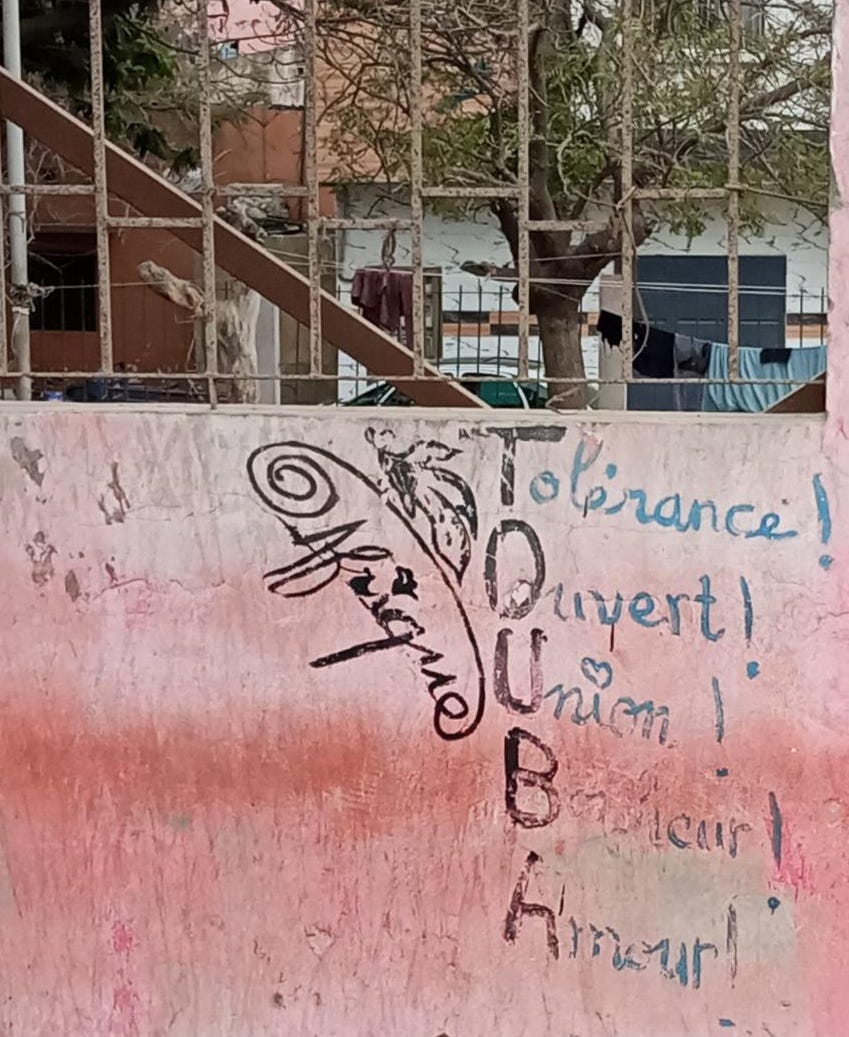
Even in Dakar I found graffiti reading, “Tolerance! Openness! Union! Happiness! Love!” Murals of Sufi leaders appear elsewhere. Spiritual graffiti still surprises me because I grew up expecting urban walls to advertise either a product or somebody’s inability to draw a penis.
I don’t want to turn this into Sénégal as a surviving communal paradise either. The warmth has hard boundaries, and LGBTQ+ people can pay brutally for crossing them.
In March 2026, Sénégal enacted Law No. 2026-08, raising the penalty for consensual same-sex intimacy to five to ten years in prison. The amended article also criminalizes public “apology” for homosexuality and certain financing or support intended to promote it. The law comes within the context of an existing reality of arrests, family rejection, harassment, assault, and mob violence—some say prison actually protects homosexuals from the mob. I don’t want to praise communal belonging while ignoring people who survive that belonging by hiding who they are—or by leaving.
A society can be spiritually alive, generous, funny, and intensely communal while still becoming cruel toward people who violate its accepted categories. Community itself isn’t automatically liberating. Everything depends on who is permitted to belong without pretending.
The otherwise forgiving social culture has other shadows, too. People may avoid confrontation so thoroughly that everybody knows who stole the sheep and nobody wants to create trouble by saying it aloud.
Where I live, neighbors steal our moringa pods every morning. Every morning! They could plant a moringa tree in their own yard. Apparently maintaining this relationship with ours is more entertaining. 😂
Everybody raises sheep here, including me, and they are extremely cute. The music, animals, joking, prayer, and constant presence of other people can make life feel like another world.
The older communal patterns are also changing. Young people move toward cities, jobs, phones, imported foods, and the wider world. Men take dangerous sea routes toward Europe. Families that once shared nearly everything become more dependent on cash and individual opportunity.
One strange survival of the old communal system is what people call the “Black Tax”: when one person begins earning money, they’re expected to support parents, siblings, cousins, school fees, medical bills, funerals, and whoever else the family is carrying. I understand the instinct behind it. In the ancestral arrangement, nobody succeeded alone. The people who fed, raised, housed, and protected you had a real claim on whatever prosperity later came through you. Sharing wasn’t charity. It was how the whole organism survived.
The modern version can become soul-destroying because the obligation survived while much of the communal life supporting it disappeared. The land, labor, childcare, food, and daily belonging are no longer fully shared, but the person earning cash may still be expected to carry everybody. They struggle to build any independence or long-term stability, while the relatives receiving the money remain dependent because the payments don’t create a viable alternative. The ancestral ethic is still alive inside an individualistic cash economy, where it can keep people alive while quietly consuming both sides.
This is also the boundary problem a money-free commune has to solve. Internal life can be cashless while taxes, hospitals, visas, school fees, family obligations, imported tools, and other outside relationships still arrive denominated in money. The question is not whether to recreate individual wages inside the commune. It is who handles that interface, how much collective cash is kept for it, and how to stop access to outside money from becoming a new status hierarchy.
Outside work complicates that boundary even before a common purse. It does not only bring cash. It brings another schedule, status system, social world, set of loyalties, and often new consumption expectations. During the first stage, an outside earner should contribute an agreed share, but money cannot buy exemption from ordinary communal work or extra political authority. The group also has to notice when outside jobs are draining the people and skills needed to build shared livelihoods. Otherwise the commune remains a dormitory for the cash economy instead of moving toward a common purse.
Zapatista communities faced a version of this with migration. Some moved from trying to stop young people from leaving toward negotiated arrangements in which migrants could work elsewhere while retaining defined communal obligations. The conflict between mobility and belonging did not disappear. It became something the community could name and negotiate.
Westerners often begin with isolation and try to rebuild tribe. Many Africans begin with inherited communal life and watch parts of it dissolve. Urban Africans interested in intentional community may arrive after feeling alienated from both the city and the tradition they left.
That makes this a global conversation rather than a Western lifestyle niche. Living villages still contain knowledge no book can reproduce, but they are living people rather than exhibits. Go respectfully, contribute something, learn the language, and do not arrive expecting a spiritual service package.
A practical note: my own residency process in Sénégal was inexpensive and straightforward. French and Wolof matter much more than English. The country’s famous ideal of Teranga—hospitality—is real in my life: I stay in a friend’s family house, and they refuse rent. That generosity exists beside watchfulness, social conservatism, bureaucracy, and all the ordinary complications of a real country.
Most community projects begin in the wrong order: land first, vision in a document, ownership concentrated because somebody had the money, and emotional preparation deferred until everyone has more time.
The better order is less cinematic. Practice together. Process a real conflict. Clarify values. Test membership. Decide ownership and exit. Then consider land.
The economic path should be staged the same way. A cluster of cooperating households can first take basic internal life out of purchase while outside earners contribute a defined share. It should move to a common purse only after it can provision members reliably and allocate the common fairly. Reducing or eliminating outside money should emerge from demonstrated capacity, not from declaring money impure while somebody else quietly pays the tax bill.
Most readers have a job, children, pets, debt, a mortgage, a sick parent, or several of these arranged in a circle. Fine. The most important pl/ork does not require land.
People sometimes buy forty acres and then import every kilogram of their unprocessed material to a more scenic location. The view improves. The conflict acquires goats.
Inner pl/ork can begin where you live. Peer counseling needs two people and enough privacy to speak. Reparenting, somatic practice, jealousy processing, and conflict repair do not wait for a deed.
A weekly group that has practiced together for two years already contains a real piece of community. It may never own land. It can still change how people survive divorce, illness, grief, parenting, and ordinary loneliness.
Remote or constrained readers can build the portion available. Hold a weekly meal with two households. Arrange a counseling exchange with one friend in person or by video. Share tools, childcare, transport, food preparation, or a sauna. Add acro-yoga, dance improvisation, a mothers’ circle, or a cuddle puddle if you’re hippie enough.
Three households reliably showing up for one another for six months will teach you more than another year of imagining the ideal village.
Here is the first month without the heroic land purchase:
Start the inner pl/ork. Read the free reparenting guide and Hearthwork manual, or begin with another serious practice you already trust. Practice before you have an audience.
Find two or three people. Call it a practice group rather than a commune. Meet regularly. Learn to listen, switch roles, handle one disagreement, and keep commitments before discussing a shared future.
Possible places to meet people include unprogrammed Quaker meetings, restorative-practice groups, open-hearted congregations, mature recovery communities, meditation groups, and people who came back from a long retreat kinder rather than more impressed with themselves.
Visit actual communities. Twin Oaks, East Wind, Acorn, other intentional communities, and many ecovillages receive visitors. Read their current visitor requirements first.
Visits teach you what no manifesto can: how much togetherness you enjoy, which forms of privacy you need, what labor system irritates you, and whether communal showers feel liberating or make you start pricing studio apartments.
Do those three things before you spend serious time or money looking for land.
I have no application form for you and no retreat to sell. The manuals are free. I’m in Sénégal and expect to buy land, but I’m not announcing a commune. I’ve simply noticed that community tends to gather wherever people experience real care, play, usefulness, and room to become more honest.
The Bruderhof shaped my father. He made a film, founded a research organization, and carried me through communal experiments. Decades later I’m publishing the film and writing this.
Maybe somebody will build something useful from it. Maybe that community will teach somebody who builds another. The transmission does not require one institution, one founder, or one official version.
If you build something real, maybe we’ll hear about each other. If you teach other people to build, hearing about it matters less.
Where’s Utopia? (1988) — my father’s documentary, made with Jerry Mintz and now online.
A Place Called Chiapas (1998) — the Zapatistas during their early years.
American Commune (2013) — The Farm through the eyes of two sisters raised there. For this article, the grown children’s perspective is essential.
Commune (2005) — Black Bear Ranch and the relational consequences of radical freedom.
A New We — a tour of European ecovillages showing how many different arrangements hide under one label.
Within Reach — a couple bicycles 6,500 miles through roughly one hundred communities.
Seeking the Good Life in America — Twin Oaks, Acorn, and Light Morning compared.
Voices of Cohousing — the partial-community option: high neighborliness with more private autonomy.
Inside the Bruderhof — high-commitment religious community, including the autonomy it requires members to surrender. My father lived there for 17 years. The Bruderhof also has an extensive YouTube channel.
Living in the Future: Lammas — community-building meets land use and planning law.
Jean Liedloff, The Continuum Concept (1975) — a foundational natural-child-rearing book based on Liedloff’s time with the Ye’kuana. Read it as provocative observation rather than settled anthropology.
Michaeleen Doucleff, Hunt, Gather, Parent (2021) — a practical, accessible book about children participating in family life, autonomy, and distributed care.
Diana Leafe Christian, Creating a Life Together — start here for sequencing, membership, money, land, and agreements.
Yana Ludwig, Building Belonging — a whole-systems guide to intentional community.
Rau and Koch-Gonzalez, Many Voices One Song — a practical sociocracy manual.
Schaub and colleagues, Building United Judgment — consensus decision-making.
Ludwig and Gimnig, The Cooperative Culture Handbook — exercises for cooperation, conflict, and group culture.
Dmitry Orlov, Communities That Abide — an uncomfortable argument that long-surviving communities often rely on communal property, separation, boundaries, and binding ideology. Cohesion and capture can resemble each other from a distance.
Rubin, Willis, and Ludwig, “Measuring Success in Intentional Communities” — asks whether longevity alone is a meaningful measure when a community may persist without members flourishing.
Rosabeth Moss Kanter, Commitment and Community — a classic comparison of nineteenth-century communes and the practices that built commitment.
Benjamin Zablocki, Alienation and Charisma — field research on communes and the role of charisma.
Jo Freeman, “The Tyranny of Structurelessness” (1970) — the classic argument that hidden hierarchy can be harder to challenge than explicit authority.
Gloria Muñoz Ramírez and Subcomandante Marcos, The Fire and the Word — movement formation, practice-before-theory, autonomous institutions, and the original Good Government Boards.
The Zapatistas’ own Enlace Zapatista archive, especially their 2023 explanations of the new autonomy.
I did a much larger source audit than would fit comfortably inside the article. The public research report shows the evidence base, limits, counterexamples, and what I still could not verify. It is there so you can inspect the research without turning this article into a 200-row ledger.
Comments
Nothing yet. Say the first thing.
Sign in to join the conversation.