
hey hi hello!!
welcome back baddies xx
*This post has a few affiliate links, which if you click and purchase from I receive compensation at no additional cost to you *
So today’s recipe is a quickie and just a little infusion on my classic pastry cream recipe. Well. Okay, not the version I have shared on the recipe archive. While that is a very banger pastry cream recipe a few of you have noticed that one calls for milk and heavy cream, while newer iterations of pastry creams in some of my more recent cake recipes call for just milk. SO YEAH, what’s up with that??
There’s actually a couple of reasons for the change. 1st of all, that is a scaled down version of pastry cream I was developed years ago, back in my production kitchen days. Something that really differs from professional kitchen to home kitchen isn’t necessarily access to ingredients, but like I do try to limit the amount of ingredients you’d need to keep on hand for a recipe (it may not feel like it… I’m still aware of what some of these recipes look like but I digress…). Does the addition of heavy cream make for a slightly richer pastry cream? Sure. But, is pastry cream made with juuust milk virtually just as creamy and maybe indistinguishable? I think so. That recipe is still great and still there for you if that’s what you prefer, but the all milk version is just to give you a little reprieve in having to buy heavy cream. IDK man. So reason 1, is from a convenience stand point.
Reason 2, will slightly counter reason 1 :) Welcome to my brain, ‘tis quite ambivalent up here. But, in “recent” years I’ve just been drawn to using a bavarian/diplomat/creme légère as a filling for cakes, donuts etc. Which are all just versions of pastry cream, possibly set with gelatin (diplomat/bav) and folded into whipped cream (légère). So for you to follow along and make any of these, you still need heavy cream… negating my decision to not add heavy cream to the pc in reason 1!!! bu bu bu buuuut, specifically when I’m going to make a whipped cream lightened variant, I don’t want it to be toooo high fat. Which crazy coming from someone who’s favorite food group is anything with heavy cream :-) ANYWAYS, too much fat can leave you with this almost slick, greasy coating on your mouth and I do not want that. So i keep the amount of fat a little lower in the pastry cream knowing I’m gonna be folding in tons of whipped cream later.
Now onto the other I want to yap about, that I always yap about :)
But, this is… just… my vanilla pastry cream, infused with lemon verbena and made the same way it’s always been made. That’s the beauty, the point. I said somewhere recently, I feel more inline with the term flavor developer at this point than recipe developer. 7 times out of 10 right now? I’m developing the flavor and not the recipe (though there is an argument to be made that developing flavor is developing the recipe… sure).
Like, every time I pump out a new pastry cream flavor, ice cream flavor etc etc I’m not starting from scratch, no one is. I start with what I know I like (a recipe I spent 2 years developing) and go from there. Having a solid base makes the next step easier and quicker.
It’s not always perfectly a plug and play situation. There is still testing and tweaking that goes into developing flavor, making sure the flavor comes across, isn’t lost, best techniques for infusing flavor, etc etc. This is something I was chatting with a consulting client about with recently. He wanted master recipes with corresponding flavor charts that said “this is pastry cream and to make chocolate you add x amount of cocoa powder or chocolate chips to this base” or “to make spiced pastry cream add x amount of ground spice to this batch size”. But, it’s not that cut and dry, there is still nuance between ingredients here. With the spiced example, cloves are far more potent than cinnamon, if the chart said add “1 teaspoon” to 1k of pastry cream, the cinnamon version would be perfectly spiced while the clove version becomes overpowering. Acidic ingredients can be added to dairy based desserts but need to be handled with care, otherwise they can curdle the dairy. So ingredient specific instructions are given when needed (these are the very key points to developing and sharing new versions of a recipe yahurme). Page 111 of Nicola Lamb’s SIFT gives a great infusions chart as a starting point for how much of different types of ingredients you should use when infusing.
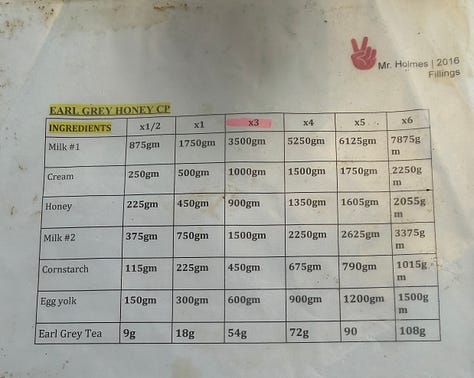
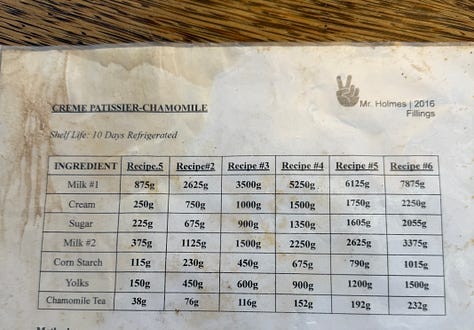
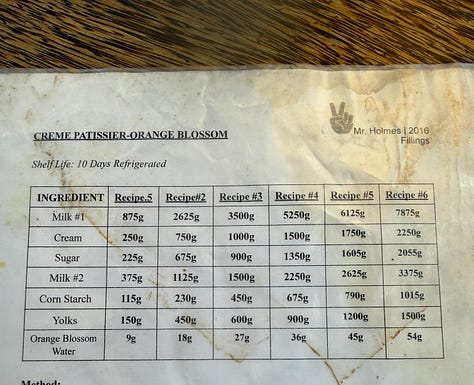
*I actually found these recipes from when I was working at Mr.Holmes. They’re very apt for the topic at hand. you’ll notice that all of them are virtually the same except for the flavoring inclusions. For the orange blossom variant, the orange blossom water was added in at flame off to preserve those delicate flavor compounds. While the earl grey and chamomile versions, infuse the tea leaves into the milk of the recipe. Even though they’re both teas, the amount use in each respective recipe differs because of the potency of each teas flavor. To get the same flavor pay off from chamomile, we were using almost 3x the amount of tea in comparison to earl grey. So, that’s what I mean by it’s not always a straight plug and play. nawmean?
Flavor and taste are also deeply personal. I think the amount of lemon verbena infused into this cream is perfect (obviously, otherwise why tf would I be sharing this?) You might think it’s too much, or not enough. ya know.
The hope here, is that eventually you’ll realize you won’t need me and my recipes to be creative. I want you to use that big, beautiful, capable mind of yours to make everything you want to make, how you want to make it. But, also to get get there, you have to expand the educational pool, get information from other chef’s, creators, books. Don’t think it’ll all come from one source… it really shouldn’t.
Now for the star of this post, the lemon verbena pastry cream. I made this with lemon verbena I grew myself!! (I bought two plants from Terrabella last week and am engaging in a little stolen valor… but they were in my care for a week so close enough!!)
The flavor or lemon verbena is reminiscent of fruit loops to me, with a lemony, minty edge. It’s the perfect herb to pair with virtually any summer fruit. I have a cake coming at ya soon that’s olive oil chiffon, vanilla poached peaches, and a lemon verbena bavarian using this recipe as the base. GIRLS, soooo summery so perfect.
Now, I do use fresh for this recipe, the flavor from dried verbena leaves is not as bright and the flavor pay off isn’t as potent as using fresh. The flavor of dried verbena leans a little earthier/grassy and not so punchy lemony. I obviously got my verbena leaves fresh from my garden (the two nursery pots sitting in a virtually empty yard <3333) but I’ve also picked up from Specialty Produce here in San Diego and at many a farm stand at LA farmer’s markets. If ya can get your hands on it, def worth playing around with. It’s also (from what I hear) very easy to grow and keep alive. So there ya go.
In an upcoming cake I mentioned I have this paired with vanilla poached peaches buuut this lemon verbena pastry cream would pair well with virtually any summer fruit, anything you already pair with lemon or mint. I especially love lemon verbena paired with raspberry. It also works well with corn. Use it to fill cakes, donuts, eclairs, I dunno anywhere you’re already using pastry cream you can use a verbena infused version instead.
makes 500 grams of pastry cream
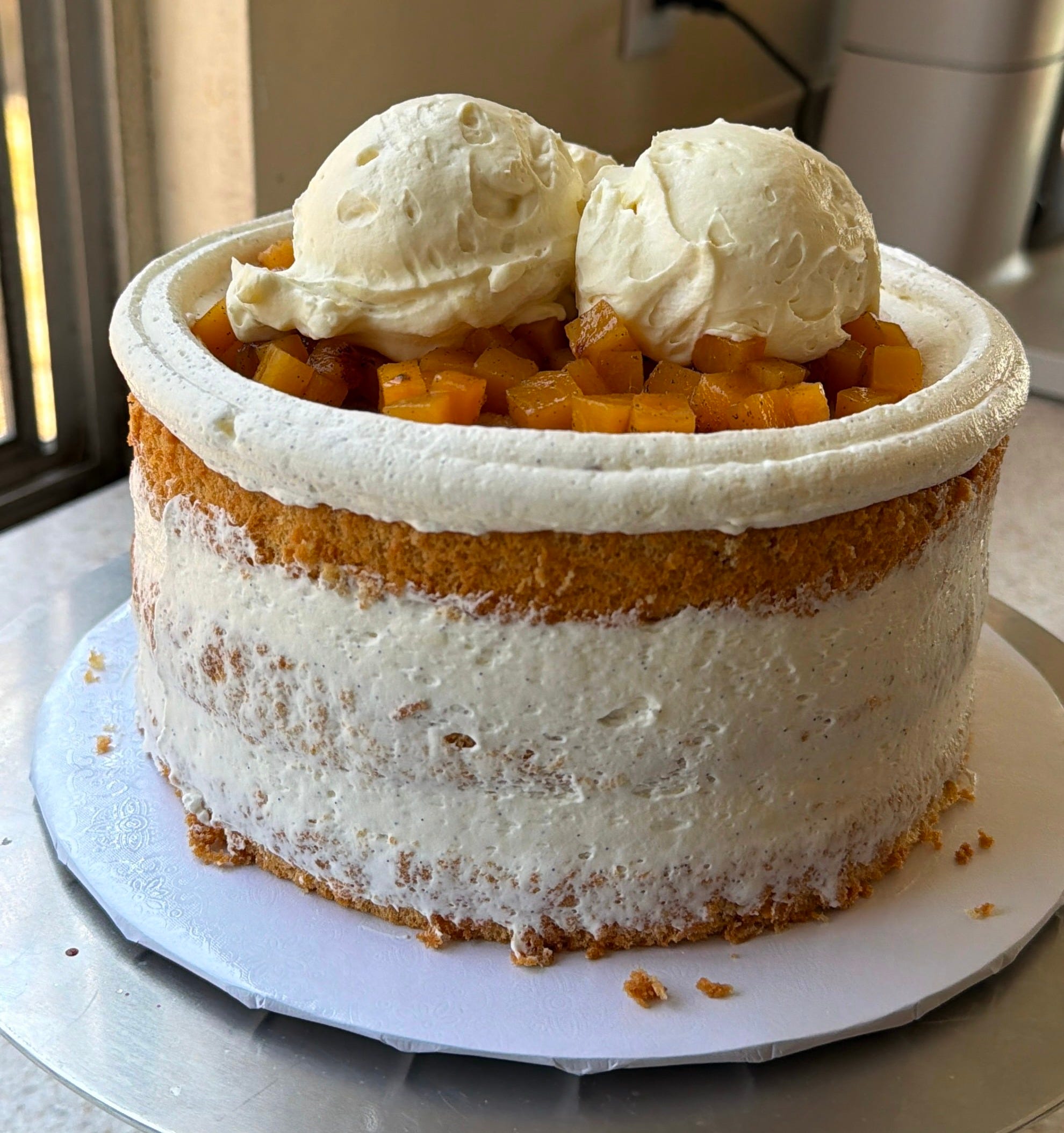
*an easy to view, printer friendly PDF version of the recipe is avail to paid subscribers at the end of this post xx *
As per usual, this is pastry cream infused with a little something special, this time fresh lemon verbena. So if you’re taking and already existing version of pastry cream, I typically start with 15-25% more milk than the recipe calls for. Depending on the flavoring ingredient it will absorb some of the milk and if you want to have the right amount for the recipe, you’ll start with more. Thankfully here, I’ve already done that for ya. But, should you be infusing your own recipe, that’s giving you an idea of where to start… hopefully. For lemon verbena I found 2.3% the weight of the milk/dairy to be the sweet spot for infusing :)
Should you want to make a gelatin set diplomat cream, which I do for the layer cake to come, I’ll include the amounts below. But, feel free to skip.
TOOLS
Kitchen timer or the one on your phone lol
Mixing bowl
Whisk
Rubber spatula
Small ladle
Immersion blender (optional)
INGREDIENTS
350 grams whole milk
8 grams fresh lemon verbena leaves, off the stem
300 grams lemon verbena infused milk
1/4 teaspoon diamond crystal kosher salt
60 grams granulated sugar
15 grams cornstarch
80 grams egg yolks (approx 4 large egg yolks)
45 grams butter, cold and cubed
optional 1/2 teaspoon powdered gelatin + 2 teaspoons cold water
To make into a diplomat cream (set with gelatin) or creme legere (no gelatin), you’ll also need 250 grams of heavy cream when ready to prepare the filling.
DIRECTIONS
In a medium sauce pan heat the 350 grams whole milk to just below a simmer. Once warmed you’ll remove from the heat and add in the 8 grams of lemon verbena leaves. Use an immersion blender to gently pulse the leaves into the milk to get a deeper flavor infusion. Alternatively you can rip the leaves up a bit before adding to the warm milk. Let this infuse for 45 minutes.
Once the 45 minutes has elapsed, strain the milk through a fine mesh sieve and discard the verbena leaves.
Before starting your pastry cream, if you’re choosing to add gelatin nows the time to prepare that. Add 1/2 teaspoon powdered gelatin to a small container with 2 teaspoons of cold water to bloom making sure the powder is evenly saturated- set aside.
Pour 300 grams of the infused milk into a medium saucepan and bring to just below a simmer again. The milk should be steamy but not boiling.
While that heats up, whisk together 1/4 teaspoon kosher salt, 60 grams granulated sugar, and 15 grams cornstarch in a medium bowl eliminate any lumps. Add 80 grams of egg yolks to the cornstarch sugar mix and whisk together until a homogenous paste forms.
Once your milk is at a simmer, temper into the yolk mixture. To temper: ladle in a small amount of the hot milk into the yolks, whisking to combine. Add another ladle full, repeating until you’ve added about half of the warmed milk.
Once tempered, slowly pour the egg yolk mixture back into the saucepan while whisking to avoid any curdling.
Whisk constantly to avoid scrambling the eggs. Continue to whisk until your cream begins to thicken and reaches a soft boil (a few slow popping and thick bubbles will form.)
At this point remove your cream from the heat and add 45 grams of cold cubed butter and the bloomed gelatin from earlier (should you be taking that route). Whisk or immersion blend to emulsify both into the warm custard.
Strain the pastry cream through a fine mesh sieve into your desired heat proof container. This is the final frontier to make sure you don’t have any scrambled eggy bits in your cream.
Cover directly with plastic wrap. Label and date the container! Store in the fridge to set until ready to use. Minimum 8 hours, but preferably overnight.
* If you find your PC has set too firm in the fridge beat it by hand with a rubber spatula to loosen before use*
If making bavarian/legere: Before you’re ready to fill or use the custard you’ll whip 250 grams of heavy cream to stiff peaks. When using a gelatin set pastry cream, I’ll add the pastry cream to the mixer with the stiff whipped cream and whip for a few seconds until evenly combined. Finishing off with a rubber spatula if needed.
When making without a gelatin set custard, I’ll gently fold the pastry cream into the stiff whipped cream with a rubber spatula, since it’s less stable you don’t want to overwork it.

Comments
Nothing yet. Say the first thing.
Sign in to join the conversation.