
Reading time: 7 minutes
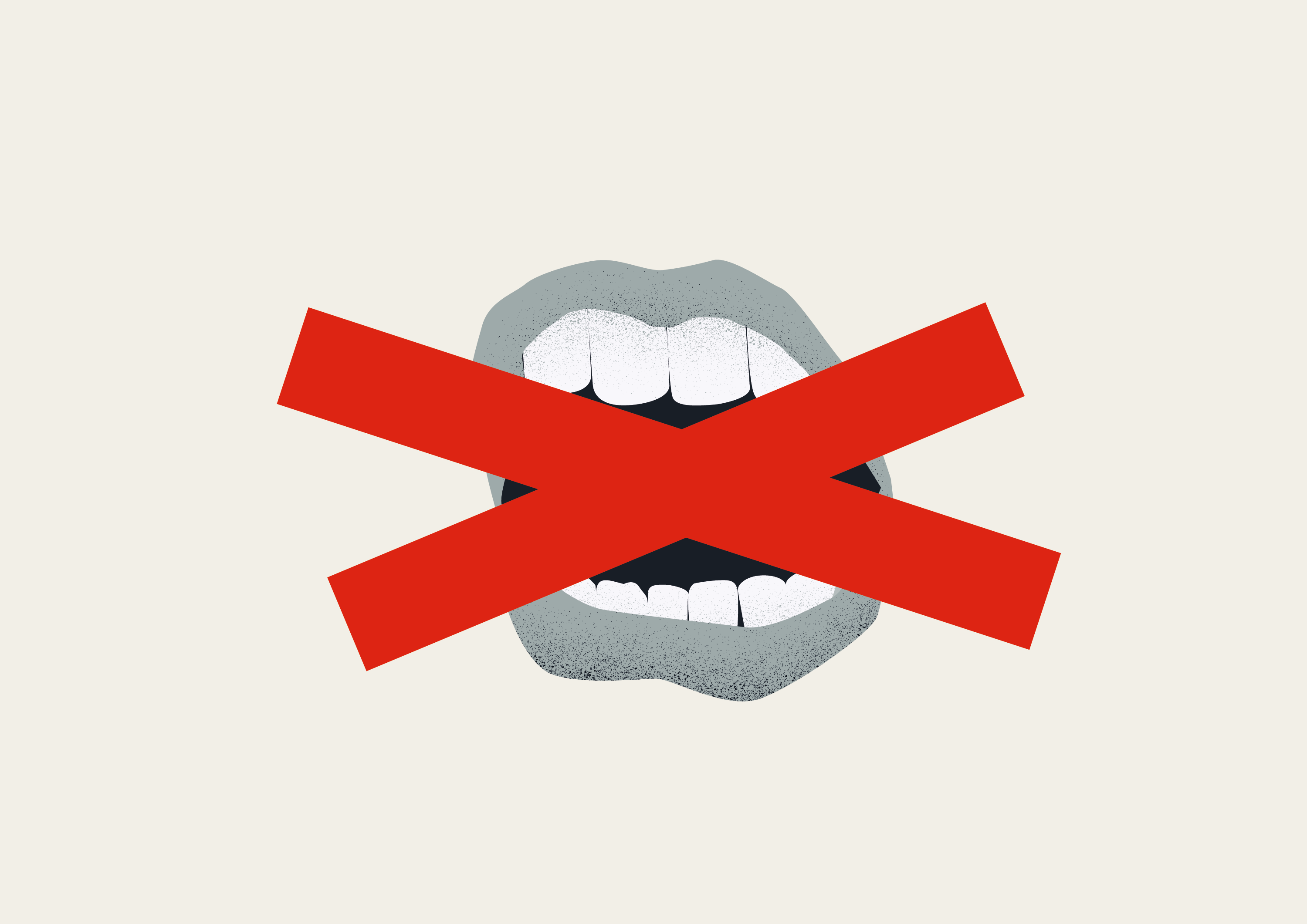
Brevity is a strategic edge for the professional creative.
If you want to…
capture someone’s attention
be understood
appear credible
be commercially formidable
…then conveying your ideas, your work, and yourself in the fewest and most exact words possible is the goal. Most people don’t employ brevity. Not because they don’t know how, but because volume is cheap and feels like competence.
Brevity is nothing new.
Sometime between 1599 and 1601, Shakespeare wrote the words, “Brevity is the soul of wit.” Polonius says this in Act II, Scene II of Hamlet. Shakespeare uses this ironically. Polonius is famously long-winded, perhaps more so than any Shakespearean character. He delivers this line as part of a rambling, self-important speech and completely fails to follow his advice. He says:
“…since brevity is the soul of wit,
And tediousness the limbs and outward flourishes,
I will be brief…”
And then proceeds not to be brief.
Shakespeare satirised those who perform intelligence through long speeches, when true intelligence (wit) lies in conciseness. He’s telling us that verbosity can masquerade as wisdom, but often reveals the opposite. The restraint that Shakespeare refers to is a skill. It is more difficult to be brief, and the editing process is a task. We hear this elsewhere.
The phrase “I have made this longer than usual because I have not had time to make it shorter” is attributed to French mathematician and philosopher Blaise Pascal. It appeared in a letter from a collection dated 1657. This sentence has been incorrectly attributed to Mark Twain, John Locke, Benjamin Franklin and even Cicero.
He speaks of the paradox of brevity. The shorter the message, the harder the work. It demands more thought, more structure, and more discipline.
All muscles that are weakening in the era of AI.
Brevity isn’t just rare. It’s resisted. Look at the modern professional setting: the decks, the emails, the meetings. People default to more. More context, more background, more explanation. The result can be good ideas buried under the weight of their delivery.
If the best minds and most creative people have eulogised brevity since the 16th century, and likely even as part of ancient wisdom in writing such as Ecclesiastes and Proverbs (e.g. King Solomon’s warning “Let your words be few”), why is brevity so hard to act on today? Consider the following reasons.
Lack of self-awareness
This sounds dismissive, but it’s not; there’s complexity. If someone doesn’t realise they are falling into the trap of verbosity, they are probably too close to the idea or the material. When you have spent days, maybe months, thinking through an idea, every detail feels relevant. You know the edge cases, the nuance, and because you have internalised it all, you think the audience needs to hear it all, too. Others don’t catch themselves overexplaining because they aren’t thinking of their audience at all. Not malice, mental absence. They forget the listener and forget to read the room. These people also hit a communication glitch; we speak at around 130 words per minute, but can process at 400-500 words per minute. Verbosity inevitably leads to familiar sentence structures, the listener’s brain races ahead, and everything else between those two points is pure fatigue. When we create fatigue, the listener will reassign their attention indiscriminately.Competence theatre:
There are two sides to this. One is overexplaining not to inform, but to impress. The need to show the listener how much work has been done and how smart they are. They want to prove they know the subject and belong in the room, so they say everything. It’s credential signalling. It’s misguided, but again, it’s hard to begrudge anyone who takes the bait – when do we ever want to look like we’re not standing on solid ground or to convey an idea that seems too simplistic? The second side is for self-protection. We add more words because we fear being misunderstood. The goal becomes “don’t look stupid", rather than “be helpful.” We think, “If I say everything, then surely, they’ll get it.” Self-protection might also mean not wanting to look rude. Some may equate brevity with a lack of respect or arrogance. So we pad, we apologise.
To add a further challenge, brevity isn’t just a personal action; it needs a cultural signal in our environment and among our teams. We calibrate our communication to what gets approval, attention or airtime. If, however, the environment rewards clarity and precision, people will adapt to that too.
My favourite example of this cultural signal is Churchill’s memo to the War Cabinet in 1940. At the height of wartime urgency, Churchill issued a memo to civil servants demanding that official communications be brief and free of bloated language. He opened the memo saying, “To do our work, we all have to read a mass of papers. Nearly all of them are far too long. This wastes time.” The memo continues with the following requests:
“…set out the main points in short, crisp paragraphs”
“If a report relies on detailed analysis…these should be set out in an Appendix”
“Let us have an end to such phrases as ‘Consideration should be given to the possibility of…’”
But my favourite piece is at the end of the memo, where he notes that these reports “…may at first seem rough as compared with the flat surface of officialese jargon, the saving in time will be great, while the discipline of setting out the real points will prove an aid to clearer thinking.”
There needs to be an environment to ‘allow’ brevity. Churchill knew this, and he made brevity an organisational expectation. Not because he wanted elegance, but because he wanted action. If we want to communicate clearly, part of what we have to ask ourselves is: What environment am I in?
How can we more easily adopt a mindset of brevity and marshal our environment to expect it? I think there is a simple, actionable method. This is something I have been training agency and in-house teams on for nearly five years, and alongside the online course, now has over 2,000 alumni. It is part of one of the three principles called The Surgeon. This is a conceptual exercise to guide how we sell ourselves and our ideas.
Why a surgeon?
It is the highest-stakes form of trust we would place in a practitioner whose counsel and expertise we need. We can all imagine what that interaction would be like, what we would want from them, and how we would want to feel. Brevity is one of the six traits of The Surgeon, and we simply need to put ourselves in the patient's shoes.
First, as a patient, we would have an expectation of limited time. As much as this perfect, world-class surgeon we have imagined wants to provide world-class care, we have only minutes to digest potentially life-changing news. They don’t use flowery prose, they don’t use jargon, they tell us only what we need to hear in that moment. The Surgeon also reminds us of the truth about our psychology and ability to retain information. In a clinical setting, speaking as someone who runs a healthtech company, up to 80% of the information given to us is forgotten immediately. Even then, only 50% of what is remembered is accurate.
Let’s look at a practical example. Let’s say you have torn the ACL in your left knee.
Here’s the communication from the clinician we don’t want:
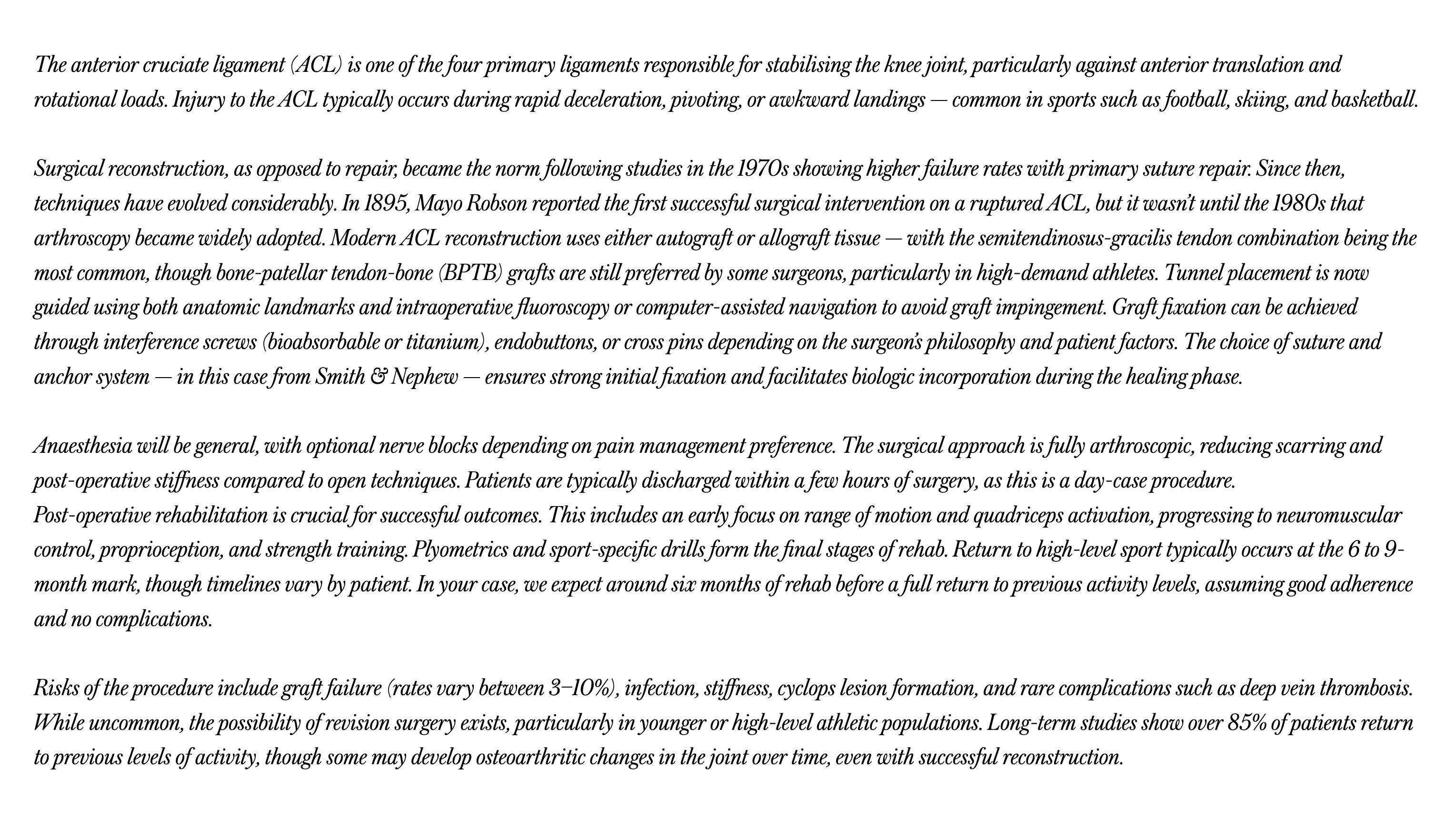
In 390 words over five paragraphs, we are given the full complexity of ACL repair. The 130-year history, the device manufacturer, the jargon, the nuance, the everything. If Polonius were a doctor, this is what we’d get.
Here’s the surgeon we do want:
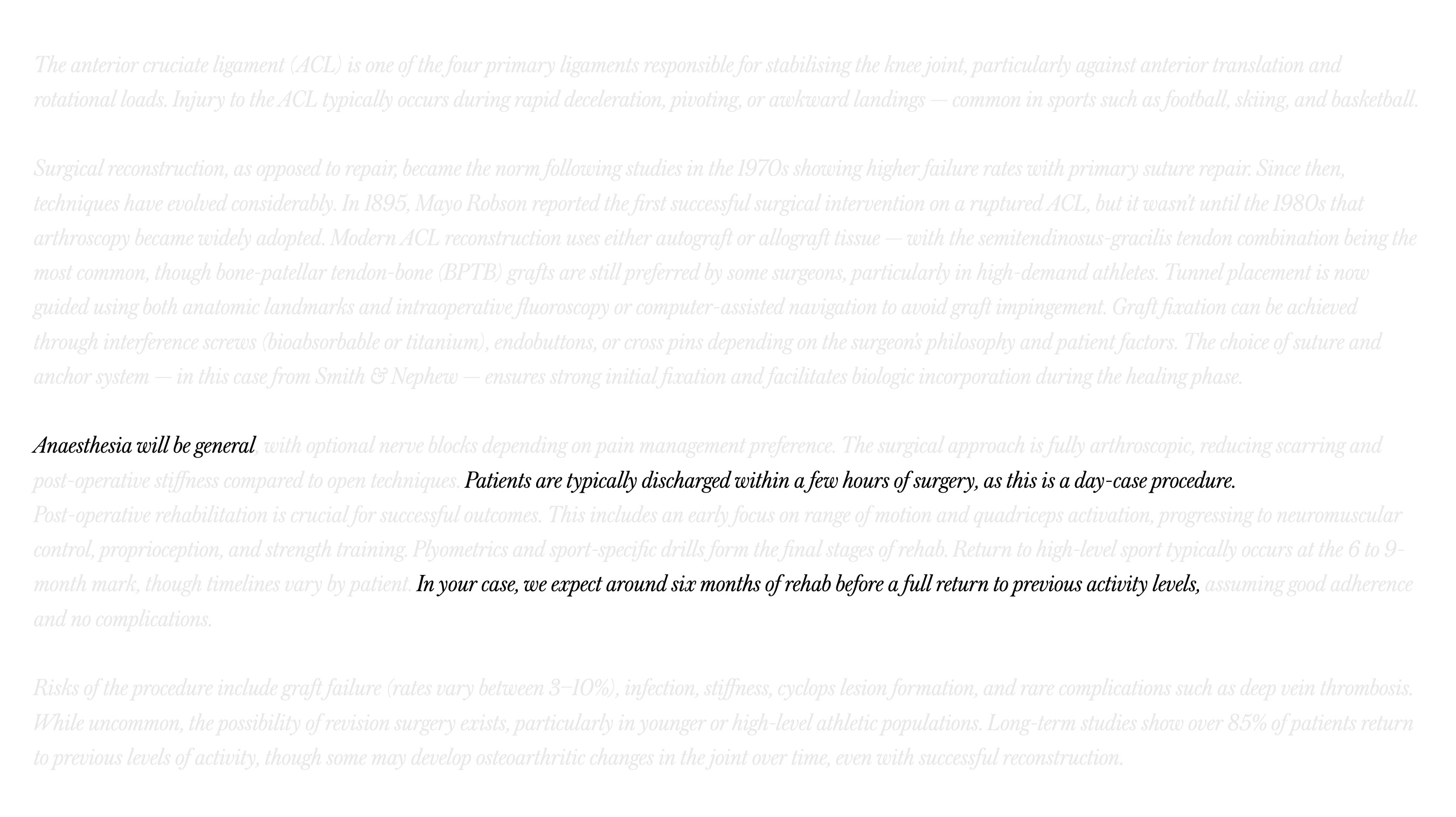
Extracted from those 390 words are 38, delivered over three sentences. It’s general anaesthetic, a day-case procedure, with an expectation of six months of rehab and a full return to previous activity levels.
This is what we need. Curation.
The Surgeon knows everything, but gives you only what matters. Not out of coldness, but because that clarity leads to better care and better outcomes. Communicate like the surgeon you would want treating you, and your audience will assign you much more affinity.
AI provides you with the ability to generate volume instantly, infinitely.
Just like everyone else.
This isn't an edge, it's a hindrance. The challenge today is not making things to put out into the world, it’s discernment. When attention is fragmented, people seek clarity. It is rare and valuable. Your strategic edge is a judgment call on what to say and what not to say.
That judgment is something your customers will gladly pay a premium for.
Like this issue? Consider sharing it with your colleagues internally or on social media. Alternatively, refer a friend to be eligible for rewards. Thank you for subscribing.
If you’re looking for other ways to keep creativity alive as an individual or a team, my course Sell the Idea can help you pitch and present your ideas more effectively. Explore the self-paced course here selltheidea.co
Comments
Nothing yet. Say the first thing.
Sign in to join the conversation.