
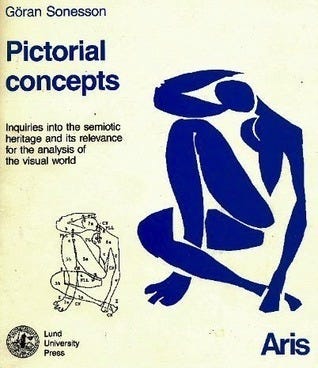
A few months ago, an email bounced back from Göran Sonesson, the Swedish semiotician. I soon discovered that he had passed away some months before. This is extremely sad as Sonesson was a brilliant, generous, yet modest scholar. In retrospect, I believe he may have had the most analytic penetration of any writer on images of the last two decades. This was because he spanned several disciplines, linguistics (including gesture studies), cognitive psychology, French semiotics, and phenomenology. Sonesson was so great because he put all those bodies of knowledge in play, and mutually improved each of them.
As many of my colleagues may see Sonesson as engaged in a specialized endeavor, I want to review his career because his work has lessons for all of us. In short, he demonstrated the way in which language and signs intersect with experience and phenomenology. The results was a cognitive, phenomenological semiotics, an almost – for those of us reared in the hyper-discursive poststructuralist 1980s - absurdity. This could not have been done by anyone from separate camps – semiotics or phenomenology. It needed to happen with someone ranging over both, and more.
Sonesson was a pupil of Algirdas Greimas in Paris. Thus, he trained in the hotbed of French structuralism, post-structuralism and semiotics. Yet Greimas, while his peers Jacques Derrida and Michel Foucault were leaving the structural fold, remained within the vocation scientifique. For whatever Greimas’ quirks, the aim was still to portray language and meaning in a rigorous manner with tools recognizable to the natural sciences.
Sonesson learned the catechism of Saussurean and Hjemslevian linguistics. Sonesson went on to challenge many of its tenants, for example, the Greimasian idea that iconicity is conventional or that it is largely perceptual. But clearly the openness of the training allowed for Sonesson’s probing investigations. Remarkably, all the themes that Sonesson would go on to enlighten over the decades are developed in Pictorial Concepts of 1989. Although its dense printing looks like a technical manual, it is written with confidence and wit and the discussions ranging from Peirce, to Husserl, Goodman or Eco, are precise and definitive. It is an amazing achievement. The book should be reissued.
Most importantly, Sonesson worked out laboriously the definition of a sign that had lapsed in so many linguists and semioticians’ works. He arrived at the formula, familiar in his later works:
It contains (at least) two parts (expression and content) and is as a whole relatively independent of that for which it stands (the referent);
These parts are differentiated, from the point of view of the subjects involved in the semiotic process, even though they may not be so objectively, that is, in the common sense Lifeworld (except as signs forming part of that Lifeworld);
There is a double asymmetry between the two parts, because one part, expression, is more directly experienced than the other; and because the other part, content, is more in focus than the other;
The sign itself is subjectively differentiated from the referent, and the referent is more indirectly known than any part of the sign.
Rather analytic, but it reflects a relentless prodding about exactly what signification is, in an effort to go beyond loose talk, whether of a Saussurian or Peirceian stamp. There has been so much hopeful discussion of “mimesis” (Merlin Donald) and “symbolism” but each is desperately in need of elaboration. Add to that debates about whether animals or children understand pictures, and in what manner. The usage of such a rigorous concept across a number of studies in Lund (Zlatev, Lenninger) has been positively salutary.
No posts
Comments
Nothing yet. Say the first thing.
Sign in to join the conversation.