
The Long Play Project: Stories of musicians who keep reaching, told through the albums they make.
I’m now running on a three-week cycle: Week one: a classic album or artist, with the connected playlist following a day or two later. Week two: a curated playlist of new and freed-from-the-archive releases. Week three: an essay about a new release, perhaps by an artist you may not have heard before. The cycle repeats.
Solo albums made by bass players don’t immediately sound like an attractive proposition. Bass players are typically solid, grounded, and paired with an equally grounded drummer (or, in the case of The Who, not). They hold the band together but might not be noticed (when Joni Mitchell wrote the lines “you don’t know what you’ve got ‘till it’s gone”, perhaps she was thinking about bass players?)
I wondered if there was a list of excellent albums by bassists. There is - Classical Music (who have ventured into the realms of prog and rock on a regular basis in recent times) published a top 15 in April 2026.
Some albums on the list are by bassists, but not bass albums. For example, Flea’s album is there but it was the result of challenging himself to learn the trumpet.1 Roger Glover is there, in the context of marshalling the musical forces for a children’s musical. What about bass players playing bass?
At 10 is Jah Wobble. Bass as invention, not rock solidity. 9 is John Paul Jones with Zooma, both demonstrating what he contributed to Led Zep and how there’s more to him than that. Jack Bruce with the odd and semi-improvised Songs for a Tailor is 6. At 5 they placed John Entwistle’s Smash Your Head Against the Wall. The ultimate rock solid bassist, a counter to the brilliantly erratic Keith Moon onstage, and almost as wild off stage. In case you’ve never heard this … (Who fans, spot the references).
2 is Stanley Clark’s School Days (1976): innovative, mind-boggling and vital according to Classical Music.
And number 1 is Jaco Pastorius, who may or may not be grounded but introduced himself to Weather Report with the words, “I’m John Francis Pastorius III. I’m the greatest bass player in the world.”
Anyway, back to the plot. What concerns us here is the record they placed at 3: Chris Squire - Fish Out of Water.
On Squire’s album, the bass is the lead instrument. Effectively, he’s playing lead on an album with no six-string guitar, not much synth, master drumming, a church organ and a symphony orchestra. Well, if your band is going to take time off for solo albums, you might as well make your own record.
Fish is sometimes described as the greatest progressive rock album most people don’t know about. It has picked up more recognition in recent years, helped by expanded reissues.
Once a musician commences a solo career they usually continue. John Entwistle, for example, made five completely solo albums alongside his continuing role in The Who. With Yes, the timeline is more complicated because of the fluid lineup of the band. Rick Wakeman has released - honestly - at least 100 solo albums, although he was in and out of Yes before he was fully out of the band, and had been replaced by Patrick Moraz for the Yes album Relayer, the one they made immediately prior to their solo sabbatical in 1975.2 Guitarist Steve Howe recorded the appropriately titled Beginnings, followed by further solo albums.
Fish, though, was Squire’s only full solo album.3
All of those first Yes solo albums fit the criteria for the Long Play Project. I’ll come back to each of them eventually. Perhaps, though, Fish Out of Water is the most ambitious of them all.
Chris Squire’s nickname was Fish for several reasons: his star sign was Pisces; he loved taking a long bath; a ‘bass’ is a species of fish as well as a variety of guitar. He cemented it by writing ‘The Fish (Schindler Praematurus)’4 for the Yes album Fragile (hear it in the connected playlist for this essay, LP Select #075).
Squire enlisted some past collaborators for the recording of his solo album. From the world of Yes and beyond: Bill Bruford (drums) and Patrick Moraz (keyboards). Mel Collins (sax, recommended by Bruford). Jimmy Hastings (flute, from the Canterbury Scene, most notably Caravan) and, vitally in terms of the ambition Squire had for Fish, Andrew Pryce Jackman, who he first met in their church choir. He’s responsible for the string arrangements and for co-writing the album, although he did not wish to be credited.
The choirmaster in those early times of Squire’s musical career was Barry Rose, who is on Fish playing the St. Paul’s Pipe Organ, and who is the source of something profound in Squire’s life. Squire said Rose “... made him realise that working at it was the only way to become best as something.” He needed to learn that at school, after being given 2/6 to get his hair cut, and took the opportunity to escape and never return. School isn’t the right environment for everyone.
He found a job selling guitars in the famous Boozey & Hawkes music shop in London, and purchased his Rickenbacker bass on staff discount. Naturally, he formed a band, The Syn (with Andew Pryce Jackman) who at one stage opened for Jimi Hendrix.
The opportunity to practice on his bass came when he was recovering from a bad LSD trip and was confined to his girlfriend’s flat, afraid to go out. Once he reentered the world he met Jon Anderson, and formed a band eventually coalescing around Bill Bruford, Tony Kaye and Peter Banks as an early version of Yes. The original intention of the band - one which they honoured over the years - was to be a vehicle for everyone’s individual styles.
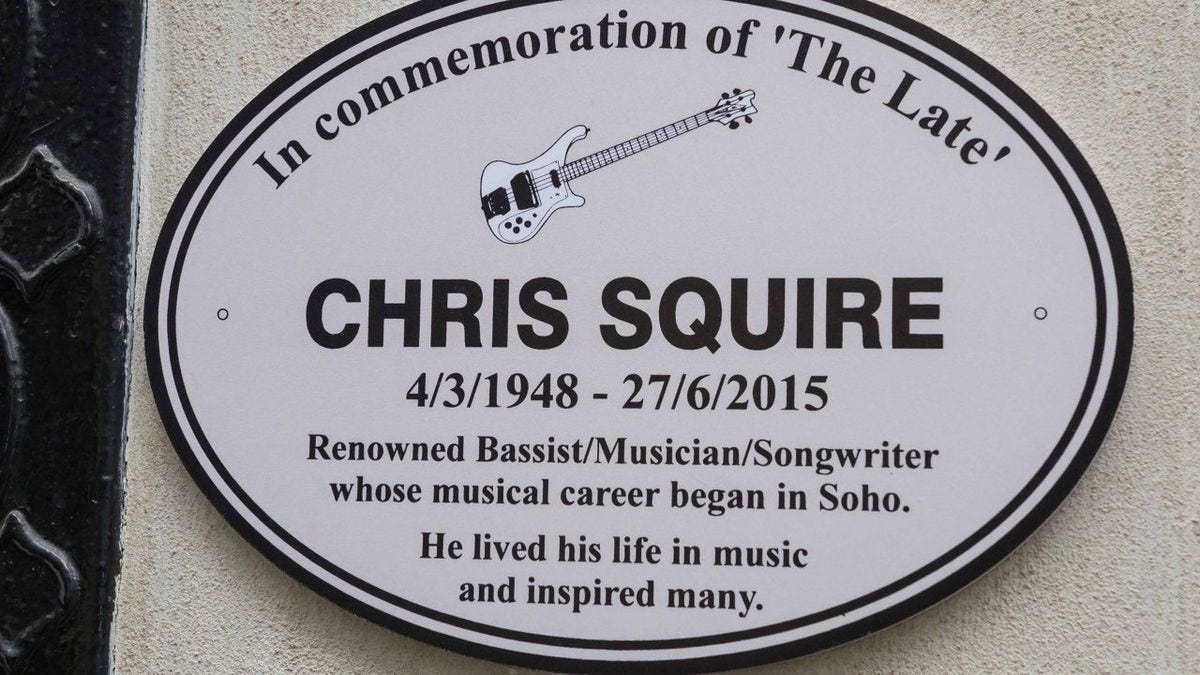
There’s a plaque in London dedicated to ‘the late Chris Squire’. Perhaps his confinement has a lasting effect. To being a master bass player and a lover of water, add an ability to turn up late for almost everything.
Chris Squire, and arranger Andrew Pryce Jackman, made a crucial decision about the sound of Fish Out of Water. This could have been a very Yes sounding record, if it was layered with the usual prog musical suspects of synths, melotrons, and electric guitars. Fish Out of Water was designed to sound different, and not just because Squire’s bass often becomes the lead instrument.
Pryce Jackman was offered a credit as co-writer, but declined the recognition. That’s not to underplay Squire’s involvement in his own album, more to recognise his determination to be a fish out of water and not make another Yes album by proxy.
The album begins in the most dramatic way possible, with mighty chords on the St. Paul’s pipe organ played by Barry Rose, rapidly joined by Squire’s bass and then a full orchestral blast. ‘Hold Out Your Hand’ is a hooky song and, across four minutes, introduces some of the key sounds and arrangements; it subtly makes the point that this is prog and yet it is not Yes.
This segues into ‘You By My Side’, slowing the tempo, featuring a flute solo, before a dramatic, loud, glorious finale. Taken together, these two opening tracks can be heard as prog’s answer to the full-length two-part ‘Layla’ (Derek & the Dominoes). The experience is nothing like listening to ‘Layla’, of course, but the structure is an echo.
If these first two tracks had been the highlights and there was nothing as good in the following 35 minutes, they alone would justify the project. There is so much more.
‘Silently Falling’ is the first of two epics; almost twelve minutes starting with fluttering woodwind, deep bass counter-melody; all very pretty and evocative and then … a simply sung “hopefully …” The bass leads us into a powerful - well, not chorus exactly, but main theme. Flowing into a complex Canterbury influenced middle section, with jazzy keyboards, gradually breaking down into a simpler arrangement. Another “hopefully …” is the signal to build it all back up again, albeit at a less frenetic level, gradually growing. Towards what? One of the trickiest aspects of writing and arranging an epic is how to end it. The option taken here is to simplify to just the bass and then … stop.
‘Lucky Seven’ is pure jazz rock, taking its cue from Mel Collins’ sax riff. This is a different approach from the remainder of the album and it’s carefully integrated, both adding variety to and extending the range of the sonic palette.
And, finally, the masterpiece.
‘Safe (Canon Song)’ leads us by the hand with an understated keyboard and strings Introduction, bass of course, and a melodic vocal. The strings pick out a new theme, preceded by descending bass notes which become a spine-tingling moment when you know what that little bass phrase heralds. Imagine an early Mike Oldfield album if Oldfield was also in Yes.
The bass is repetitive and insistent, always growing, and even across a fifteen minute track it feels as if the riff could just continue … and continue … and grow … and always be there. Although in a different style, think of the vibe expressed by Chris Squire’s occasional partner in crime Steve Hackett, on ‘Shadow of the Hierophant’ from his first solo album (and on many live albums since). Another point of - well, if not comparison, then spiritual empathy, are Rick Wakeman’s early solo albums.
And then there’s the moment when the bass descends down the scale and brass kicks in. This is another spine-tingling moment every time. A little discordant piano. Are we there? Not quite; time for one more musical kitchen sink.
I’m wary of over-statement but this track is one of the finest achievements in all of prog rock. Is that going too far - I’m happy to receive your comments (button below).
Oh, and almost unbelievably, there’s a three minute single edit of ‘Silently Falling’ that removes most of the ambition before just fading out. Record companies always need a single.
Look out for the curated playlist associated with Fish Out of Water, LP Select #075, with you tomorrow - and with my Listening Guide for paid members.
Next week comes a new curated playlist featuring some new releases I’d like to share, followed by a full essay on an ambitious new album. Look out for me in Notes as I narrow my selections.
His extraordinary version of ‘Wichita Lineman’ with Nick Cave on lead vocals is a candidate for LP Select #076.
He was involved with projects outside of Yes, notably Squackett with Steve Hackett, and Chris Squires Swiss Choir, an album of Christmas songs that surely had to be made once someone had found that title.
According to Wikipedia: Schindleria (Gobiidae) are the world’s smallest and fastest maturing marine vertebrates. They are likely the most extreme case of paedomorphism among teleost fishes. Adult S. praematura have an average body length of around 10–20 mm resembling the body length of most fishes’ early larval stage.[7] Some of the larval characteristics observed in sexually mature individuals include functional pronephros (most primitive form of a kidney for excretory organ functions), a transparent body and a largely unossified skeleton (not yet converted to bone or lacking a bony structure).
Does anyone know why Squire went for that specific species when writing ‘The Fish’?
Comments
Nothing yet. Say the first thing.
Sign in to join the conversation.