
I was in Savoy Place yesterday - the London office of the Institution of Engineering and Technology, of which I am a member.

I was there to meet with a company representative to discuss a few things and I was reminded of some of the history of the IET, and its predecessor the IEE. This came about because the person I was meeting with had not really heard of the IET and generally when that happens I go through some of the more common things that it is known for - and that always settles on the IET Wiring Regulations, and then ultimately on one of the first electrical engineers who was responsible for so much trail blazing work that affects every single person in the UK, and also many who are not from the UK or even in the UK - Dame Caroline Haslett.
It is at this point that I hand over to Professor Hannah Fry.
The British Power plug and socket, that marvel of engineering was driven to its creation by one of the first women electrical engineers. She worked to solve one of the key problems that every engineer has to deal with at some point in their lives - to standardise the solution, in this case the humble plug. In fact, the IET celebrates her through naming one of its rooms in Savoy Place after her - you can see it here https://savoyplace.theiet.org/our-rooms/haslett-room/

Now you don’t hear too much said about other countries’ power plugs, but you always hear about the British one.
“Why is it so big?”
“Why does it have a longer pin and two shorter ones?”
“Why does it have plastic around the base of the two shorter pins?”
“Why does it have a fuse?”
“Why is it so complex”
The simple answer is - because it works. All of that is answered by Professor Hannah Fry in the video. It is a marvel of engineering that almost no one thinks about today.
Using European earthed plugs with the perpetually bent earth pins that make it almost impossible to insert your adapter into the socket soundly.
Using American two pin or even three pin plugs drives me insane. It cannot stay in the socket - the plug continues falling out of the socket even through just gravity. How bad is a plug and socket if gravity defeats it?
Also with the American plug due to the use of 115V a.c, the travel kettle takes ages to boil for that important travel cup of tea. A very important thing for the British when travelling overseas.
As for the lovely sparks you get when inserting and or unplugging, they are really not what I need in an electrical plug.
Then we have the serious impact - where people complain about the fuse in the plug, on top of the trip in the main consumer unit. They say why do we have both? and even a fuse inside the device? Well for a very good reason - it can isolate the device to which it is connected.
I have no clearer example of that in my past. I remember how a company I worked with purchased its Sun servers for a Billing platform in the UK, and shipped them to Poland. This was great - all you had to do was put some UK to EU adapters on the end and everything worked - and worked better than expected. It also solved a minor delivery and supply issue as this was before Poland joined the EU.
This was when the ropey power for the Soviet era building went out of spec and blew every single power supply of every computer in the building in one go - except the two UK supplied Servers still using their UK supplied fused power plugs. That saved £25K… and a readiness date. It was really hard to get a Sun Server in Poland in the late 1990s.
So we get a bit of stick for the British Plug, as defined by BS1363, but it does not deserve it. It is one of the most wonderful pieces of engineering that impacts many lives to the better. It serves us in good stead, and I would not swap it for the world.
I also love that it has been used for testing of the correctness of multi-modal models - because asking for an image of the inner workings and connections of a British Plug has produced some really scary reproductions - with the Live, Neutral and Earth not connected completely correctly, or loops of wire connecting Live and Neutral, and all sorts of other combinations. Just look at these two examples:
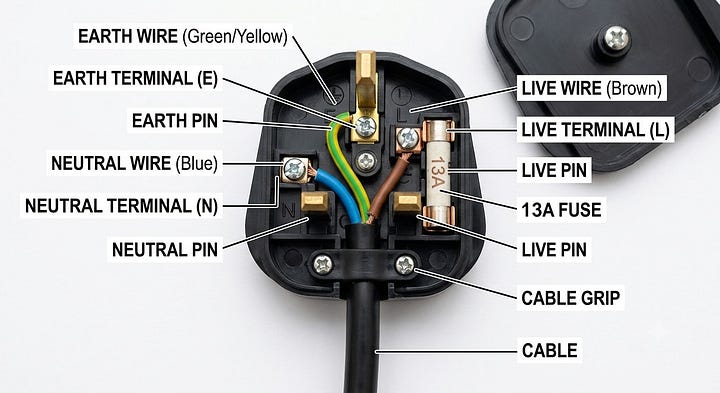
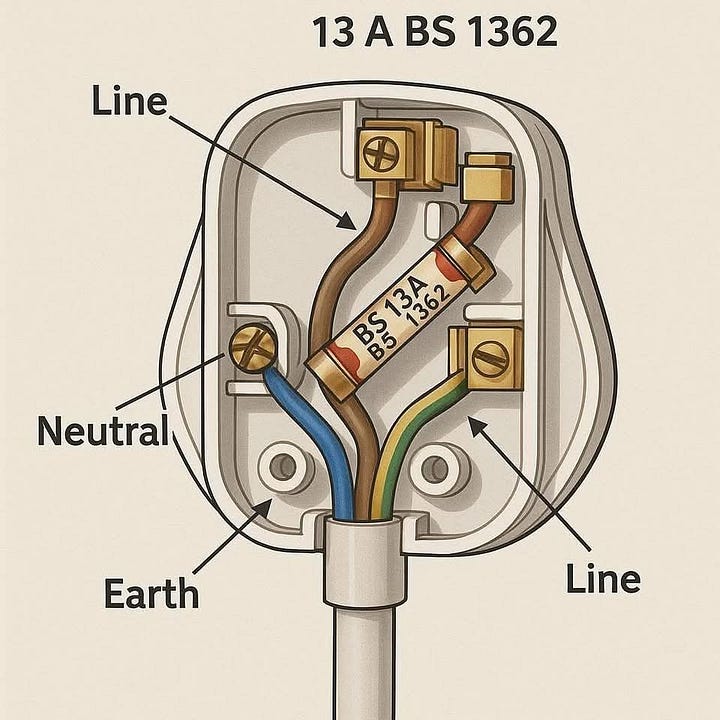
We cannot wait for World Models that will apparently get it right because they will understand what an AC circuit actually is, and how it is supposed to work, but lets see if that actually comes to pass.
If you look at the two AI examples, one is obviously wrong but other one is as well. Close but no cigar, after all the three main pins are extruded back towards you and out through the plug cover rather than the other way so that they could end up in the wall. Not even the most likely answer on that one Gemini / ChatGPT / Claude 😀.
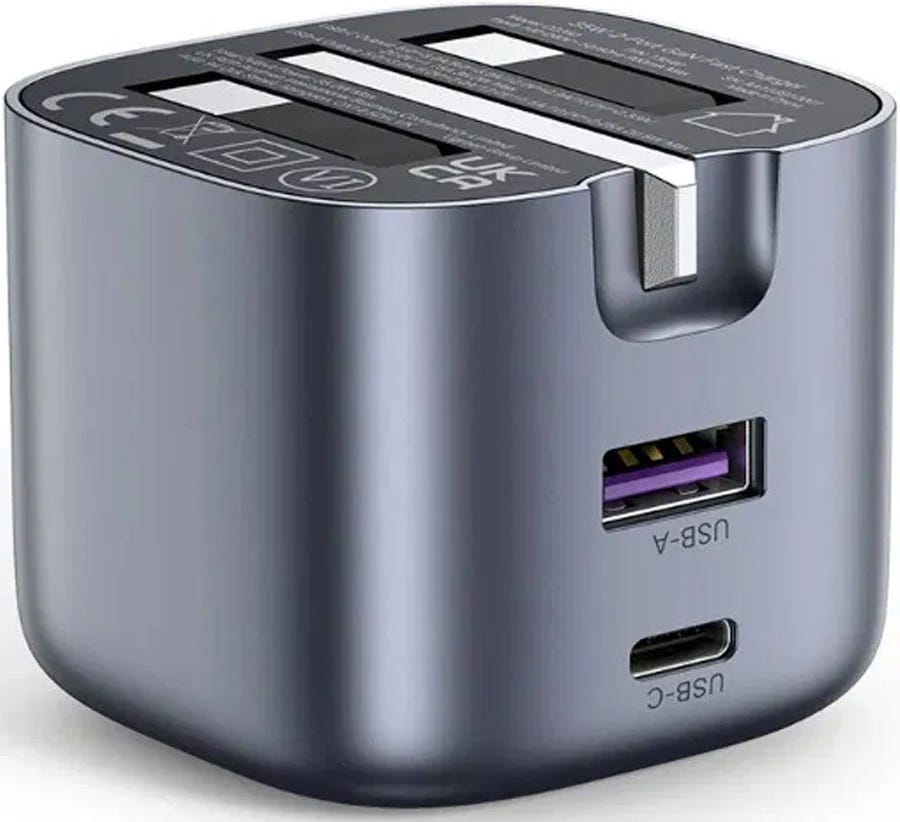
However it would be nice if there more of those collapsible ones, You know the ones that recess the pins of the plug into the body when not in use. I would love more of those This is because it is pretty big when fitting it into the travel bag, but still I swear by my British Plug as standardised by BS1363, and you should too - not those somewhat poorer designs you come across in other places. So lets hear it for the humble BS1363 plug and one Dame Caroline Haslett - a STEM icon.
No posts
Comments
Nothing yet. Say the first thing.
Sign in to join the conversation.