
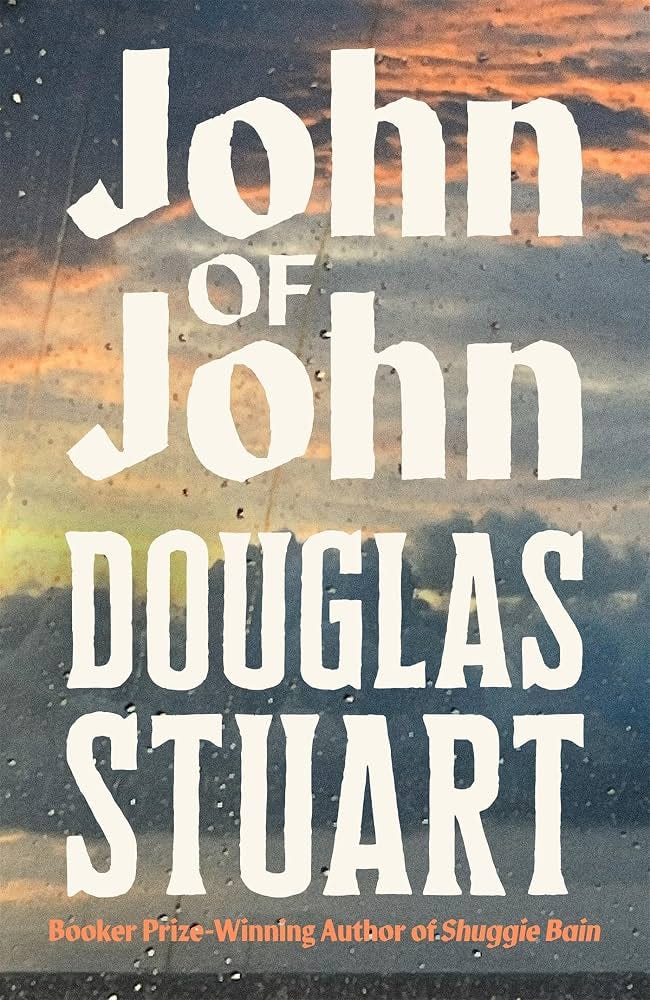
I finished Douglas Stuart’s John of John just as it was announced that it had been longlisted for the Booker. Even before I picked it up, I had a strong feeling it would feature on awards lists and end-of-year round-ups. Not an especially bold guess on my part. Stuart won the Booker for his debut Shuggie Bain (a book I have not read1) and John of John received glowing reviews when it came out in May. What finally got me across the line was the NYT Book Review Book Club choosing John of John as July’s book.
That’s a whole lot of needless throat-clearing and justification to say that I really liked John of John. I know saying you were “moved” by a novel is a flogged-to-death cliché, but John of John absolutely fits the bill.
The novel is the story of two gay men (well, actually, three gay men… but we will circle back to that), both named John. If you’re smarter than me, the title will have clued you into the fact that the Johns are father and son. Neither has come out as gay. Not because the novel is set in the 1990s, when the stigma of AIDS was still front of mind, but because both men are part of a deeply devout Calvinist community. John Macleod, the elder, is a sheep farmer, weaver and respected member of the Free Presbyterian Church who knows he will be expelled from the church if he’s found to be gay. His son, John-Calum, who goes by Cal, has been attending a textile school on the mainland and, as such, has been a little more open about his sexuality. But on the pretext that his grandmother, Ella, is ailing, his father guilts Cal into returning to the (fictional) town of Falabay.
In truth, Ella is perfectly healthy—as healthy as an old woman can be while enduring the bitter, windy, rainy, rocky surroundings of Falabay. Ella, who was by far my favourite character, is outspoken and oddly charming, but also very canny and careful (when she needs to be), and manipulated Cal’s return for reasons of her own. The point is, the twenty-something (who, to be fair, is skint; there’s not much design work on offer for a graduate in 1990s Scotland) returns to a place where he has to hide who he is from everyone he knows. The exception is his best friend, Doll. Before he left for the mainland, Cal and Doll were occasional lovers. Cal is also unaware that his father is gay and in love with the next-door neighbour, Innes MacInnes (yes, cracking name), both men hiding their shared affection from the small community.
It’s an emotional minefield, made all the more challenging by Cal’s mother, Grace (Ella’s daughter), who left John for John’s brother after she found her husband with Innes.2 While she has no intention of ever revealing her husband’s secret, when Ella dies, it’s Grace who will inherit the house and the croft, throwing John out onto the street.
So, yeah, plenty going on.3 But Stuart paces the novel like a pro, skilfully juggling story with character. I found it interesting that, despite the title, the novel increasingly centres on John’s relationship with Innes, one he can’t fully embrace or sometimes even acknowledge (even in secret behind thick curtains), so riven is he by guilt. A guilt he takes out on his son physically and psychologically. Cal further complicates things by falling for Innes, a situation that, in lesser hands, would be ripe for melodrama, but instead speaks to a desire, a yearning, shrouded in shame and concealment.
As sad and tragic and mournful as John of John can sometimes be (it’s also funny; Ella cracked me up several times), it didn’t reduce me to tears.4 Stuart wants you to feel for his characters, to love them despite their flaws, but he’s also not interested in wish fulfilment or emotionally manipulative (or even cathartic) climaxes.
There’s a warning of this early in the novel when Cal replies to a “lonely hearts” ad from a man, William, living on the mainland. It’s all very awkward and tender and a little bit naughty, especially after Cal sends William a knitted facsimile of his cock (brilliant, brilliant scene). And just when we think something will come of it… Stuart says no. That’s not how this works. Cal gets a curt rejection letter back from William, cock sock included. That’s the novel in a nutshell, Stuart reminding us that life is difficult, that no matter how hard we work, or how nice we are, or how much we love, things don’t always play out the way we want them to. And if that sounds dour and earnest and bleak, fear not. There will be few books you read this year so full of life.
But it could be pulled out of Andy Miller’s Gilded Amaretti Posh Bingo Tin of Destiny in the next several months.
This is one cliché I could have done without—but it’s a small sin, though not for a Calvinist!
There’s a subplot involving the two Macdonald children—Doll and Isla—also neighbours of the Macleods. Doll is an alcoholic. Isla is the eighth-smartest girl in Scotland (sort of), but “ruins” herself in the eyes of the Church when she goes and gets herself pregnant.
Though I did learn quite a bit about crofting and weaving. That John works himself to the bone tending the land and caring for the sheep while owning none of it, is depressing. As for the weaving, I had no idea how strictly governed the process was with strict rules to ensure the garment is made using traditional methods. Fascinating.
No posts
Comments
Nothing yet. Say the first thing.
Sign in to join the conversation.