

- The annual economic value of US coral reefs, according to NOAA. The flood protection they provide is half of this value, with the other half coming from fisheries and tourism.
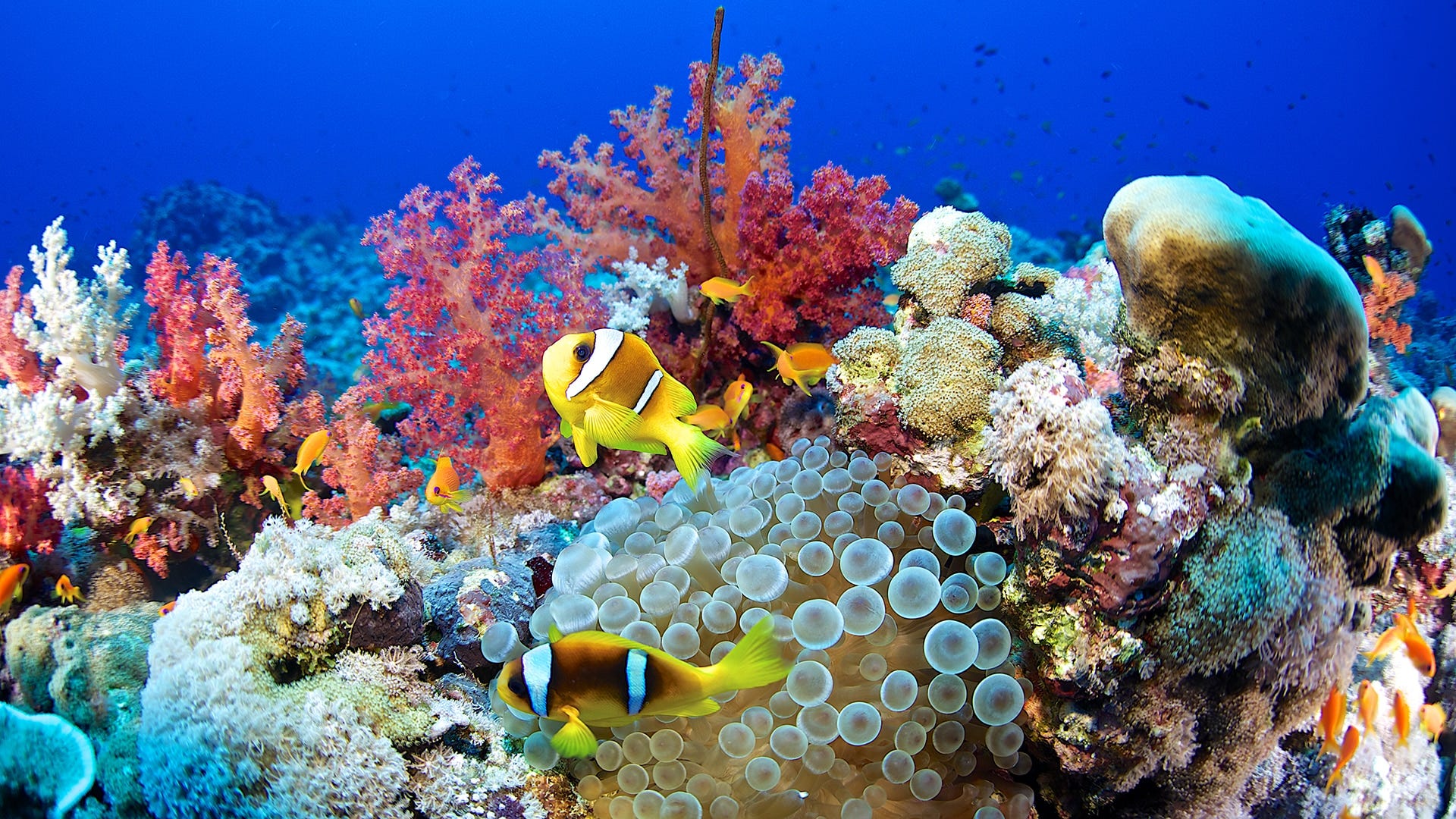
Coral reefs, besides being beautiful ecosystems that we find inherently valuable, are important for food, income, and potentially future medicines.
Some 25% of fish rely on coral reefs1, and roughly half a billion people depend on these fish for a significant share of their protein, and/or income. Compounds found in coral reefs have also led to life-saving medicines, with more to be discovered.
Besides these objective goods, preventing the destruction of coral reefs would also be a benefit to the way we conceive of ourselves as stewards of this planet. We want to live in a world where the sentiment that humanity is a ‘scourge’ on the planet is rare, not mainstream.
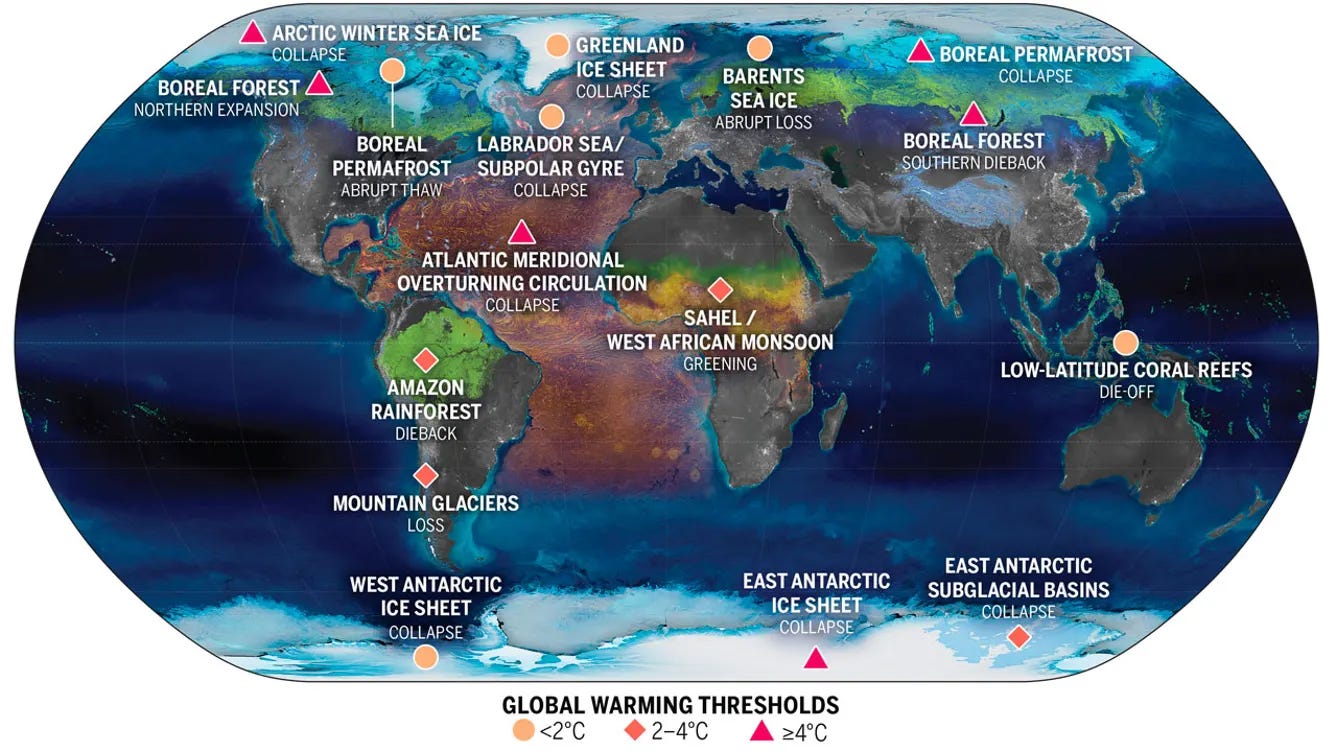
Unfortunately, coral reef bleaching is one of the first tipping points, occurring at just 1.5°C, which we’re currently at. The death of most coral reefs will be irreversible in just decades, while most of the other tipping points listed below occur over timescales of 50+ years before becoming irreversible.
Good question! It is perhaps the weirdest animal.
Corals belong to the phylum Cnidaria, which includes jellyfish and sea anemones.
They begin their life as a < 1mm larvae before attaching to rocks, and metamorphosing into a polyp. This polyp then attracts and retains a photosynthetic algae called zooxanthellae, which provides food for the coral polyp over its lifetime as it reproduces asexually through budding and/or fragmentation, growing in size.
Different coral species then reproduce sexually through either broadcast spawning like salmon (releasing eggs and sperm that float to the surface and combine), or brooding, where coral sperm swims to other corals and fertilizes its eggs within the coral.
70% of coral species are actually hermaphroditic, so any coral can reproduce with any other coral.
I recently attended the second annual Progress Conference where Ramez Naam, a clean energy advocate and author gave a talk on the most promising methods to save coral reefs. Here’s my understanding and summary of them.
There are 800+ species of coral-building reefs, including ones that live in the Arabian Sea and around the island nation of Palau in Oceania, which are capable of withstanding significantly higher temperatures than the species of coral native to places like the Australian Great Barrier Reef (GBR).
One proposed solution to coral die-offs outside of these areas is to introduce these non-native corals, and have them replace the native species.
We don’t know how the ecosystem would be affected, and what biodiversity would be lost due to incompatibility with the new species. Australians also aren’t enthusiastic about accepting extinction for the coral species that makes up the GBR.
A more palatable approach is to cross-breed native corals with more heat-resistant corals from the Arabian Sea or Palau.
There is evidence this has positive results in the same coral species that make up the GBR, though the observed tolerance is less than that of the purebred heat-tolerant species.
There are experiments underway which aim to artificially breed the native corals to be more heat-tolerant.
If successful, this would retain the natural biodiversity of the local coral species, while hastening their adaptation to warming oceans.
The temperature and acidity of the water are gradually raised, and the individual corals most suited to these conditions are selected to birth the next generation. This process continues until individuals from the local coral species can withstand future ocean temperatures.
There is some evidence that this approach can yield corals that can better survive short-duration marine heatwaves, but long-term success is unclear.
In the last decade, we’ve made enough progress in understanding how coral genomes are organized to edit them directly. We know at least a dozen genes associated with heat-tolerance, including many of the same heat-shock proteins that we have!2
Directly engineering a combination of these genes would yield greater heat-tolerance in corals.
Based on a survey of over 1,000 Australians, there is fairly strong support for this idea if the benefits are clear and the risks are relatively small. I had thought concerns about unknown risks from genetic editing would be larger in the general population, but I’m quite enthused that protecting the reef seems to outweigh default skepticism of genetic engineering.
Coral bleaching occurs after stressed corals expel their natural symbiotic3 algae zooxanthellae, which provide them 70% of their nutrients. If the corals do not then reacquire these algae, they begin bleaching.
Experiments have shown that changing the algal species to one from more heat-tolerant coral species influences gene expression within their coral hosts. The exact mechanisms and how far this effect can be taken are still being studied.
Coral reefs provide a huge amount of protein, income, and biological compounds (medicines) to humanity. Their loss would be more than emotionally painful, though the damage to our collective psyche and self-concept as a species should not be overlooked.
Despite coral reef bleaching being our earliest and most rapid tipping point, we have multiple avenues to save them. Long-term, the most effective way to save the corals is to slow down, halt, and then reverse the warming of our oceans. However, our cumulative emissions to date puts us in a situation where direct intervention is necessary to save corals.
While we don’t yet know which method, or which combination of methods will prove the best, there is no fundamental reason it can’t be done. Like saving the ozone layer and banning whaling, preventing the death of coral reefs can be an environmental win that proves we are capable of averting disaster.
Thanks for reading! Restacking this on Substack is the best way to support me, and help imperfect, but improving! grow.
Edited by my wife Minttu!
Sources vary on the exact % of fish that rely on coral reefs. Most sources say 25%, while other numbers can be found. It is highly regional, with Southeast Asia particularly dependent on them.
I was surprised that we shared some of the same heat-shock proteins with corals, since that indicates they originated prior to our evolutionary divergence. It turns out they are truly ancient, originating prior to the emergence of bacteria and archaea.
Technically, corals and zooxanthellae are mutualistic because they depend on one another for survival.
No posts
Comments
Nothing yet. Say the first thing.
Sign in to join the conversation.