
Much has been written about Peto’s Paradox - the surprising fact that larger animals aren’t bursting at the seams with tumors, rather exhibiting even lower cancer rates than smaller animals.
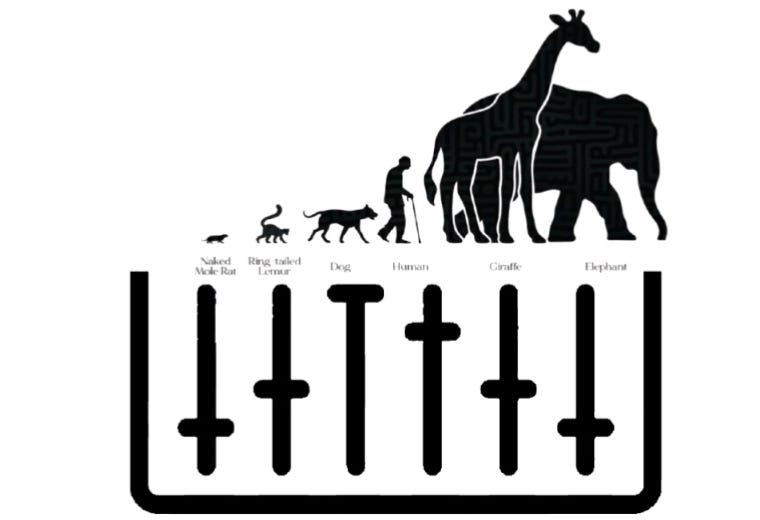
Small animals with notably low cancer rates have often received less attention. Squirrels and naked mole rats have super low cancer rates - especially for rodents.
Is there something that helps explain the cancer rates we find on both ends of this size spectrum? Perhaps!
An interdisciplinary team from the University of Buenos Aires published their proposed explanation in Science in November 2025. My video covering their paper got a couple million views and lots of interesting questions, so I reached out to them to discuss it in greater detail. They kindly obliged.
In a nutshell, they propose that specific rates of cancer (including high rates!) may be selected for by evolution, depending on an organism’s lifestyle.
In the case of species that cooperate and spend a lot of time and resources caring for their young, this is intuitive. Having mom and dad die of cancer isn’t ideal when you’re young and totally dependent on them. If mom or dad has genes that decrease the likelihood they get cancer, their children are more likely to survive, and mom and dad may even live long enough to make more children, further spreading their anti-cancer gene(s).
The selection pressure is straightforward, and helps explain why cooperative species that invest a lot into their young like whales and elephants have special cancer-resistance mechanisms (fewer mutations, or a greater tolerance for mutations, respectively).
But cancer kills, so why do so many species like cats, dogs, and rodents still have high cancer rates? Why didn’t they develop cancer-resistance mechanisms?
Professor Matías Blaustein, the senior author of the paper summarizes the two standard answers to this question at the beginning of our interview:
Antagonistic pleiotropy: cancer is a side-effect of genes that drive growth and development, so it sticks around, especially considering that -
Evolution is “blind” to it: Individuals usually get cancer after they’ve already reproduced and passed on their genes, so evolution cannot “see” the fact that these genes happen to cause cancer later in life.
While these explanations seem to make sense, they actually leave much unexplained.
Why do squirrels have low cancer rates, when they have similar lifespans to rats? Neither of the above explanations provides a reason.
The answer proposed by this paper is that high rates of cancer can actually be evolutionarily beneficial in species with lots of internal competition.
In the right situation, a cancer-causing gene can actually increase an individual’s chance of reproductive success by allowing its offspring to prosper.
This received more questions and skepticism than any other aspect of the paper, and I want to focus on it in depth because it gets at a longstanding debate in evolutionary biology.
In species that compete internally for resources, shortening the lifespans of the oldest members frees up resources (like food, territory, or mates) for the younger members. This is a known phenomenon in ecology, termed the Hydra Effect.
But as many comments pointed out - there’s a puzzle here.
Sure, the Hydra Effect can be true, but how would it cause a pro-cancer gene to spread through a population? If one rat develops a pro-cancer gene, it will die earlier on average, and have fewer offspring on average. Stating that this gene would spread through the species sounds a lot like it would happen “for the good of the species,” which is termed group selection.
Group selection was ridiculed by evolutionary biologists in the 20th century, but has a place in today’s understanding of evolution. It is the idea that beneficial traits are determined at the group level. A colony of ants that help one another is going to defeat a rival group of ants that don’t help one another, so the altruistic “help-one-another” traits from the first group would survive, and be selected for.
However, very few species are colonies in this way, so group selection is not seen as a driving evolutionary force in animals like rats or primates because they rarely organize in silos where cross-group mating does not exist. Today, evolutionary biologists see group selection as a valid, but ultimately weak evolutionary force.
The authors are ultimately agnostic as to the exact selection pressures, and how they vary by species, but I want to dive into a traditional kin-selection example to explain how this theory holds even if you think group selection is nonsense in most contexts.
A gene that shortens the lifespan of an old daddy rat can still spread selfishly through the species, as long as the death of the old daddy rat increases the survival odds (and therefore expected number of offspring) of his children.
If the old daddy rat is protective of his territory and other female rats, is violent to the children, or hogs food from his children, then his early death (from cancer) would increase his children’s survival and reproduction odds. This is classic kin-selection, with no need for group selection pressures.
This logic has been formalized as Hamilton’s Rule: as long as the expected benefit to your genetic relatives is larger than the cost to you, then that altruistic gene will proliferate.
In species with lots of internal competition, dying early is a form of altruism to the young!
In my opinion, this theory does a much better job of explaining why some species have evolved cancer resistance, while others have not. Evolution is clearly capable of developing these mechanisms, and existing theories don’t do a satisfying job of explaining why evolution found a way in one species, but not another with a similar size and lifespan. As this area of research evolves, I’m sure the explanation will become more nuanced, and identify which factors are particularly likely to increase or decrease the selection pressure for cancer.
A huge thanks to Matías Blaustein, Julian Maxwell and the rest of their team for taking the time to chat with me about their publication.
Thanks for reading! Leave any questions you have in the comments, and I can pass them along to the authors if I don’t have the answer.
Edited by my wife, Minttu
No posts
Comments
Nothing yet. Say the first thing.
Sign in to join the conversation.