

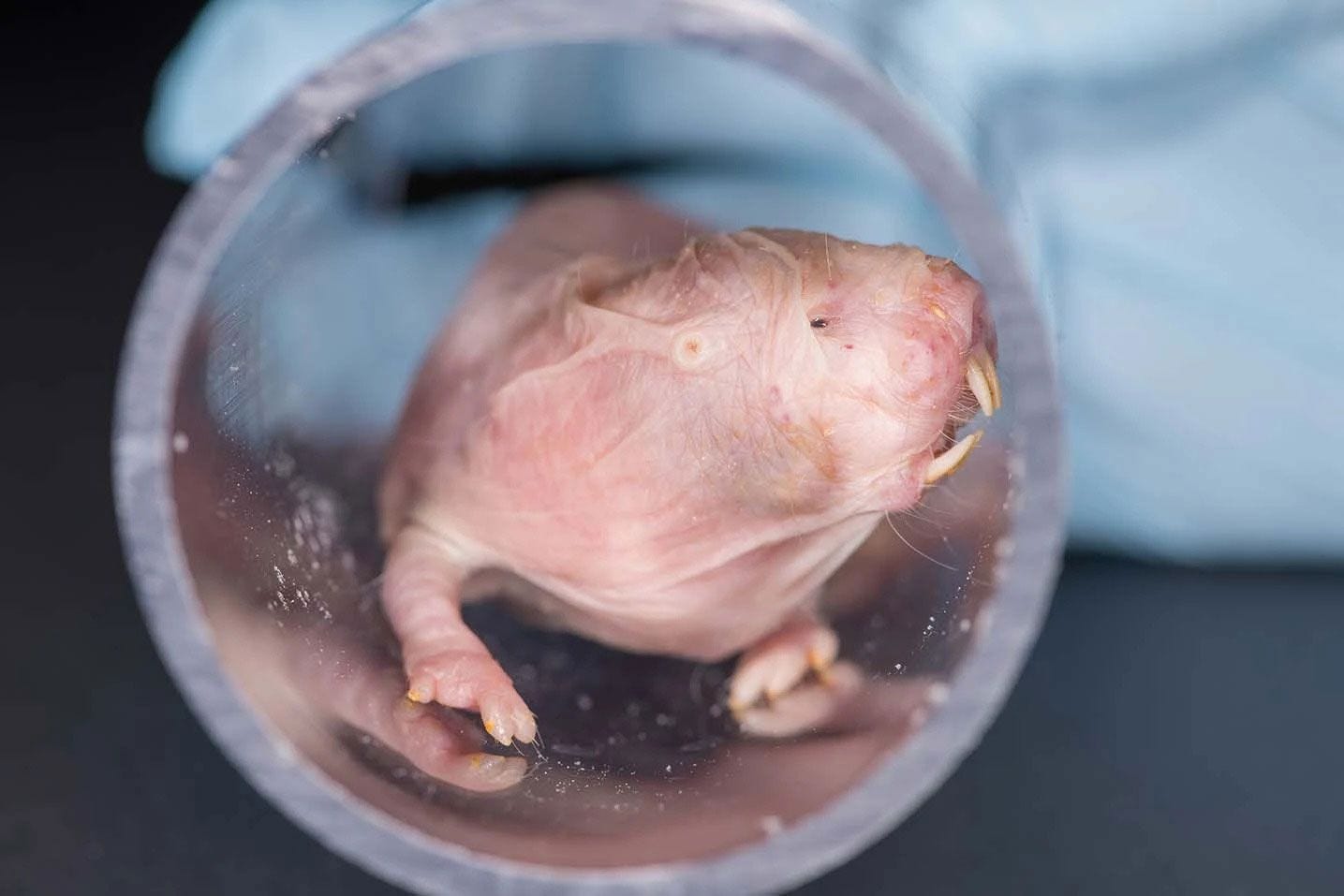
- The oldest confirmed age of Joe, the world’s oldest naked mole rat.
I can’t find an update on him since this 2021 article, so it’s possible he’s over 40 now. If you were born after 1985, there’s probably a naked mole rat older than you.
Scientists discovered at least one reason why bowhead whales (the longest lived mammal, and the second largest animal in the world), get so little cancer (“Peto’s Paradox”)
Similarly, scientists discovered at least one reason why naked mole rats get much less cancer than expected, particularly given their extremely anomalous lifespans (20x longer than rats or mice)
Scientists theorized a reason that evolution would not select against cancer, and could even favor it in certain types of mammals
Each of these topics could be the subject of a whole article, but they intersect in fascinating ways, with the last paper giving a really nice conceptual framework by which to understand the first two.
Cancer is essentially a random process. For a cell to begin growing uncontrollably, its genome has to suffer a series of mutations in the wrong places. Some growth-causing genes have to be mutated or over-expressed so they are continuously promoting growth, while other tumor-suppressing genes are mutated so they no longer prevent uncontrolled cell division.
As animals get larger, they have more cells, and they also tend to live for longer. Given the essentially random nature of cancer as a series of unfortunate mutations that occur to a cell’s DNA, this should mean the bigger, or longer lived, the organism, the more opportunities for cancerous cells. However, this is not what we observe.
Bowhead whales are the longest lived mammal at ~200 years1, and the second largest at ~80,000 kg. For comparison, mice live for 2 years and (chonky mice) weigh 40 grams. Given the bowhead whale’s 100x lifespan and 2,000,000x size compared to mice, one would expect bowhead whales to have 200 million times the rate of cancer. Yet, this is not the case.
This is “Peto’s Paradox.” Why do larger, long-lived animals not immediately become riddled with tumors?
There are 3 solutions to this paradox, or a combination of multiple:
Larger/long-lived animals get fewer mutations
Larger/long-lived animals can sustain more mutations before cells become cancerous
Larger/long-lived animals are more resilient to cancerous cells (through better immune responses or other mechanisms)
The second explanation has been the most favored - that larger animals have more tumor suppressing genes and therefore could handle more mutations before developing cancer. For example, elephants have 20 copies of p53, a tumor suppressing gene that is mutated in most human cancers. In comparison, humans have only 1 copy.
However, bowhead whales also have just one copy of p53, and their cells actually required fewer mutations than human cells to become cancerous2. So what’s the explanation behind their low-cancer incidence and longevity?
A study published last month in Nature shows that bowhead whale cells are better at repairing double-stranded DNA breaks3, which prevents disastrous mutations from occurring in the first place. They have roughly 100x the amount of a particular protein in their cells, which enhances the repair process, resulting in fewer mutations. Scientists even transplanted this protein into fruit flies, and showed that it improved their ability to survive radiation.
Double-stranded DNA breaks are responsible for a small portion of all cellular mutations, but the mutations they can cause are particularly devastating. This is the reason that radiation increases the risk of cancer - by inducing double stranded DNA breaks.

Understanding the mechanisms behind bowhead whale and other long-lived mammals DNA repair is likely to be essential for extending human longevity - AND it segues beautifully into the next paper.
Just a few weeks prior, this study was published in the journal Science, explaining one reason why naked mole rats have better ‘genomic stability’ (lower mutation rates) that contributes to their low cancer rates and long lives.
There’s a protein complex in mammals called cGAS which helps our immune systems respond to infection. Once it detects DNA floating around outside the cell nucleus (a sign that bacteria or viruses have invaded the cell), cGAS responds by activating immune processes. This is a key part of our innate immune system.
However, cGAS can float into the cell nucleus, where it can impair our ability to repair double-stranded DNA breaks, because it can bind to DNA and get in the way of the repair machinery. This isn’t ideal.
This breakthrough finding shows that naked mole rat cGAS varies from human/mice cGAS by just a few amino acids4, and that makes all the difference. Instead of impairing the process of repairing double-stranded DNA breaks when cGAS is in the nucleus, naked mole rat cGAS improves it.
Scientists even placed this version of cGAS into both mice and fruit flies, and saw all kinds of general aging improvements.
“Consequently, naked mole-rat cGAS attenuated stress-induced cellular senescence, mitigated organ degeneration, and extended life span in fruit flies. Furthermore[…] virus–mediated delivery of naked mole-rat cGAS to aged mice reduced frailty, attenuated hair graying[…] and decreased cellular senescence markers in multiple tissues.” - Science paper
This is not only a big finding for the importance of DNA repair, but through isolating the exact differences, the benefits of this slightly-differently-shaped protein can translate well into improvements for other organisms.
But why did evolution come up with clever solutions to decrease cancer in whales and naked mole rats, but not humans?
“Nothing in biology makes sense except in the light of evolution.”
— Theodosius Dobzhansky
If evolution developed elegant solutions for preventing cancer in whales and naked mole rats, why not humans? There are big benefits to living longer since we’re so intelligent and accumulate knowledge over our lifetimes, and this is clearly something evolution noticed and rewarded. After all, we are one of the only species to evolve menopause5 so that older women survive longer and can share their wisdom with younger generations!
The general explanation for cancer prevalence has been that it is:
A negative effect of growing faster, and evolution simply prioritized growing faster in some species because that was more important
And/or evolution is relatively blind to cancer, because older individuals reproduce less or die of other causes, so decreasing their cancer rate isn’t very important
However, a new paper found some correlations between cancer rates and animal lifestyles that present a very pleasing answer to why evolution worked hard to decrease cancer in some mammals, while not giving a damn in others (big cats, dogs, rats, ferrets, opossums).
They find that cooperation, vs competition, is a particularly good framework for understanding why evolution favors cancer in some species.
“We hypothesized that cancer prevalence and mortality risk might have been fine-tuned by evolution. Using public databases, we show that species with cooperative habits have lower cancer prevalence and mortality risk.” - Sierra et al.
This makes intuitive sense - it’s the same logic as the evolution of menopause. Old members help younger members, and the whole tribe is better off.
But why would evolution ever favor cancer?
A phenomenon called the Hydra Effect explains it. In species with high rates of internal competition for mates and resources, decreasing the lifespan of an individual can actually lead to an increase in the overall population size!
Basically, be eliminating seniors earlier, resources and mates are freed up for the younger, more reproductive members (who would also birth healthier offspring).
In addition to being conceptually intuitive, this tracked with the data. The more competitive a species was, and the more children they birthed in a litter, the more likely that species is to have high cancer rates6:
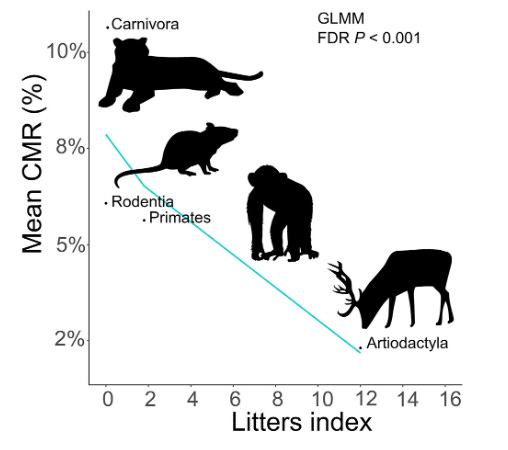
There isn’t as much competition in herbivorous species like deer as there is in carnivorous mammals, and the cancer rates correlate with that intuition.
So why do humans have the cancer rates we do? Because evolution found that rate to be somewhat optimal for primates, given their cooperative, intelligent, yet still internally competitive dynamics. Thankfully, our lifespans are no longer limited to the whims of evolution, and we can learn borrow and learn from the solutions evolution engineered for preventing cancer in other mammals!
Thanks for reading! Restacking and sharing this newsletter is the best way to support me, and help imperfect, but improving! grow.
Edited by my wife Minttu!
In this case, the “fewer mutations” required for bowhead whales to become cancerous were instead tracked as the minimum number of cellular pathways that had to be disrupted before a cell could become cancerous. In mice it’s 2, in humans it’s 5, and in bowhead whales it’s 4.
The particular protein in bowhead whales is CIRBP: cold-induced RNA-binding protein.
Naked mole rat cGAS has 16 amino acid differences out of the 522 amino acids that make it up, but only 4 matter for the active binding sites and give naked role rat cGAS enhanced DNA repair properties. They proved this by creating cGAS with only those 4 amino acid differences, and showed that the benefits of this version of cGAS disappeared if those amino acids weren’t different.
The species that have evolved menopause track VERY well with being highly social, intelligent creatures. Orcas, other smart-ass whales, humans and chimpanzees.
The authors actually analyzed species by the order they belong, to smooth the data out and create nice curves. I say species for simplicity/brevity sake. They also analyzed within each order as well, but the chart groups species by the order they belong to.
No posts
Comments
Nothing yet. Say the first thing.
Sign in to join the conversation.