
In a little under three weeks I’m performing with a small number of other readers at an even focused on Climate Change. Having been invited to read, I needed to scan my back catalogue to check for material that might fit the bill; the last thing I wanted to do was to ‘write to order’. I did that once for an altogether different topic/event and I don’t think it turned out very well…
Happily — and a little surprisingly! — I discovered I had sufficient material to fulfil the obligations attendant on a 15-20 minute slot. I say ‘surprisingly’ because I’ve never considered climate change as a ‘hot topic’ for my writing; a serious issue, obviously, but not one I’d consciously dedicated too much effort to writing about.
My pieces come at the subject from an oblique angle, looking at aftermaths and impacts rather than causes; either that or they find an alternative way into the subject, allowing it to lurk like a shadow in the background. In their own way they are quietly political.
When I was editing New Contexts’ anthologies during Covid I saw far too many ‘covid poems’. The majority — and the weakest — tried to tackle the subject matter head-on, were opinionated and explicit, happy to lay blame, be self-righteous and all-knowing. It seemed to me that many people were attempting to write ‘the definitive covid poem’. However, the most effective poems were those which looked at the epidemic and its after-effects through a slightly skewed lens, one step removed from the coal face. The subtlety worked well, as did the space these poems allowed readers to inhabit for themselves.
“Tell it slant” - Emily Dickinson
Of course it’s very easy — and very reductive — to come at a subject such as climate change with a set view, a notion of ‘right’ and ‘wrong’. The danger, from a writer’s perspective, is that the importance of the message can be lost if a piece comes across as bombastic and opinionated, if it attempts to talk down to its audience or tells granny how to suck eggs. There’s probably no simpler way of alienating your audience by telling them they’re wrong, whatever the subject.
Perhaps that’s why, in casual conversation, we’re encouraged not to talk about sex, politics or religion. Each of these are subjects where people can adopt entrenched views all too readily (two out of the three start wars, for goodness’ sake!). Stand up in front of an audience of Americans and declaim, explicitly, that all Democrats are Commies or all Republicans are Fascists and you will have lost at least half your audience straight away!
Which is why I hope my fellow readers in a couple of weeks are not people who see the event as an opportunity to drive home their ‘message’ bluntly and without subtlety. Given most people are capable of joining the dots and thinking for themselves, I hope they choose to come at the topic more ‘slant’ than not.
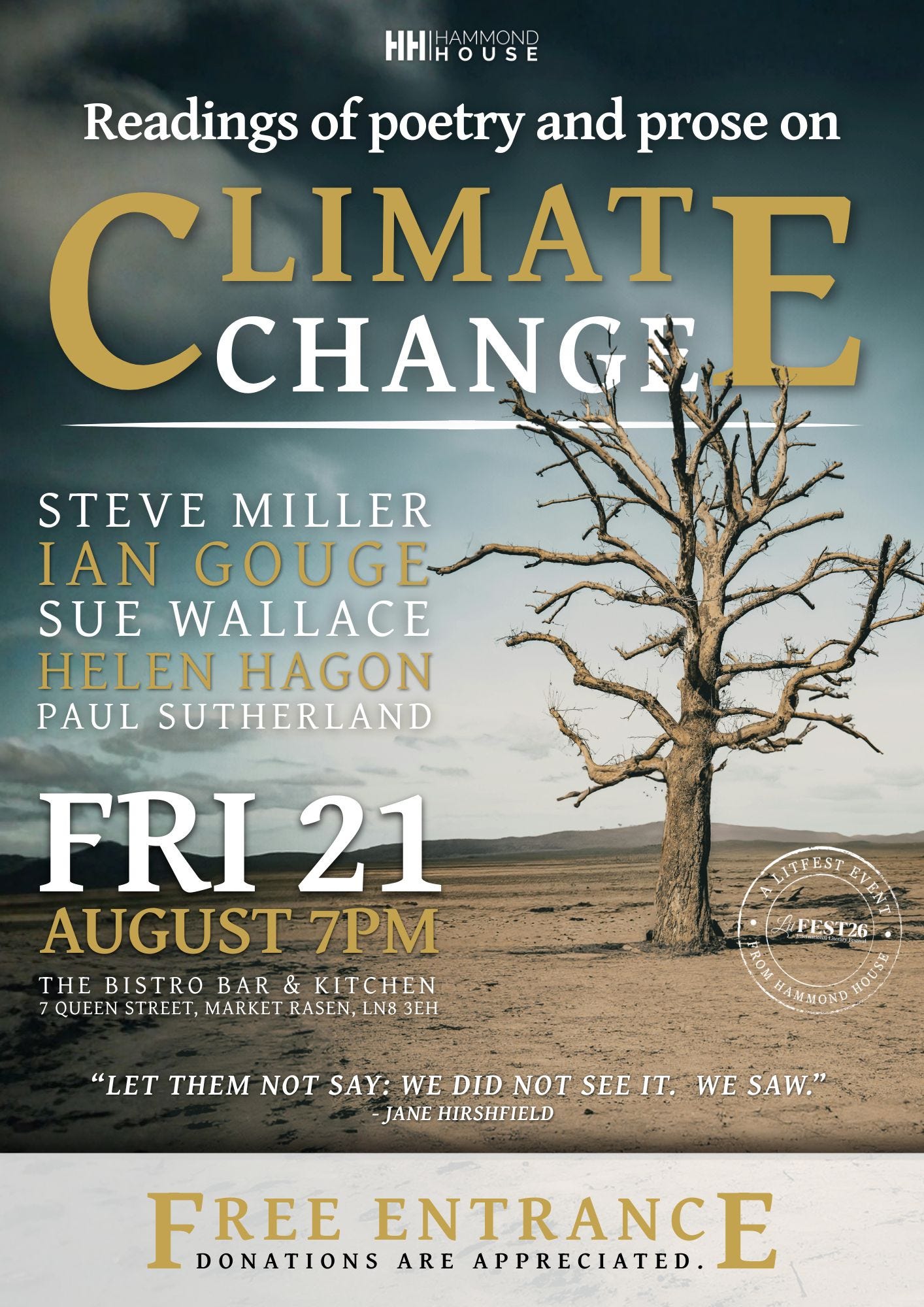
This is one in an occasional series of articles where I share some of my work using a ‘theme’ of one kind or another as the jumping-off point. In this case, Climate Change.
Text within this block will maintain its original spacing when published
The Mirage of Progress
Trapped in the heat between mountain ranges
where the air is lip-chapping dry, Dust Devils spin,
harbinger winds blowing death from the sun-baked lake
salt-coating farms whose barren tracts kiss the horizon.
Loosed from the deep recesses of time, an arid
iron-rich landscape unfurls like a leaf-shaped bowl.
Almost beyond recognition, the gentle incline of the old lake shore;
and there, a fish skull bleached brilliant white,
	a discarded pair of rubber boots,
		boats abandoned in cracked silt,
			piers that lead nowhere.
In a flash of evaporation
turquoise waters mineral-stained blood-red,
their legacy, a photo opportunity for the intrepid
unencumbered with a sense of how it once was.
Text within this block will maintain its original spacing when published
The New-Build
“Make thee an ark of gopher wood; rooms shalt thou make in the ark, and shalt pitch it within and without with pitch.” - Genesis 6:14
If it’s not one thing it’s another
his wife’s favourite maxim
designed to cover every eventuality.
At the small formica table she kneads dough,
bemoans their moving from the city,
ties herself up in the knots of her past life,
the life before him.
It never rained until I met you
a contestable complaint.
He wades through omnipresent mud
to a makeshift garden office
- a windowless Portakabin with limited ventilation -
and questions inadequate plans,
listens to the thrumming on the roof,
the antics of cooped-up caravan-children,
the restlessness of animals
corralled outside.
This is not the future he was sold.
Rumour runs in rivulets;
whispers say it’s the same everywhere,
banks bursting onto non-existent floodplains
where families like his sit and wait
uninsured against an Act of God.
If one of my books meant something to you, an honest review on Amazon or elsewhere helps other readers find it. It takes about two minutes, and it makes a real difference for an independent author. You can find my books on Amazon (probably where most people initially look) via my author page and navigate from there:
If you enjoyed this article, please ‘like’ or ‘share’ - your validation is really important to me. It’s writing’s lifeblood.
Comments
Nothing yet. Say the first thing.
Sign in to join the conversation.