

Over the years Ducati has exemplified the Italian flair for style, exhibiting both the best, and the worst. The best was brilliant, and the worst just made you ask what were they thinking? Ducati isn’t the only Italian company to display this, it is also quite common in the automobile sector, but over the years Ducati seemed to have excelled at creating a giant chasm between their best and worst designs.
This scenario basically came about because, prior to the establishment of the Cagiva Research Centre in 1985, Ducati either did their styling in house, or engaged outside designers. And often Ducati’s management was also swayed by distributor demands, particularly those of Berliner in the United States.
During the 1960s and 1970s all the sporting designs were a product of form following function. These sporting models were derived from racing machines and they were generally designed by Ing. Fabio Taglioni, Renzo Neri, and Franco Farne. This included the 125 and 175 Sport, 250 Mach 1, “Silver Shotgun” desmo singles, 750 GT and 750 SS. Only the 1973 750 Sport and rear seat design of the desmo singles were the result of outside input, these by Leopoldo Tartarini of nearby Italjet. Tartarini would later be involved in the 900 SD Darmah and 500 Sport Desmo, but that’s another story.
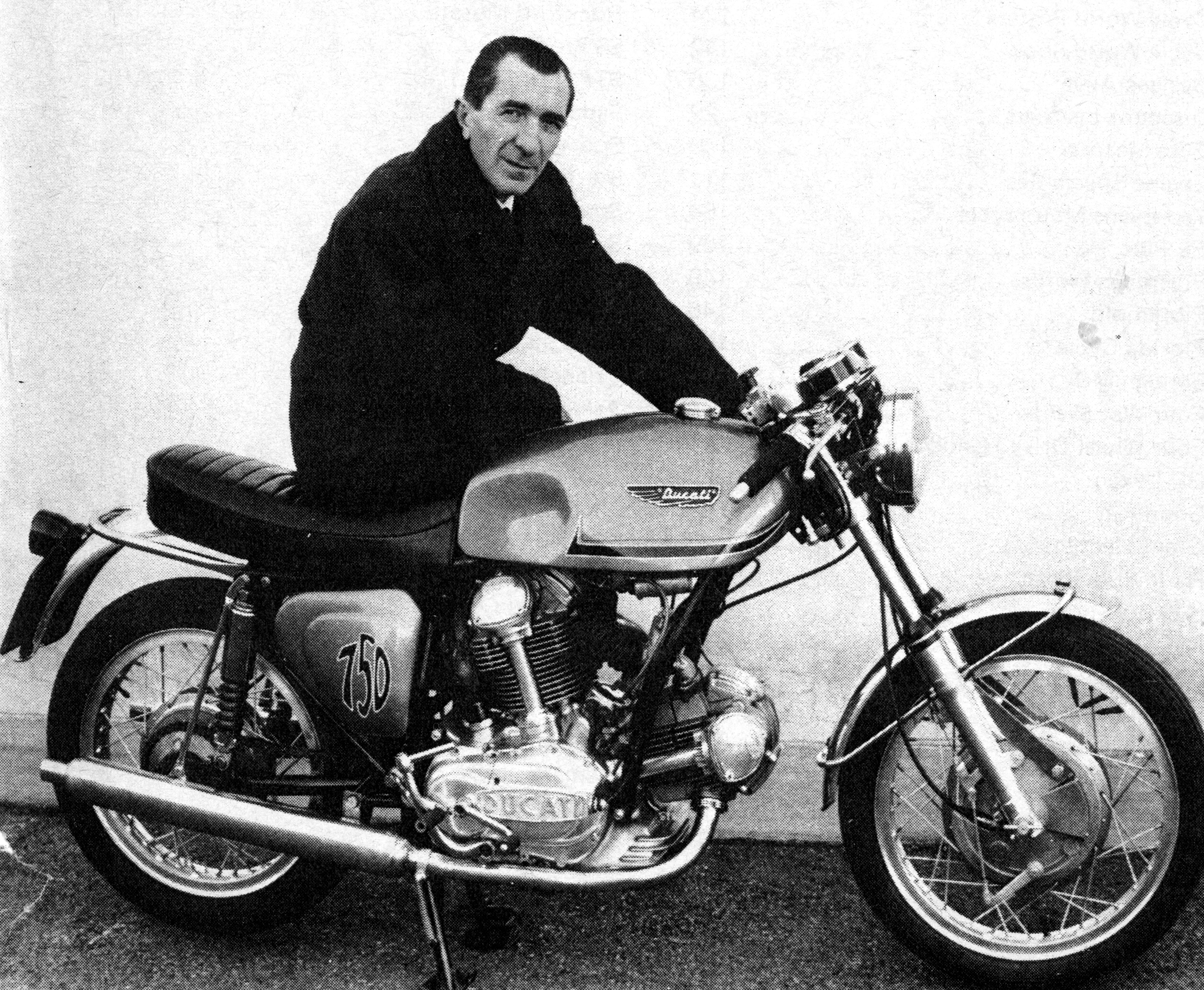
The release of the 860 GT in 1974 was the harbinger of a change in direction for Ducati. Following a series of dubious ventures, including the distribution of British Triumph cars in Italy, by the end of the 1960s Ducati was in a precarious financial position. Ducati Meccanica required an immediate injection of capital and was placed under direct government control as part of the EFIM (Ente Finanzaria per gli Industrie Metalmeccaniche) group at the end of 1969. New directors (Arnaldo Milvio, Fredmano Spairani, and Cosimo Calcagnile) and the release of the round-case 750 rejuvenated the company. Ducati won the 1972 Imola 200 Formula 750 race and was riding a wave of success they hadn’t previously experienced.
Demand for the 750 was strong but Ducati simply didn’t have the resources to mass produce the complex 750 engine. While the Ducati 750 was on everyone’s lips as the world-beating 750, fewer than 2000 twins were produced during 1972. There was simply no way the company could sustain their expensive racing program with such low production numbers, and the directors were accountable.
Milvio and Spairani paid for their extravagance, replaced by Ing. Cristiano de Eccher. De Eccher was previously with Aermacchi prior to its sale to AMF in America and he immediately implemented cost cutting and increased production. He instructed Taglioni to begin the redesign of the expensive 750cc bevel-drive engine so it was cheaper to manufacture, and he cut the racing program.
In October 1973, Ing. de Eccher announced at a press conference that Ducati would produce 15,000 motorcycles in 1974. Citing excessive production costs and difficulties in meeting increasing noise and emission legislation, de Eccher indicated the 860 GT would replace the 750. At the same time the overhead camshaft singles would make way for a new parallel twin. Besides being cheaper to manufacture, quieter and more environmentally friendly, the 860 GT would also meet forthcoming left side gearshift requirements in the US.
Unlike earlier managers of Ducati (Montano, Milvio, and Spairani) de Eccher wasn’t a motorcycle enthusiast. He wasn’t particularly interested the emotional or aesthetic aspect of motorcycles, only sales, and instead of entrusting the styling to Taglioni’s preference, Leopoldo Tartarini, he engaged automobile designer Giorgetto Giugiaro’s ItalDesign Studio at Moncalieri in Turin to style the 860. Giugiaro came with some impressive automotive credentials but he also had little motorcycle experience.
Born on 7 August, 1938, in Garessio, near Cuneo in the Piedmont, Giugiaro began his career with Fiat at the age of 17 years. Towards the end of 1959 he joined Bertone, where he designed the Alfa Romeo Giulia GT and Fiat 850 Spider. Giugiaro moved to head Ghia’s design studio at the end of 1965 and was responsible for several landmark designs, notably the Maserati Ghibli and De Tomaso Pampero. In 1967 Giugiaro established ItalDesign and in the early 1970s initiated the “folded paper” looks of straight lines and hard edges.
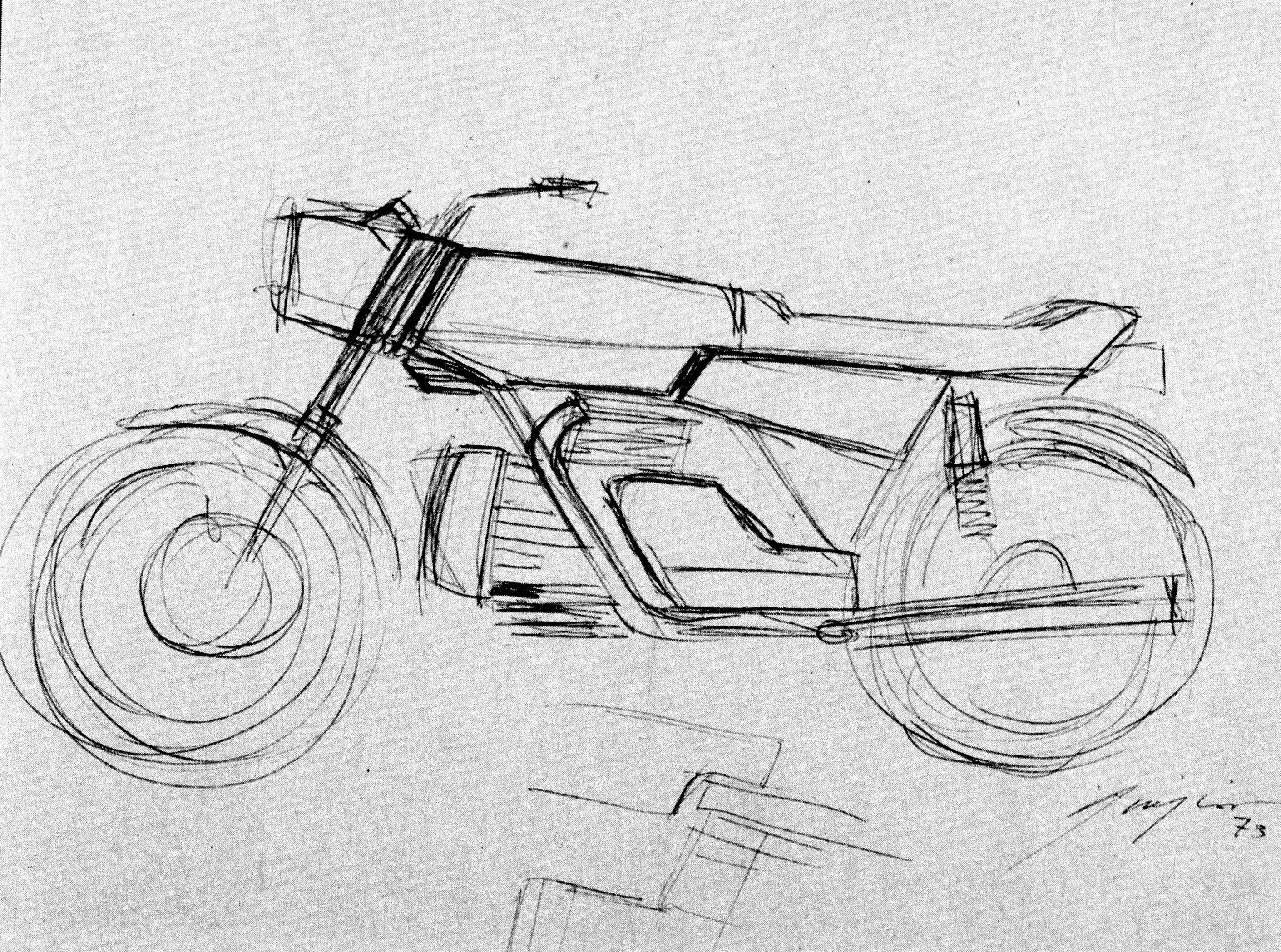
The first example of this style was the Lotus Esprit of 1972, followed by the Volkswagen Golf, Hyundai Pony and the Lancia Delta. In was within this design climate that the 860 was created. Although it seemed incongruous to commission an automotive design studio to style the 860, Giugiaro was already expanding his design parameters beyond cars and after the 860 moved into cameras, telephones and electrical appliances. His Ducati 860 design also evolved into the equally troublesome 350/500 GTL parallel twin, and also the MV Agusta 350 Ipotesi twin.
At around the same time as Taglioni was preparing the first 860cc racer a 750 GT was despatched to ItalDesign. Giugiaro and Ducati’s engineers then spent most of 1973 on the 860 project. As the engine for the 860 was also considerably redesigned, it took longer than expected for production to be implemented. The 860 GT finally went into production in September 1974, after the traditional summer break, and was available early in 1975 alongside stocks of unsold 750s.
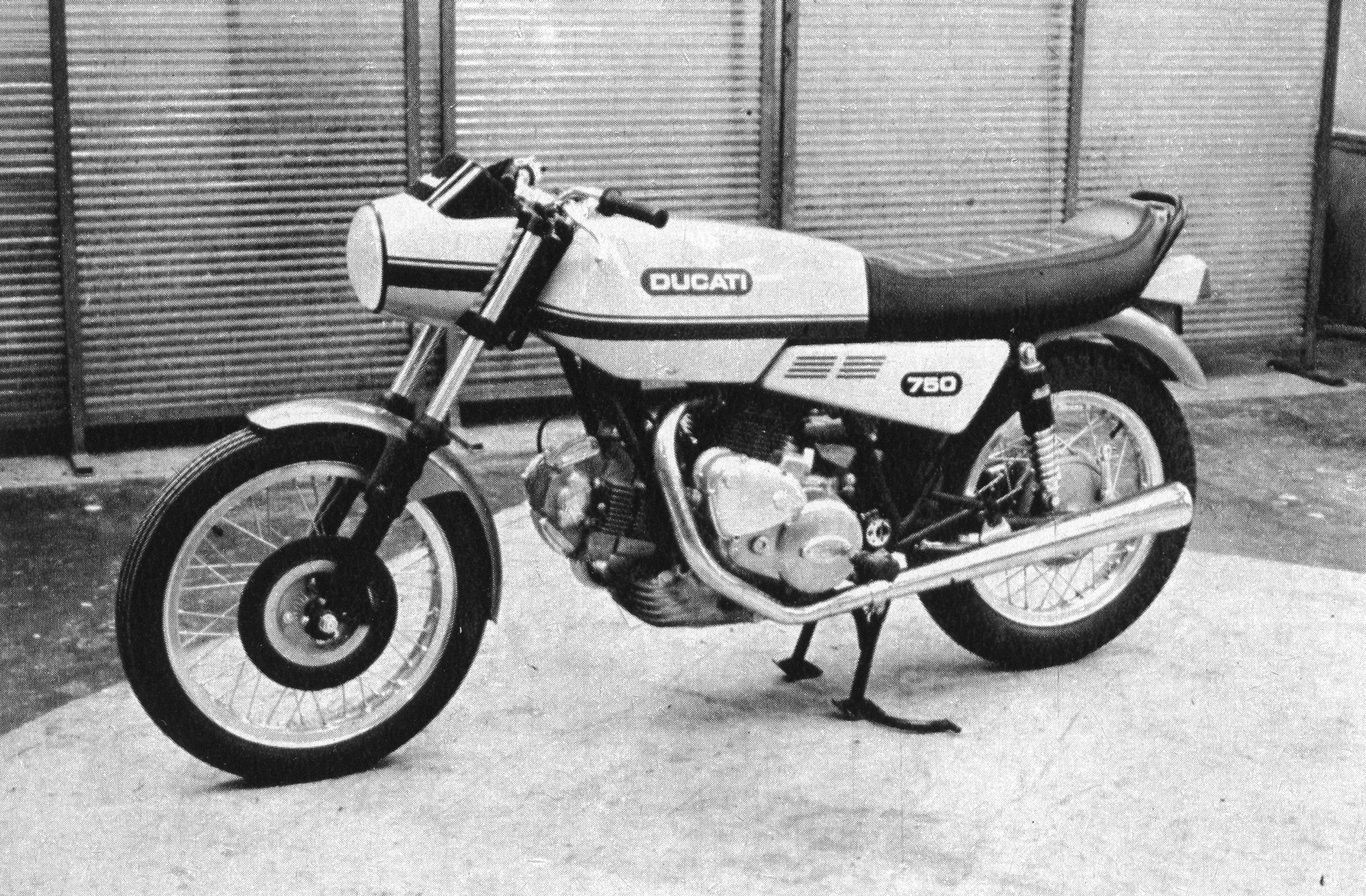
There was another, more pragmatic, reason for the creation of the 860. Even by 1973 there was no doubt that increasing legislation was beginning to catch up with the 750 GT. Noise restrictions would soon mean an end to the distinctive Conti exhaust system with its loud bark, and bikes manufactured after September 1974 would need to shift on the left side to be able to be sold in the United States. The only way that the already modest performance of the 750 GT could be maintained with further inlet and exhaust restrictions was by enlarging the engine capacity.
According to Fabio Taglioni, in an interview with me in 1995, it was Cristiano de Eccher who commissioned Giugiaro to design the 860. De Eccher allowed Giugiaro total control of the eventual product and Taglioni recalled Giugiaro requesting the engine cases and Lafranconi mufflers be redesigned to comply with his “folded-paper” vision.
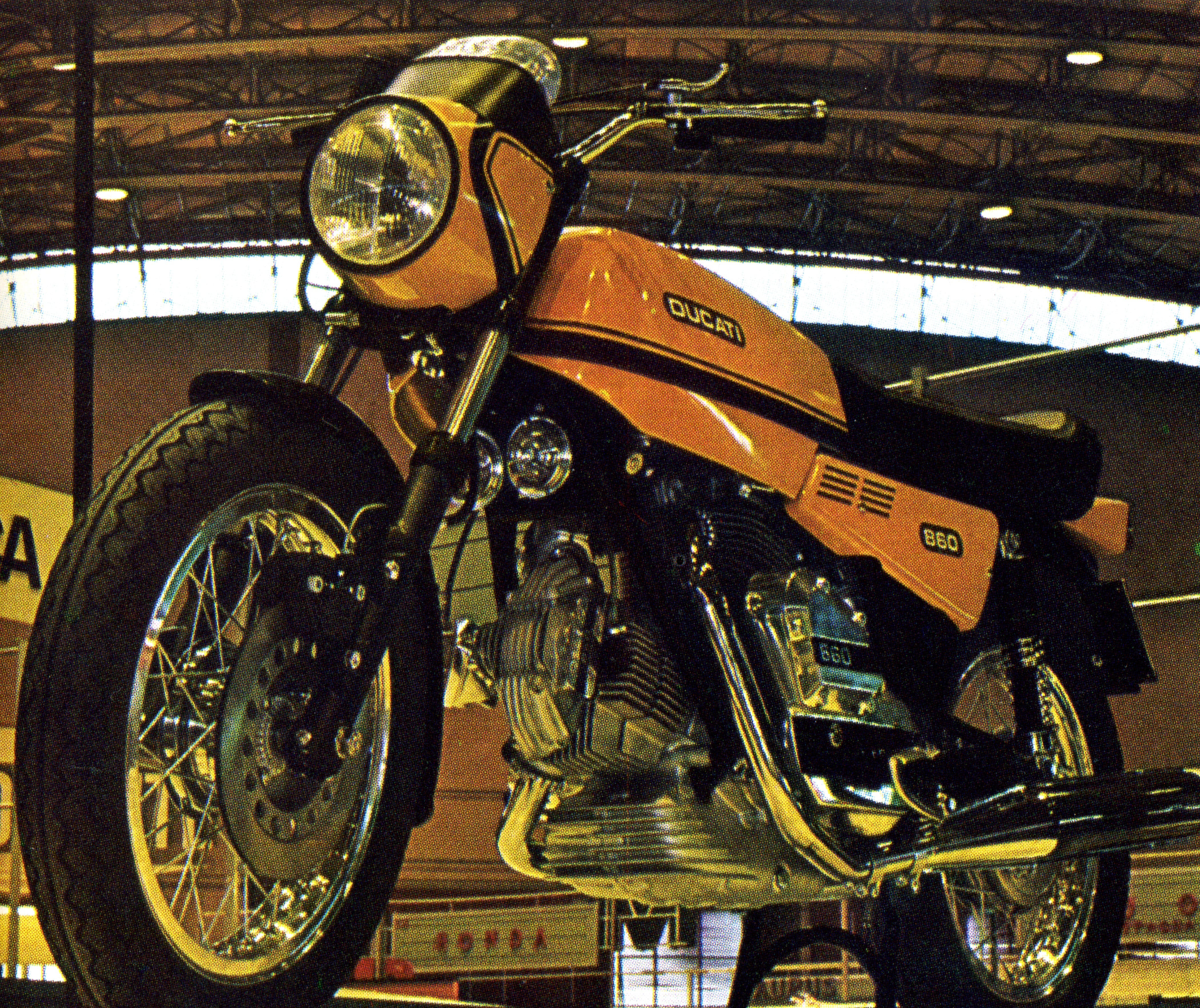
As the prototype 860 needed to be ready for the Milan Show in November 1973 it remained essentially a cosmetically modified 750. The earliest mock-up retained the 750 GT leading axle front fork, 19-inch front wheel, and wide rear subframe bent upwards at the rear. For the Milan Show prototype, the front wheel was changed to an 18-inch Borrani and the fork was a Ceriani centre-axle with a single Brembo disc brake. The frame was considerably modified at the rear but at this stage retained the 750-style straight front downtubes. The rear subframe was narrowed with the rear shock absorber mounts outside the frame tubes, and this prototype already the swingarm with eccentric adjusters for chain adjustment that featured on the 1973 Imola 750 factory racers.
The yellow and black bodywork included angular mudguards, fuel tank, seat and side covers, a small headlight nacelle fairing, and faired taillight assembly. The ignition switch was located under the fuel tank on the left and there were new style CEV handlebar switches. The later distinctive Giugiaro graphics had yet to appear.
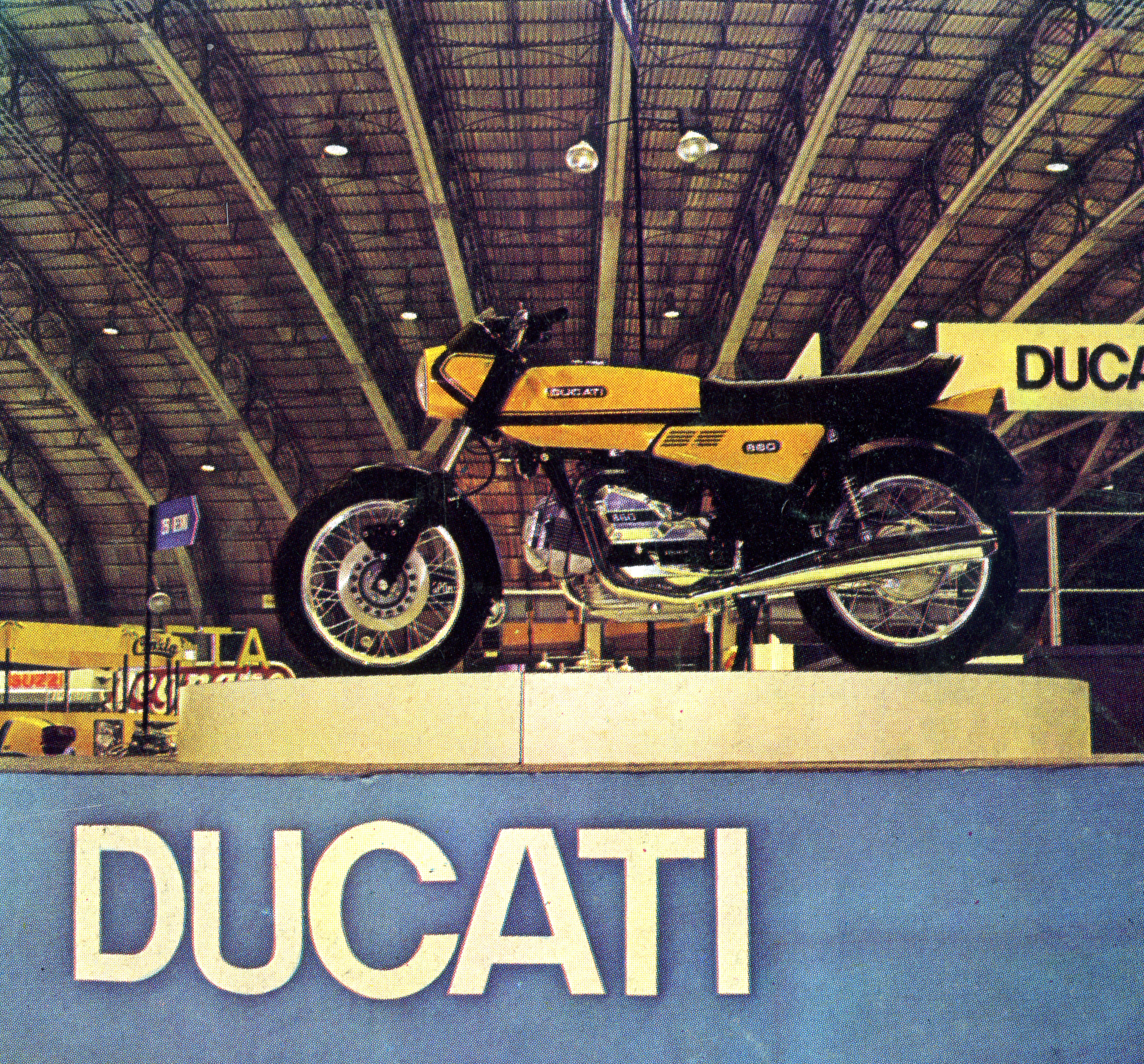
By the time of the Milan Show Taglioni had also managed to redesign the engine, internally and externally. The prototype included an electric start, and many of the features of the eventual production version (oil filter, revised camshaft drive, and electronic ignition). This prototype retained the right-side gearshift and left side brake, and included larger and quieter Lafranconi mufflers. When displayed at Milan the 860 didn’t exactly cause a sensation as it was overshadowed by the new 750 Super Sport desmodromic “Imola” replica. Milan 1973 was really the show for the sporting 750 with Laverda showing their new 750 SFC and Moto Guzzi the 750 S.
While its appearance at Milan was greeted with only mild enthusiasm Ing. De Eccher had already made it clear the 860 was to replace the 750 during 1974. Test rider Raoul Martini continued its development and by March 1974 the small headlight fairing disappeared. A few months later another prototype appeared painted black and white. This now had a left side gearshift but retained the Borrani alloy wheel rims and appeared in some advertising material.
Difficulties continued during 1974. The factory was beset by rolling strikes and there were many problems with the supply of proprietary components from outside suppliers. Ducati couldn’t meet their production target and only 7703 motorcycles were produced in 1974. They could only hope the situation would improve for 1975 and the 860 would be their saviour. History now shows this didn’t happen, but fortunately Ducati survived this temporary slump and prospered.
Look for my good friend Guy Allen’s Substack at allmoto.substack.com.
All Ducatis are covered in this book
No posts
Comments
Nothing yet. Say the first thing.
Sign in to join the conversation.