
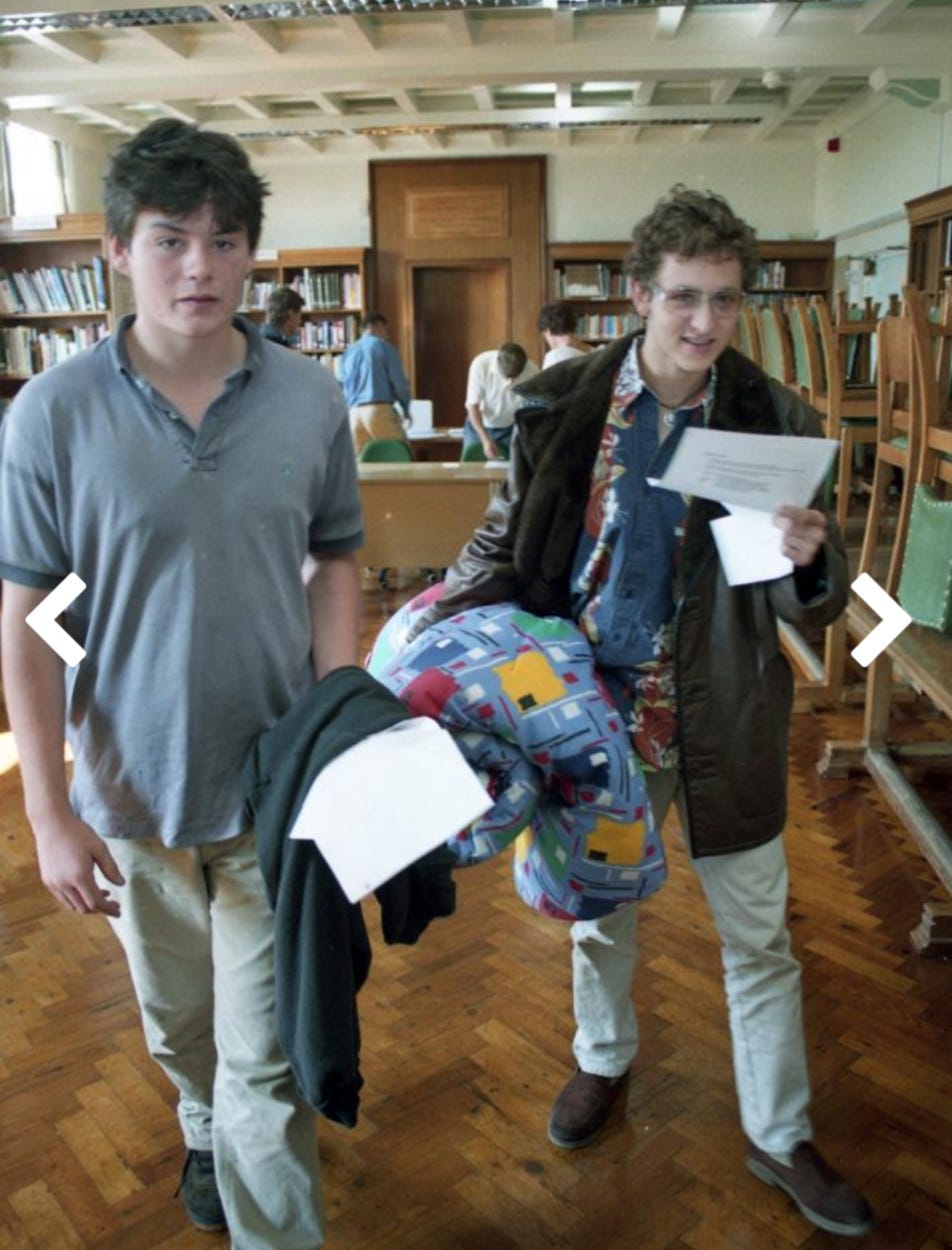
My main memory is misery. That’s what I think whenever I see the image of celebrating teenagers getting their GCSE results. What a horrible, stressful, bludgeoning experience that really was.
People tend to forget their GCSEs once they finish them. They matter a lot as they’re happening, then not at all afterwards. No-one will ever ask you about them. You will never be required to include them in a job application. You will never talk about them at a party. It’s like they never happened.
The whole thing was for nothing really. It lacked any real purpose. And yet, I still have deep memories of the process, of the merciless perpetual misery of the revision period, the drudgery, the workload. And that’s because GCSEs actually mark a number of weird turning points in life which no-one really talks about - the point between childhood and adulthood, between generalisation and specialisation, between forced information processing and genuine curiosity.
I’m not under the impression that any teenagers read this newsletter. They don’t - I’ve seen the stats, it must be like 1% of the readership. But let’s imagine that they do. This is what I would say.
GCSEs are the first moment I can remember working hard. I’d had exams before of course, but that revision period clearly did something to me because I remember it well, even now.
Until that point, there’s been a concerted effort by the world to pretend that everything is alright. You know what I mean. You do it too. You see a kid and you smile at them, or you try to make them laugh, you ruffle their hair. The adult world conspires to convince children that the world is a great place full of lovely happy people. It’s only later that we admit a series of foundational truths: Everyone dies, everything ends, you are born alone and will die alone, there is no natural justice, life is arbitrary, rewards are not distributed fairly, the fundamental conflicts of the human condition are insolvable, all propositions are vulnerable to doubt.
We try to keep this shit from children for as long as possible, relying on brief glimpses of tragedy in Disney films, like the death of Bambi’s mother, to hint at a future existential crisis that parents are too cowardly to address themselves.
One of life’s tragedies, which we keep from young people, is that it involves a tremendous amount of work and that this work is often very boring. It doesn’t really matter what field you’re in or what level of seniority you achieve. Even someone at the absolute peak of their career will have to do lots of very boring work.
For a minister it will be box work, pounding their way through a red box full of documents that need signing. For a junior assistant in an office somewhere, it’ll be the avalanche of things which more senior people have dumped on your desk so they don’t have to do it themselves. There’s just lots of work to do in a life, and GCSEs are the first point at which this becomes truly clear. It’s like someone lifts a curtain and suddenly all the rainbows and unicorns are replaced by a torture chamber.
I am therefore grateful to GCSEs. Not because they taught me anything - I learned absolutely nothing - but because they instructed me on how to work. And in particular they taught me how to work for sustained periods of intense activity.
This comes in very useful. The final six months of writing a book are very painful indeed. There are no weekends. If you write best in the morning, as I do, you have to get up at 5am to maximise your time. I tend to finish at 8pm, then find myself asleep on the sofa by 10pm out of sheer mental exhaustion. You’re stressed about the quality of the work, the accuracy of the work, the reception, whether anyone will buy it, whether anyone will even notice it’s been published. It’s hard. Seasons of Origin Story are like a minor version of the same process, culminating in a crescendo of work in which you lose much of your spare time.
Writing is particularly bad for this. The big difference between a writer and all the people who say they want to be writers is that writers write. That’s really all there is to it. They sit and they write and they fucking do it. They do it on good days and bad days, they do it without immediate promise of gratification and in the absence of any meaningful sense of competition, lacking in any of the incentives which usually stimulate human activity.
Writing is a particularly egregious example but most jobs require bursts of intense activity requiring full concentration. You need to be able to do it and to do it you need to be trained in it. That really is the chief achievement of GCSEs. Someone has unveiled the bleak reality of a working life - which is that it is full of tedium, and hard labour, and intense periods of activity in which leisure time ceases to exist.
It’ll always be this way. No matter how clever AI gets or how successful Universal Basic Income becomes, big important things will always be accomplished by people working really fucking hard. It is good for individuals and for the species. Kids therefore have to learn it at some point and that point may as well be GCSEs.
The core of GCSEs - English, maths, science, language, humanities - suggests a kind of full renaissance education, as if it is supplying the base materials of a universal human knowledge. But actually, it has severe gaps.
The biggest gap is drama, or theatre studies. No-one ever thinks this, of course, they think drama is just acting. But in fact it is much more than that. It is about being able to speak in public, to have the glare of a spotlight on you and feel nervous and wonder how you’re going to breathe, and then perform anyway. Most of all, it is about learning how to own a space: to see a platform, stand on it, and think: I belong here, I am entitled to be here. To have the confidence to inhabit that space and make it your own.
Most jobs, especially white collar jobs but not just them, require performance in some way. In my case, I need to be able to do TV, or private speaking, or panels, or book promotion, or even podcast recording. There is actually an awful lot of performance given that my job basically is writing. But other jobs require it too. What is a presentation to the board? It is a performance. What is a barrister in court, a doctor speaking with a patient, an IT worker convincing their colleagues on the best way to proceed? A performance.
The responsibility for teaching confidence in performance should not rest with drama, but this is the only space left to dump it.
This is actually unusual in western history. Until relatively recently, the art of rhetoric was the core component of education - not just part of it but arguably the central aspect. And this was not just about structuring an argument or breaking down a logic sequence. It was specifically about performance: Voice, gesture, timing, pace, real-time responses, delivery as a perfectable skill. In Ancient Greece, Aristotle’s rhetoric aimed to guide those speaking in a legal case, or arguing proposals in an assembly, or acting as a speaker in a civic ceremony. In Rome, pronuntiatio taught the art of delivering speeches. In early modern England, rhetoric tailored how you structured a speech but also how it was delivered, either in scholastic disputation or in the Commons.
This great educational discipline - the art of persuasion, of convincing people, in person - has been lost from education. And yet it remains as fundamental to a working life as it ever was. For some reason we have decided that no training is required in this area when in fact it requires a great deal. Some people will be good at it and we should make them great at it. Others will be bad at it and we should make them competent, so they do not fear it and are not held back by it.
My memories of GCSEs are not just about hard work through labour. They are also about the brutality of having to work without any real intellectual content at all, the horror of being processed through a system which has forgotten what it was originally for.
Early in my education, between around eight to 13, school was about learning. Don’t get me wrong, the school experience was horrific. Several of the teachers were sadists. It was a prep school, designed to get pupils into public school, so the whole process was designed to mould these children into die-cast representations of the English upper middle class: Athletic, self-confident, sexually petrified and emotionally barren.
But that period had something which the later period did not, which was a desire to teach for its own sake and without the pressure of exams.
I vividly remember one teacher telling us that the purpose of school in this period was to learn how to learn. That teacher - technically a maths teacher but in reality a kind of human Wikipedia who was motivated by his desire to encourage curiosity in children - could be kept permanently off topic by pupils asking how something worked. It became a kind of game. One would ask how TVs worked, he would explain in detail. Another would ask how rivers worked, or why people did certain things, or where football came from. Evidently he believed that answering these questions, and nurturing the desire to ask them, took precedence over whatever was supposed to be happening that morning.
Another teacher - ostensibly the English teacher - took time out to teach us TV and film. He showed us how the actor’s shadow was sharply outlined, unlike his own blurry shadow on the classroom wall. This was because of the powerful lighting used on set. He played us a scene of a film that went from comedic, to perilous, to awe-inspiring and explained how the music had guided our emotional reaction. In short, he taught us how to watch TV, how to recognise the ways in which we were being affected, to be critical and self-aware of the things we were seeing in this little box, in front of which we would spend much of our lives.
I know that others will have had different experiences. This is about a very particular education at a very particular time and place. But my main memories of this period were of education before examination and of the freedoms that were available by virtue of exams having a fairly limited role in what was going on. It was a period in which curiosity was encouraged and the fact that something was interesting was reason enough to dwell on it without asking any further questions about its utility.
Once GCSEs started, that all ended. Education stopped being about learning and started being about passing exams. In fact, it barely counted as education at all. It degenerated into little more than a memory exercise. Can you take information from Source A - your revision notes - retain it, and then input it into Source B - the exam paper. This system produced very reliable exam results, which were used to promote the school to the next set of parents, but it did not produce, did not even aim to produce, people with a love of knowledge or a natural curiosity about the world. It was actually completely indifferent to curiosity. Speaking about it in that context would be like trying to insert Smarties into a slot machine.
At the point of GCSEs, we really do lose that greater educational virtue. We gain things - the work ethic, the need to perform - but we lose things too. And that loss, the complete absence of any genuine intellectual endeavor, is why GCSEs are often such a harrowing period.
The good news is that, once GCSEs are over, a curtain rises on one of the great pleasures of a post-educational world. This is the pleasure we derive from finding out about things outside of our area of expertise.
Almost the second I finished GCSEs I fell in love with reading about science. Obviously I was never going to do it for A-Levels. I was shit at it - especially shit at chemistry, which was just an unfathomable jumble of gibberish to me, like being asked to translate Hieroglyphs - but also shit at physics and biology. I had no natural aptitude, I resented being asked to study them immensely, I was completely uninterested.
And then, almost the second they were no longer mandatory, I was fascinated. I still remember the first popular science book I bought - The Emperor’s New Mind by Roger Penrose. It was like this whole world was opening up in front of me. I loved reading Stephen Hawkings on black holes, Richard Dawkins on evolution. Throughout my life, I have gained an immense amount of enjoyment reading popular science books or listening to popular science podcasts - all concerning a subject I am objectively shit at.
It’s impossible to really enjoy these things when you are being forced to do them. Something in the human spirit resists the idea that it can find something hedonistic and mandatory at the same time. We can only really discover the pleasure of something organically, through our wishes rather than our duties. But also, the structure of the learning, and the stakes of the exams, makes it a fundamentally unpleasant experience.
Teenagers often expect that A-Levels will be more enjoyable because you can pick subjects you’re good at. It’s true, but perhaps the greatest joy to be found after GCSEs is specifically in the subjects you’re bad at, which you can now approach through curiosity rather than coercion. This is one of the most exquisite kinds of intellectual joy. It can stay with you through the rest of your life.
You can listen to this newsletter as a podcast at the top of the page or on Spotify. You can follow me on BlueSky, Instagram or TikTok.
My column for the i paper this week was on Reform’s decision to suspend Tim Montgomerie. You can read it here. My contribution to Late Night Live touched on Count Binface, Jason Arday and how the Labour party has wasted a perfectly good crisis when it comes to the summer heatwaves. You can listen here.
Tickets are still available for Origin Story Live: The History of the Daily Telegraph. I’ve spent much of the week buried in memoirs by editors of the newspaper and doing off-the-record chats with people who worked for the publication as it went mad - slowly at first, then at speed. It’s going to be quite a fucking night. You can buy tickets here.
This week, I am finally saying goodbye to Cyberpunk 2077, the game that I have now surely played more than any other. This is my third playthrough and I must now stop, but I will miss it dreadfully. I will miss my chooms and my chrome, the corpos and the eddies, the edgerunner life, and all the gonks I met on the way.
I keep asking myself why I return to it and I think it’s this: The game is the product of people who took a task really seriously. The key is in the depth of what they have done. Each vehicle handles slightly differently, each weapon has a learning curve, every part of the city has been designed and refined as if it were real, each character you meet has a personality, every song you hear on a passing radio suits the world, and the vast web of cyberware, skills and modifications is the product of a game that has thought very hard about satisfying progression.
It is the most deeply textured virtual world I have played in. This is because it works to a set of themes, the most obvious of which is corruption under capitalism. There are never good choices. You try hard to make decent calls, to find the best result, but the basic incentives of the society reduce everything to the worst possible outcome. It is a tragedy in the truest sense of the word, which haunts you long after you finished playing.
It is a dank, depressing world, a cynical world, but one with a real sense of vision, with something to say. It’s a properly complete work of art, expressing itself through the unique mechanisms of video games. And the way I will miss it is completely unlike the way you would miss something else - a novel, say, or a film. I will miss it as a world I used to inhabit. What a weird wonderful thing that is. It’s the kind of cultural reward which is only available to gamers and one only they understand.
Right that’s your lot cunts, see you next time. Now fuck off.
Comments
Nothing yet. Say the first thing.
Sign in to join the conversation.