
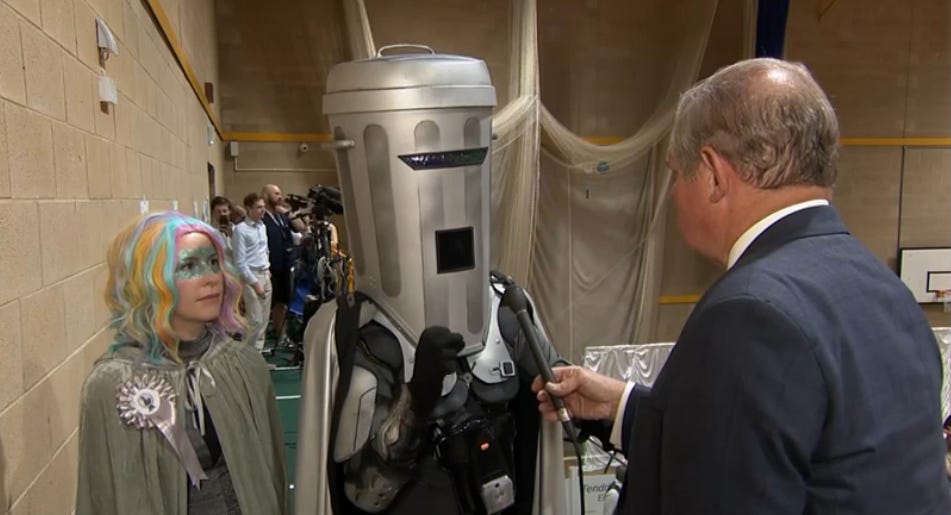
Reform leader Nigel Farage has won the Clacton byelection. Some disparate thoughts below.
On the face of it, this was about as good a result as Farage could hope for. He was never going to lose this seat, so the key tests centred on whether turnout would drop or his vote share would crumble. That didn’t really happen. The Reform leader won by 22,239 votes to Count Binface’s 9,455. That’s actually an increase on his vote from 21,225 in 2024. Turnout was down from 58.4% in 2024 to 44.37% today, but it’s at a perfectly respectable level for a byelection, especially during school holidays.
At the Reform party, Farage announced that “it’s a convincing win”. The room burst into applause and chants of ‘Nigel’.
But no matter what he says, Farage knows he’s in trouble. Incredibly, he did not attend the count. This is basically unheard of. I can’t think of a single other instance of it happening. Even sadsack losers like Matthew Goodwin turn up before going off in a strop complaining about conspiracies by Muslims.
Farage claimed this was because of a threat against him. “I’ve been advised tonight by Essex police that there is an organised campaign to corrupt and degrade the result which will take place in a few hours time,” he told supporters, who needless to say whipped themselves into a state of outrage and started shouting “shame”.
Obviously, this is all bullshit. The Press Association reported that Essex Police did not tell Farage, or any other candidate, not to attend the count. The acting returning officer for the byelection said: “It is a candidate’s decision whether or not to attend the count. However I want to reassure people we have no reason not to proceed with the count process at this time.”
So why wasn’t he there? His other comments hint at the reason. “I’m not scared of these people, far from it,” he told his supporters. “But I’m damned if I’m going to stand on a stage, having won a resounding victory, a ringing endorsement of all that I’ve tried to fight for, and you’ve tried to fight for, and be demeaned and humiliated by nobodies”.
Ah yes. Humiliated by nobodies. That makes things a little clearer.
The announcement of the results in Clacton was a carnival of eccentric tosh. Dozens of candidates, each of them sillier than the last. On TV, you got a strange atmosphere of sullen mirth, with proper prizes-for-everyone sports-day vibes, as the names of obscure candidates were read out. “Nick the incredibly blik,” the returning officer said, then hesitated and corrected himself. “Brick.” No, that wasn’t right either. “Nick the incredible flying brick,” he concluded. And on and on it went, for another 33 candidates.
It’s obvious why Farage avoided this event. Its charming preposterousness refuted the anti-elitist narrative he had tried to create.
He thought he would own the summer news months on the campaign trail. He thought he could spread his man-of-the-people conspiracist storyline about the inquiries into his financial arrangements, which, incidentally, are murky as hell. He imagined it would culminate in this moment, when he stood alongside the Labour, Conservative and Liberal Democrat candidates and trounced them before his adoring voters. Instead, he would have stood next to Count Binface and Marcus White, the sole representative of the Everyone is God party.
His supposed night of victory would only diminish him. Not so long ago, he was expected to be our next prime minister. Now he looks like a laughing stock. Presenters on news programmes have often struggled to hide their smirk when Reform guests claim Binface is a member of the establishment.
This is the reason he wasn’t at that count. It’s got nothing to do with security. It’s because he’s made a fool of himself and he knows it.
He might have won Clacton, but this byelection sunk Farage nationally. There are many sensible well-meaning people in the Clacton constituency but there are also 22,239 other people there who are either happy to be lied to or unable to spot when it’s happening, no matter how egregious it is. We’re not supposed to speak ill of voters of course, but if you can’t spot the self-interest and mendacity of this man, at this moment, then I don’t know what to tell you. My one piece of advice is: Be wary of emails from Nigerian princes.
Clacton, however, is not the country. In the nation at large - which, let’s remember, is where general elections are decided - Farage is in serious trouble. His decision to hold this byelection has made that situation worse.
This time last year, Reform was soaring. We had to keep asking the very worst question: Is there a ceiling on the party’s support? No matter what happened, it seemed to keep pushing upwards, past the 30% mark, to the mid-30s. That was the moment of true fear, the icy fingers down the spine, where it became increasingly difficult to imagine how a Farage government could be avoided.
Then the party plateaued. This is because there is ultimately a limit to how many British people will back this type of politics by this type of man. Hold that thought close, because it is reassuring. Shortly afterwards, the support fell. It did so slowly. Because of Keir Starmer’s lack of popularity, Reform was often still coming top of the polls, which muddied the coverage. But the trend is now clear and undeniable: Reform saw a rise in support during late 2024 and 2025, then hit a ceiling, plateaued, and entered a state of decline. The question now is not about its ceiling, but about its floor.
Just 22% of Brits have a favourable view of Farage according to YouGov. It’s the lowest recorded by their tracker this decade. Sixty-eight per cent see him negatively and 56% very unfavourably. He is currently on -46, equivalent to Boris Johnson after partygate (-42) and Starmer just before his resignation (-45). He is in the death zone.
The decline in Reform’s fortunes worsened significantly over the course of this byelection. Polling by BMG Research for the i paper showed his net approval rating collapsed by ten percentage points in the last month, putting him at -49%. More in Common have similar results, with Farage’s approval ratings collapsing ten points in two weeks to -32%.
Farage kept his support in Clacton, but the campaign - self-interested, cynical, sleazy, desperate and ultimately preposterous - hurt his chances across the UK.
Paradoxically, this is actually pretty good evidence of the strategic danger to Reform. It should be impossible to take a local result this strong for Farage and turn it into a demonstration of his weakness, but actually even the Clacton numbers hold worrying signs for his party.
What do we know about Reform, after several byelections? We know that non-Reform voters are highly motivated to vote tactically in order to beat them. In other words, they are not really non-Reform voters, they are anti-Reform voters, who will back almost anyone to stop them.
In Caerphilly in October 2025 tactical voting handed the victory to Plaid. Labour, Green and Lib Dem support collapsed and went to Welsh nationalists. The BBC even reported some Tory voters backing the party. In Gorton and Denton last February it handed the victory to the Greens. Ahead of the vote, 77% Labour voters said they’d vote Green to stop Reform, as did 73% of Lib Dems and 24% of Tories.
We saw a similar pattern towards Labour in Andy Burnham’s Makerfield contest, although it’s obviously complicated by how unusual that byelection was. The ensuing Manchester mayoral byelection last month, on the other hand, provided unusual degrees of clarity. This is because it uses a supplementary system, where voters pick the candidate they most want to win but can express their preferences even if they lose. It allows us to see clearly the kind of thinking which we usually have to interpret from vote share.
Labour’s Bev Craig won 47.1% in the first preference votes against Reform’s 21%. When supplementary voters were distributed, she won 66.3% to Reform’s 33.7%. More in Common polling showed 66% of Green voters backed the Labour candidate as their second choice. They were supported by a sizable minority of Conservative voters.
So that’s the background. Now let’s see what happened in Clacton. This is the most right-wing seat in the country. In 2024 it had the highest combined right vote of any constituency. And that, of course, is why we all expected Farage to win. But even here, in the deepest heartland, there was significant tactical voting. After all, what the hell else is a vote for Count Binface? The normal parties aren’t standing, so he became the default vehicle by which you’d try to stop Reform. This secured him 9,455 votes. For a satirical space alien whose main policy proposal is about the height of a hand dryer in a pub toilet.
Tactical voting is alive and well. This pattern, repeated across the country, is what should trouble Reform. Will it ever stop Farage in Clacton? No. But it’ll ruin him nationally, especially if the Conservative vote holds up.
Farage is caught in a pincer movement. He surely gets the tactical voting problem. He’s not an idiot. But he is now trapped by the X.com eco-system.
Elon Musk has worked diligently to give the ethno-nationalist Rupert Lowe and his Restore party all the momentum, biting Reform’s ankles from even further to the right. Meanwhile, Farage’s own people are degenerating into ever more extreme and angry rhetoric. Reform home affairs spokesman Zia Yusuv branded former defence secretary and member of the armed forces Ben Wallace a “traitor” recently, earning only a mild rebuke from his party leader.
Across the Atlantic, Democrat politician Alexandria Ocasio-Cortez prompted thousands of think pieces this week when she said that “woke 1 was crazy” - a reference to the period of ‘defund the police’ and online pile-ons in the early 2020s. There is a general sense that Twitter’s progressive edge during that period pushed left-wingers into adopting radical positions which turned the electorate against them.
I’ve no idea if that’s true or not, but I think we can clearly see that X.com, which now has an ethno-nationalist edge, is pushing right-wingers to adopt radical positions which turn the electorate against them.
Farage is therefore in the worst of all worlds. He is seeing concerted tactical voting against his candidates in diverse areas of the UK - from Wales to Manchester to Clacton itself. His best way of defusing those tactical votes is to moderate the rhetoric of his colleagues, to try to upset people a little less and therefore play less of a role in their voting calculations. But he cannot do so, because the remorseless logic of the X radicalisation algorithm pushes his party towards becoming more severe, or else it loses its activist base and its most highly-engaged voters to Restore. He’s trapped.
Farage is no Trump. This was a real test case for Farage’s brand of politics. He wants to create the same conditions in the UK which apply to Donald Trump in the US. He wants to dismiss any allegations against him by branding it a conspiracy of the elites. He wants to undermine and eventually eradicate independent scrutiny processes, like parliamentary standards inquiries. He wants to take a mindless question-nothing hero-worshipping support base and equate it with the will of the people, so that he can amass unlimited executive power. He wants to abolish the entire notion of objective truth as a currency in political discourse. We know what the plan is because we can see it in its advanced stages in the US.
That’s what this tragicomic byelection was really about. Farage wanted to use it to swipe away all the sleaze stories around him. He wanted to own the news agenda over the summer months. He wanted to capture the political momentum once again.
In Clacton, electorally, it worked, as he knew it would or else he’d never have tried it. But the plan was never really for Clacton. It was for the country. And there it failed. Journalists wouldn’t take the bait. Politicians wouldn’t take the bait. And the public wouldn’t take the bait.
Why? Because Farage is no Trump. The Reform leader does not posses that ineffable blood-magic, the link between leader and follower, that Trump enjoys. He can secure the support of between a fifth to a quarter of voters, absolutely. But he cannot convince enough Brits to submit their conscience and their independence of thought to his will.
I don’t think this is Farage’s fault. He is really very effective as a political communicator. I think the reason he struggles is because Brits are not Americans. We are basically incapable of sincerity. We are averse to idealism, positive or negative. We do not do religion, and therefore lack a pattern of behaviour in which we relinquish our minds to a spiritual leader. The whole muscle-memory of evangelism, from pulpit bashers to TV preachers, means nothing to us. We do not have a pattern of historic racial politics which slots political debates into a pre-existing us-vs-them narrative.
We are too cynical, too jaded, too keen to mock. These are usually ugly qualities. They prevent us from having serious political discussions and reduce politics to a permanent state of listless pragmatism. But in this particular area it is actually quite healthy. It’s really very difficult to imagine any figure who is able to do here what Trump does in the US.
That’s not to say we’re immune to populism or the extreme right. We absolutely demonstrably are not. But we may be immune to the unquestioning hero-worship and epistemological collapse that we see across the Atlantic. This was a test case for that type of politics. It showed that there was some support for it in his support base, but none outside of it.
Farage will, of course, claim today as a victory. But in reality, as almost anyone can see, it was anything but.
Still, at least he’s got the standards inquiry to look forward to.
I’m going to say this once, and only once, unless I decide to say it again later: Buy tickets to our live show. Buy them you fucking cunts.
I am inexplicably spending the summer reading about the history of the Daily Telegraph while everyone else is frolicking in the park and I think I therefore deserve all the support I can get. We’ll tell the full story of Britain’s most batshit newspaper, from a Fleet Street institution to howling godforsaken bedlam, on September 1st at the Union Chapel. Buy the fucking tickets.
I take the lead in this week’s episode of Origin Story as we tell the story of George Villiers, the Duke of Buckingham - favourite to King James I and King Charles I. We’ve always had these figures who act as a deflecting mechanism for leadership - like Dominic Cummings or Morgan McSweeney. When critics can’t attack the leader directly, they go for The Favourite. What worked for kings works now for prime ministers.
The story of Buckingham is extremely dramatic - it’s crammed with queer history, love affairs, courtly romance, adventures on horseback, war, a shitload of dysentery, terrible deaths and the early embryonic years of parliamentary resistance to royal power. But the core role and dangers of the Favourite are the same in the early 17th Century as they are today. Get it wherever you get your podcasts.
My culture pick this week is Widow’s Bay. It’s such a glorious combination of Stephen King nostalgia, good solid laughs and proper nasty chills. It’s a show that accomplishes exactly what it sets out to do, in no small part because of the effortless performance of Matthew Rhys. Exactly as good as people told you it was. Well worth a watch.
Right, off you fuck mate. Cheerio.
Comments
Nothing yet. Say the first thing.
Sign in to join the conversation.