
Rechargeable
A month and a half ago, I wrote about how, between childcare, work, and trying to finish a draft of the novel, I had no time to recharge the creative batteries. Well, I finished my novel, went on parental leave, caught a nasty summer cold, and have had some time to read and watch and play. Here are seven great things from a month of recharging.
Black Hole holds up
I just reread Charles Burns's wonderful and totally sick and weird Black Hole, a graphic novel that's equal parts teen angst and body horror. For a book that gets assigned in graphic novel and literature classes all over the country, there's not a lot of commentary about it available online—I think that's a result of it being published in collected form in 2005, before the explosion of online content. I did, however, find this great interview with Charles Burns in Vulture.
I also found the original cover for issue #4 (the Pantheon edition left out the original covers and interstitials, which is really too bad), and it is in the running for best comic book cover of all time:
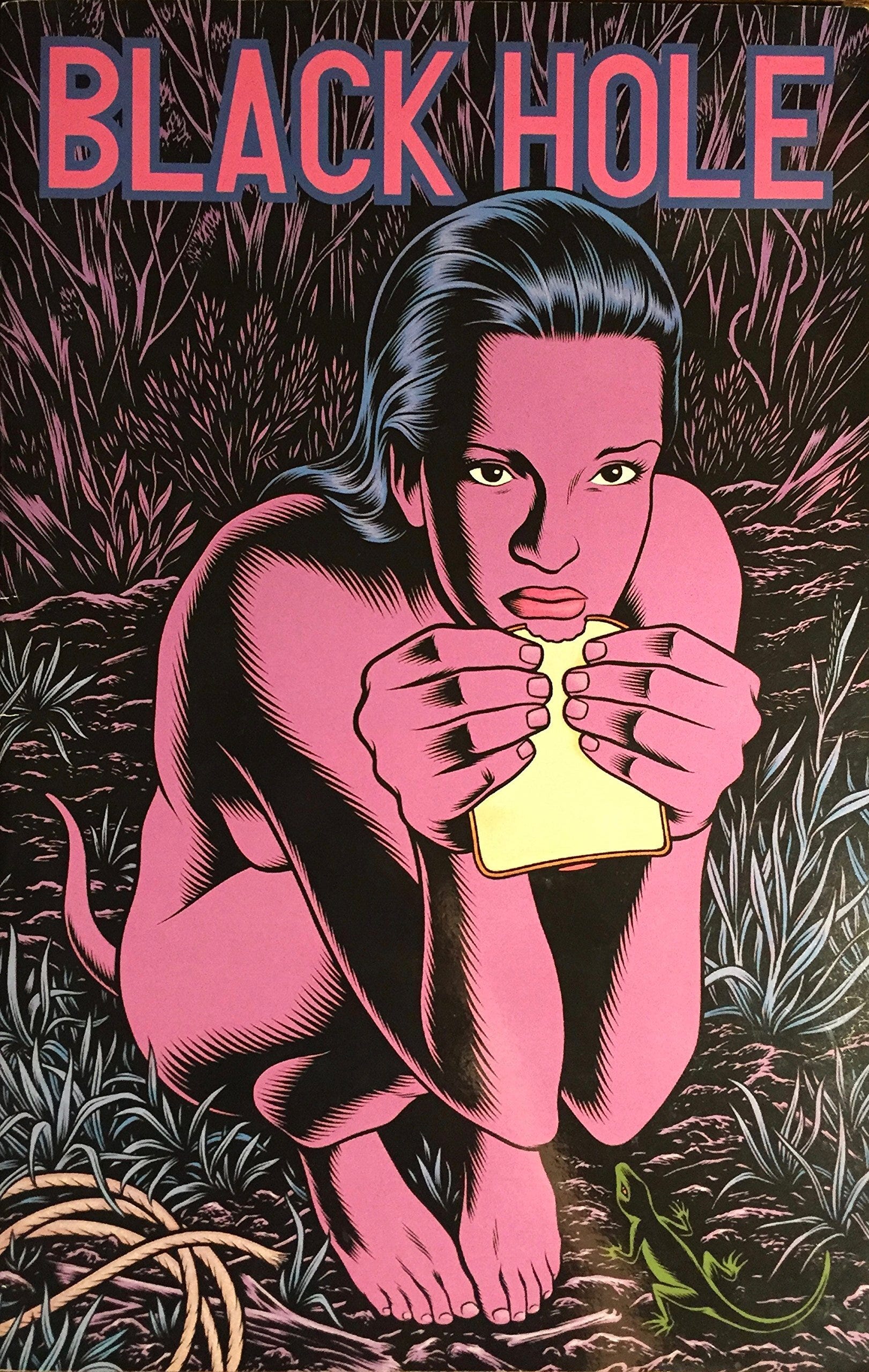
The tail! The sandwich! I want to frame this and hang it on a wall.
Moral fiction vs. lyrical nonsense
I just read Brandon Taylor's craft talk "A Dark Room on the Other Side of the World," about writing moral fiction, D.H. Lawrence, and avoiding art-as-virtue-signaling. A favorite little bit: "Lyrical nonsense is not the antithesis of moral art. It is an effect of art that fails to be moral in a D.H. Lawrence sense. Language meant to obfuscate a lack of moral accounting, by which I mean mostly, fiction that has no skeletal system except some outwardly derived thoughts about what is and is not socially acceptable. A moral novel has no interest in what is socially acceptable. A novel is about people."
Amoral syntax
Want a wild ride? Read this absolutely buckwild interview with Gordon Lish, the famous editor. He displays some, uhhhh, quixotic syntax and style. A sample: "In retreat, I (in reverie) rare back in dispute, refusing to concede, reckoning (puerilely) that I’ll never. . . . Yes, do believe I could bring off the beaut of beauts (rival, equal, stand in the same circle where stand Cormac McCarthy, Don DeLillo, and Jason Schwartz), but (sob) know the belief, the willed delusion, to be a snare."
He sounds like the narcissistic old white dude who "loves the beats, man," shows up at the open mic, and goes five minutes over the time limit. You know the guy.
Gaming like it's 1999
When I'm sick, I need video game comfort food. I've been playing Suikoden II, an old JRPG from the late-nineties. Many people consider it one of the best roleplaying games of all time, and I can see why. The story does a great job balancing macro stuff—politics, the movement of armies, treaty negotiations—with micro stuff—a surprisingly tender portrait of three children sucked into a war. It feels a little like JRPG Game of Thrones, and I mean that in a good way. Plus there's an insane Iron Chef minigame.
Are anime characters white?
Lucy and I just watched the Studio Ghibli movie From Up on Poppy Hill. It's set in Yokohama in the mid-sixties, and it raised a question: why do anime characters look white? The short answer: they look white to white people and Japanese to Japanese people. The long answer: that, but other factors include cultural baggage like Japan's relative ethnic homogeneity and pre-European-contact ideas of what constitutes Japanese beauty; and conventions of the genre, like the fact that anime characters are intentionally drawn with mukokuseki ("statelessness" or "without nationality," i.e., without stereotypically ethnic features) and the huge influence of Disney's style on early manga artists (the "god of manga" and creator of the first anime, Astro Boy, Osama Tezuka had a real thing for Donald Duck).
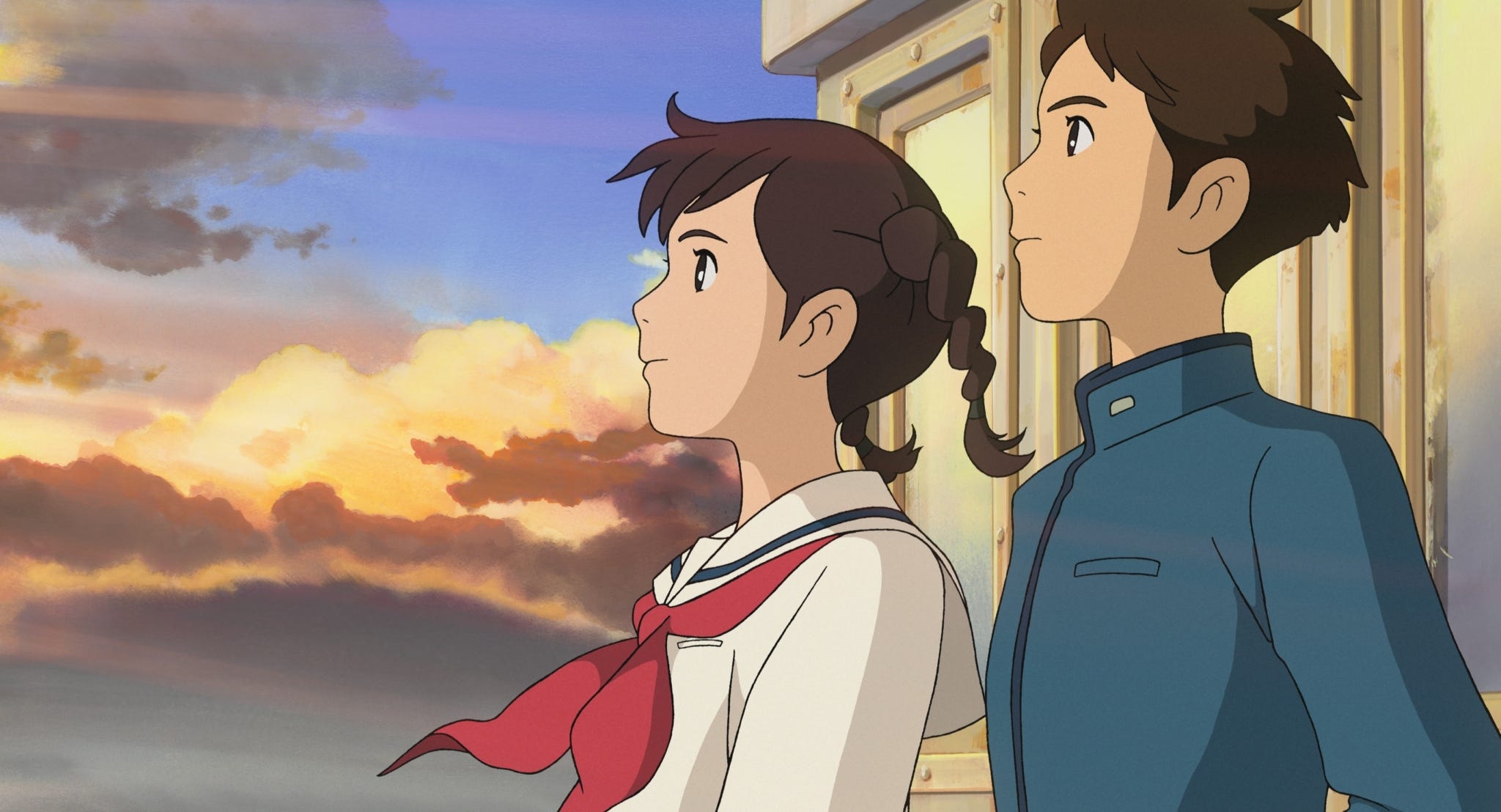
Umi and Shun, two mukokuseki schoolkids, aesthetic descendants of Donald Duck.
I had to hunt for well-reasoned answers to this, and I hope that one day someone smarter and more informed than me or the internet commentariat writes a thinkpiece about it.
Charles Yu and another Ghibli connection
I recently read Charles Yu's Interior Chinatown. Several times since finishing, I've reopened the book and reread one particular paragraph that blew me away—a digression about the main character's father and his generation's embarrassing habit of singing John Denver songs at karaoke. Here's the passage:
Maybe it’s the dream of the open highway. The romantic myth of the West. A reminder that these funny little Orientals have actually been Americans longer than you have. Know something about this country that you haven’t figured out. If you don’t believe it, go down to your local karaoke on open mic night. Wait until the third hour, when the drunk frat boys and gastropub waitresses with headshots are all done with Backstreet Boys and Alicia Keys and locate the slightly older Asian businessman waiting patiently in line for his turn, his face warmly rouged on Crown or Japanese lager, and when he steps up and starts singing “Country Roads,” try not to laugh, or wink knowingly, or clap a little too hard, because by the time he gets to “West Virginia, mountain mama,” you’re going to be singing along, and by the time he’s done, you might understand why a 77-year-old guy from a tiny island in the Taiwan strait, who’s been in a foreign country for two-thirds of his life, can nail a song note-perfect about wanting to go home.
Good god, that last, long sentence! The way it builds to "wanting to go home!" It gives me chills every time I read it.
Thinking about that passage and watching From Up on Poppy Hill, I was reminded of my absolute favorite slice-of-life Ghibli film, Whisper of the Heart, in which John Denver's "Country Roads" features prominently. I remember being kind of shocked when it came on the soundtrack—it's the last song you expect to hear in an movie set in Tokyo in the 1990s—but it turns out that anime and John Denver are two great tastes that taste great together.
Comfort food
New York City has a lot of great tacos, but finding a burrito that stands up to West Coast standards is next to impossible, especially if you're outside of the hip foodie zones, which we are—Washington Heights ain't exactly the Village. That said, after two years of searching, I've finally found a burrito worth eating, and it's only fifteen blocks from my apartment. God bless you, Frijolito's.

Stay safe out there, don't fuck with the delta variant, and if you're feeling sad, eat a burrito. Burritos are edible happiness.
With love,
Ian
No posts
Comments
Nothing yet. Say the first thing.
Sign in to join the conversation.